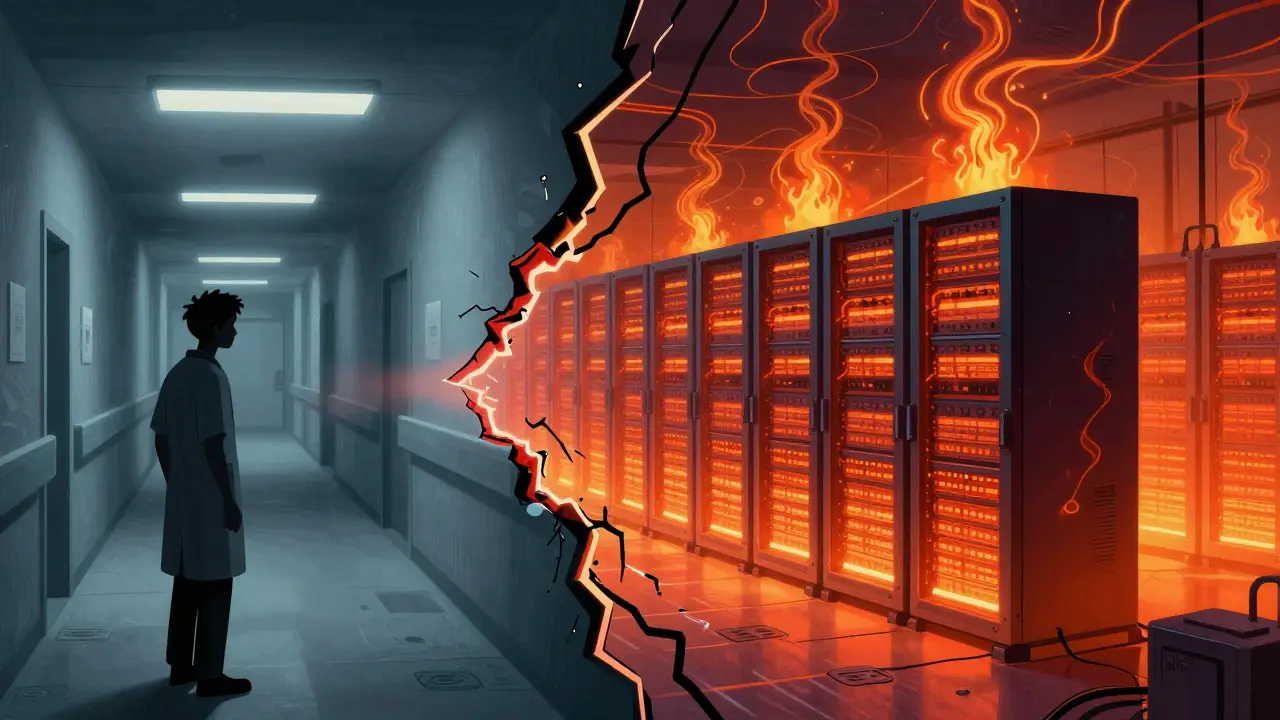
Imagine a hospital running on generators while a nearby warehouse hums with industrial power. That was the reality in Luanda before Angola moved to crack down on cryptocurrency mining. The country didn't ban crypto out of ideological dislike for digital assets; it did so because the lights were literally going out elsewhere. With a population of 39 million and a national grid capacity of just 5,500 megawatts, every kilowatt counts. When mining farms started sucking up roughly 15% of available electricity during peak hours, the government had no choice but to act.
The result? A nationwide ban effective April 2024 that criminalizes operating mining equipment. But this isn't just a paper rule. It’s a high-stakes enforcement operation involving Interpol, seized millions in hardware, and a deep dive into why Africa's energy landscape is forcing tough choices on the crypto industry.
The Energy Deficit: Why the Grid Couldn't Take It
To understand the ban, you have to look at the numbers. Angola’s per capita electricity consumption sits at just 420 kWh annually-less than 10% of the global average. Dr. Elena Mwamba, Senior Energy Analyst at the African Development Bank, puts it bluntly: "Angola's grid loses 28% of generated electricity through transmission inefficiencies." In other words, even if you generate enough power, half of it vanishes before it reaches your home. Add to that the fact that 60% of urban households experience daily blackouts, and you see why adding massive, constant-load consumers like Bitcoin miners was unsustainable.
Mining operations were consuming between 50 and 200 megawatts collectively. That’s equivalent to powering 300,000 households. For context, the entire country has only 5,500 megawatts of total capacity. The Ministry of Energy and Water calculated that mining one Bitcoin cost 1,440 kilowatt-hours of local energy-40 times more than a traditional banking transaction. When 15 million citizens still lack reliable grid access, diverting power for speculative digital assets became a political and social flashpoint.
From Warning to Criminal Offense
The regulatory shift wasn't sudden. Chinese officials warned residents in Angola not to "support or engage in virtual currency mining activities" in early 2024. By April 15, 2024, the notice was formalized. The ban defines illegal mining as any operation using more than 10 kilowatts of continuous power without authorization from the National Electricity Agency (INE). However, enforcement prioritized industrial-scale operations exceeding 100 kilowatts.
The penalties are steep. Operating unauthorized mining equipment carries a sentence of one to five years in prison, plus mandatory confiscation of all related gear. This wasn't just about stopping the activity; it was about sending a message that grid stability takes precedence over industrial profit. As Energy Minister João Baptista Borges stated in September 2025, "With 15 million citizens lacking reliable grid access, we cannot permit energy diversion for speculative digital assets." A Sonangol Energy Survey conducted in July 2025 found that 78% of respondents supported this stance.
Operation Serengeti 2.0: The Global Crackdown
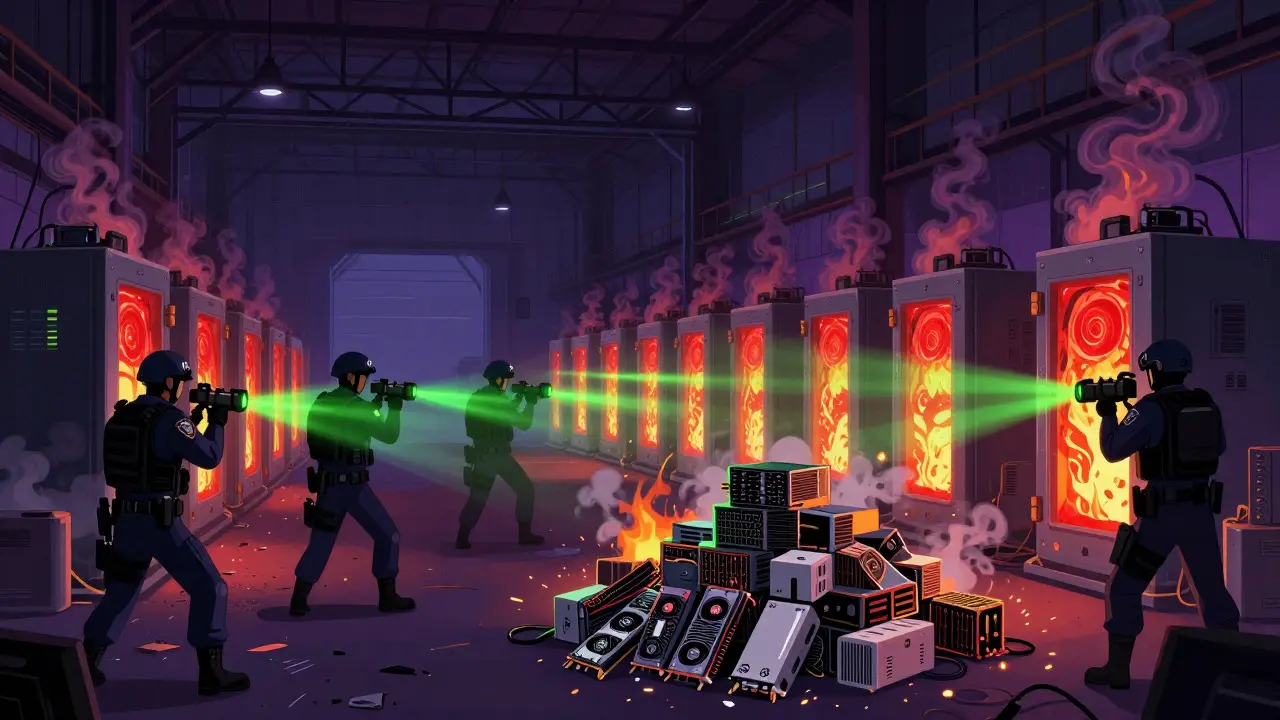
The ban gained teeth during Interpol's Operation Serengeti 2.0, a coordinated cybercrime initiative spanning June to August 2025. Law enforcement agencies from 18 African nations and the United Kingdom joined forces. In Angola, the results were dramatic. Authorities dismantled 25 illegal mining centers run by 60 Chinese nationals. They seized mining equipment valued at $37.2 million and confiscated 45 illicit power stations that were bypassing grid meters.
Cybersecurity expert Dmitri Alperovitch noted that these illicit stations weren't just stealing power; they were creating fire hazards. "The 45 illicit power stations seized in Angola were bypassing grid meters and safety controls, creating fire hazards that endangered entire neighborhoods in Luanda and Benguela provinces," he explained. The physical infrastructure targeted included 8,300 ASIC units and 15,000 graphics cards. These machines, designed for heavy computational work, ran hot and drew immense power, straining transformers that were already failing under normal residential load.
Who Was Mining, and Why?
You might wonder why miners took the risk in the first place. The answer is simple: cheap electricity. Before the ban, electricity costs in some Angolan regions dropped as low as $0.03 per kilowatt-hour-less than half the global mining average. This attracted operators, primarily from China, who saw an opportunity to maximize margins.
However, the reality on the ground was messier. Forum discussions on MiningRigRentals.com revealed complaints about "unreliable grid connections causing 40% equipment failure rates." Miners also reported paying bribes totaling $500 monthly per facility to local utility inspectors. Leaked WeChat chats from operators in Lobito province described weekly power outages of 18-24 hours during the dry season, forcing them to use expensive generators that increased operational costs by 35%. So, while the headline price was attractive, the operational instability ate into profits and created legal risks.
| Feature | Angola (Pre-Ban) | Namibia | South Africa |
|---|---|---|---|
| Electricity Cost (USD/kWh) | $0.03 | $0.12 | Varies (Taxed Model) |
| Regulatory Status | Banned (Criminalized) | Permitted (High Cost) | Permitted (15% Energy Tax) |
| Grid Reliability | Low (Frequent Blackouts) | Moderate | High |
| Impact on Local Grid | Severe Strain | Managed | Funds Upgrades via Tax |
Enforcement Tactics: How They Caught the Miners
Catching illegal miners requires more than just walking into a warehouse. The National Electricity Agency (INE) uses smart meter data to scan for anomalies. If a facility shows abnormal 24/7 power consumption patterns exceeding 100 kilowatts, it gets flagged. Police units trained by Interpol’s Digital Crime Directorate then use thermal imaging to detect heat signatures above 45°C-a clear sign of active ASIC miners.
Community involvement played a huge role. In May 2024, the government launched a whistleblower program offering 5% of the seized equipment value (capped at $50,000) for verified tips. This worked. 73% of the raids in August 2025 originated from community reports. Residents in Sambizanga district, for example, complained that mining operations caused frequent transformer explosions that blacked out hospitals for hours. Small business owners in Luanda’s Benfica neighborhood cited a 22% increase in electricity tariffs in 2023 due to grid strain. These local grievances fueled the tip-off line.

Market Shifts and Future Outlook
The ban sent shockwaves through the regional market. Angola’s hash rate contribution fell from 0.8% to 0.02% of the global total, losing 1.2 exahashes per second of capacity. Many operators fled to neighboring Namibia, where facility registrations jumped 200% between April 2024 and August 2025. However, Namibia’s higher electricity costs ($0.12/kWh) reduced profit margins by 60%, making it a less attractive destination despite the regulatory clarity.
Will Angola ever allow mining again? Probably not soon. BloombergNEF projects that without structural grid improvements, Angola will remain unattractive for compliant mining until at least 2028. That’s when the $4.5 billion Cambambe III hydropower expansion comes online, adding 1,150 megawatts to national capacity. Until then, the priority remains fixing the basics. The World Bank has committed $15 million to help develop energy allocation frameworks, but Naledi Molefe, Head of Digital Assets at Standard Bank, notes that Angola won’t consider regulated mining until grid reliability exceeds 90%-a threshold unlikely before 2027.
For now, the focus is on redistribution. The government plans to auction seized equipment within 90 days and redistribute computing power to public institutions. 65% of the hardware goes to university computer science departments, and 35% to municipal e-government initiatives. It’s a pragmatic move: turning a source of grid strain into a tool for education and public service.
Frequently Asked Questions
Is cryptocurrency mining completely banned in Angola?
Yes, effectively. Since April 2024, operating mining equipment without authorization is a criminal offense. The ban targets operations using more than 10 kilowatts continuously, with severe penalties for larger industrial setups. There are currently no exemptions, even for renewable-powered operations.
Why did Angola ban crypto mining instead of regulating it?
The primary driver was energy scarcity. With only 47% of the population having reliable grid access and significant transmission losses, the government determined that diverting power to mining threatened critical services like hospitals and schools. Regulation was seen as too risky given the scale of the deficit.
What happened to the seized mining equipment?
Equipment valued over $10,000 is auctioned within 90 days. The government announced plans to redistribute 100% of the computing equipment to public institutions, with most going to universities and municipal e-government projects. Some equipment may be sold to fund these redistributions.
Where did Angolan miners go after the ban?
Many moved to neighboring countries like Namibia, which saw a 200% increase in mining facility registrations. However, higher electricity costs in Namibia significantly reduced profit margins compared to Angola's pre-ban rates.
When might Angola allow crypto mining again?
Analysts predict it could happen around 2028, once the Cambambe III hydropower expansion adds 1,150 megawatts to the grid. Current estimates suggest grid reliability needs to exceed 90% before regulators will consider allowing mining, likely requiring 100% off-grid renewable energy solutions.





Darren Moon
August 17, 2026 AT 11:17One must observe the profound inefficiency of this regulatory apparatus, which fails to account for the macroeconomic externalities of energy arbitrage. The enforcement mechanism appears arbitrarily punitive, lacking the nuanced fiscal modeling required to balance grid stability against industrial output potential. It is a rather tedious exercise in bureaucratic overreach that ignores the fundamental principles of resource allocation.
Quang Thai Tran
August 18, 2026 AT 23:44The timeline is too convenient; Interpol’s involvement suggests a coordinated suppression of decentralized finance by central banking interests. The 'energy crisis' narrative serves as a smokescreen for what is clearly an orchestrated effort to consolidate monetary control under state oversight. One cannot help but suspect that the seized hardware was merely a pretext for deeper surveillance integration within the national grid infrastructure.
Calliope Clio
August 19, 2026 AT 19:23Oh, how *quaint* of them to criminalize progress while their own hospitals run on generators 🙄💡. Truly, the pinnacle of sophisticated governance! 😂📉
Abigail Sparks
August 21, 2026 AT 00:04You’re missing the point entirely! This isn’t about ideology, it’s about survival. If you can’t power a hospital, you don’t get to power a Bitcoin node. Simple math, people. The grid is broken, and miners were just another leak in the dam. Fix the pipes before you fill the bucket!
Mike Baca
August 22, 2026 AT 18:25honestly its wild how we always talk about crypto like its just some tech toy but here its literally a life or death issue for basic services. makes you think about what "scarcity" really means when your lights go out every day vs when its just a bad trade on your portfolio. maybe the real decentralization needed is in our local grids not just the blockchain. anyway cool story tho 👍