
India Crypto Tax Calculator
Calculate Your Crypto Tax Liability
Based on India's 30% tax on gains and 1% TDS on all trades
Enter values to see tax calculation
Remember: No loss offsetting allowed.
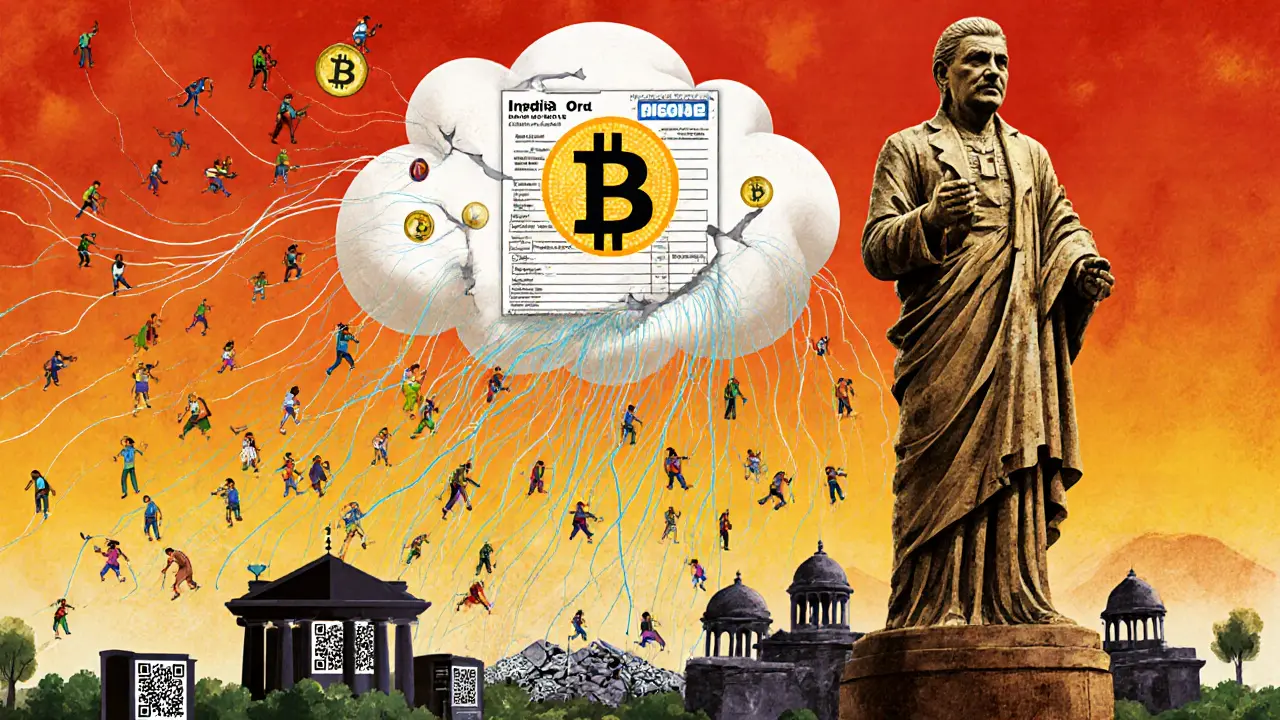
India doesn’t have a ban on cryptocurrency. But it doesn’t have clear rules either. Instead, it has one of the highest tax rates on crypto in the world: 30% on gains, plus 1% TDS on every trade. No deductions. No offsetting losses. Even small transactions get taxed. And yet, India leads the world in crypto adoption.
According to Chainalysis’ 2025 Global Crypto Adoption Index, India ranks #1 - not just in one category, but in all five: retail, centralized finance, decentralized finance, institutional, and overall adoption. That’s more than the U.S., more than Vietnam, more than Brazil. And it’s happening despite a tax system designed to discourage use.
How? Because people didn’t wait for permission.
Grassroots Adoption: From Students to Street Vendors
In Delhi, a 19-year-old engineering student uses crypto to get paid for freelance coding gigs from clients in the U.S. and Europe. He doesn’t use banks. He uses USDT. Why? Because bank transfers take days. Crypto takes minutes. And the fees are a fraction of what PayPal charges.
In Jaipur, a family-run spice business accepts Bitcoin for exports to the Middle East. They convert it to INR through local P2P platforms. No bank account needed. No paperwork. No delays.
This isn’t rare. It’s normal. Across India, crypto isn’t seen as speculation - it’s a tool. A way to bypass slow, expensive, and exclusionary financial systems. With over 800 million smartphone users and UPI payments already embedded in daily life, switching to crypto felt natural. People were already used to digital money. Crypto was just the next step.
Why Bitcoin Dominates - and How Stablecoins Keep the Flow Going
Between July 2024 and June 2025, $4.6 trillion in fiat flowed into Bitcoin in India. That’s more than any other country on Earth. Bitcoin is the entry point. It’s the digital gold people trust. But Bitcoin alone can’t handle everyday payments. That’s where stablecoins come in.
USDT and USDC are everywhere. A small shopkeeper in Chennai receives USDC for online orders. He converts it to INR the same day through a local exchange. No volatility. No risk. Just speed.
New stablecoins like Circle’s EURC and PayPal’s PYUSD are starting to show up too. Why? Because Indian businesses are connecting with global markets. And global markets want stable, fast, low-cost rails. Crypto provides that. Banks don’t.
The Institutional Shift: Banks, Exchanges, and the Quiet Backing of Big Players
It’s easy to think crypto adoption in India is only about individuals. But institutions are moving too.
Major Indian exchanges like WazirX, CoinSwitch, and ZebPay now serve over 150 million registered users. That’s more than the entire U.S. population. These platforms don’t just trade - they offer staking, lending, and even crypto-backed loans. Some banks quietly partner with them to offer custody services.
Startups in Bengaluru and Hyderabad are building DeFi protocols tailored for Indian users. One platform lets farmers lock up their crop receipts as collateral to get instant crypto loans. Another helps small exporters get paid in USDC and convert it to INR in real time.
And it’s not just startups. India’s top fintech investors - Sequoia, Accel, and Tiger Global - have poured billions into crypto infrastructure. They’re not betting on hype. They’re betting on utility.

The Tax Paradox: Why Harsh Rules Didn’t Kill Crypto
In 2022, India introduced a 30% tax on crypto gains and a 1% TDS on every transaction. The government said it was to curb speculation. But it backfired.
Instead of driving users away, it forced them to get smarter. People started using peer-to-peer (P2P) platforms to avoid TDS. They held assets longer to minimize taxable events. They used decentralized exchanges to trade without intermediaries. They learned to track their own records.
And here’s the irony: the tax system made crypto feel more real. People weren’t gambling. They were managing assets like any other investment. They filed returns. They kept receipts. They paid taxes. The system didn’t stop adoption - it forced it to mature.
Today, Indian crypto users are among the most financially literate in the world. They know the difference between a wallet and an exchange. They understand gas fees and slippage. They know how to self-custody. That’s not luck. That’s necessity.
India’s Digital Infrastructure: The Hidden Engine Behind the Boom
Crypto didn’t grow in a vacuum. It rode on India’s existing digital revolution.
UPI - the real-time payment system used by over 9 billion transactions a month - proved Indians could handle fast, secure, mobile-first money. e-Rupi, the government’s digital voucher system, showed they trusted digital identity. Aadhaar, the world’s largest biometric ID system, made KYC easy.
Crypto platforms didn’t have to build everything from scratch. They plugged into what already worked. A user with a phone, a bank account, and a UPI ID could buy crypto in under 60 seconds. No forms. No branches. No waiting.
That’s why adoption spread so fast - from Mumbai slums to Tier-2 cities. It wasn’t about wealth. It was about access.
The Future: Bitcoin Reserve and the Changing Game
There are whispers in Delhi. Rumors. Leaks. And they’re big.
India is reportedly considering creating a national Bitcoin reserve. Not for speculation. Not for trading. But as a strategic asset - like gold. A hedge against currency volatility. A store of value outside the traditional banking system.
If this happens, it won’t be a surprise. It’ll be the next logical step. India already leads in adoption. Now, it might lead in policy.
Other countries are watching. The U.S. has Bitcoin ETFs. Switzerland has crypto-friendly laws. But India has something neither has: mass, real-world, bottom-up adoption. And that’s harder to replicate.
What’s Next for India’s Crypto Scene?
Regulation is coming. It always does. But it won’t look like China’s ban or the EU’s strict rules. India’s approach will be unique: heavy taxes now, but recognition later.
Expect more partnerships between crypto platforms and banks. More DeFi tools for farmers and small businesses. More stablecoin integration in export markets. And more people using crypto not as a get-rich-quick scheme, but as a practical tool for survival and growth.
The message is clear: you can’t stop adoption by taxing it. You can only make it smarter. And India? It’s getting very, very smart.






Maggie Harrison
December 1, 2025 AT 01:47India’s crypto movement isn’t just adoption-it’s a revolution in quiet defiance. 🌏✨ People didn’t wait for permission because they’ve been denied for too long. When your bank takes 3 days to send $50 and charges $20 to do it, crypto isn’t a gamble-it’s dignity. USDT isn’t a coin, it’s a lifeline. And the fact that street vendors, students, and farmers are using it like electricity? That’s not innovation. That’s evolution. 🙌
Britney Power
December 2, 2025 AT 02:41While it is undeniably fascinating to observe the emergent behavioral patterns of retail participants in a regulatory gray zone, one must exercise caution against romanticizing financial informality as a panacea for systemic exclusion. The 30% capital gains tax, though ostensibly punitive, functions as a de facto liquidity filter-eliminating speculative noise while preserving only those actors with genuine utility-driven demand. Moreover, the proliferation of stablecoins, while pragmatically expedient, introduces non-trivial counterparty and custodial risks that are systematically underreported in popular discourse. The absence of formal legal recognition does not equate to operational safety, and the normalization of P2P transactions, while culturally resonant, may engender unintended regulatory escalation in the medium term.
Lawal Ayomide
December 2, 2025 AT 12:45India don’t need permission. They just do it. Simple.
justin allen
December 2, 2025 AT 15:12Let’s be real-this is just another case of Americans pretending they understand global finance because they read a Chainalysis report. The U.S. has more crypto users than India, but you don’t see us letting every chai-wallah run a node. This ‘bottom-up adoption’ is just tax evasion with a blockchain aesthetic. And don’t even get me started on ‘Bitcoin reserve’ rumors-next they’ll be minting gold-plated NFTs as legal tender. 🇺🇸 We built the internet. They built a workaround. Big difference.
samuel goodge
December 2, 2025 AT 18:25What’s truly remarkable here is not merely the volume of transactions, nor even the ingenuity of the P2P infrastructure-but the cognitive shift in public perception: crypto is no longer viewed as speculative, but as infrastructural. This mirrors the transition from analog telephony to mobile in the early 2000s-except this time, the leap bypassed intermediaries entirely. The integration with UPI is genius: it’s not crypto replacing banks, but crypto replacing the *friction* of banks. And the tax regime? It’s a perverse form of financial education-forcing users to understand accounting, timing, and self-custody, turning casual users into financially literate actors. The real story isn’t adoption-it’s maturation under pressure.
Katherine Alva
December 3, 2025 AT 17:39This is beautiful. People aren’t waiting for governments to catch up-they’re building the future with their phones. 💛 No one asked for permission, and now the world is watching. India didn’t break the system. They just used it differently. And honestly? That’s how change happens.