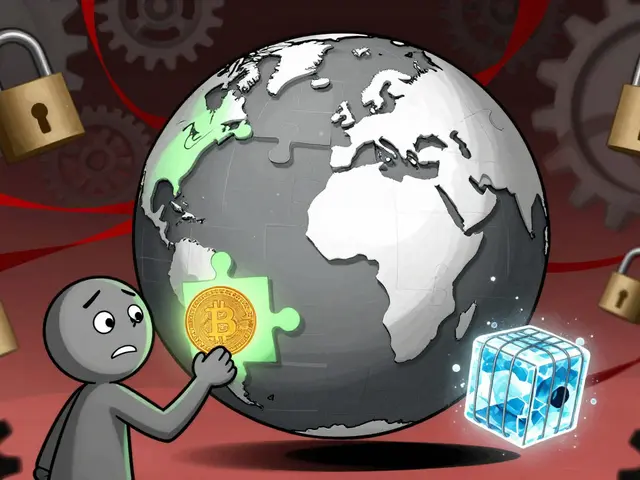
You bought a digital token representing a Miami penthouse. You hold the key in your wallet. But when you try to sell it or collect rent, the county recorder’s office says they don’t recognize your “ownership.” This isn’t a hypothetical nightmare scenario-it’s the daily reality for many early adopters of real estate NFTs.
Real estate NFTs are blockchain-based digital certificates that represent ownership, fractional interests, or usage rights to physical or virtual properties. Unlike traditional paper deeds, these tokens live on distributed ledgers like Ethereum or Polygon. However, owning the token does not automatically mean you own the brick-and-mortar asset in the eyes of the law. The gap between code and statute is where most investors get stuck.
The legal landscape for property tokenization is shifting fast. In 2024, the global market saw $14.2 billion in transaction volume, up from $3.7 billion the year before. Yet, only 18% of these deals used pure NFT structures. Most relied on security token offerings (STOs) to stay compliant with regulators. If you are looking to tokenize a property or buy one, you need to understand the specific legal wrappers, securities laws, and jurisdictional quirks that govern this space today.
The Core Misconception: Token vs. Title
The biggest hurdle in real estate NFTs legal framework discussions is the assumption that the NFT itself is the deed. It usually isn’t. When you buy an NFT linked to a house, you are typically buying a membership interest in a Special Purpose Vehicle (SPV), such as a Limited Liability Company (LLC). The SPV holds the legal title to the property. Your NFT represents your share of that LLC.
This distinction matters immensely. The Law Commission of England and Wales clarified this in August 2023, stating that while crypto tokens can be recognized as personal property, this recognition applies only to the digital asset itself-not the real-world asset it references. Owning the NFT gives you rights against the issuer or the SPV, but it does not grant you direct legal standing over the physical building unless the underlying contracts explicitly link the two.
In the U.S., this separation creates friction. A 2022 case in Wyoming highlighted this when a property transfer via NFT failed because the local county recorder rejected the blockchain deed without traditional notarization. Until local governments update their registries to read blockchain data, the NFT remains a secondary record, dependent on off-chain legal agreements to hold value.
Structuring the Deal: The Role of SPVs
To bridge the gap between blockchain and property law, developers use legal wrappers. The most common structure is the Delaware LLC SPV. According to LegalNodes’ 2024 analysis of 47 tokenized projects, 89% of U.S.-based initiatives chose Delaware for its flexible governance and established legal precedent. Here is how the chain of custody works:
- Property Acquisition: The SPV buys the physical property and holds the title.
- Tokenization: The SPV issues tokens (NFTs or fungible tokens) that represent equity in the company.
- Smart Contract Alignment: The operating agreement of the LLC is written to mirror the smart contract logic. Transferring the token triggers a change in membership records within the SPV.
This structure protects investors by isolating liability. If the property faces a lawsuit, the risk stays within the SPV. However, it adds complexity. You are not just dealing with blockchain gas fees; you are paying for corporate formation, annual LLC filings, and legal counsel to ensure the “legal wrapper” matches the on-chain activity.
For example, the $150 million tokenization of a Berlin office building by LAB10 collective succeeded because they employed a rigorous legal wrapper. Their SPV’s operating agreement explicitly referenced the blockchain ledger as the authoritative ownership record. This model was validated in a German court ruling in February 2025, setting a precedent for institutional adoption.
Securities Laws: The SEC’s Watchful Eye
If your real estate NFT promises profit participation-whether through rental income or property appreciation-it is likely classified as a security under U.S. law. The Securities and Exchange Commission (SEC) has been aggressive here. Between 2021 and 2024, the SEC filed 17 enforcement actions against non-compliant real estate tokenization projects.
The landmark case SEC v. REcoin Foundation (2023) established that any expectation of profit from property management triggers securities classification. This means you cannot simply mint an NFT and sell it on an open marketplace. You must comply with the Securities Act, typically using Regulation D exemptions like Rule 506(c) for accredited investors, or Regulation A+ for broader public offerings.
Here is what this means for you practically:
- Accreditation Checks: Platforms must verify that buyers meet income or net worth thresholds.
- Liquidity Restrictions: You may not be able to resell the token freely. Secondary trading often requires registration on regulated exchanges.
- Disclosure Requirements: Issuers must provide detailed financial reports, similar to traditional Real Estate Investment Trusts (REITs).
Projects attempting to bypass this by labeling tokens as “utility” NFTs-claiming they only offer access rights, like vacation home usage-face scrutiny. Regulators look at the economic substance, not the label. If investors expect returns, it’s a security.
| Jurisdiction | Classification | Key Requirement | Adoption Status |
|---|---|---|---|
| United States | Security (usually) | SEC Registration / Exemption (Reg D/A) | Fragmented (State-by-State) |
| Switzerland | Security or Payment Instrument | FINMA Guidelines; SIX Digital Exchange listing | Highly Regulated |
| UAE (Dubai) | Regulated Asset | SCA Approved Exchange | Leading Global Hub |
| England & Wales | Personal Property (Token only) | Common Law Recognition | Evolving Case Law |
| China | Prohibited | Ban on Crypto Assets | Zero Legal Transactions |

Global Divergence: Where Can You Trade?
The legality of real estate NFTs depends heavily on where you are located. While the U.S. struggles with federal-state fragmentation, other jurisdictions have moved faster.
In Switzerland, the Financial Market Supervisory Authority (FINMA) issued guidelines in January 2023. They classify real estate NFTs as securities if they promise profit. This requires listing on approved platforms like the SIX Digital Exchange. This clarity has attracted institutional capital, making Switzerland a top destination for compliant tokenization.
The United Arab Emirates has gone further. The UAE’s Securities and Commodities Authority (SCA) approved the world’s first fully regulated real estate NFT exchange in Dubai in September 2023. By December 2024, 127 properties were tokenized through this platform. The UAE’s approach provides a clear path for both issuers and investors, reducing the regulatory arbitrage seen elsewhere.
Conversely, China’s 2022 cryptocurrency ban explicitly prohibits NFTs representing real-world assets. Despite significant blockchain development activity in the country, there are zero legally recognized real estate NFT transactions. Investors must be aware that cross-border holding can create tax and legal nightmares if the underlying jurisdiction prohibits the asset class.
Practical Hurdles: Title Companies and Recorders
Even if the law allows it, the infrastructure often doesn’t keep up. User feedback from communities like Reddit’s r/RealEstateNFT reveals that 68% of surveyed users faced difficulties with traditional title companies refusing to recognize blockchain transfers.
One user documented a 147-day delay in a $450,000 Colorado property transfer because the county recorder’s office was unfamiliar with NFT documentation. This highlights the “oracle problem” in real estate: how do you get off-chain events (like a deed recording) to trigger on-chain updates reliably?
Solutions are emerging. Propy’s platform processed over 1,200 hybrid transactions across 14 U.S. counties by Q3 2024. These systems use smart contracts to trigger traditional title transfers once payment is confirmed on-chain. However, only three U.S. jurisdictions-Wyoming, Vermont, and Ohio-have enacted specific legislation recognizing blockchain-based property records. Wyoming’s 2025 update now requires NFT-based deeds to include a QR code linking to the county’s traditional records system, a compromise that balances innovation with bureaucratic familiarity.

Tax Implications and Compliance Costs
Tax treatment remains a gray area. In the U.S., the IRS treats cryptocurrencies as property. Therefore, selling a real estate NFT may trigger capital gains taxes. Additionally, if the NFT generates rental income, that income might be taxed as ordinary income or qualified dividends, depending on the structure of the SPV.
A survey of investors in a $22 million Manhattan apartment tokenization via RealT showed that while capital distribution was 92% faster (7 days vs. 90 days), 34% experienced tax complications due to inconsistent state treatments of crypto dividends. You need to consult with a tax professional who understands both real estate and digital assets.
The cost of compliance is also rising. Trakti’s 2025 data shows the average legal compliance cost for tokenizing a $1 million property is $47,300-18% higher than traditional securitization. This includes:
- SPV Formation: $15,000-$25,000 in legal fees.
- KYC/AML Protocols: $8,000-$12,000 to meet FATF Travel Rule requirements.
- Smart Contract Audits: Fees for firms like Quantstamp or OpenZeppelin to secure the code.
These costs are necessary to mitigate the 37% higher transaction risk identified by the CRE Finance Council for projects lacking standardized frameworks.
Metaverse Real Estate: A Different Beast
Virtual land presents unique legal challenges. Unlike physical property, metaverse land exists solely within private platforms. In 2024, 68% of virtual land disputes involved unclear jurisdictional boundaries between platform Terms of Service (T&Cs) and national laws.
A $2.4 million lawsuit filed in Florida federal court in March 2025 regarding ownership rights to a Decentraland plot highlighted this issue. The plaintiff argued they owned the land based on their NFT, while the platform cited its T&Cs, which reserved ultimate control. Currently, buying virtual land is less about property law and more about licensing agreements. You are renting the right to use the space, subject to the platform’s whims.
Future Outlook: What Comes Next?
The World Economic Forum predicts that 10% of global real estate will be tokenized by 2030. For this to happen, three critical gaps must close:
- Cross-Jurisdictional Integration: Property registries must interoperate globally.
- Tax Clarity: Governments need clear frameworks for taxing NFT-based ownership transfers.
- Dispute Resolution: Internationally recognized mechanisms for resolving blockchain property conflicts are essential.
The European Commission’s MiCA II framework, expected in Q3 2025, aims to establish EU-wide standards for real-world asset tokenization, including mandatory title registry integration. In the U.S., the CFTC and SEC jointly proposed rules in December 2024 requiring real estate NFT platforms to register as Alternative Trading Systems. These moves signal a shift from wild west experimentation to regulated maturity.
As an investor or developer, your best bet is to stick to jurisdictions with clear laws, use robust SPV structures, and never assume the NFT alone is sufficient proof of ownership. Always verify the off-chain legal documents.
Is owning a real estate NFT the same as owning the property?
No. Typically, the NFT represents a membership interest in a Special Purpose Vehicle (SPV) that holds the legal title to the property. You own a share of the company, not the physical building directly, unless specific local laws and deed recordings link the two explicitly.
Are real estate NFTs considered securities?
In most cases, yes. If the NFT offers profit participation through rental income or property appreciation, regulators like the U.S. SEC classify it as a security. This requires compliance with regulations like Regulation D or A+, including investor accreditation checks.
Which countries have the best legal frameworks for real estate NFTs?
Switzerland, the UAE (specifically Dubai), and Singapore lead in regulatory clarity. Switzerland has strict FINMA guidelines, while the UAE has launched fully regulated exchanges for tokenized real estate. The U.S. is fragmented, with only states like Wyoming and Vermont having supportive legislation.
How much does it cost to tokenize a property legally?
The average legal compliance cost for a $1 million property is approximately $47,300. This includes SPV formation ($15k-$25k), KYC/AML protocols ($8k-$12k), and smart contract audits. These costs are higher than traditional securitization but offer faster liquidity.
What happens if I lose my private key to a real estate NFT?
If you lose your private key, you lose access to the token. However, because the token usually represents shares in an SPV, some platforms have recovery mechanisms via multi-sig wallets or custodial services. Check the specific project’s terms. If it’s a self-custody-only model, the loss may be permanent, though the underlying asset still exists in the SPV.
Can I sell my real estate NFT on any marketplace?
Not necessarily. Because these assets are often securities, they can only be traded on registered Alternative Trading Systems (ATS) or regulated exchanges. Public marketplaces like OpenSea generally do not support compliant secondary trading of security-classified real estate NFTs due to lack of KYC/AML controls.
How are taxes handled for rental income from tokenized real estate?
Tax treatment varies by jurisdiction and SPV structure. In the U.S., rental income distributed via tokens may be taxed as ordinary income or qualified dividends. Capital gains apply upon sale. Due to inconsistent state treatments, consulting a tax advisor familiar with crypto-assets is crucial to avoid penalties.
Is metaverse real estate legally protected?
Minimal protection exists. Virtual land ownership is governed by the platform’s Terms of Service, not traditional property law. You essentially hold a license to use the digital space. Disputes are increasingly being litigated in federal courts, but precedents are scarce and outcomes uncertain.