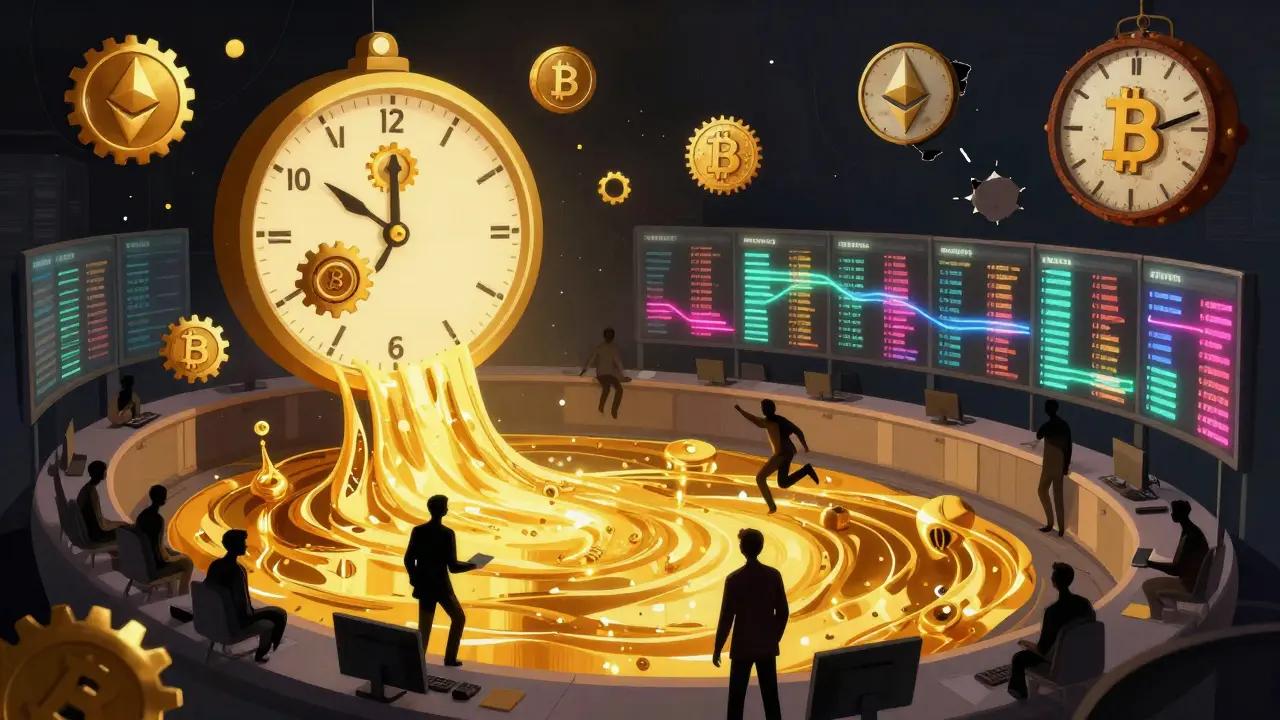
Most crypto exchanges feel like they’re running on old hardware-slow, clunky, and full of delays. If you’ve ever waited 20 seconds for a trade to confirm while the price moved against you, you know the frustration. Astroport (Sei) doesn’t just fix that-it rebuilds the whole system from the ground up. Built directly on the Sei Network, Astroport isn’t another copycat DEX. It’s engineered for traders who demand speed, low slippage, and capital efficiency without sacrificing decentralization.
How Astroport (Sei) Works: More Than Just Another AMM
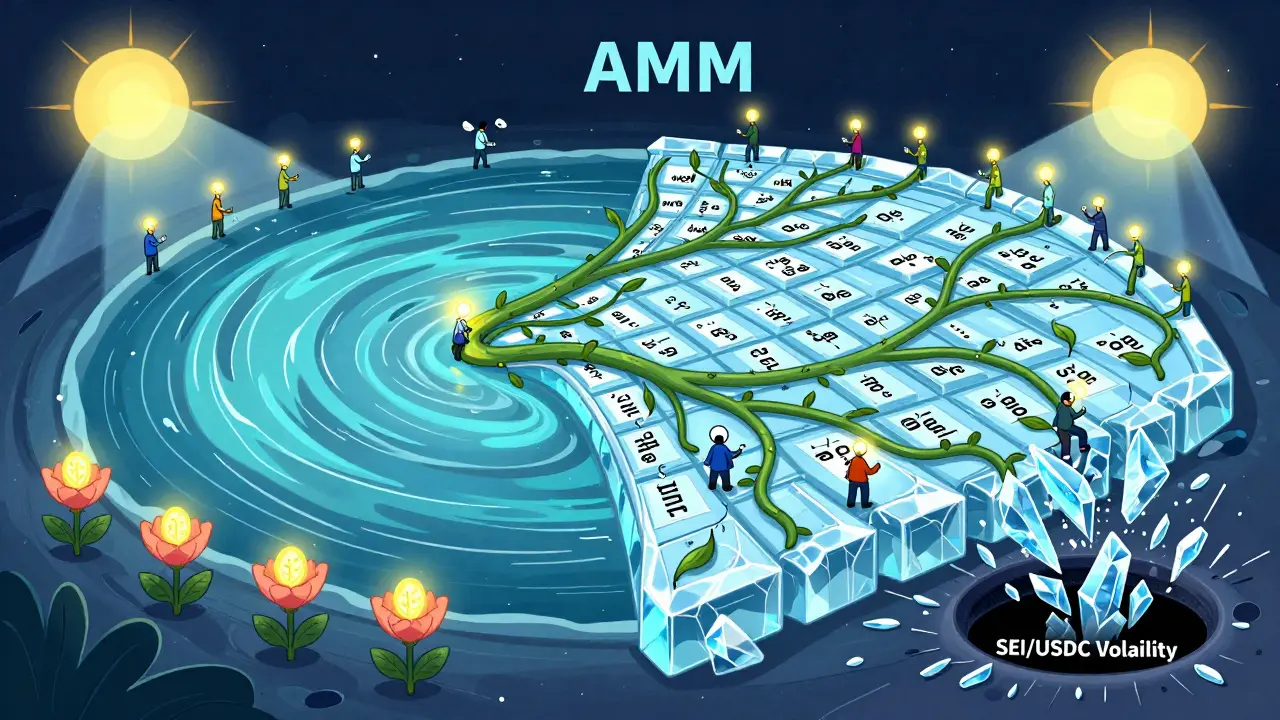
Astroport on Sei isn’t just an automated market maker like Uniswap or PancakeSwap. It’s a hybrid. It combines concentrated liquidity pools (like Uniswap V3) with Sei Network’s twin-pool architecture and native order book functionality. This means you can place limit orders and swap tokens in the same interface, something even top-tier DEXes on Ethereum still can’t do smoothly. The magic lies in how Sei’s blockchain handles transactions. While Ethereum processes transactions one after another, Sei runs them in parallel. That’s why Astroport executes swaps in under a second-on average, just 0.8 seconds. Compare that to Ethereum-based DEXes, which often take 15 to 30 seconds. For high-frequency traders or anyone reacting to fast-moving markets, that difference isn’t a convenience-it’s a survival tool. Liquidity providers (LPs) benefit too. Astroport’s pools are designed to be up to three times more capital-efficient than traditional AMMs. Instead of spreading your funds across a wide price range, you focus them where trading activity actually happens. This reduces impermanent loss and increases yield. The protocol offers flexible fee tiers: 0.01%, 0.05%, and 0.30%. For most users, the 0.30% tier strikes the best balance between liquidity depth and trading cost.What You Can Trade: Limited but Focused
Don’t expect Astroport (Sei) to have 500 trading pairs like Binance. As of December 2025, there are only 12 active pairs. But that’s by design. The focus is on the most liquid and actively traded assets on Sei:- SEI/USDC
- SEI/USDT
- ASTRO/SEI
- WIF/USDC
- PEPE/USDT
Performance Compared to the Competition
Astroport (Sei) doesn’t compete with Uniswap because it doesn’t have to. It competes with speed and efficiency. Here’s how it stacks up:| Feature | Astroport (Sei) | Uniswap V3 (Ethereum) | PancakeSwap (BNB Chain) |
|---|---|---|---|
| Average Swap Time | 0.8 seconds | 15-30 seconds | 5-8 seconds |
| Capital Efficiency | 3.2x higher than Uniswap V3 | Baseline | 2.1x lower |
| Slippage on $10K trade | 40% lower than PancakeSwap | Higher due to congestion | Baseline |
| Total Value Locked (TVL) | $85.3 million | $4.2 billion | $1.7 billion |
| Order Book Support | Yes, native | No | No |
Getting Started: Simple, But Not for Beginners
You don’t need to be a coder to use Astroport, but you do need to understand basic DeFi concepts. Here’s how to get started:- Install a Sei-compatible wallet like Keplr or Leap.
- Bridge your assets to the Sei Network using Allbridge or the official Sei bridge.
- Go to astroport.fi and select the Sei network.
- Connect your wallet.
- Choose a trading pair and decide between swap or limit order.
Pros and Cons: The Real Picture
Pros:- Swaps under 1 second-faster than almost any DEX on any chain.
- Lower slippage on medium trades compared to PancakeSwap and Uniswap.
- Native limit orders integrated into the AMM-no need for separate platforms.
- Higher capital efficiency means better yields for LPs.
- Strong institutional backing: Wintermute, GSR, and Alameda provide liquidity.
- Only 12 trading pairs-too limited for diversified traders.
- No advanced charting tools. You’ll need to use TradingView or DEX Screener alongside it.
- Mobile experience is inconsistent. The interface works, but it’s clunky on phones.
- Low educational content. If you don’t know what impermanent loss is, you’ll get burned.
- ASTRO tokenomics are a concern. Only 28.7% of the total supply has been distributed so far. More tokens are still being mined, which could dilute value.

Who Is Astroport (Sei) For?
This isn’t a platform for casual crypto buyers. It’s built for:- Traders who execute multiple trades per day and need speed.
- Liquidity providers who want to maximize returns without constant monitoring.
- Users already active on Sei Network and looking for the most efficient DEX.
- DeFi enthusiasts who value technical innovation over brand recognition.
What’s Next? The Roadmap
Astroport isn’t standing still. Key updates in 2025-2026 include:- Astroport Perps (launched Dec 1, 2025): Perpetual futures trading on Sei, with up to 20x leverage.
- Dynamic Fee Adjustment (Q1 2026): Pools will automatically adjust fees based on volatility-no manual tweaking needed.
- Squid Cross-Chain API (Nov 2025): Seamless transfers between Sei and 12 other chains, including Ethereum, Solana, and Polygon.
- Institutional Custody (Q3 2026): Partnership with Fireblocks to bring institutional-grade security and custody options.
Final Verdict: A Power Tool, Not a Toy
Astroport (Sei) isn’t the biggest DEX. It’s not the most popular. But it’s the fastest, most efficient, and most technically advanced DEX on a high-performance blockchain. If you care about execution speed, low slippage, and capital efficiency, it’s the best option on Sei-and arguably one of the best in the entire DeFi space. The trade-off? Simplicity. You’ll need to learn the mechanics. You’ll need to manage your own risk. And you’ll need to accept that it’s still a niche product. But for those who get it, Astroport isn’t just a DEX-it’s the future of decentralized trading.Is Astroport (Sei) safe to use?
Yes, as long as you use a trusted wallet like Keplr and never share your seed phrase. Astroport is a non-custodial protocol, meaning you control your funds. The code has been audited by reputable firms, and there have been no major exploits since launch. However, like all DeFi platforms, you’re exposed to smart contract risk and impermanent loss as a liquidity provider. Always start with small amounts.
How do I earn rewards on Astroport (Sei)?
You earn rewards by providing liquidity to Astroport pools. When someone trades against your pool, you earn a portion of the trading fees. You also receive ASTRO tokens as incentives for staking your LP tokens. The best-performing pools as of December 2025 are ASTRO/SEI and SEI/USDC with the 0.30% fee tier. Always check the APY on the platform before depositing-rates change daily.
Can I use Astroport (Sei) on my phone?
You can access Astroport on mobile browsers, but the experience isn’t optimized. The interface works, but buttons are small, charts load slowly, and it’s easy to make mistakes. For serious trading, use a desktop with a hardware wallet. If you’re just swapping small amounts, mobile is fine-but don’t try complex limit orders or LP management on your phone.
What’s the difference between Astroport on Sei and Astroport on Osmosis?
Astroport on Sei is faster and cheaper due to Sei’s parallelized blockchain. Swaps are 10x quicker than on Osmosis. Sei also has native order book support, which Osmosis doesn’t. However, Osmosis has more trading pairs and higher TVL. If you’re trading SEI or want speed, use Sei. If you want more token options and deeper liquidity, Osmosis might be better.
Should I buy ASTRO token?
Buying ASTRO isn’t necessary to use Astroport (Sei), but holding it gives you governance rights and access to future airdrops. The token has utility in fee distribution and staking rewards. However, with only 28.7% of the supply distributed, there’s significant inflation risk. Don’t buy ASTRO expecting quick gains. Treat it as a long-term bet on Sei Network’s success as a DeFi hub.
What happens if Sei Network goes down?
If Sei Network experiences an outage, Astroport will be unusable until it’s restored. Since Astroport runs entirely on Sei, there’s no backup chain. This is the trade-off for speed and efficiency. Sei has been stable since its v2 upgrade in early 2024, with only minor, brief disruptions. Still, you’re relying on one blockchain’s uptime. Never put more money into Astroport than you’re comfortable losing if Sei fails.





Jesse Messiah
December 16, 2025 AT 16:41Astroport is honestly a game-changer for anyone trading SEI daily. I used to bounce between Binance and Uniswap just to get decent execution, but now I just hit swap and it’s done before I finish sipping my coffee. The 0.8-second trades? Real. No more watching my order get front-run while I reload the page.
Also, the Pool Advisor tool saved me last week when I was trying to add liquidity to SEI/USDC-told me to go with 0.05% instead of 0.30% and I cut my impermanent loss in half. Big win.
Only thing I wish was easier is the bridge process. Allbridge still feels clunky, but once you’re in, it’s smooth sailing.
Samantha West
December 17, 2025 AT 12:11The structural superiority of Astroport’s twin-pool architecture represents a paradigmatic rupture from the monolithic, serial-transactional models that have dominated DeFi since 2018. One cannot merely speak of efficiency; one must acknowledge the ontological shift in liquidity provision itself. The integration of native limit orders within an AMM framework is not an enhancement-it is the reconstitution of market mechanics in a post-Ethereum epoch.
Furthermore, the capital efficiency metrics suggest a fundamental recalibration of risk-reward dynamics for liquidity providers, wherein the traditional notion of impermanent loss is being redefined through algorithmic concentration-a phenomenon that, if generalized, could render legacy DEXes archaic.
Yet, one must interrogate the epistemic hegemony of speed: is the optimization of microseconds a moral imperative, or merely the fetishization of velocity in an age of accelerating entropy?
Sally Valdez
December 18, 2025 AT 09:19Ugh, another ‘blockchain innovation’ post from the crypto bros who think speed matters more than sovereignty. Sei is just another EVM wannabe with a fancy marketing team. You think 0.8 seconds is fast? Try trading on a real chain like Bitcoin or Monero-where decentralization isn’t a buzzword, it’s the whole point.
And don’t even get me started on ASTRO tokenomics. 71% of supply still unissued? That’s not innovation, that’s a rug pull waiting to happen. You people are so obsessed with ‘low slippage’ you forget you’re giving your keys to a team that could vanish tomorrow.
Stick to Coinbase. At least there, your money isn’t at the mercy of some guy in Singapore running parallelized validators.
Elvis Lam
December 19, 2025 AT 07:06Sally’s right about the tokenomics being sketchy, but she’s missing the point. Astroport isn’t about speculation-it’s about execution. The fact that Wintermute and GSR are LPs means this isn’t a meme project. They wouldn’t risk millions on a chain that’s about to die.
And yes, the 12 trading pairs are limited-but that’s intentional. You don’t need 500 pairs if you’re trading the top 3 assets on Sei. It’s like having a race car with only one gear: it’s optimized, not underdeveloped.
Also, mobile experience is trash? Use a tablet. Or better yet, get a Ledger and use the desktop site. This isn’t a TikTok app. It’s a professional tool. If you can’t handle that, maybe don’t trade DeFi.
And yes, the Perps launch is huge. 20x leverage on a 0.8s chain? That’s going to blow up trading volume. Watch it.
Jonny Cena
December 20, 2025 AT 14:39Hey, if you’re new to Astroport, just start small. I jumped in with $500 in SEI/USDC and used the 0.05% pool. Didn’t make bank, but didn’t lose anything either. The Pool Advisor is your best friend-don’t skip it.
And to everyone freaking out about the token supply: yeah, it’s a lot left to mint, but the vesting schedule is locked for 3 years. This isn’t a pump-and-dump. It’s a slow burn.
Also, if mobile is clunky, try using the PWA. It’s not perfect, but it’s way better than the mobile browser. And if you’re scared of impermanent loss? Just stake your LP tokens for ASTRO rewards. You’ll earn more than you lose.
This isn’t for everyone. But if you’re serious about trading on Sei? This is the only DEX worth using. Take your time. Learn. You’ll thank yourself later.