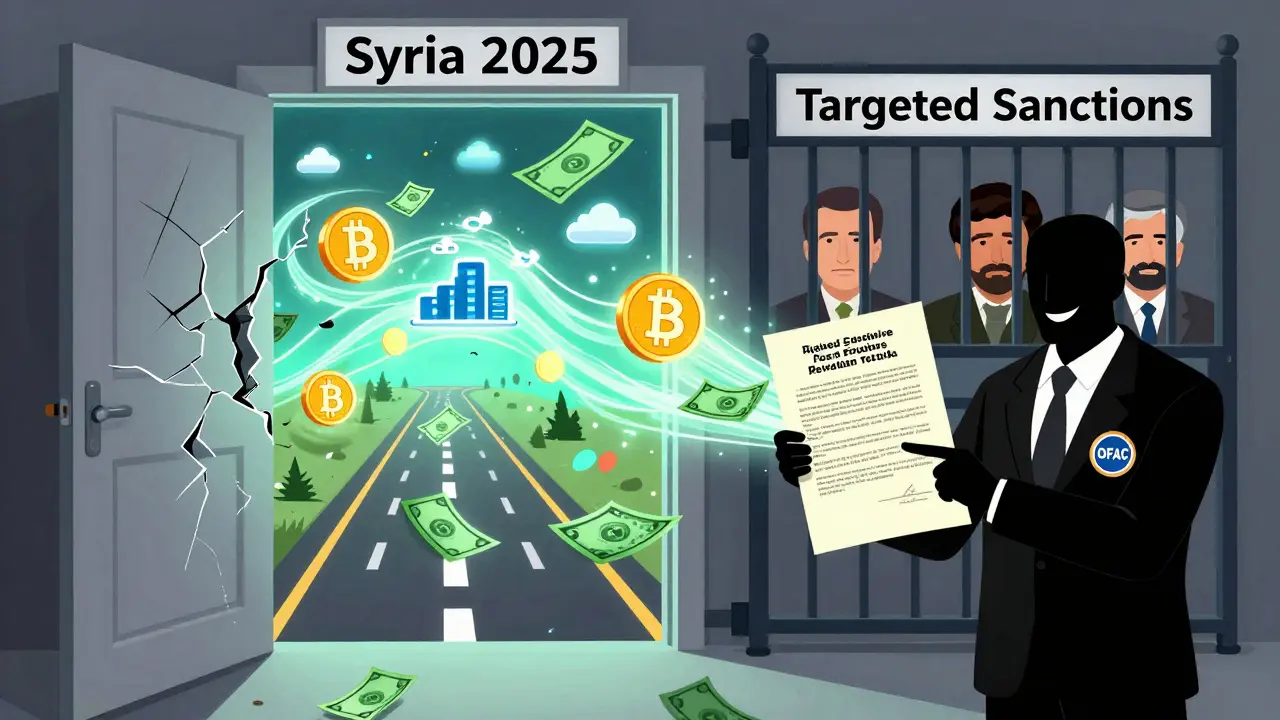
When the U.S. lifted comprehensive sanctions on Syria on July 1, 2025, it didn’t just change trade rules-it opened a door that had been welded shut for over two decades. At the same time, Cuba faced the opposite: tighter restrictions, renewed enforcement, and a clear message that financial isolation was back on the table. For anyone trying to move money, run a business, or even use cryptocurrency in either country, the difference couldn’t be starker. One is now open for business. The other is more locked down than ever.
Syria’s Sanctions Lift: What Changed in 2025
Before June 2025, doing business with Syria meant jumping through a maze of U.S. restrictions. The country had been under a full economic embargo since 2004, banning everything from exporting services to making investments. Even sending a wire transfer to a Syrian business could trigger a violation. That all changed with Executive Order 14312 issued by President Trump on June 30, 2025, which revoked six prior executive orders that had maintained Syria’s sanctions regime. The order didn’t just ease restrictions-it erased them.
By July 1, 2025, the U.S. Treasury’s Office of Foreign Assets Control (OFAC) removed the Central Bank of Syria and all its affiliated institutions from the Specially Designated Nationals (SDN) List. That meant U.S. banks could now open correspondent accounts with Syrian banks. American companies could legally export financial services, software, and even cloud infrastructure to Syria without needing a special license. For the first time in 21 years, cross-border payments between the U.S. and Syria became routine-not risky.
But here’s the catch: the lift wasn’t blanket. Targeted sanctions still apply to the Assad family, former regime officials, individuals linked to the illicit captagon drug trade, and those involved in human rights abuses. If you’re sending money to a Syrian hospital, that’s fine. If you’re sending it to a shell company owned by a sanctioned general, you’re still breaking the law. Compliance isn’t optional-it’s critical.
Crypto in Syria: Legal Gray Zone, Growing Access
Syria never had a law banning cryptocurrency. It never had a law allowing it, either. That’s why it’s a gray zone. Before July 2025, major exchanges like Binance restricted Syrian users due to U.S. sanctions and fear of regulatory backlash. After the sanctions lifted, those restrictions were dropped. Syrians could now trade, receive, and send crypto without being flagged by U.S.-based platforms.
But that doesn’t mean it’s easy. International banks still hesitate. Why? Because Syria’s AML/CFT framework is weak. There’s no central financial intelligence unit. No clear rules on KYC for crypto exchanges. No transparency. So even if U.S. sanctions are gone, European and Asian banks still block transactions to Syrian entities out of caution. This creates delays, rejections, and lost deals.
Some fintech firms are stepping in. Lightspark developed Grid Switch, a system that lets institutions send fiat payments to Syria using the Lightning Network as a settlement layer-without ever touching crypto on their balance sheets. It’s a workaround that keeps compliance teams happy and payments flowing.
Cuba: The Tightening Noose
While Syria got freedom, Cuba got a prison sentence.
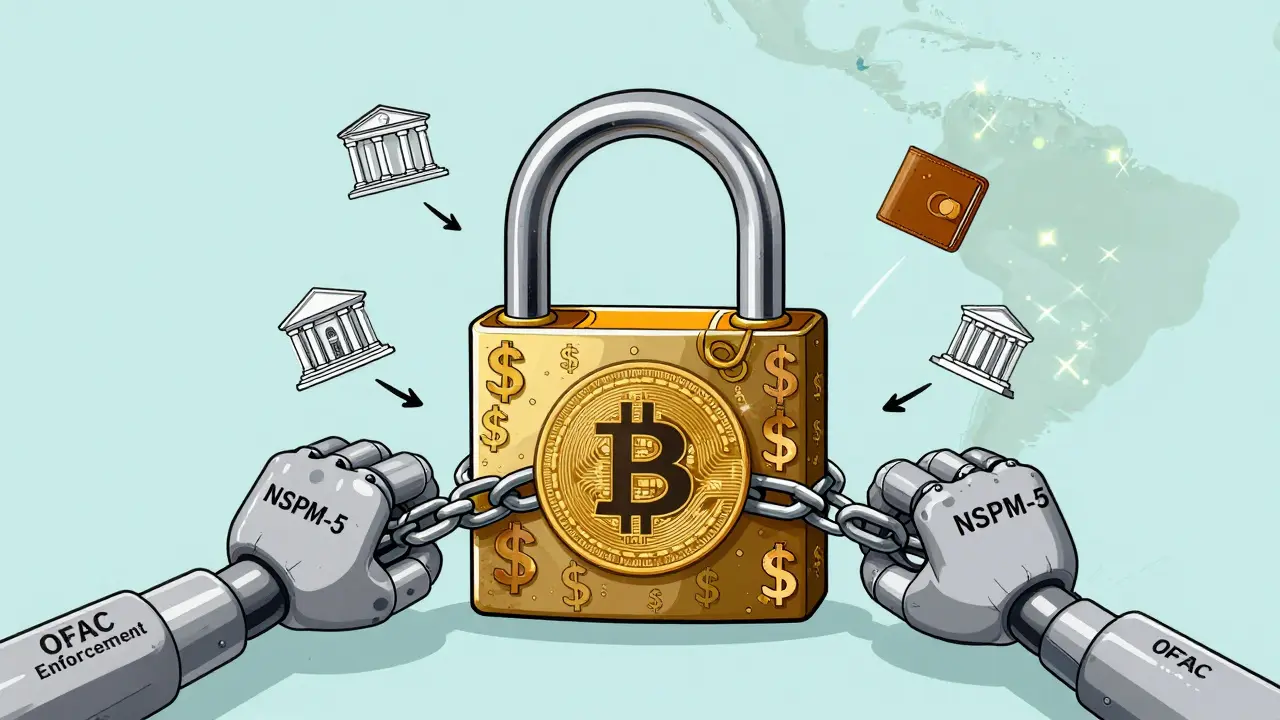
In 2022, President Biden eased some Cuba sanctions-lifting limits on family remittances, allowing travel for certain categories, and permitting U.S. companies to engage in limited transactions. Those changes were reversed in 2025 by National Security Presidential Memorandum 5 (NSPM-5) which reinstated the full force of the Cuba Assets Control Regime (CACR). No more remittance flexibility. No more travel exceptions. No more loopholes.
The message was clear: even indirect support for Cuba is unacceptable. In July 2025, Key Holding, LLC a U.S.-based logistics firm, paid $608,825 in penalties after its subsidiary shipped goods from Colombia to Cuba. The violation? A single shipment. The fine? One of the largest ever for a non-willful breach. This wasn’t about smuggling weapons. It was about a logistics company managing freight for a Cuban hospital. OFAC didn’t care. They made an example.
And it gets worse. The CACR applies to non-U.S. subsidiaries of U.S. companies. So if you’re a German company owned by a U.S. parent, and you ship medical supplies to Havana, you’re still at risk. That’s unique. Most sanctions regimes don’t reach that far. Cuba’s are designed to choke off any possible lifeline.
Crypto and Cuba: A Closed Door
While Syria’s crypto scene opened up, Cuba’s remains locked. The U.S. government hasn’t banned cryptocurrency outright in Cuba-but it doesn’t need to. The sanctions do it for them.
Major exchanges still block Cuban users. Why? Because even if you’re just sending Bitcoin to a family member in Havana, you’re technically violating OFAC rules if the recipient is in a sanctioned sector. And since Cuba’s government controls nearly all economic activity, any transaction could be seen as supporting the regime.
There’s no equivalent to Lightspark in Cuba. No fintech firm is building bridges. Why? Because the risk is too high. One penalty could wipe out a startup. No bank will touch a Cuban crypto wallet. No payment processor will clear a transaction. The result? Cubans are cut off from global crypto markets, even as the rest of the world moves forward.
Why the Difference? Strategy, Not Logic
At first glance, this makes no sense. Why lift sanctions on Syria, a country with a brutal regime, while doubling down on Cuba, a nation that hasn’t changed in 60 years? The answer isn’t about human rights. It’s about geopolitics.
Syria’s shift was tied to a broader U.S. strategy in the Middle East. In July 2025, the State Department announced the revocation of the FTO designation for Hay’at Tahrir al-Sham (HTS), a group once labeled a terrorist organization. Why? Because Syria’s new leadership, under President Ahmed al-Sharaa, claimed to have dissolved HTS and pledged to fight terrorism. The U.S. saw an opening: rebuild Syria as a counterweight to Iran and Russia, not a failed state.
Cuba? No such deal. No new leadership. No political shift. The U.S. sees Cuba as a Russian and Chinese proxy. So the strategy is simple: isolate it. Starve it. Keep it weak. Sanctions aren’t about punishment here-they’re about containment.
What This Means for Businesses and Users
If you’re a business trying to operate in Syria: you can now send payments, open bank accounts, and use crypto exchanges without U.S. legal risk. But you still need to screen every counterparty against the remaining targeted sanctions list. One mistake, and you’re fined.
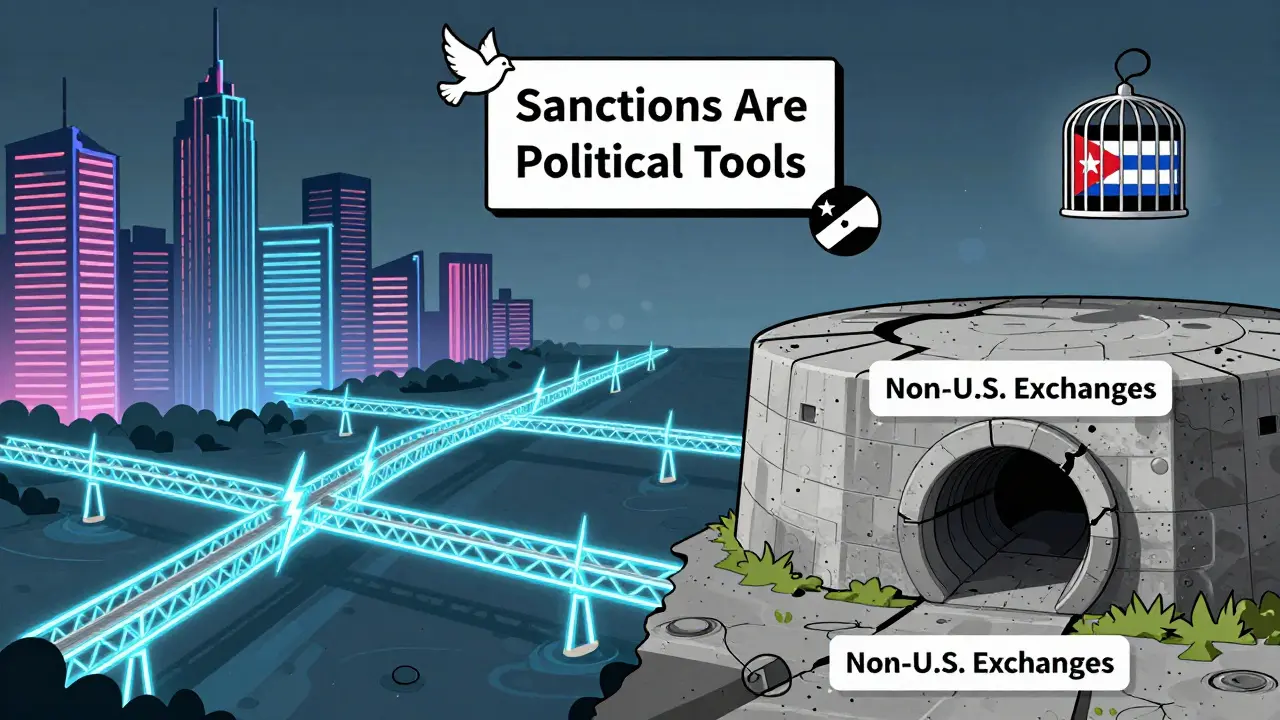
If you’re in Cuba: forget U.S. banks. Forget major crypto exchanges. Your only options are non-U.S. platforms-like those based in Asia or Latin America-and even those are under pressure. Remittances? They’re still possible, but they’re slow, expensive, and risky.
For crypto users in Syria: you have access. But you’re still in a legal gray zone. No regulation means no protection. No oversight means no recourse if you’re scammed. Use exchanges with strong KYC. Avoid peer-to-peer trades with unknown parties. Keep records.
For crypto users in Cuba: you’re on your own. The tools exist-wallets, bridges, decentralized exchanges-but they’re not safe. You’re not just risking money-you’re risking legal exposure if your transaction is traced back to a sanctioned entity.
Looking Ahead: The New Normal
By 2026, Syria is slowly rebuilding its financial infrastructure. U.S. firms are signing deals. Payment gateways are being integrated. Crypto adoption is rising-not because it’s preferred, but because it’s one of the few tools left to bypass lingering banking hesitancy.
Cuba? Nothing’s changing. The regime still controls every dollar. The U.S. still sees it as an enemy. The sanctions are tightening further, with new enforcement actions expected in 2026 targeting cryptocurrency mixers used by Cuban entities.
The lesson? Sanctions aren’t static. They’re political tools. And when the U.S. changes its mind, the world has to scramble to keep up.
Are cryptocurrency transactions legal in Syria now?
Yes, but not because there’s a law allowing it. Syria has no crypto laws at all. After U.S. sanctions were lifted in July 2025, major exchanges like Binance lifted restrictions on Syrian users. However, since there’s no regulatory framework, users operate in a legal gray zone. Transactions must still comply with Syria’s AML/CFT rules, and international banks may still block payments due to perceived risk.
Can I send Bitcoin to someone in Cuba?
Technically, yes-but you risk violating U.S. sanctions. The Cuba Assets Control Regime (CACR) prohibits virtually all financial transactions with Cuban entities, even if they’re private individuals. If your transaction is traced to a Cuban bank, government entity, or even a state-owned business, OFAC can penalize you. Most exchanges block Cuban users entirely. Even using decentralized exchanges carries risk if the recipient is linked to sanctioned sectors.
Why did the U.S. lift sanctions on Syria but not Cuba?
It’s about strategy, not morality. Syria’s new leadership, under President Ahmed al-Sharaa, claimed to have dissolved the terrorist group HTS and pledged to fight terrorism. The U.S. saw a chance to pull Syria away from Russia and Iran. Cuba, however, remains a close ally of both countries and shows no signs of political change. The U.S. strategy is to isolate Cuba to limit Russian and Chinese influence, not to pressure its government into reform.
Can U.S. companies do business with Syria now?
Yes, but with strict limits. U.S. companies can now export services, invest, and open bank accounts in Syria without a license. However, they must avoid any dealings with individuals or entities still on OFAC’s targeted sanctions list-including the Assad family, former regime officials, and those linked to the captagon drug trade. Enhanced due diligence is mandatory. Failure to screen properly can result in fines, even if the violation was unintentional.
What happened to the Central Bank of Syria’s sanctions status?
On July 1, 2025, the Central Bank of Syria was removed from OFAC’s Specially Designated Nationals (SDN) List. This means U.S. financial institutions can now legally establish correspondent banking relationships with it. The move allowed for direct dollar transactions, cross-border payments, and access to international financial systems. It was one of the most significant sanctions reversals in modern U.S. history.
Is there a risk of U.S. sanctions being reinstated on Syria?
Yes. The sanctions relief is tied to Syria’s continued cooperation on counterterrorism and regional stability. If the Assad regime or its allies re-emerge in power, or if HTS regroups, the U.S. could reinstate sanctions quickly. There’s no guarantee this change is permanent. Businesses operating in Syria should monitor OFAC updates and maintain compliance programs, even if they’re currently operating legally.




Adam Ashworth
March 13, 2026 AT 00:51Syria’s sanctions lift is a masterstroke in realpolitik. No more pretending this is about human rights-it’s about cutting Iran’s supply lines and pulling Syria into the US orbit. The fact that Binance dropped restrictions overnight proves how much leverage US policy has over global crypto infrastructure. They didn’t just open a door-they rewired the whole building.
And yeah, the gray zone is real. No laws in Syria? Perfect. That’s not a bug-it’s a feature. It means no regulatory overhead, no compliance costs, and no bureaucratic delays. Just pure, unregulated liquidity flowing through the Lightning Network. Who needs oversight when you’ve got market forces?
karan narware
March 14, 2026 AT 21:39Ohhh, so now the U.S. is the benevolent giant, lifting sanctions on Syria-because, you know, it’s ‘strategic’-while locking Cuba in a medieval dungeon because it’s ‘containing influence’? Let me grab my monocle and top hat… because this isn’t foreign policy-it’s a Shakespearean tragedy written by a corporate lobbyist with a grudge.
One country gets a golden handshake for pretending to be less evil, the other gets a boot to the neck for refusing to kneel. Tell me again how this isn’t imperialism dressed in Excel spreadsheets? 🤔
Michael Suttle
March 15, 2026 AT 13:09THIS IS A COVERT OPERATION. 😈
They lifted sanctions on Syria because they’re using crypto to launder money for the new regime-and Binance? Totally in on it. You think they just ‘dropped restrictions’? Nah. They planted backdoors. Every transaction is being logged. Every wallet is being tracked. They want to build a digital surveillance state under the guise of ‘economic normalization’.
Meanwhile, Cuba? They’re not banning crypto-they’re using it as a trap. If you send Bitcoin to your cousin in Havana? Congrats, you just got flagged for ‘supporting state infrastructure’. It’s a honeypot. And we’re all being played.
Also… who’s really controlling the Central Bank of Syria now? 🤔
Jenni James
March 16, 2026 AT 00:04While it is certainly true that the U.S. Treasury’s decision to remove the Central Bank of Syria from the SDN list represents a significant policy shift, one must not overlook the fact that this action was predicated upon geopolitical expediency rather than any principled reconsideration of human rights or democratic governance.
Moreover, the assertion that ‘crypto is legal’ in Syria is a gross mischaracterization; there is no legal framework, no regulatory authority, no consumer protections-only a vacuum. And in such a vacuum, the only entities that thrive are those with the capital to exploit it.
Furthermore, the claim that ‘international banks still hesitate’ is not a flaw in the system-it is the system working as intended. Risk aversion is not irrational; it is prudent. To suggest otherwise is to misunderstand the nature of global finance.
And Cuba? The U.S. policy is not ‘tightening the noose’-it is maintaining a legally coherent, historically consistent, and morally defensible position against a regime that has not changed in sixty years. To equate the two is not analysis-it is moral equivalence fallacy.
Chelsea Boonstra
March 16, 2026 AT 07:09So let me get this straight-Syria gets a free pass because their new president says ‘we’re not terrorists anymore’ and suddenly everyone’s fine with it? What happens when he’s assassinated next year and the old guard comes back? Do we just say ‘oops’ and slap sanctions back on? And why does no one talk about the captagon trade? That’s not going away just because the U.S. ‘lifted’ sanctions.
Meanwhile, Cuba? People are starving. Medical supplies are being blocked. And you call this ‘containment’? This isn’t strategy-it’s cruelty disguised as policy. You don’t starve civilians to punish a government-you starve them to break them. And that’s not just bad policy-it’s evil.
And don’t even get me started on crypto. If you can’t send Bitcoin to your sick aunt in Havana without risking a $600k fine, then the system is broken. Not the people. The system.
Alex Thorn
March 17, 2026 AT 07:41There’s something deeply human here, beneath the spreadsheets and sanctions lists.
People in Syria-mothers, shopkeepers, doctors-have spent 21 years living under a shadow. Not because they chose the regime, but because history trapped them. And now? A sliver of light. Not because they earned it. Not because they were ‘good.’ But because the world decided, for now, that it’s more useful to have them in the game than out of it.
Meanwhile, in Cuba, a grandmother sends her grandson a message: ‘I can’t get medicine.’ He replies: ‘I sent you Bitcoin.’ But the transaction fails. Not because of tech. Not because of geography. Because of a policy written in Washington that sees people as chess pieces.
We talk about systems. But systems don’t feel hunger. Systems don’t cry. The real question isn’t whether sanctions work-it’s whether we still have the moral courage to call them what they are: collective punishment.
Howard Headlee
March 17, 2026 AT 14:14LET’S BE REAL-SYRIA IS NOW THE WILDCAT OF CRYPTO. 🚀
No rules? No banks? No oversight? That’s not a loophole-that’s a gold rush. You think the Syrians are sitting around waiting for compliance manuals? Nah. They’re building their own financial ecosystem with Lightning Nodes, P2P wallets, and Telegram bots. It’s messy. It’s dangerous. It’s beautiful.
And Cuba? Bro, they’re stuck in 1998. No crypto access. No remittances. No hope. Meanwhile, Venezuelans and Argentines are using crypto to survive. But Cuba? Still stuck with a regime that thinks Bitcoin is a CIA plot.
This isn’t about politics-it’s about who gets to play in the future. And right now, Syria’s got the keys. Cuba? They’re still trying to charge their phone with a hand-crank.
Julie Tomek
March 19, 2026 AT 09:34It is imperative to recognize that the distinction between Syria and Cuba is not arbitrary, but rather grounded in a nuanced understanding of international legal frameworks, state behavior, and the broader strategic imperatives of U.S. foreign policy.
The removal of sanctions from Syria was contingent upon verifiable, documented changes in governance structures, including the dissolution of designated terrorist entities and the establishment of counterterrorism cooperation protocols with international partners. This is not merely a political gesture-it is a legally conditioned action, subject to ongoing monitoring and review.
In contrast, the Cuban government continues to maintain systemic control over all economic activity, including the allocation of foreign currency, the operation of state-owned enterprises, and the suppression of civil society. Any financial transaction, regardless of its ostensible private nature, inherently supports a structure that violates fundamental human rights principles.
Therefore, while the outcomes may appear contradictory on the surface, the underlying rationale is both legally sound and ethically consistent. The notion that this constitutes hypocrisy is a misreading of the legal architecture that governs U.S. sanctions policy.
It is not about morality-it is about compliance, accountability, and enforceable norms.
Brandon Kaufman
March 20, 2026 AT 12:43I just want to say-this whole thing hits different when you think about real people.
I have a friend whose mom in Syria got a wire transfer from her cousin in Chicago for the first time last month. She cried. Said she could finally afford insulin. No one’s talking about that.
And my cousin in Havana? She’s still using a burner phone to send crypto through a guy in Mexico who walks it across the border. She’s not a criminal. She’s just trying to survive.
Sure, the policy makes sense on paper. But policy doesn’t feel cold. Doesn’t get sick. Doesn’t miss a birthday because the bank froze the account.
Just… don’t forget the humans behind the headlines, okay?
Craig Gregory
March 21, 2026 AT 10:27