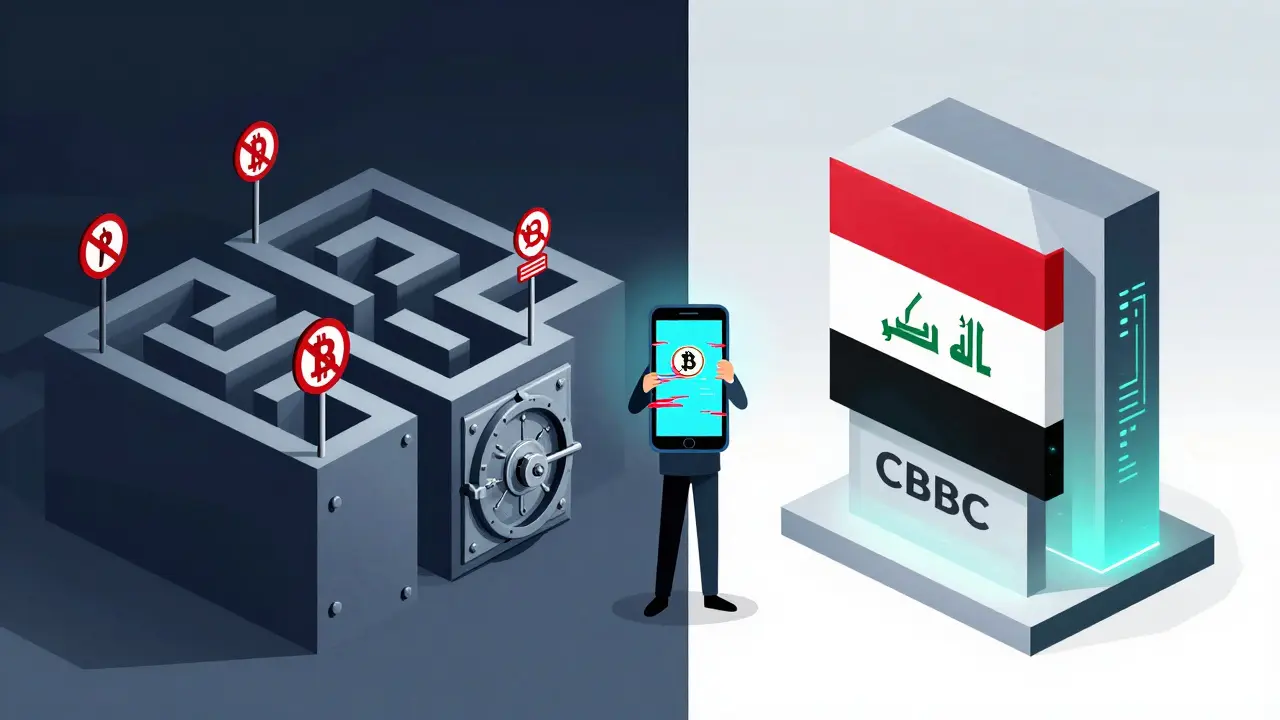
Imagine trying to send money to a friend abroad, but every digital path is blocked. That is the reality for anyone in Iraq who wants to use cryptocurrency. The Central Bank of Iraq has maintained one of the strictest bans on digital assets in the world. If you are looking to trade Bitcoin or Ethereum here, you are operating in a legal gray zone that carries serious risks.
This isn't just about old rules; it is an active, enforced policy. As of 2026, Iraq remains one of only ten countries with a complete prohibition on cryptocurrency transactions. But while private coins are banned, the government is quietly building its own digital currency. Understanding this split between banning your crypto and issuing their own is crucial for anyone dealing with Iraqi finance.
The Legal Wall: Why Crypto Is Banned in Iraq
To understand the restrictions, you have to look at the specific laws. The cornerstone of this ban is CBI Circular No. (125/5/9), issued on November 22, 2021. This document didn't just suggest caution; it explicitly prohibited all supervised financial institutions-including banks, non-bank intermediaries, and electronic payment providers-from touching virtual assets.
Here is what that means for you:
- No Legal Tender Status: Cryptocurrencies are not recognized as money in Iraq. You cannot legally demand payment in Bitcoin for goods or services.
- Institutional Ban: Banks cannot process crypto-related transactions. If they detect such activity, they must block it.
- Payment Card Prohibition: A follow-up directive in March 2022 specifically banned using payment cards and e-wallets for speculative trading or crypto purchases.
The Central Bank justified this by citing three main fears: market volatility, consumer protection issues, and the risk of financial crimes like money laundering. They aligned these rules with Financial Action Task Force (FATF) recommendations, aiming to stop terrorist financing. In short, the state views decentralized crypto as a threat to national financial stability.
The Enforcement Gap: Theory vs. Reality
On paper, the ban is absolute. In practice, it is messy. While banks are strictly monitored, individual users often operate in the shadows. There is no specific law that criminalizes merely *holding* Bitcoin on your personal phone, but using it for transactions can trigger Anti-Money Laundering (AML) investigations.
This creates a dangerous ambiguity. You might buy crypto on a peer-to-peer platform, thinking you are safe because no bank was involved. However, if those funds are traced back to illicit activities, or even just large unexplained transfers, you face legal exposure. The enforcement against individuals is inconsistent, which doesn't mean it's safe-it means it's unpredictable.
Informal trading networks still exist. Just like in other restrictive nations, underground markets thrive where regulation fails. But unlike in China, where massive adoption persists despite bans, Iraq’s formal financial system shows virtually zero legitimate crypto activity. The disconnect between official prohibition and actual usage leaves consumers vulnerable to scams and fraud without any regulatory recourse.
The Religious Dimension: Fatwas Against Crypto
In Iraq, finance is not just regulated by the state; it is also guided by religious authority. This adds another layer of complexity to the crypto ban. The Supreme Fatwa Authority of the Kurdistan Regional Government (KRG) issued a ruling against OneCoin in 2018.
While OneCoin was later exposed as a massive Ponzi scheme, the fatwa signaled a broader skepticism toward digital assets. Religious rulings carry significant weight in Iraqi society. When religious leaders label something as haram (forbidden) or risky due to its speculative nature, it influences public behavior beyond what laws can achieve. This cultural resistance makes widespread adoption of decentralized cryptocurrencies even harder than in secular jurisdictions.

The Pivot: Iraq’s Own Digital Currency (CBDC)
Here is the twist: while the Central Bank bans your crypto, it wants to issue its own. In March 2025, Mazhar Mohammed Saleh, financial advisor to the Iraqi Prime Minister, announced that the Central Bank Digital Currency (CBDC) project was moving forward.
The goal? To replace paper money gradually. The stated benefits include:
- Reducing cash leakage and printing costs.
- Enhancing control over financial flows.
- Tracking spending trends to combat money laundering.
- Achieving greater financial inclusion.
This is not Bitcoin. It is a centralized digital version of the Iraqi dinar. The government retains full control. Every transaction is visible to the state. For a country struggling with liquidity-where deposited funds account for only 8.8% of the total money supply-this offers a way to tighten its grip on the economy. But for citizens, it raises serious privacy concerns.
| Feature | Private Cryptocurrency (e.g., Bitcoin) | Iraqi CBDC (Planned) |
|---|---|---|
| Status in Iraq | Banned / Illegal | Under Development (State-Controlled) |
| Control | Decentralized (No single owner) | Centralized (Central Bank of Iraq) |
| Privacy | Pseudonymous (Harder to trace) | Fully Transparent (Government tracks all) |
| Risk | High Volatility, Scams | Surveillance, Loss of Financial Freedom |
| Use Case | Cross-border, Speculation | Domestic Payments, Budget Control |
Why Liquidity Crises Drive These Policies
You cannot separate crypto policy from Iraq’s economic struggles. The country faces severe liquidity constraints. Monthly budgetary needs range between 18 and 20 trillion dinars, yet there isn't enough cash flow to sustain the system comfortably.
This scarcity led to the 2020 devaluation of the Iraqi dinar, shifting from 1,182 to 1,450 dinars per dollar. Prices surged, and public discontent grew. In this environment, the government fears capital flight. If people could easily convert dinars to stablecoins or Bitcoin, the state would lose control over monetary policy. The ban is partly a defensive move to keep money inside the traditional banking system, where the Central Bank can monitor and manage it.

Human Rights and Surveillance Concerns
The push for a CBDC is not just economic; it is political. The Human Rights Foundation rates Iraq as an 'Electoral Autocracy' with low scores for civil liberties (4.38/10) and financial freedom. Critics warn that a state-controlled digital currency could expand surveillance capabilities significantly.
If every transaction is recorded on a government database, dissenters could be financially penalized. Given that commentary on controversial topics sometimes leads to arrest or salary docking, the ability to track spending patterns poses a real threat to personal freedom. Legal analysts argue that Iraq risks creating a 'legal vacuum' where crypto is neither legitimized nor effectively deterred, exacerbating financial integrity risks while potentially enabling authoritarian control.
What Should You Do?
If you are in Iraq or dealing with Iraqi entities, the advice is clear: avoid private cryptocurrencies. The legal framework is hostile, and the lack of consumer protection means you have no recourse if you are scammed. Using informal P2P networks exposes you to AML risks and potential legal trouble.
Instead, focus on the formal banking system, despite its inefficiencies. Keep an eye on the CBDC rollout. When it launches, it will likely become the primary method for digital payments. Until then, the safest route is to stick to fiat currency and traditional channels. The era of wild west crypto trading in Iraq is over; the age of state-controlled digital finance is beginning.
Is it illegal to hold Bitcoin in Iraq?
There is no specific law that criminalizes merely holding cryptocurrency on a personal device. However, using it for transactions, trading, or exchanging it for fiat currency through financial institutions is strictly prohibited under CBI Circular No. (125/5/9). Engaging in these activities can lead to legal complications under Anti-Money Laundering laws.
When will Iraq launch its own digital currency?
As of mid-2026, the Central Bank of Iraq is in the research and development phase for its Central Bank Digital Currency (CBDC). Announcements in March 2025 indicated a move toward gradual implementation to replace paper currency, but no specific launch date has been finalized. It will be a state-controlled version of the Iraqi dinar.
Can I use my bank card to buy crypto in Iraq?
No. A directive issued in March 2022 explicitly prohibits the use of payment cards, e-wallets, and other financial instruments for speculative trading or cryptocurrency transactions. Banks are required to block such activities.
Why did Iraq ban cryptocurrency?
The Central Bank cited risks related to financial crimes, market volatility, and consumer protection. Additionally, the ban helps prevent capital flight in a country facing liquidity crises and allows the government to maintain strict control over monetary policy and financial flows.
How does the religious stance affect crypto in Iraq?
Religious authorities, such as the Supreme Fatwa Authority of the KRG, have issued rulings against specific crypto schemes like OneCoin. This adds a cultural and ideological barrier to adoption, as many Iraqis respect religious guidance on financial matters, viewing speculative assets as risky or unethical.
Is the Iraqi CBDC private like Bitcoin?
No. The planned CBDC is fully centralized and controlled by the Central Bank of Iraq. Unlike Bitcoin, it offers no anonymity. All transactions will be visible to the government, raising concerns about surveillance and financial freedom among human rights organizations.