
If you’ve ever tried to trade crypto and got blocked by a message like "This service isn’t available in your country", you’ve hit one of the biggest real-world barriers in crypto: geographic restrictions. It’s not just about internet speed or language-it’s about where you live determining whether you can buy Bitcoin, trade Ethereum, or even access a wallet. The difference between a centralized exchange (CEX) and a decentralized exchange (DEX) isn’t just technical-it’s life-changing when it comes to who gets to trade and who doesn’t.
Why CEXs Block You Based on Where You Live
Centralized exchanges like Binance, Coinbase, or Kraken act like banks. They hold your money, verify your identity, and answer to governments. That’s why they can’t just let anyone from anywhere trade. If you’re in the U.S., you can’t trade derivatives on Binance.US. If you’re in Nigeria, you might be blocked from depositing fiat via bank transfer even if you can withdraw crypto. In Russia, some exchanges don’t allow new accounts at all. These aren’t random decisions-they’re legal requirements.Every CEX must get a license to operate in each country. In the EU, they need MiCA compliance. In the U.S., they need state money transmitter licenses. In Japan, they’re regulated by the FSA. Each license comes with rules: who you can serve, what assets you can list, and how much KYC you need. That’s why you see the same exchange offering different features in different places.
CEXs use your IP address, phone number, and government ID to lock you out. If your ID says you live in Iran, you won’t get past the sign-up screen-even if you’re traveling in Canada. Your location isn’t just a detail; it’s a gatekeeper.
How DEXs Bypass Geographic Blocks (For Now)
Decentralized exchanges like Uniswap, SushiSwap, or PancakeSwap don’t have offices, CEOs, or compliance teams. They run on code-smart contracts on blockchains like Ethereum or BSC. You don’t sign up. You don’t upload a passport. You just connect your wallet-MetaMask, Phantom, or Trust Wallet-and start trading.Because there’s no central server to shut down or license to revoke, DEXs are technically global. A user in Venezuela, Ukraine, or Saudi Arabia can trade the same tokens as someone in Germany or Canada. No IP block can stop it because there’s no single point to block. You’re not interacting with a company-you’re interacting with code.
That’s why DEXs became the go-to for people in countries with strict capital controls or banking bans. In Argentina, where the peso loses value fast, traders use DEXs to swap pesos for USDT and then trade ETH. In Turkey, where banks freeze crypto deposits, users rely on DEXs to move assets without intermediaries.
But here’s the catch: DEXs aren’t truly free from geography. They just hide it better.
The Hidden Rules: When DEXs Start Following Local Laws
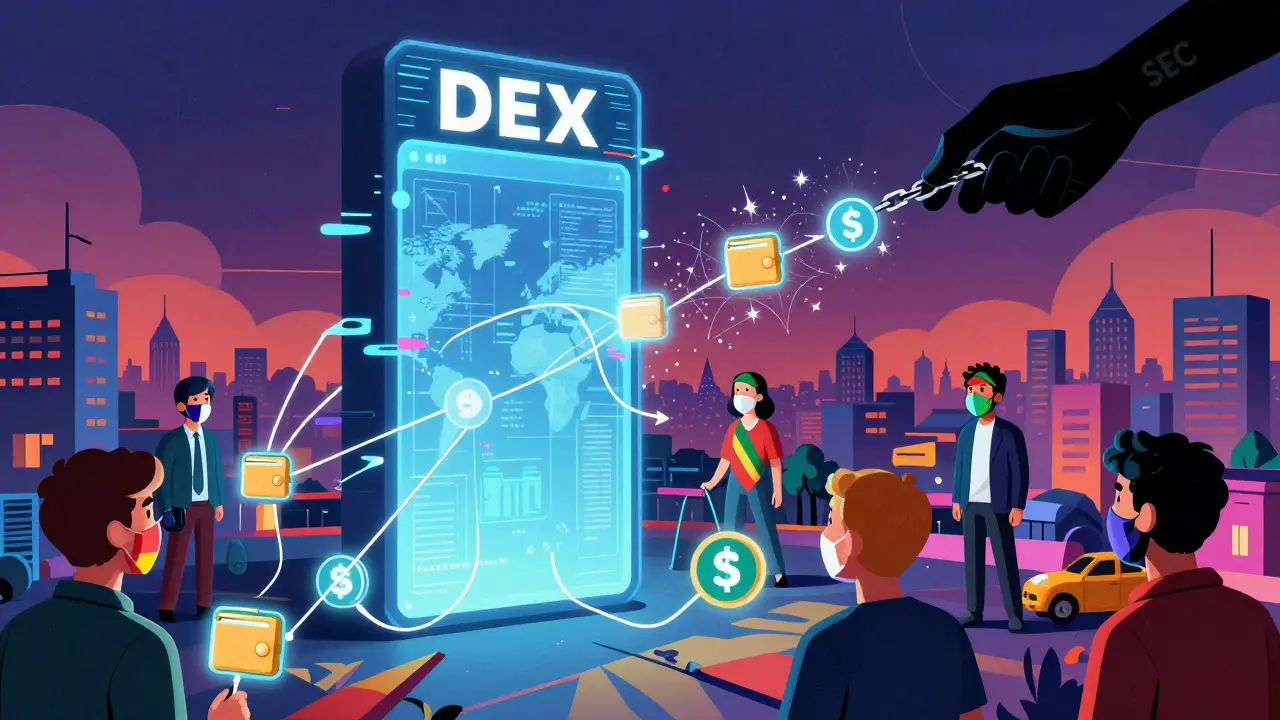
You might think DEXs are lawless. But regulators aren’t ignoring them. In 2024, the U.S. SEC started targeting DEXs that list tokens it considers unregistered securities. In the EU, MiCA now includes rules for decentralized protocols that offer services to EU residents. Some DEXs have quietly started blocking EU IPs. Others have added wallet address blacklists.It’s not the DEX code changing-it’s the infrastructure around it. Wallet providers like MetaMask now show warnings if you’re in a restricted jurisdiction. Token projects are adding geo-filters to their liquidity pools. Some DEX aggregators like 1inch now ask users to confirm they’re not in a banned country before routing trades.
This isn’t censorship-it’s survival. DEXs that ignore regulation risk being sued, fined, or having their developers targeted. So while you can still connect your wallet from anywhere, the ecosystem is slowly building walls.
Fiat On-Ramps: The Real Geographic Divide
Here’s the biggest practical difference: CEXs let you buy crypto with your bank account. DEXs don’t.If you live in a country with a stable banking system, you can deposit $500 from your Chase account, buy Bitcoin on Coinbase, and trade it on a DEX. Easy.
If you live in a country where banks don’t work with crypto companies-like Indonesia, Egypt, or parts of Africa-you can’t deposit fiat on any CEX. But you can still get crypto. You might buy it from a peer-to-peer seller on LocalBitcoins, get it via a crypto ATM, or receive it from a friend abroad. Then you connect your wallet to a DEX and trade.
So while CEXs cut you off at the door, DEXs let you walk in-if you can get the key first. That’s why DEXs are more accessible for the unbanked, but also harder to enter for beginners without crypto already in hand.
Security, Control, and Responsibility
When you use a CEX, you’re trusting them to keep your money safe. They use cold storage, insurance, and internal fraud detection. But if the government orders them to freeze your account, they will. Your funds aren’t yours-they’re on their servers.On a DEX, you control everything. Your private keys. Your wallet. Your funds. No one can freeze your account-not even the DEX team. But if you send your crypto to the wrong address, or lose your seed phrase, there’s no customer service to call. No refund. No reset.
This isn’t just about tech-it’s about who bears the risk. CEXs shift risk to regulators. DEXs shift it to you. In countries with unstable governments or weak rule of law, that’s a trade-off many prefer.
What Happens If You’re Blocked?
If you’re blocked from a CEX, you’re stuck. You can’t just switch servers. You can’t use a VPN to bypass KYC-their ID verification will still flag your documents. Your only options are: wait for the exchange to expand, find a local peer-to-peer market, or use a DEX.On a DEX, you’re not blocked by the platform-but you might be blocked by your own access. If your country bans crypto entirely (like China), even using a DEX could be risky. If your bank monitors wallet activity, you might get flagged for suspicious transfers. And if you’re using a wallet linked to your real identity (like a Coinbase wallet), you’re still traceable.
There’s no perfect solution. But DEXs give you more paths around the walls.
Which One Should You Use?
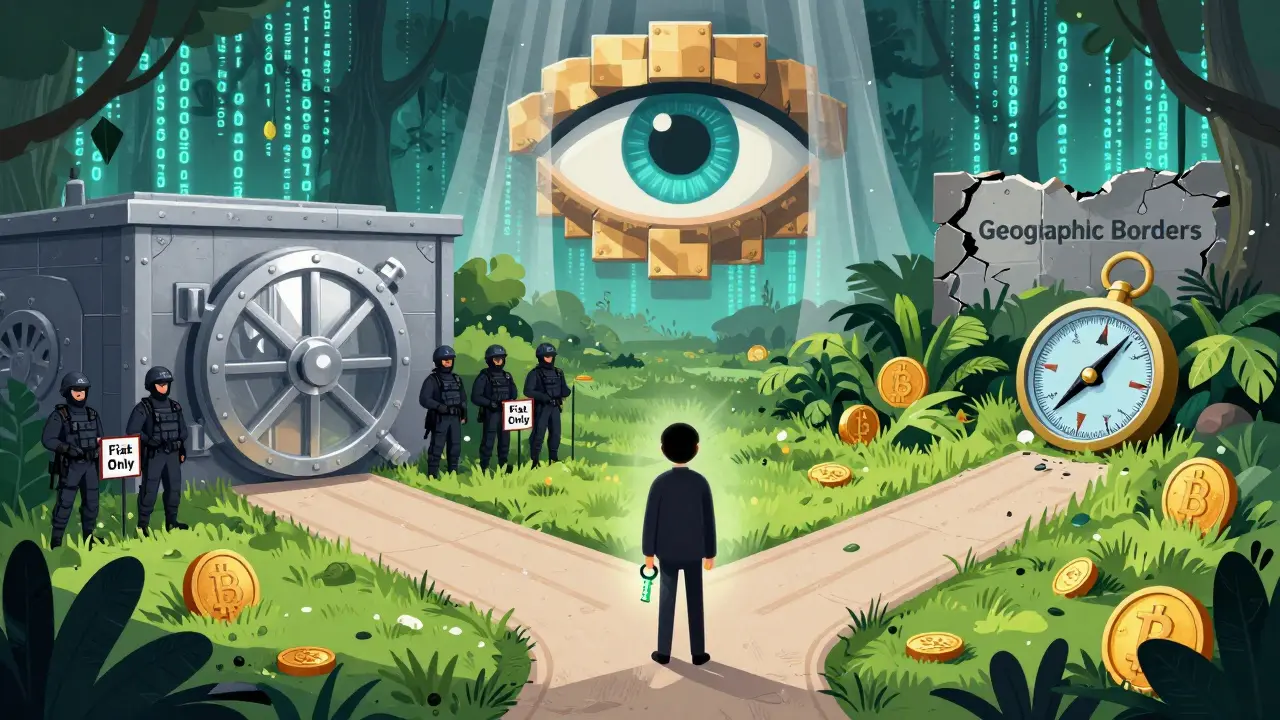
If you live in the U.S., Canada, UK, Germany, or Japan: CEXs are easier. You get fiat on-ramps, customer support, and regulated security. Use them.If you live in Nigeria, Brazil, Argentina, Turkey, or any country with banking restrictions: DEXs are your lifeline. Use them to trade, hedge, or store value.
If you’re somewhere in between-like India, South Korea, or Australia-check what’s allowed. Some CEXs offer limited services. DEXs are always there as backup.
Many savvy users do both: buy crypto on a CEX, then move it to a DEX for trading. That way, you get the convenience of fiat access and the freedom of decentralized control.
The Future: Will DEXs Become Regulated Too?
Right now, DEXs are the wild west. But regulators are catching up. We’re already seeing:- DEX aggregators adding geo-blocks for EU users
- Wallet providers showing compliance warnings
- Token issuers disabling trading for certain regions
It’s not about shutting down DEXs-it’s about making them accountable. The next big shift won’t be a ban. It’ll be a requirement: DEXs must know who’s using them, or face penalties.
That means the era of completely unrestricted DEX trading might be ending. But not because the tech failed. Because the world changed.
Bottom Line: Your Location Still Matters
Crypto promised freedom from borders. But the reality? Geography still controls access. CEXs make it obvious: you’re blocked because of where you live. DEXs hide it behind code-but the walls are still there.Your best move? Know your options. Use CEXs when you can. Use DEXs when you must. And always understand the risks-not just of hacking or scams, but of laws you didn’t ask for.
The next time you see a "not available in your country" message, don’t just close it. Ask: Is this a technical limit-or a political one?
Can I use a VPN to bypass CEX geographic restrictions?
Technically, yes-but it’s risky. CEXs use KYC to verify your identity, not just your IP. If your ID says you’re in Brazil but your VPN shows you in the U.S., the exchange may freeze your account for fraud. Some users get banned permanently. It’s not worth it unless you’re prepared to lose access.
Do DEXs really have no geographic restrictions?
No, they don’t have built-in restrictions like CEXs-but they’re not free from them. Many DEXs now work with wallet providers and token issuers that block certain regions. You might be able to connect your wallet, but you won’t be able to trade certain tokens. The restrictions are just harder to see.
Why can’t DEXs just add KYC like CEXs?
They could-but it would defeat their purpose. DEXs exist to remove intermediaries. Adding KYC turns them into CEXs in disguise. Most users choose DEXs for privacy, not compliance. That’s why the industry is resisting it-though pressure from regulators is growing.
Can I trade crypto on a DEX if my country bans it?
You can technically access it, but you’re breaking the law. Countries like China, Egypt, and Algeria have outright bans. Using a DEX there could lead to fines, asset seizure, or legal action. Just because you can doesn’t mean you should.
Are DEXs safer than CEXs for users in restricted countries?
It depends. DEXs protect you from government freezes and exchange hacks, but they put all responsibility on you. If you lose your seed phrase, your crypto is gone forever. In high-risk regions, that’s a trade-off many accept-but only if they understand how to secure their wallet properly.





Amit Kumar
December 19, 2025 AT 19:42Bro, in India we don’t even get to use Binance properly. They blocked UPI, then said "oh sorry" and vanished. Meanwhile, my cousin in Lagos is swapping USDT for BTC via Telegram traders while his bank account gets frozen every other week. DEXs? They’re the only thing keeping our wealth from turning into paper napkins. No KYC, no begging for permission - just code and courage.
Helen Pieracacos
December 21, 2025 AT 05:15Oh wow, so DEXs are "free" until the SEC whispers to MetaMask and suddenly your wallet says "sorry, you’re in a bad neighborhood." 😏 I love how we call it "survival" when it’s just corporate cowardice dressed up as decentralization.
Dustin Bright
December 22, 2025 AT 01:06fr tho… i just want to trade my eth without filling out 17 forms 😭 my bank thinks i'm laundering crypto just for buying a pizza with usdt. dexters are my only hope… even if they glitch every time i try to swap. but hey, at least they don't ask for my birth certificate 🙏
Melissa Black
December 23, 2025 AT 18:53The fundamental asymmetry lies in the ontological shift from custodial intermediation to non-custodial autonomy. CEXs externalize regulatory risk onto sovereign jurisdictions; DEXs internalize operational risk onto the individual user. This isn’t merely a UX difference-it’s a philosophical divergence in the locus of trust. The unbanked don’t want permission-they want sovereignty. And that’s why DEXs persist despite the creeping regulatory encroachment. The architecture of freedom is fragile, but it’s still alive.
Mmathapelo Ndlovu
December 24, 2025 AT 13:06Here in South Africa, we’ve been using DEXs since 2021 when banks started blocking crypto deposits. I bought my first ETH from a guy at a taxi rank who paid me in cash. Now I swap on PancakeSwap every weekend. Yeah, MetaMask sometimes says "this might be risky"… but at least no one’s freezing my account. 🤝🌍
Tyler Porter
December 24, 2025 AT 16:54Look, if you’re in a country where the money keeps losing value, you do whatever you can to survive!! DEXs aren’t perfect, but they’re the only thing standing between you and poverty!! Don’t overthink it!! Just connect your wallet and go!!
Rishav Ranjan
December 25, 2025 AT 09:09CEXs block you. DEXs don’t. Done.
Steve B
December 26, 2025 AT 06:45It is a matter of profound regret that the promise of decentralization is being eroded by the very forces it sought to transcend. One cannot help but observe that the commodification of freedom, under the guise of regulatory compliance, constitutes a quiet capitulation. The user, once sovereign, is now a data point in an algorithmic ledger of exclusion.
Sophia Wade
December 27, 2025 AT 02:29What’s truly haunting isn’t that borders still matter in crypto-it’s that we thought we’d outgrown them. DEXs were the last cathedral of digital anarchism, and now even the stained glass is being replaced with compliance banners. We didn’t lose freedom because the tech failed. We lost it because the world refused to let go of control. And now, every wallet is a potential crime scene.