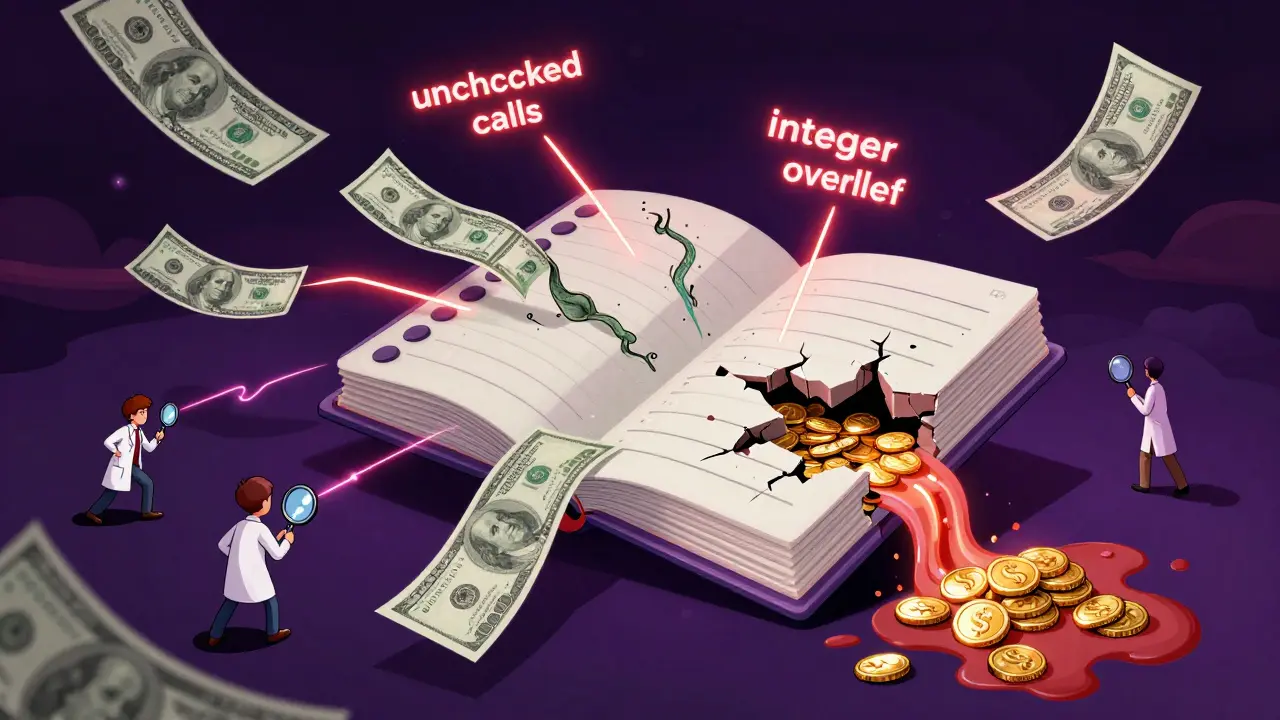
One line of flawed code can erase $60 million. That’s not fiction-it’s what happened in The DAO hack of 2016. Since then, blockchain code review has gone from an optional step to a non-negotiable requirement. Unlike traditional software, blockchain code can’t be patched after deployment. Once it’s on the chain, it’s permanent. A single logic error in a smart contract can drain wallets, break token economies, and destroy trust overnight. That’s why code review isn’t just about finding typos-it’s about survival.
Why Blockchain Code Review Is Different
Traditional code reviews focus on readability, performance, and maintainability. Blockchain code reviews? They’re about stopping attackers before they strike. The stakes are higher because blockchain systems handle real money, and once a transaction is confirmed, it’s irreversible. You can’t roll back a bug like you can with a web app. There’s no ‘undo’ button on Ethereum. According to Nethermind’s 2022 research, 73% of smart contract vulnerabilities could have been caught before deployment. That means most of the big hacks weren’t caused by unknown zero-days-they were caused by simple mistakes that someone missed during review. Common issues include integer overflows, reentrancy attacks, improper access control, and unchecked external calls. These aren’t hard to spot… if you know what to look for. And it’s not just smart contracts. Core blockchain nodes-like Ethereum’s reth client-have layers of complexity: primitives, EVM execution, consensus logic, and API communication. A flaw in the consensus layer can let malicious validators double-spend or stall the network. That’s why reviews need to go deeper than surface-level checks.The Two Approaches: Bottom-Up vs. Top-Down
There are two main ways to review blockchain code, and choosing the right one depends on your experience. The Bottom-Up Approach is best for beginners. Start small. Look at the basic data structures first-things like how addresses are stored, how transactions are encoded, or how gas limits are calculated. In Ethereum clients, this means diving intoreth-primitives. Then move up: check the EVM execution layer (reth-evm), then the consensus logic (reth-consensus), and finally the API layer (reth-engine-api). This method builds your understanding piece by piece. It’s slow, but it prevents overwhelm.
The Top-Down Approach is for seasoned reviewers. Start at the entry points-where users interact with the system. Trace how a transaction flows from the frontend API, through the smart contract, into the EVM, and finally into block validation. Think of it like a depth-first search through the code’s call graph. You’re asking: What happens if someone sends a malformed input here? What if they call this function twice in one block? This approach is faster but requires deep familiarity with the system’s architecture.
Most teams use a hybrid: start bottom-up to learn the codebase, then switch to top-down to test edge cases.
Automated Tools Aren’t Enough
You’ll hear people say, “Just run Slither or MythX.” And yes, those tools are helpful. Tools like SonarQube, Veracode, OWASP ZAP, and Burp Suite can catch obvious issues: hardcoded keys, unencrypted data, or common vulnerability patterns. But here’s the hard truth: automated scanners only find 30-40% of vulnerabilities, according to OWASP’s Code Review Guide v2. Why? Because they can’t understand intent. They don’t know if a function is supposed to allow anyone to withdraw funds or if that’s a mistake. They can’t spot a reentrancy attack hidden inside a complex state update. They miss logic flaws that only a human, thinking like an attacker, can find. Sigma Prime’s engineers warn against over-relying on automation. “Not everything can be detected using a manual tool,” they write. “But business logic errors? Those require human eyes.” LLMs like ChatGPT are getting better at reading code. But even they’re not ready to replace reviewers. Sigma Prime explicitly says: use LLMs only for initial understanding, never for final approval. Always trace the logic yourself. An LLM might say, “This looks fine,” while missing that the contract allows anyone to callwithdrawAll() after a single check.

The Must-Have Checklist
A good code review isn’t random. It follows a structured checklist. Here’s what every blockchain review should include:- Input validation: Are all user inputs sanitized? Are arrays bounded? Can someone overflow a uint256?
- Error handling: Does the contract revert cleanly? Does it leak stack traces or internal state?
- Access control: Who can call this function? Is it restricted to owners? Are roles properly enforced?
- External calls: Are calls to untrusted contracts checked for success? Is
call.value()used safely? - Reentrancy: Are external calls made before state changes? Are locks or checks-effects-interactions patterns used?
- Gas efficiency: Are loops bounded? Are storage reads minimized?
- Mathematical operations: Are additions, multiplications, and divisions using SafeMath or checked operators?
- State mutability: Are functions marked
vieworpurewhere appropriate? - Infrastructure security: Are RPC endpoints rate-limited? Is the node hardened? Are private keys stored securely?
- Data protection: Is sensitive data encrypted at rest (AES-256)? Is TDE or CLE used in databases?
Manual Review Is Non-Negotiable
Automated tools give you a starting point. But real security comes from manual review. And manual review means tracing execution paths, simulating attacks, and asking “what if?” over and over. For smart contracts, use fuzz testing. Tools like Foundry or Echidna generate random inputs and see if the contract breaks. This catches edge cases unit tests miss-like sending 10^18 wei to a function that expects 10^15. Or calling a function with a zero address. Or triggering a state change during a reentrant call. Integration testing matters too. A contract might be secure in isolation, but break when interacting with a token, oracle, or liquidity pool. Test the whole flow: deposit → swap → withdraw. What happens if the oracle feeds bad data? What if the token’s transfer function fails? And don’t forget formal verification. Nethermind predicts that by 2025, 60% of high-value contracts will use it. Tools like Certora or KeY prove mathematically that a contract meets its spec under all possible conditions. It’s not magic-it’s heavy lifting. But for DeFi protocols handling hundreds of millions, it’s worth the cost.Teamwork and Timing
Code reviews shouldn’t be a one-person job. Even the best engineers miss things. Use pair reviews: two people, one screen, one checklist. Encourage questions. If someone says, “This seems weird,” don’t brush it off. Dig in. Timing matters too. Reviews should happen early-before merge requests are approved. Dev.to’s 2023 analysis found that reviews are most effective when developers aren’t in “flow state.” Pushing code late at night? Delay the review until the next day. Rushed reviews lead to missed bugs. Set deadlines. A 500-line contract should take no more than 3 days to review. A 5,000-line node client? Plan for 2-4 weeks. Blockchains are complex. Don’t pretend you can review them in an hour.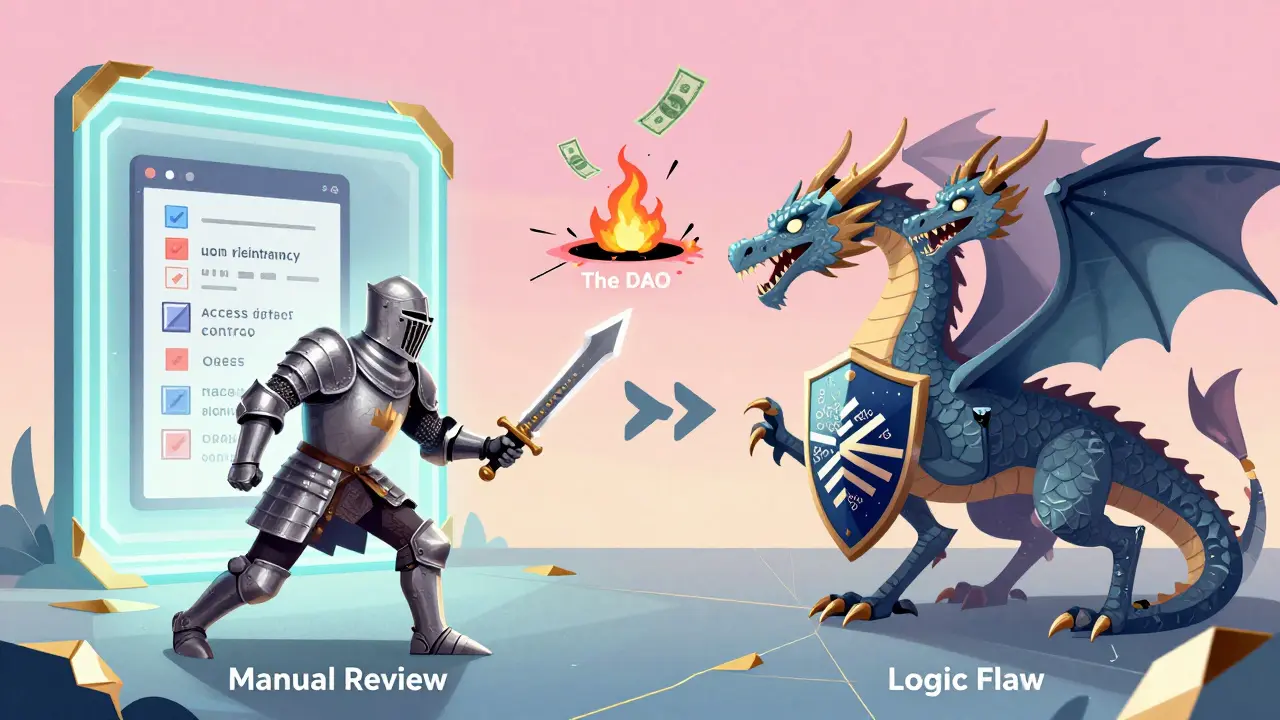
Industry Trends and Regulation
The market is catching up. The blockchain security industry was worth $1.14 billion in 2022. By 2032, it’s projected to hit $15.68 billion. Why? Because institutions won’t touch blockchain without audits. Nethermind’s 2022 survey found 87% of enterprise blockchain projects now require third-party audits before mainnet launch. Regulation is accelerating too. The EU’s MiCA regulation, effective in 2024, mandates standardized security assessments for crypto service providers. That includes code reviews. In the U.S., state regulators are starting to follow suit. More teams are integrating reviews into CI/CD pipelines. OWASP reports that 63% of blockchain teams now run automated scanners on every commit. That’s good. But it’s not enough. Human review still happens after CI-usually before deployment.What Happens If You Skip It?
The $610 million Poly Network hack? Caused by a missing access check in a cross-chain bridge. The $60 million The DAO hack? A reentrancy bug in a simple withdrawal function. The $100 million Harmony Bridge exploit? A compromised validator key and no multi-sig fallback. These weren’t “unforeseeable” attacks. They were preventable. All of them. Skipping code review doesn’t save time. It just delays disaster. And when disaster hits, the cost isn’t just financial-it’s reputational. Users won’t come back. Investors will flee. Partners will walk away.Where to Start
If you’re new to blockchain code review:- Learn the basics of Ethereum and Solidity. Understand how the EVM works.
- Study the OWASP Top 10 for Smart Contracts.
- Run Slither on open-source contracts like Uniswap or Aave. Read the findings.
- Practice with Capture The Flag (CTF) challenges like those on Ethernaut or Damn Vulnerable DeFi.
- Join a review team. Even if you’re just checking off items on a checklist, you’ll learn.
Is automated scanning enough for blockchain code review?
No. Automated tools like Slither or MythX can catch common vulnerabilities, but they miss 60-70% of critical issues-especially logic errors, reentrancy flaws, and improper access controls. Human review is essential to understand intent and trace execution paths. Relying only on automation is like locking your front door but leaving your windows open.
How long should a blockchain code review take?
It depends on complexity. A simple ERC-20 token might take 1-2 days. A DeFi protocol with multiple contracts and oracles? Plan for 5-10 days. Core blockchain nodes like Ethereum clients can take 2-4 weeks. Speed matters, but rushing leads to missed bugs. Always allow time for follow-up reviews after fixes.
Can blockchain code be patched after deployment?
Generally, no. Once deployed on a public blockchain, smart contracts are immutable. You can’t edit the code. The only options are to deploy a new contract and migrate users, or use a proxy pattern (which adds complexity and its own risks). This is why pre-deployment review is non-negotiable-there’s no backup plan.
What’s the difference between a smart contract audit and a code review?
A smart contract audit is a formal, often third-party review focused on security and compliance. A code review is a broader, ongoing process that can be done internally and includes not just security, but also architecture, efficiency, and maintainability. Audits are typically done once before launch. Code reviews happen throughout development. Think of audits as a final checkpoint and code reviews as daily quality control.
Do I need to know how consensus algorithms work to review blockchain code?
If you’re reviewing core node software (like Geth or reth), yes. Consensus logic handles block validation, finality, and fork resolution. A flaw here can crash the network or enable double-spending. If you’re only reviewing smart contracts on top of Ethereum, you don’t need to dig into Proof-of-Stake mechanics-but you should understand how the EVM interacts with the consensus layer, especially for state transitions and block timestamps.
Are LLMs like ChatGPT safe to use in blockchain code reviews?
Only as a starting point. LLMs can explain code, suggest fixes, or generate test cases. But they don’t understand context. They’ve been trained on public code that may contain vulnerabilities. Sigma Prime and other top firms warn: never trust an LLM’s security assessment. Always verify every suggestion manually by tracing execution paths and checking state changes.
What’s the most common mistake in blockchain code reviews?
Assuming the code works because it passed tests. Many teams write unit tests that cover happy paths but miss edge cases. The biggest failures happen when attackers exploit conditions the developer never thought of-like a zero-value transfer, a reentrant call during a state update, or an oracle feed returning stale data. Always ask: “What’s the worst thing someone could do here?”
How do I know if my code review process is effective?
Track your findings. If you’re consistently catching high-severity bugs before deployment, your process is working. If you’re only finding syntax errors or style issues, you’re missing the point. Also, compare your results with third-party audits. If an external auditor finds nothing you missed, you’re doing well. If they find major flaws you overlooked, it’s time to upgrade your training and checklist.







Megan O'Brien
December 23, 2025 AT 23:40Look, I get the checklist. But let’s be real-most teams run Slither, slap on a ‘Reviewed’ sticker, and call it a day. The real hacks? They’re in the gaps between the bullet points. You think someone’s gonna manually trace reentrancy in a 5k-line EVM module? Nah. They’ll just pray the auditors caught it.
And don’t even get me started on ‘formal verification.’ That’s a luxury for protocols with $500M TVL. Most startups are still figuring out how to deploy without burning gas.
Bottom line: we’re treating blockchain security like it’s aerospace engineering. It’s not. It’s cowboy coding with real money. And we’re all just waiting for the next trainwreck.
Kevin Karpiak
December 25, 2025 AT 00:36China and Russia don’t care about your ‘checklist.’ They’re building sovereign chains with zero audits. Your ‘non-negotiable’ review process is just Western privilege dressed up as security. If you’re not deploying fast, you’re already dead.
Stop pretending blockchain is banking. It’s not. It’s a wild west sandbox. Fix the code? No. Outpace the hackers. That’s the only real best practice.
Amit Kumar
December 25, 2025 AT 14:12Bro, I just reviewed a DeFi contract in Bangalore last week-3 engineers, 2 coffee breaks, 1 whiteboard covered in arrows-and we caught a reentrancy bug that Slither missed because the function used a custom modifier called ‘onlyWhenMoon’ 😂
Automated tools? They’re like GPS in the Himalayas-useful until you hit a cliff. Human eyes? They see the whole mountain. I’ve seen devs miss a zero-check because they were ‘in flow.’ That’s why we do pair reviews at 10 AM, not 2 AM after chai.
And yes, LLMs help explain Solidity syntax-but when I asked ChatGPT why ‘transferFrom’ could be exploited with a negative allowance, it said ‘probably a typo.’ I nearly threw my laptop.
Real security isn’t in tools. It’s in the guy who asks, ‘Wait, what if someone calls this before the owner sets the key?’ That’s the question that saves millions.
Helen Pieracacos
December 26, 2025 AT 08:35Wow. So the solution to billion-dollar hacks is… more checklists? How revolutionary. Next you’ll tell us to wear seatbelts in spaceships.
Let me guess-you also think ‘view’ and ‘pure’ functions are magic shields against reentrancy. Cute. The DAO didn’t get hacked because someone forgot to mark a function as ‘pure.’ It got hacked because someone thought ‘if balance > 0’ was enough to stop a recursive call.
Stop treating code review like a compliance checkbox. It’s not. It’s a war room. And if you’re not screaming at your code, you’re not trying hard enough.
Naman Modi
December 26, 2025 AT 13:24LOL at ‘formal verification.’ You people are so desperate to feel safe you’ll pay $200k to prove your contract doesn’t crash when someone sends -1 wei. Meanwhile, the real exploit? A dev hardcoded the admin key in the frontend JS. 🤦♂️
Stop over-engineering. Most hacks happen because someone reused a library from GitHub without checking the license, let alone the code. Your checklist doesn’t matter if your CI/CD pipeline is running on a rented VPS with SSH password auth.
Fix the basics first. Then we’ll talk about EVM opcodes.
Sybille Wernheim
December 26, 2025 AT 22:21YES. YES. YES. This is the most real thing I’ve read all year. I’m a junior dev and I just reviewed my first smart contract last week-I used the checklist, ran Slither, and then sat with a senior for 2 hours tracing a single function. We found a gas leak that would’ve cost $2M in wasted fees.
Don’t wait for a hack to start caring. Start today. Review one line. Ask one dumb question. That’s how you become the person who stops the next $60M disaster.
Also, coffee helps. Lots of coffee.
Cathy Bounchareune
December 28, 2025 AT 16:54Blockchain code review is like being a detective in a heist movie where the vault is made of glass and the alarm is on mute. You’ve got a checklist, sure-but the real magic is in the quiet moments when you stare at a line of code and whisper, ‘Why does this even exist?’
I once spent three days on a 12-line function because it called a contract with no validation. Turns out, it was meant to be a test function. The dev forgot to delete it. One line. One missed comment. $40M in potential loss.
It’s not about tools. It’s about obsession. About seeing the ghost in the machine before it ghosts your users’ funds.
And yes-I still use emoticons. 💀