
DeFi vs Traditional Banking Cost Calculator
Calculate Your Savings
See how much you could save by using DeFi instead of traditional banking based on your financial habits.
Note: Traditional banking fees include $12.50 monthly maintenance, $2.50 ATM fees, and $25 wire transfer fees. DeFi fees are gas fees only. Interest rates are based on 2025 industry averages.
Imagine you’re in rural India, with no bank nearby and no paperwork to prove you own land. But you have a smartphone and a $50 crypto wallet. In 20 minutes, you’re earning 12% interest on your USDC - no credit check, no branch visit, no waiting. That’s DeFi. Now picture the same person walking into a local bank branch, asked for three forms of ID, a utility bill, and a minimum deposit of $250. They leave empty-handed. This isn’t science fiction. It’s the real divide between DeFi and traditional banking in 2025.
Who Controls Your Money?
In traditional banking, your money lives inside the bank’s system. They hold it. They lend it. They decide if you can withdraw it. You get a login, a password, and a promise that your funds are safe - backed by FDIC insurance up to $250,000 in the U.S., or ₹5 lakh in India. But you don’t own the keys. If the bank freezes your account for suspicious activity, you’re stuck waiting for a human to review your case - sometimes for weeks. DeFi flips this. You hold your own money in a wallet like MetaMask or Trust Wallet. The private key? That’s your ID, your password, your bank manager - all in one. No one can freeze it. No one can block you. But if you lose that key? Gone. Forever. There’s no customer service line to call. No recovery option. It’s like owning cash in your pocket - great until you drop it down a sewer.Speed: Seconds vs. Days
Sending money across borders with traditional banking? Expect 3 to 5 business days. SWIFT networks move slowly. Fees? Often 5-7% of the transfer amount. A $1,000 remittance might cost you $70 in hidden charges. DeFi? On Polygon or Solana, it takes under a second. On Ethereum, maybe 15 seconds. Fees? Around $1.20 on Polygon. No middlemen. No intermediaries. No delays. That’s why a farmer in Bihar can send money to his daughter in Bangalore in under a minute - and at a fraction of the cost. Traditional banks still can’t match that.Fees: Hidden vs. Transparent
Traditional banks charge you for almost everything. Monthly maintenance: $12.50 average. ATM withdrawals: $2-$3. Wire transfers: $25-$30. Overdrafts? $35. These fees add up - and they’re buried in fine print. A 2025 Bankrate survey found that 62% of U.S. bank customers didn’t realize they were paying for a “non-sufficient funds” fee until it hit their account. DeFi fees? They’re public. You see the gas fee before you click “confirm.” On Ethereum, it’s $3.50 during normal traffic. On Polygon? $1.20. On Stellar? $0.0001. No surprises. No hidden charges. You pay for the network, not a bank’s profit margin.Interest Rates: 0.45% vs. 8.7%
Your savings account earns 0.45% APY? That’s the 2025 average from the FDIC. Inflation? 3.1%. You’re losing money just by keeping it there. On Aave, you can lend USDC and earn 8.7% APY. On Compound, 7.9%. On decentralized lending platforms, yields are set by supply and demand - not by a boardroom. That’s not a gimmick. It’s math. More people want to borrow stablecoins? Rates go up. More people deposit? Rates drop. It’s a free market. Traditional banks don’t offer that. They pay you pennies to hold your money so they can lend it out at 8-12%.
Transparency: Public Ledger vs. Black Box
Every transaction on DeFi is on-chain. Public. Permanent. Anyone can look up how much ETH is in a wallet. How much USDC was lent on Aave. How many people are using Uniswap. It’s all there. You don’t need to trust a bank - you can verify it yourself. Traditional banking? Everything’s opaque. You get a monthly statement. You see your balance. But you have no idea how your money is being used. Is it loaned to a fossil fuel company? A private prison? A hedge fund? You can’t tell. And you can’t audit it.Security: Code vs. Courts
DeFi has been hacked. A lot. The Poly Network breach in 2021 stole $610 million. In 2022-2024, $3.2 billion was lost to smart contract exploits, according to Chainalysis. But here’s the twist: 38% of those hacks were reversed within 24 hours because the community spotted the flaw and coordinated a fix. The code is public. The flaw gets patched. The money gets returned - sometimes. Traditional banking? No code exploits. No smart contract bugs. But fraud happens. Account takeovers. Phishing. Identity theft. And here’s the kicker: 97% of those cases are resolved by the bank. The FDIC reimburses you. You get your money back. No drama. No community vote. No GitHub pull request. Just a call to customer service.Access: 5.4 Billion People vs. Paperwork
The World Bank estimates 5.4 billion people globally are unbanked or underbanked. Why? No ID. No address proof. No credit history. No minimum deposit. Traditional banking shuts them out. DeFi doesn’t care. You don’t need a passport. You don’t need a Social Security number. You just need internet. A phone. And a crypto wallet. In Kenya, Nigeria, and Indonesia, millions are using DeFi for the first time. A Nairobi user told CoinMetro: “I went from no banking access to earning 9.1% APY in 20 minutes.” That’s not a feature. That’s a revolution.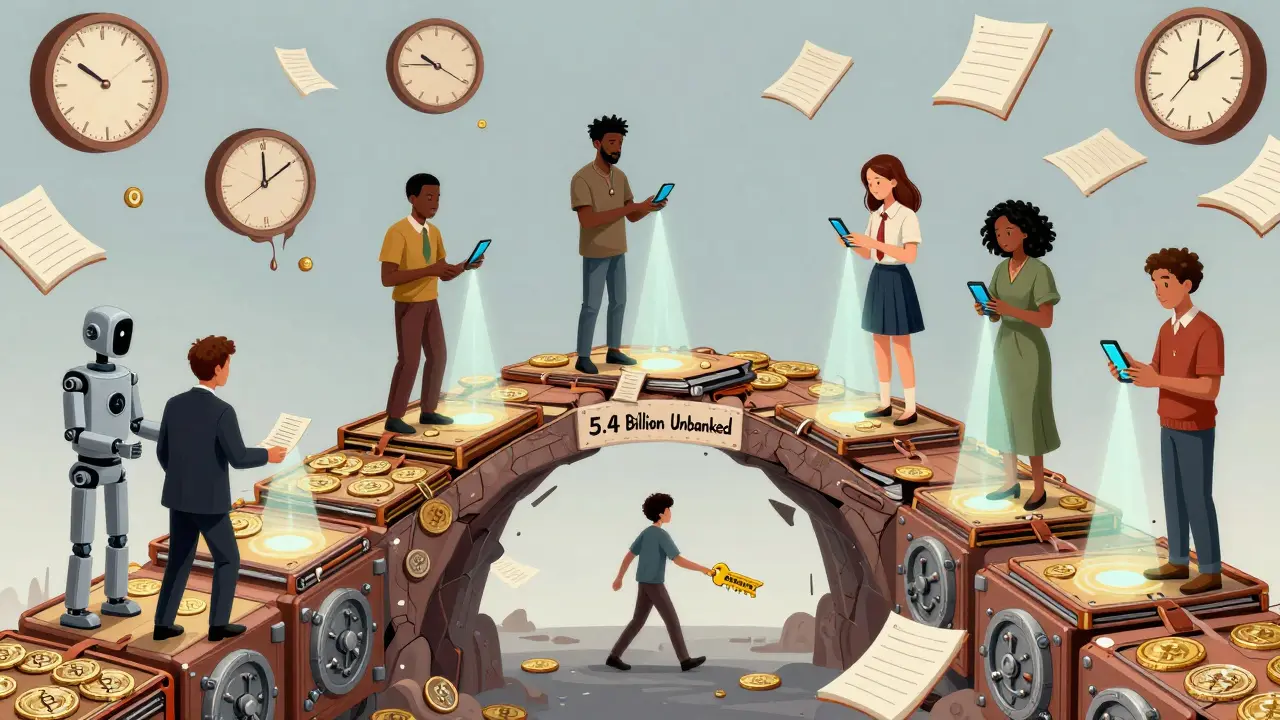
Innovation: Weekly Updates vs. 18-Month Cycles
Uniswap v4 launched in April 2025. It introduced “hook contracts” - a new way to customize how trades work. That’s a major upgrade. And it took months, not years. Traditional banks? They’re still rolling out mobile check deposit. A new feature? Takes 18 months on average, per McKinsey’s 2025 report. Why? Compliance. Regulations. Legal reviews. Risk committees. Bureaucracy. DeFi moves at startup speed. Banking moves at government speed.Who’s Using It?
The data is clear: 57% of Millennials and Gen Z prefer DeFi apps over mobile banking, according to a 2025 survey cited by former SEC Chair Gary Gensler. Why? Transparency. Higher returns. No paperwork. No waiting. But here’s the catch: 68% of new DeFi users say it’s too complex. Managing seed phrases. Understanding slippage. Gas fees. Wallet security. It’s not user-friendly - yet. Traditional banking? You open an account in 15 minutes. You’re done.The Future: Convergence, Not Replacement
DeFi isn’t killing banking. It’s forcing it to change. JPMorgan’s Onyx processed $1.2 trillion in blockchain transactions in 2024. Singapore’s Project Guardian is testing DeFi protocols under regulated supervision. The U.S. approved 17 national banks to custody crypto. Banks aren’t ignoring DeFi. They’re learning from it. DeFi’s $247 billion in total value locked sounds huge. But it’s just 4.8% of traditional banking’s $19.7 trillion in assets. It’s not replacing banks - it’s giving people another option. One that’s faster, cheaper, and more open. The real question isn’t “Which is better?” It’s “What do you value?” If you want safety, legal recourse, and someone to call when things go wrong - stick with your bank. If you want control, speed, higher yields, and to bypass the system - DeFi is waiting. The future isn’t DeFi or banking. It’s DeFi and banking. And the people who win? The ones who use both.Is DeFi safer than traditional banking?
It depends on what you mean by “safe.” DeFi has no government insurance, so if you lose your private key or get hacked, you’re out of luck - 97% of DeFi fraud victims get no reimbursement. But DeFi’s code is open, so flaws can be found and fixed quickly. Traditional banking has FDIC insurance and legal protections - if your account is stolen, they’ll refund you. But banks can freeze your account, and you have no control over your money. DeFi is safer for control. Banking is safer for recovery.
Can I use DeFi without crypto?
No. DeFi runs on blockchain networks, which require cryptocurrency. You need to buy crypto (like ETH, USDC, or MATIC) on an exchange like Coinbase or Kraken, then send it to a wallet like MetaMask. Once you have crypto, you can use DeFi apps to lend, borrow, or trade. You can’t access DeFi with just a bank account or credit card.
Why do DeFi interest rates change so much?
DeFi rates are set by supply and demand - not by a bank’s board. If lots of people want to borrow USDC, the interest rate goes up. If more people deposit USDC, the rate drops. On Aave, rates can swing from 5% to 12% in weeks. Traditional banks set fixed rates based on the Federal Reserve’s benchmark - they don’t react to real-time demand. DeFi is a marketplace. Banking is a monopoly.
Is DeFi legal?
In most countries, yes - but regulations vary. The U.S. doesn’t ban DeFi, but the SEC is cracking down on tokens it considers securities. India taxes crypto gains at 30% and adds 1% TDS on every trade. The EU is moving toward MiCA rules to regulate DeFi platforms. You can use DeFi legally, but you must report earnings and follow local tax laws. Ignorance isn’t a defense.
What’s the easiest way to start with DeFi?
Start with a stablecoin like USDC on Polygon. Buy USDC on Coinbase, send it to a MetaMask wallet, then go to Aave or Compound. Deposit your USDC and earn interest. The gas fees are low, the interface is simple, and you’re not exposed to crypto volatility. Once you’re comfortable, explore lending or swapping tokens. Don’t try to stake ETH or use leverage until you understand how it works.
Do I need to pay taxes on DeFi earnings?
Yes. In the U.S., earning interest on DeFi is taxable income. Every time you receive interest, it’s a taxable event based on the USD value at that time. Trading tokens? Capital gains. Even swapping one stablecoin for another can trigger a tax. Tools like Koinly or CoinTracker help track this. Most people don’t report it - but the IRS is auditing DeFi users now.
Can traditional banks ever compete with DeFi on speed and fees?
Not without changing their entire model. Banks are built on legacy systems, compliance layers, and physical infrastructure. They can’t match DeFi’s 15-second settlement or $0.15 fees. But they’re trying: JPMorgan’s Onyx uses blockchain for interbank payments. Some banks now offer crypto custody and interest-bearing accounts. But they’ll always be slower and more expensive. DeFi’s advantage isn’t tech - it’s structure. Banks are institutions. DeFi is software.
Is DeFi just for rich people or tech experts?
No. DeFi’s biggest users are in Africa and Southeast Asia - places where banks are inaccessible. A farmer in Bihar, a vendor in Nairobi, a student in Manila - they’re using DeFi because it’s the only option. You don’t need to be rich. You just need $10 and a phone. The barrier isn’t money. It’s knowledge. And that’s changing fast as apps get simpler.






Shane Budge
December 4, 2025 AT 21:40DeFi’s real win isn’t the yield-it’s the dignity. No one asking for your birth certificate to let you save money.
sonia sifflet
December 5, 2025 AT 00:46Stop romanticizing DeFi. In rural India, most people don’t even know what a private key is. You think a farmer in Bihar can recover a lost seed phrase? He’s lucky if he knows how to charge his phone. This isn’t empowerment-it’s elitist fantasy wrapped in blockchain jargon.
Regina Jestrow
December 6, 2025 AT 20:52I used to think DeFi was just for crypto bros-until my aunt in Ohio lost her savings because she clicked a phishing link on her iPad. She’s 72. She doesn’t know what ‘slippage’ means. And now she’s terrified of anything digital. DeFi’s transparency doesn’t help when you don’t understand the rules. The real innovation isn’t the protocol-it’s making it safe for non-tech people. Right now, it’s a minefield with a 12% reward.
Lore Vanvliet
December 8, 2025 AT 04:48Oh wow, another Silicon Valley fairy tale. Let me guess-next you’ll tell me that American banks are evil because they have branches? I’ve lived in 12 countries. In Europe, you get instant transfers, zero fees, and real customer service. DeFi is a glorified gambling den with extra steps. And don’t even get me started on ‘community fixes’ after $600M hacks. That’s not innovation-that’s chaos with a whitepaper. If you want freedom, move to Switzerland. Don’t pretend crypto is justice.
Scott Sơn
December 8, 2025 AT 13:27DeFi isn’t just changing finance-it’s burning the whole damn building down and rebuilding it with Ethereum bricks. Traditional banks are dinosaurs with PowerPoint decks and a 1987 mindset. Meanwhile, a 16-year-old in Manila is earning more on Aave than her dad makes at his factory job. The old system isn’t broken-it’s dead. And the only thing sadder than a bank that won’t adapt? A person who still thinks FDIC insurance is a moral high ground. Wake up. The future’s got a MetaMask and zero patience.
Cristal Consulting
December 8, 2025 AT 18:09Shane nailed it. The dignity point? That’s everything. But Sonia’s right too-most people don’t know what a seed phrase is. So here’s the real challenge: we need DeFi apps that feel like WhatsApp, not a crypto terminal. Start with USDC on Polygon. Use a custodial wallet if you’re scared. Learn slowly. You don’t have to be a coder to benefit. And if you’re still using a bank that charges $35 for an overdraft? You’re paying for the privilege of being treated like a problem. Try DeFi for a week. Worst case? You lose $1 in gas. Best case? You finally feel like you own your money.