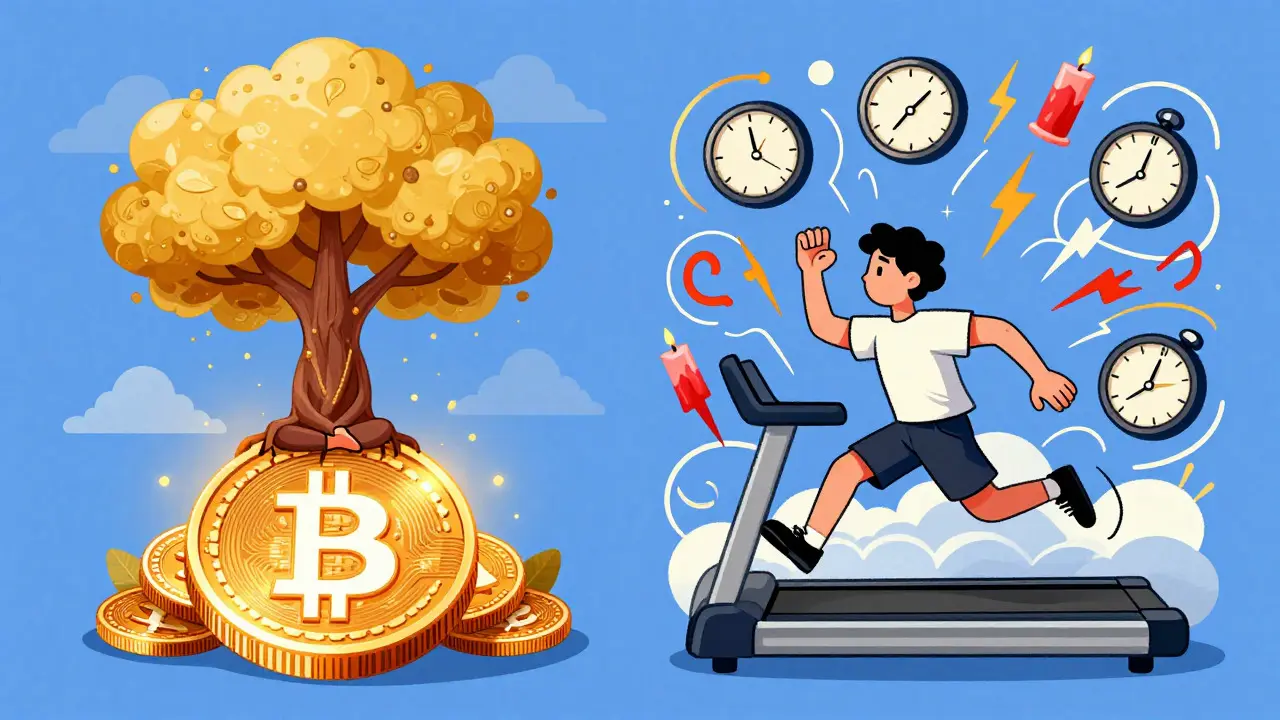
Imagine you bought Bitcoin in 2017. Did you sell it at the peak? Or did you just hold on and ignore the noise? If you held, you likely rode out a brutal crash to watch your investment multiply over time. If you traded actively, you might have captured quick profits but also faced the stress of timing the market perfectly. This is the core debate in cryptocurrency investing: HODL is a long-term passive investment strategy where investors hold assets regardless of short-term price fluctuations, originating from a 2013 misspelled forum post meaning 'Hold On for Dear Life'. On the other side, we have active trading, which involves constantly buying and selling to profit from short-term volatility.
In 2026, with the crypto market maturing and regulatory frameworks like MiCA in Europe taking shape, choosing between these two approaches isn't just about luck-it's about understanding your personality, resources, and risk tolerance. One size does not fit all. Let’s break down exactly how these strategies work, their real-world costs, and which one might actually make you money without losing your mind.
The HODL Philosophy: Patience as a Profit Engine
The term HODL started as a joke. In December 2013, a user named GameKyuubi posted on Bitcointalk during a market crash, titled "I AM HODLING." He meant to type "holding," but the typo stuck. It evolved into an acronym: Hold On for Dear Life. Today, it represents a disciplined approach to investing that ignores daily price swings.
The logic behind HODL is simple. Cryptocurrencies like Bitcoin is the first decentralized digital currency launched in 2009 by Satoshi Nakamoto and Ethereum is a blockchain platform supporting smart contracts and decentralized applications, launched in 2015 are volatile. Prices can drop 20% in a week or surge 50% in a month. A HODLer accepts this volatility as the cost of entry for long-term growth. They believe that over years, the underlying technology and adoption will drive prices up.
This strategy requires minimal time. You check your portfolio weekly or monthly, not hourly. The main technical requirement is security. You need to store your coins safely, often using hardware wallets like Ledger or Trezor. According to data from Chainalysis, about 67% of Bitcoin supply was held for over 12 months as of mid-2023, showing that long-term conviction is the dominant behavior among serious investors.
However, HODLing is not without risks. The biggest danger is picking the wrong asset. While Bitcoin has survived multiple crashes, many altcoins have gone to zero. For example, TerraUSD collapsed in 2022, wiping out billions. A HODLer must do basic research to ensure the project has strong fundamentals before committing capital. Additionally, emotional resilience is key. Watching your portfolio drop 50% can be terrifying, even if you know it will recover eventually.
Active Trading: Chasing Volatility
If HODLing is marathon running, active trading is sprinting. Active traders aim to profit from short-term price movements. This includes day trading (opening and closing positions within 24 hours), swing trading (holding for days or weeks), and scalping (making tiny profits on minute-by-minute changes).
This approach demands significant time and skill. Traders spend hours analyzing charts, reading news, and monitoring order books. They use technical analysis tools like candlestick patterns, volume indicators, and moving averages. Platforms like TradingView are essential for visualizing these trends. The goal is to buy low and sell high repeatedly, compounding gains over time.
The potential rewards can be high. During volatile periods, such as Bitcoin’s 2021 bull run, active traders captured multiple 20-30% swings within months. However, the failure rate is staggering. Studies cited by ZebPay indicate that only 1-4% of day traders consistently profit in the long term. Most lose money due to fees, slippage, and emotional decision-making.
Costs are a major hurdle. Every trade incurs exchange fees, typically ranging from 0.1% to 0.6% on platforms like Binance. If you trade ten times a day, those fees add up quickly. Plus, there’s slippage-the difference between the expected price and the executed price-which eats into profits during fast-moving markets.
Risk management is critical. Active traders use stop-loss orders to limit losses, usually setting them at 1-5% per trade. But discipline is hard to maintain. Revenge trading-trying to win back losses immediately-is a common pitfall. A 2023 Binance research paper found that 85% of traders admit to revenge trading after a loss.
Head-to-Head Comparison: Costs, Time, and Stress
To decide which strategy fits you, let’s compare them across key dimensions. Here is a breakdown of how HODL and active trading differ in practice:
| Factor | HODL Strategy | Active Trading |
|---|---|---|
| Time Commitment | Low (hours per month) | High (hours per day) |
| Technical Skill Required | Basic (wallet setup, security) | Advanced (chart analysis, indicators) |
| Transaction Costs | Low (few trades) | High (frequent fees + slippage) |
| Stress Level | Low (ignore daily noise) | High (constant decision pressure) |
| Profit Potential | Long-term growth (years) | Short-term gains (days/weeks) |
| Success Rate | Higher for beginners | Low (<5% consistent winners) |
| Tax Complexity | Simpler (fewer events) | Complex (every trade is taxable) |
Notice the tax complexity. In the US, the IRS treats every crypto transaction as a taxable event. If you trade actively, you generate dozens of capital gains reports annually. HODLers deal with fewer transactions, making tax filing much easier. This administrative burden is often overlooked by new traders.
Who Should Choose Which Strategy?
Your choice depends on your lifestyle, experience, and goals. Here’s a quick guide to help you decide.
Choose HODL if:
- You have a full-time job and limited free time.
- You are new to cryptocurrency and want to learn basics first.
- You prefer lower stress and can handle occasional large drawdowns.
- You believe in the long-term value of established projects like Bitcoin or Ethereum.
- You want to avoid complex tax reporting.
Choose Active Trading if:
- You can dedicate several hours daily to market analysis.
- You have experience with technical analysis and risk management.
- You thrive under pressure and enjoy fast-paced decision-making.
- You have extra capital specifically allocated for high-risk investments.
- You are comfortable tracking every trade for tax purposes.
The Hybrid Approach: Core and Satellite
Does it have to be one or the other? Not necessarily. Many experienced investors use a hybrid model called the "core-satellite" strategy. As noted by industry analyst Michael van de Poppe, successful portfolios often allocate 70-80% of funds to long-term HODL positions (the core) and 20-30% to active trading (the satellite).
This approach balances stability with opportunity. Your core holdings provide steady growth and reduce overall portfolio volatility. Your satellite portion allows you to test trading skills and capture short-term gains without risking your entire net worth. If your trading loses money, your core still grows. If your trading wins, you boost returns significantly.
For example, you might hold Bitcoin and Ethereum as your core assets. Then, you use a smaller portion of your portfolio to trade emerging altcoins or participate in DeFi yield farming. This diversification mitigates the risk of total loss while keeping you engaged with the market.

Practical Steps to Get Started
Whether you choose HODL, trading, or both, execution matters. Here’s how to start safely.
For HODLers:
- Select Strong Assets: Focus on cryptocurrencies with proven track records, large communities, and clear utility. Avoid hype-driven tokens with no fundamentals.
- Secure Your Storage: Use a hardware wallet like Ledger Nano X or Trezor Model T. Never leave large amounts on exchanges, which can be hacked or frozen.
- Use Dollar-Cost Averaging (DCA): Instead of buying all at once, invest fixed amounts regularly (e.g., $100 weekly). This smooths out price volatility and reduces timing risk.
- Ignore Noise: Unfollow social media accounts that pump fear or greed. Check your portfolio monthly, not daily.
For Active Traders:
- Learn Technical Analysis: Study support/resistance levels, trendlines, and volume indicators. Free resources on YouTube and TradingView tutorials are a great start.
- Start Small: Begin with a small amount of capital you can afford to lose. Treat it as tuition for learning.
- Set Strict Rules: Define entry and exit points before every trade. Use stop-loss orders to limit downside. Never move your stop-loss further away to avoid realizing a loss.
- Track Everything: Use software like Koinly or CoinTracker to log every transaction. This simplifies tax season immensely.
- Manage Emotions: Take breaks after losses. Revenge trading destroys accounts faster than bad market conditions.
Future Outlook: What Does 2026 Mean for These Strategies?
The crypto landscape continues to evolve. Regulatory clarity is increasing, especially with the EU’s Markets in Crypto-Assets (MiCA) regulation coming into full effect. This benefits HODLers by reducing uncertainty around institutional adoption. For traders, leverage limits and stricter KYC rules may constrain some strategies but create a fairer playing field.
Technological advancements also play a role. Staking-as-a-service now offers yields of 3-8% on assets like Ethereum, enhancing HODL returns without selling. Meanwhile, AI-powered analytics tools help traders identify patterns faster, though they don’t guarantee success. Algorithmic trading is capturing more market share, making it harder for retail traders to compete on speed.
Despite these changes, human behavior remains constant. Fear and greed still drive markets. Whether you hold for years or trade for minutes, understanding your own psychology is the most valuable tool you have.
Is HODL better than active trading for beginners?
Yes, HODL is generally better for beginners. It requires less time, lower technical skill, and reduces emotional stress. Beginners often lack the discipline and knowledge needed for consistent active trading, leading to higher failure rates. Starting with HODL allows new investors to learn market dynamics without risking significant capital through frequent mistakes.
Can I combine HODL and active trading?
Absolutely. The core-satellite strategy combines both approaches. Allocate 70-80% of your portfolio to long-term HODL positions in stable assets like Bitcoin or Ethereum. Use the remaining 20-30% for active trading to capture short-term opportunities. This balances risk and reward, providing stability while allowing for aggressive growth attempts.
What are the biggest risks of active trading?
The biggest risks include high transaction fees, emotional decision-making, and time commitment. Fees can erode profits quickly, especially with frequent trades. Emotional errors like revenge trading or FOMO (fear of missing out) lead to poor entries and exits. Additionally, active trading demands hours of daily screen time, which can impact work-life balance and mental health.
How do taxes affect HODL vs active trading?
Taxes are simpler for HODLers because they have fewer transactions. Each sale or swap triggers a capital gains event. Active traders generate dozens or hundreds of taxable events annually, requiring meticulous record-keeping. Using tax software is highly recommended for traders to avoid penalties and simplify reporting. HODLers typically report once a year when they finally sell.
Which strategy works best in a bear market?
HODLing is often safer in bear markets for long-term believers. While prices drop, holding avoids realizing losses. Active trading can be profitable in bear markets through short-selling or trading volatility, but it carries higher risk due to unpredictable wicks and sudden reversals. Many active traders get liquidated during sharp downturns, whereas HODLers wait for the next bull cycle.
Do I need a hardware wallet for HODLing?
It is highly recommended. Hardware wallets like Ledger or Trezor store your private keys offline, protecting them from online hacks. Exchanges can be compromised or freeze withdrawals. For long-term holdings, self-custody via a hardware wallet provides the highest level of security. Software wallets are convenient but vulnerable to phishing and malware attacks.
What percentage of active traders actually make money?
Studies suggest only 1-4% of active day traders consistently profit over the long term. Most lose money due to fees, slippage, and emotional errors. Swing traders may have slightly better success rates, but still face significant challenges. This highlights the difficulty of beating the market consistently and supports the case for passive strategies for most retail investors.
How does staking enhance the HODL strategy?
Staking allows you to earn yield on your held assets without selling them. For proof-of-stake networks like Ethereum, you can stake your coins to secure the network and receive rewards, typically 3-8% annually. This turns passive holding into an income-generating activity, improving overall returns while maintaining your long-term position. However, be aware of lock-up periods and slashing risks.


Nick Darring
August 7, 2026 AT 01:07Look, I know everyone loves to throw around the HODL mantra like it's some kind of sacred religious text written by Satoshi himself, but let's be real for a second here because I feel like we're all pretending that just sitting on your hands and ignoring reality is actually a 'strategy' rather than just pure laziness disguised as wisdom. I mean, think about it, if you bought Bitcoin in 2017 and held through the entire bear market of 2018, 2019, and 2020, you probably lost your mind at least three times over watching your portfolio get sliced and diced while your friends who traded actively were buying new cars or paying off their student loans with those quick flips they made during the volatility spikes. It's not just about patience, it's about having a stomach of steel and a complete disregard for the opportunity cost of capital sitting idle when you could potentially be compounding those gains through disciplined swing trading or even just simple yield farming on stablecoins during the downtime. People forget that active trading isn't just about gambling; it's about skill acquisition, risk management, and understanding market microstructure, which are actual learnable skills unlike the lottery-ticket mentality of hoping an altcoin goes to the moon because the community is loud enough on Twitter. So maybe instead of shaming traders for trying to outsmart the market, we should acknowledge that for some people, the psychological toll of watching a 50% drawdown without doing anything is actually worse than the stress of making trades, and that's a perfectly valid reason to choose activity over passivity depending on your personal risk tolerance and financial goals.
Eden Tadesse
August 8, 2026 AT 23:04i totally agree with nick about the psycholigcal toll its so hard to just sit there and do nothing when the charts are going crazy every single day i find myself checking my phone every 5 mins even though i tell myself not too
Prudence Flemming
August 9, 2026 AT 11:51the dichotomy between action and inaction is false; both are forms of engagement with the market's chaotic entropy. hodling is merely a bet on the network effect's long tail distribution while trading is a bet on short term variance exploitation. neither is superior inherently only contextually dependent on one's temporal horizon and cognitive bandwidth allocation. jargon aside the core issue is emotional regulation which most lack regardless of strategy choice.
Matt Kay
August 11, 2026 AT 03:53boring article. fees kill traders anyway. just buy btc and sleep.
Dave Kjendal
August 13, 2026 AT 00:02You guys are missing the point entirely. It's not about being lazy or smart, it's about survival. Most traders are gamblers, not investors. They chase pumps and dump bags. Real wealth comes from holding assets that have intrinsic value or strong network effects. Trading is a zero-sum game where the house always wins via fees. Unless you are a quant bot or have inside info, you are losing money slowly. Stop deluding yourself with technical analysis charts that look like tea leaves.
Aryan MISHRA
August 14, 2026 AT 15:34Incorrect assumptions. Technical analysis provides probabilistic edges, not certainties. Volatility is friend to the agile trader. MiCA regulations favor institutional players who trade actively. Retail must adapt or perish. Stop-losses mitigate downside risk effectively. Discipline is key. Market structure dictates strategy. Adaptability ensures longevity. Ignorance breeds loss.
Ryan Robinson
August 16, 2026 AT 11:48i mean honestly i do a mix of both. i hodl my main stack like btc and eth cause i believe in the tech long term but i take small profits on the alts when they pump. its not all or nothing man. why fight it? just chill and do what feels right for ur wallet size.
Earl Kott65
August 18, 2026 AT 00:27Oh, look at us, playing god with our portfolios! 🤡 One minute you're a genius trader, the next you're crying in the shower because you missed a stop loss. 😂 Just remember, whether you HODL or trade, the market doesn't care about your feelings. Stay humble, stay liquid, and for the love of Satoshi, don't leverage more than you can afford to lose! 💸📉🚀