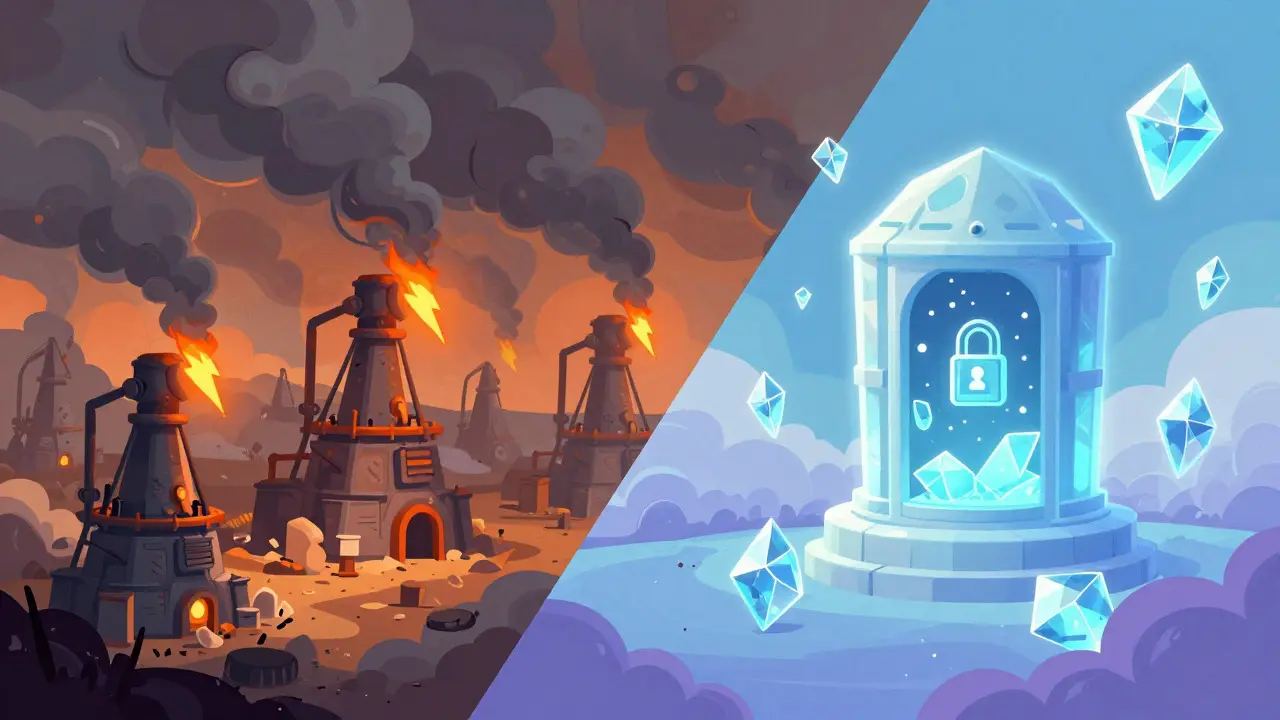
Imagine a world where securing a global financial network doesn't require burning through megawatts of electricity to solve math puzzles. That is exactly what Proof of Stake is doing right now. It has fundamentally shifted how blockchains operate by swapping out energy-hungry hardware for economic commitment. Instead of competing with raw computational power, participants lock up their digital assets to earn the right to validate transactions. This change isn't just a technical tweak; it is a complete reimagining of how we trust decentralized systems.
The core idea is simple but powerful. In traditional systems, you need expensive machines to participate. In staking-based networks, you just need to hold and commit your coins. This shift eliminates the massive carbon footprint associated with older models while opening the door for everyday users to participate in network security. Let’s break down exactly how this mechanism works and why it is becoming the standard for modern blockchain infrastructure.
From Hash Power to Economic Commitment
To understand the replacement, you first have to look at what is being replaced. In Proof of Work, miners race to solve complex cryptographic puzzles. The first one to find the solution gets to add a new block to the ledger and collects a reward. This process is inherently competitive and wasteful. It requires specialized hardware, like ASICs, and consumes enormous amounts of energy. Bitcoin remains the most famous example of this model, where the difficulty of the puzzle adjusts automatically to keep block times consistent, regardless of how much computing power joins the network.
Staking flips this logic on its head. There are no puzzles to solve. Instead, the network selects validators based on how much cryptocurrency they are willing to risk. Think of it as a deposit. You lock up your tokens as collateral to prove you have skin in the game. If you act honestly, you get paid. If you cheat or go offline, you lose part of that deposit. This transforms validation from a race of speed into a contest of trust and capital allocation. The barrier to entry drops significantly because you don’t need to buy industrial-grade servers; you just need access to the network and some crypto to hold.
The Mechanics of Validator Selection
You might wonder how the network decides who validates the next block. It isn’t simply "whoever has the most money wins." That would lead to extreme centralization. Most modern PoS protocols use a combination of stake amount and randomization. The more you stake, the higher your probability of being selected, but luck still plays a role. This ensures that even smaller validators have a chance to earn rewards over time.
In Ethereum, which transitioned to PoS in 2022, the requirement is specific: you must stake exactly 32 ETH to run a solo validator node. This threshold was chosen to balance security with accessibility. However, not everyone wants to manage their own node. That is where staking pools come in. By joining a pool, multiple users combine their funds to meet the 32 ETH minimum. The pool then distributes rewards back to members based on their contribution. This setup allows anyone, regardless of technical skill or wallet size, to participate in the consensus process.
Rewards and Penalties: The Economic Engine
Why do people stake? Mostly for the passive income. Validators earn rewards in the form of newly minted tokens and transaction fees. These rewards are proportional to your stake. If you stake 10% of the total supply, you generally earn around 10% of the available rewards for that period. It functions similarly to interest on a savings account, but with the added benefit of helping secure a global network.
However, there is a catch. The system relies on penalties to keep validators honest. This process is called Slashing. If a validator goes offline for too long, they might miss a few blocks and lose a small portion of their rewards. But if they actively try to cheat-like signing two different blocks for the same slot-they face slashing. This means a significant chunk of their staked collateral is burned and removed from circulation. For bad actors, the cost of attacking the network is incredibly high. To successfully double-spend or corrupt the ledger, an attacker would need to control 51% of the total staked supply. Buying and locking up half of all the tokens in existence is far more expensive and difficult than buying enough mining rigs to overpower the network's hash rate.
| Feature | Proof of Work (Mining) | Proof of Stake (Staking) |
|---|---|---|
| Primary Resource | Computational Power (Hash Rate) | Economic Stake (Locked Crypto) |
| Energy Consumption | Very High | Low |
| Hardware Requirements | Specialized ASICs/GPUs | Standard Computer/Server |
| Security Barrier | Cost of Electricity + Hardware | Cost of Acquiring 51% Token Supply |
| Punishment Mechanism | None (Orphaned Blocks) | Slashing (Loss of Stake) |

Environmental Impact and Efficiency
One of the biggest selling points for staking is its environmental profile. Mining is often criticized for its carbon footprint. Data centers housing thousands of mining rigs consume enough electricity to power small cities. When that electricity comes from fossil fuels, the environmental cost is substantial. Staking removes the need for continuous, high-load computation. Validators only need to be online to sign blocks occasionally. This reduces energy consumption by orders of magnitude. For many new blockchain projects, this efficiency is a key reason they choose PoS from day one rather than retrofitting it later.
This efficiency also translates to lower operational costs for the network. Without the need to subsidize miners with high block rewards to cover their electricity bills, PoS networks can often maintain healthier tokenomics. The inflation rate can be tuned more precisely, and the focus shifts from rewarding energy expenditure to rewarding network participation. This makes the system more sustainable in the long run, both environmentally and economically.
Centralization Risks and Network Health
No system is perfect, and PoS has its own set of challenges. Critics argue that staking can lead to centralization among large whale holders. If a few entities control a massive percentage of the staked supply, they effectively control the network's decision-making power. This is a risk that PoW networks also face, where large mining pools dominate block production. However, the dynamics are different. In PoW, centralization is driven by access to cheap electricity and efficient hardware. In PoS, it is driven by capital accumulation.
There is also the issue of liquidity. When you stake your tokens, they are locked up. You cannot sell them or move them elsewhere until you unstake, which often involves a waiting period. This can reduce the circulating supply of a token and potentially affect its price volatility. Networks design these unbonding periods carefully to balance security with user flexibility. Too short, and attackers can quickly enter and exit the market. Too long, and users feel trapped. Finding the right balance is a constant engineering challenge for protocol developers.

Who Should Participate?
So, how do you actually get involved? It depends on your technical comfort level and the size of your portfolio. If you are a developer or a tech-savvy user with at least 32 ETH (or the equivalent in other chains), running a solo validator gives you full control. You manage your own keys, monitor your uptime, and collect rewards directly. It is a serious responsibility, though. One server crash could mean missed rewards, and a software bug could trigger slashing.
For most people, delegated staking is the way to go. You can stake directly through your exchange, like Coinbase or Kraken, or join a community-run pool. This is the easiest route. You click a button, your tokens are locked, and rewards are credited to your wallet periodically. You don’t need to worry about server maintenance or software updates. The trade-off is that you trust the pool operator or exchange to handle the technical side correctly. Always check the fee structure of any pool before joining, as fees can range from 0% to 10% or more of your rewards.
Frequently Asked Questions
Is staking safer than holding in a cold wallet?
It depends on the implementation. Solo staking requires you to keep your keys secure and your node online, which introduces some technical risk. Delegated staking via an exchange adds counterparty risk, meaning you trust the exchange not to fail. Holding in a cold wallet has zero smart contract or node downtime risk but offers no yield. For most users, the risk of staking is low if they use reputable providers, but it is not zero.
What happens if I want to sell my staked crypto?
You usually have to wait for an unbonding period. On Ethereum, this is currently around 3 days, but it varies by chain. During this time, your tokens are locked and cannot be transferred. Once the period ends, they return to your active balance, and you can sell them freely. Some exchanges allow you to trade staked positions immediately, but this is a separate product from direct protocol staking.
Can I lose all my money by staking?
Losing everything is rare but possible in extreme scenarios. Slashing typically penalizes you a percentage of your stake, not 100%. However, if the underlying project fails or the token value crashes, you lose your investment regardless of staking status. Additionally, if a malicious validator attacks the network and succeeds, the entire economic model could be compromised, though this is theoretically very difficult to achieve due to the high cost of acquiring 51% of the supply.
Does staking make me a shareholder in the company?
Not exactly. Staking gives you voting rights in some governance-focused chains, allowing you to influence protocol upgrades. It also secures the network. However, it does not give you equity in a traditional corporate sense. You don't get dividends from profits; you get rewards from inflation and fees. It is closer to being a bondholder in a decentralized bank than a shareholder in a corporation.
Which cryptocurrencies support staking?
Many major networks use Proof of Stake. This includes Ethereum, Cardano, Polkadot, Solana, Tezos, and Avalanche. Almost every new Layer 1 blockchain launched in the last five years uses some form of PoS or a hybrid model. Before staking, always verify that the specific coin you hold supports native staking and check the current annual percentage yield (APY) offered by the network.




Matt Reckdenwald
August 26, 2026 AT 11:30Oh, the sheer poetry of it all!
It’s like watching a chaotic storm settle into a calm, economic tide.
We are no longer burning the world to keep the lights on; we are simply holding our breath and waiting for the block.
There is something so profoundly human about locking up your assets as a promise of honesty.
It feels less like technology and more like a social contract written in code.
I find myself moved by the idea that trust can be quantified in tokens.
The old way was a race of speed, a frantic scramble for power.
This new way is a dance of patience and capital.
It makes you wonder if we’ve finally found the right rhythm for digital society.
The energy savings aren't just numbers; they are a relief to the planet's weary lungs.
It’s a dramatic shift from brute force to subtle influence.
And yet, isn't there a melancholy in losing the rugged individualism of the miner?
Perhaps we have traded one kind of hero for another.
But still, the vision is beautiful, even if the execution is complex.
Let us hope this tide carries us to safer shores.
Emmanuel Ogbomo
August 28, 2026 AT 07:54Interesting perspective on the transition.
One must consider the philosophical implications of shifting from labor to capital.
In PoW, effort was the currency of security.
In PoS, wealth becomes the barrier to entry.
Does this not create a different kind of inequality?
Yet, the efficiency gains are undeniable.
The reduction in carbon footprint is a significant moral argument.
It aligns with the broader trend toward sustainable infrastructure.
The mechanism of slashing acts as a powerful deterrent against malfeasance.
It forces validators to act with integrity, or suffer financial loss.
This creates a self-regulating ecosystem.
However, the centralization risk remains a valid concern.
If a few whales control the majority of stake, do they control the narrative?
Perhaps.
But then again, mining pools were never truly decentralized either.
The dynamics change, but the fundamental challenge of distribution persists.
A thoughtful piece on the mechanics.
Melanie Armijo
August 29, 2026 AT 02:19So basically, we stopped solving math problems and started betting on each other?
That’s actually kind of profound when you think about it.
It’s like the blockchain version of 'skin in the game'.
You don’t get to cheat unless you’re willing to lose your own money.
It feels much more honest than just having the fastest computer.
I always thought mining was a bit wasteful, like running a car engine just to stay warm.
Now it’s more like parking your car in a spot and getting paid for the space.
Simple enough for me to understand.
And the environmental angle really seals the deal for me.
Less electricity means less guilt when I buy my next coffee.
Just glad we’re moving away from the noisy rigs.
My neighbor had one, and it sounded like a jet engine taking off every morning.
Peace and quiet now, thanks to staking.
Pretty neat evolution of the tech, honestly.
Makes the whole thing feel a lot more mature.
Who knew economics could be so cool?
Laine Van Sickle
August 30, 2026 AT 03:45yeah sure its great until the big guys take over
its just another way for rich people to make more money while we watch
who cares about the environment if the whales are happy
i dont trust these exchanges anyway they will hack us eventually
just hold your coins in cold storage and be done with it
staking is just a fancy word for gambling
you could lose it all if the network goes down
and what happens when the price drops? you cant sell
so you are stuck with worthless tokens
thats why i stayed away from all this hype
mining was at least honest work
this is just lazy capitalism
but whatever maybe im just jealous
Ashwin Bhandurge
August 30, 2026 AT 18:36This is a fantastic breakdown!
The clarity here is inspiring.
For those on the fence, remember: action beats anxiety.
Staking is not just a yield strategy; it is a commitment to the network's health.
Think of it as planting a tree whose shade you may not sit in, but which others will enjoy.
The barriers to entry are lower than ever before.
You do not need to be a genius to participate.
You just need to be informed and consistent.
The rewards are modest, but the impact is global.
Every block validated is a brick in the foundation of decentralized finance.
Do not let the complexity scare you.
Start small.
Learn the unbonding periods.
Understand the slashing risks.
Then step into the arena.
The future belongs to those who secure it.
Let’s build something lasting together.
Stay motivated and keep learning.
The journey is just beginning.
Embrace the change.
You have got this!
Teresa Watson
August 31, 2026 AT 01:57oh please save us from the environmentalists
they only care about the trees because they want to stop progress
mining was better because it was real work
now its just rich people sitting around counting their coins
who decided that locking up money is a good idea?
it reduces liquidity and thats bad for the market
we should be spending not hoarding
this whole staking thing is just a tax on the poor
the whales love it because they have nothing else to do
meanwhile the rest of us are left with high fees
typical
just give me my bitcoin back
no more nonsense
back to basics
simple and effective
not this complicated mess
im tired of reading articles like this
just tell me where to put my money
and stop pretending its charity
its greed dressed up in green clothing
Nadia Christian
August 31, 2026 AT 04:48Finally, some sensible discussion about infrastructure!
It is crucial that we support American innovation in this space.
Many of the key protocols are built by US-based teams.
We must ensure that our regulatory framework supports this growth.
Staking provides a stable yield without the volatility of trading.
It is a responsible way for citizens to engage with digital assets.
The energy savings are a bonus for our national grid.
We should be proud of this technological leap.
It puts the US ahead of competitors who still rely on outdated models.
Let us champion these efforts.
Strong networks require strong participants.
We must protect our interests in this new economy.
Do not let foreign entities dominate our blockchain landscape.
Support domestic validators.
Keep the benefits here at home.
It is about time we took ownership of this future.
Great article, very informative.
Let’s move forward together.
America first, always.
jeffry jones
September 1, 2026 AT 16:33Good overview.
Key point: consensus mechanism dictates security model.
PoS shifts threat vector from compute to capital.
51% attack cost scales with token valuation.
Higher price = higher attack cost.
Self-reinforcing security loop.
Watch out for validator set size.
Small sets increase centralization risk.
Large sets improve decentralization but complicate coordination.
Ethereum’s 32 ETH threshold is a deliberate design choice.
Balances accessibility vs. node overhead.
Pools mitigate individual risk but add counterparty dependency.
Slashing conditions must be clear and fair.
Ambiguity leads to disputes.
Clear rules foster trust.
Overall, a solid foundation for modern DeFi.
Keep an eye on governance parameters.
They evolve over time.
Adaptability is key.
Stay tuned.
Aaliyah Simpson
September 2, 2026 AT 18:38classic corporate spin
they say its efficient but its just a way to print more tokens
inflation is hidden in the rewards
you think you are earning interest but its just dilution
the whales know this and they are laughing at us
they lock up their supply to keep the price up
then they dump on the little guys
its a rigged game
why would anyone trust a system run by anonymous developers?
one day they will change the rules and wipe out our stakes
happened before
will happen again
keep your distance
the only safe place is under a mattress
or in gold
crypto is just a casino with extra steps
and staking is just the house edge
they win no matter what
we are just pawns
wake up people
before it is too late
trust no one
especially not the ones selling you the dream
Paul Needham
September 4, 2026 AT 06:35Sure, and I'm sure the moon is made of cheese.
Another overly optimistic take on a flawed system.
Let's not pretend that slashing doesn't punish honest mistakes.
One server hiccup and you're paying for it.
Meanwhile, the pool operators skim off the top.
It's a pyramid scheme with better branding.
At least miners got to flex their hardware.
Now we just flex our wallets and pray.
Brilliant analysis, really.
Couldn't agree more with the skepticism.
Or wait, did I miss that part?
Whatever, it's fine.
Carry on.