
Yield farming sounds simple: deposit your crypto, earn rewards, and watch your balance grow. But if you’ve ever looked at a DeFi dashboard and seen a 120% APY on one pool and 45% on another, you know there’s more to it than just picking the highest number. Yield farming returns aren’t just about the rate - they’re about compounding, risks, fees, and whether you’re even getting what the platform says you are.
APR vs APY: The Most Important Distinction
The first thing you need to understand is the difference between APR and APY. Many platforms use them interchangeably, but they’re not the same - and mixing them up can cost you money. APR (Annual Percentage Rate) is the simple interest rate you earn over a year. It doesn’t account for compounding. If you put $1,000 into a pool with 20% APR and don’t reinvest your rewards, you’ll get $200 after a year. Simple math: $1,000 × 0.20 = $200. APY (Annual Percentage Yield) includes compounding. That means your rewards are automatically reinvested, and you earn interest on your interest. If that same 20% rate compounds daily, your actual return jumps to about 22.1%. Why? Because every day, your balance grows slightly, and the next day’s reward is calculated on that new, higher balance. Most DeFi protocols compound rewards daily or even multiple times per day. So when you see a 70% APY, you’re not just earning 70% once a year - you’re earning a fraction of that every single day, and it builds on itself. That’s why a 40% APY with daily compounding can outperform a 60% APR with no compounding.How to Actually Calculate Your Returns
You don’t need to be a math wizard to estimate your returns. Here’s how to do it step by step:- Find the APY (not APR) of the liquidity pool. Check the protocol’s dashboard or a trusted aggregator like DeFiLlama.
- Know your initial deposit. Let’s say you deposit 5,000 USDC.
- Use this formula: Final Amount = Principal × (1 + APY/compounding frequency)compounding frequency × time.
$5,000 × (1 + 0.70/365)365 = $5,000 × 2.014 = $10,070 That’s a 101% return in one year - not 70%. But wait - that’s just the math. Reality is messier.
What’s Not Included in the APY Number
The APY you see on a DeFi app is often just the base yield. It doesn’t tell you the full story. Here’s what’s missing:- Governance token rewards: Many pools pay extra in tokens like CRV, SUSHI, or AAVE. These can add 10-50%+ to your returns - but only if the token price stays stable. If CRV drops 30% in a week, your “70% APY” just became a 20% net return.
- Trading fees: Liquidity providers earn a cut of every trade in the pool. If the pool has high volume (like ETH/USDC on Uniswap), fees can add 5-15% extra. But if the market is flat, you might earn nothing from fees.
- Platform fees: Some protocols charge withdrawal fees, performance fees, or gas fees that eat into your returns. Always check the fine print.
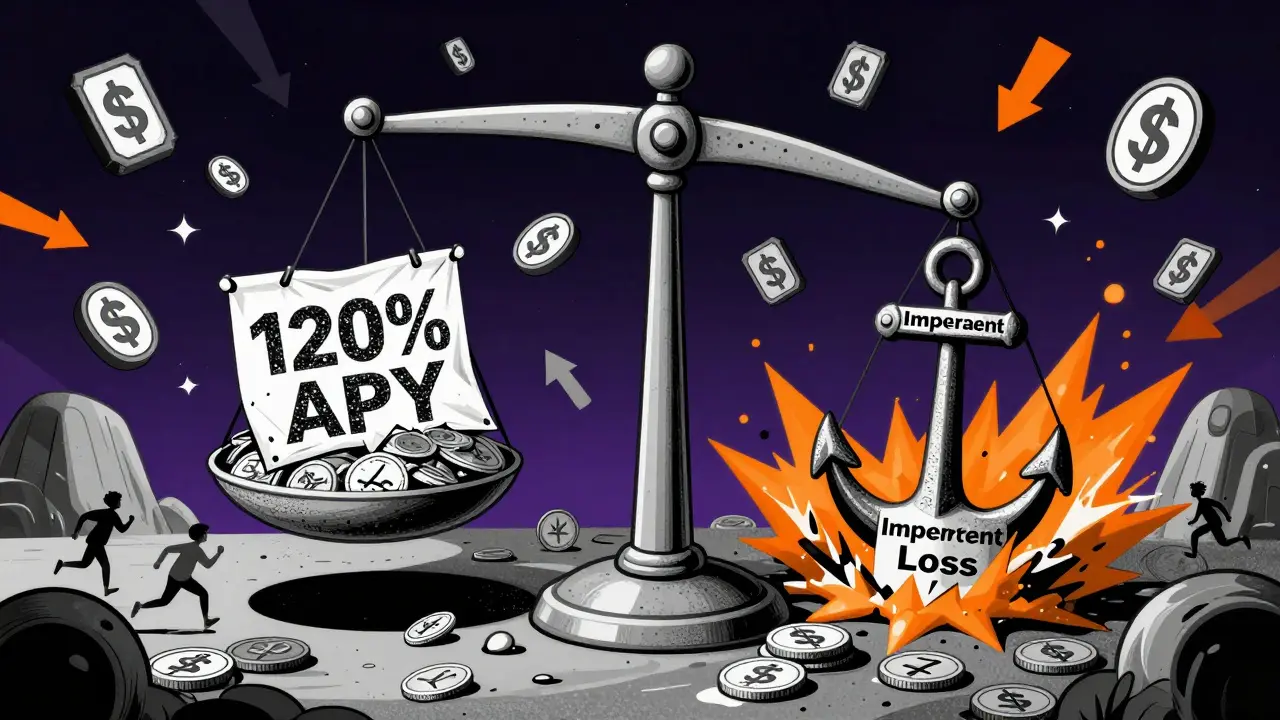
- Impermanent loss: This is the silent killer. If you deposit ETH and USDC into a pool and ETH drops 40%, you’ll lose value compared to just holding ETH. Even if your APY is 80%, you could still be down 20% overall. Impermanent loss isn’t a fee - it’s a price movement effect. It’s “impermanent” only if the assets return to their original ratio.
Real-World Example: A Yield Farming Scenario
Let’s say you deposit $10,000 into a pool offering:- 35% base APY from trading fees
- 40% in CRV token rewards
- 5% in protocol-specific bonus tokens
- CRV drops 50% over the next 3 months - your 40% reward is now worth 20%.
- ETH (the other half of your pair) drops 15% - you take a 7% impermanent loss.
- Gas fees for claiming rewards cost you $120 total.
Use a Yield Calculator - But Don’t Trust It Blindly
Tools like DeFiSaver, Yearn’s calculator, or Zapper’s yield tracker are essential. They pull live APYs, estimate token rewards, and factor in compounding. But here’s the catch: they assume token prices won’t change. They assume no smart contract exploit. They assume the protocol won’t change its reward schedule. That’s why you should:- Check the protocol’s official docs - not just the dashboard.
- Look at historical APY trends. Is the rate dropping? That’s a red flag.
- Compare across multiple calculators. If one says 90% and another says 65%, dig deeper.
- Look at total value locked (TVL). If TVL is crashing, the protocol may be losing trust.
Leveraged Yield Farming: Higher Returns, Higher Risk
Some platforms let you borrow funds to amplify your farming. Borrow $10,000, add your $10,000, farm with $20,000. If the APY is 60%, you earn $12,000 instead of $6,000. Sounds like free money. But if the price of your deposited asset drops 10%, you might get liquidated. You lose your entire position - plus owe the loan. Borrowing costs (interest on the loan) can be 15-30% per year. If your farming APY is 80%, but your borrowing cost is 25%, your net is only 55%. And if the market turns? You’re wiped out. Leveraged farming isn’t for beginners. It’s for people who understand liquidation thresholds, margin calls, and can monitor positions 24/7.How to Avoid Common Mistakes
Most people lose money in yield farming not because the math is hard - but because they skip the basics:- Don’t chase APY: The highest yield is often the riskiest. A 200% APY pool on a new protocol? Probably a rug pull or soon-to-be-dead token.
- Check the token pair: Stablecoin pairs (USDC/DAI) have low impermanent loss. ETH/USDC is riskier. New tokens? High risk.
- Read the contract: Use DeFiSafety or CertiK to check for audits. No audit? Walk away.
- Don’t forget gas: Claiming rewards on Ethereum can cost $5-$15 per claim. On Polygon or BSC, it’s pennies. Factor that in.
- Track everything: Use a DeFi portfolio tracker like Zapper or DeBank. Manual spreadsheets get outdated fast.
Final Reality Check
Yield farming isn’t a get-rich-quick scheme. It’s a high-effort, high-risk investment strategy that requires constant attention. The best returns go to those who understand not just the numbers, but the mechanics behind them. Forget the flashy headlines. Focus on:- Net APY after fees and token depreciation
- Impermanent loss exposure
- Protocol security and longevity
- Realistic time commitment
Is APY guaranteed in yield farming?
No, APY is not guaranteed. It’s an estimated return based on current reward rates and compounding frequency. Protocols can change reward distributions, token prices can crash, and liquidity pools can dry up. What looks like 100% APY today might drop to 10% next week.
What’s the safest yield farming strategy?
The safest approach is using well-audited protocols with stablecoin pairs (like USDC/DAI or USDT/USDC) on platforms like Curve or Aave. These have low impermanent loss, minimal token volatility, and proven smart contracts. Avoid new tokens, leveraged pools, and protocols without audits.
Why is my APY dropping even though I didn’t touch my funds?
APY drops when more people deposit into the pool. More liquidity means rewards are split among more participants. Also, if the protocol reduces its incentive tokens (like CRV or COMP), the APY will fall. This is normal - it’s called reward dilution.
Can I lose money even if my APY is positive?
Yes. If the value of your deposited assets drops (like ETH falling 30%), you can lose more than your APY gains. This is impermanent loss. You might earn 50% in rewards but lose 60% in asset value - ending up with a net loss.
Do I need to claim rewards manually?
Some protocols auto-compound rewards - others don’t. If you don’t claim your rewards, you miss out on compounding. Always check if your pool auto-reinvests. If not, you’ll need to claim and re-deposit manually, which costs gas each time.






Devyn Ranere-Carleton
January 31, 2026 AT 00:24Kevin Thomas
February 1, 2026 AT 14:38Robert Mills
February 2, 2026 AT 04:39Tressie Trezza
February 3, 2026 AT 11:14Gustavo Gonzalez
February 3, 2026 AT 18:35Jeremy Dayde
February 4, 2026 AT 08:32Ramona Langthaler
February 5, 2026 AT 17:18Sunil Srivastva
February 7, 2026 AT 06:09Elizabeth Jones
February 8, 2026 AT 14:34Rachel Stone
February 8, 2026 AT 21:44