
Key Takeaways
- The IRGC has built a "crypto cartel" to generate revenue and evade international sanctions.
- State-backed mining farms often use subsidized or stolen electricity, causing widespread power outages.
- A two-tier system exists: private miners face strict rules, while military operations enjoy total immunity.
- Cryptocurrency serves as a vital tool for funding regional proxies and bypassing the traditional banking system.
The Rise of the Military Crypto Cartel
Around 2019, the Islamic Revolutionary Guard Corps (IRGC) shifted from being a military entity to a financial powerhouse in the digital space. Under direct orders from Supreme Leader Ali Khamenei, the IRGC realized that Bitcoin and other digital assets provided a perfect loophole. When international sanctions cut off Iran's access to the U.S. dollar and global banking networks, the regime needed a way to move money without a middleman. Cryptocurrency provided that bridge.
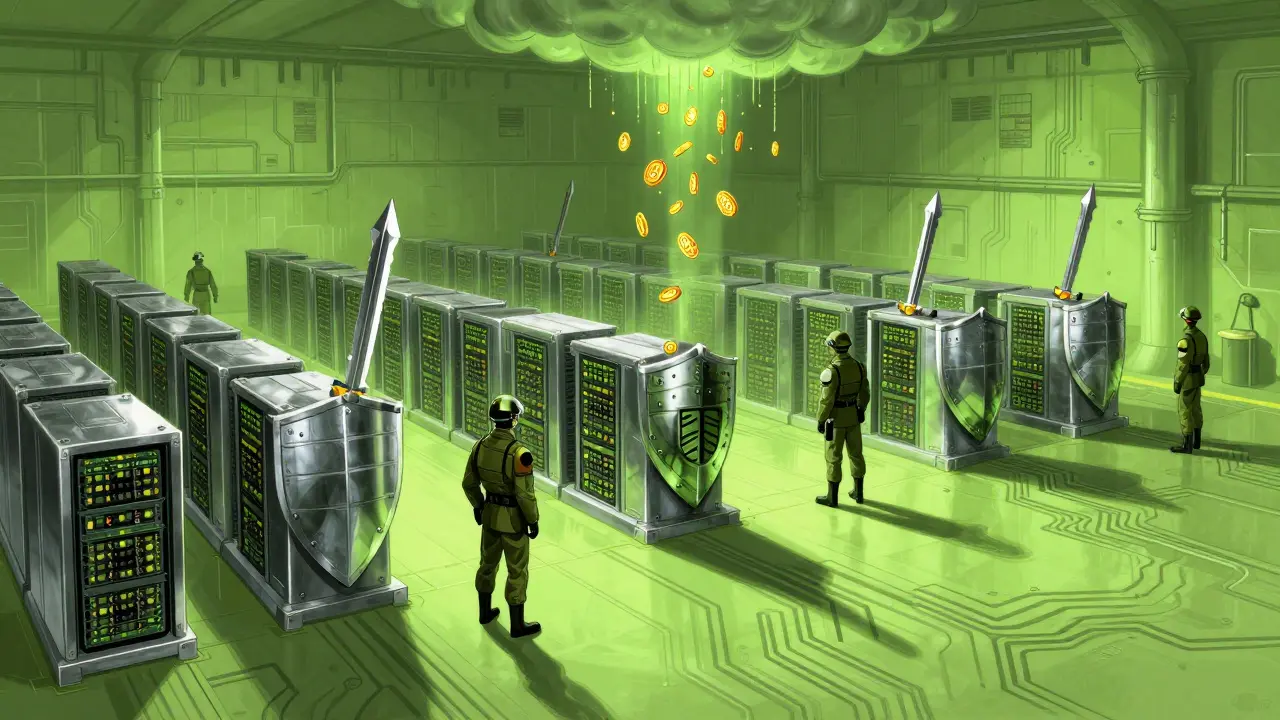
They didn't just start small. The IRGC established industrial-scale mining operations, often partnering with foreign entities, particularly from China. One striking example is the 175-megawatt mining farm in Rafsanjan, Kerman Province. On paper, it looks like a joint venture, but in reality, it's a strategic asset located in a special economic zone where civilian laws simply don't apply. By placing these farms on military bases, the IRGC ensures that no one-not even government inspectors-can see how much power they are actually consuming.
The Energy Heist: Powering Servers, Not Homes
Mining cryptocurrency requires an immense amount of electricity to run ASIC miners-specialized hardware designed solely to solve complex math problems for blockchain rewards. In most countries, this cost is the biggest hurdle for miners. In Iran, the IRGC has solved this by essentially stealing from the public. Through political leverage, these operations access electricity at nearly zero cost or simply refuse to pay their utility bills.
This energy drain has created a national crisis. While the military's servers hum 24/7, homes and factories across Iran face debilitating outages. The irony is palpable: the Energy Minister, Ali Abadi, is a former IRGC commander. He has called unauthorized mining "an ugly and unpleasant theft," yet the largest "thieves" are his former colleagues in the Guard. The situation was further cemented in 2022 when the Iranian parliament passed a law allowing the military to build its own private power plants and transmission lines, effectively giving the IRGC a legal way to bypass the national grid and hoard energy.
| Feature | Private Miners | IRGC-Linked Operations |
|---|---|---|
| Electricity Cost | High tariffs / Market rates | Subsidized or Free |
| Regulatory Oversight | Strict (Ministry of Industry) | Minimal / Immune |
| Asset Requirements | Must sell to Central Bank | Private control for sanctions evasion |
| Location | Commercial/Residential | Military bases / Economic zones |
A Strategy for Sanctions Evasion
Why go through all this trouble? Because the Central Bank of Iran (CBI) is largely locked out of the global financial system. Traditional bank transfers leave a paper trail that the U.S. Treasury can track and block. Cryptocurrency, however, allows for peer-to-peer transactions. By mining their own coins, the IRGC generates "clean" digital wealth that can be swapped for other currencies on global exchanges without needing a traditional bank account.
This isn't just about balancing books; it's about geopolitics. Reports from Israeli intelligence and the U.S. Treasury suggest that the Bitcoin wallets tied to these IRGC operations are used to fund proxy groups and military activities across the region. The anonymity provided by two-way encryption and digital wallets makes it incredibly difficult for international regulators to freeze these funds in real-time.
The Illusion of Regulation
Iran officially legalized crypto mining in 2019, but the rules are designed to trap, not to help. For a private citizen to get a license, they must agree to sell their mined coins to the Central Bank at a rate the government decides. This makes legitimate mining almost impossible for the average person. Consequently, many private miners go underground, which then gives the government a perfect excuse to raid "illegal" farms-while the IRGC's massive sites remain untouched.
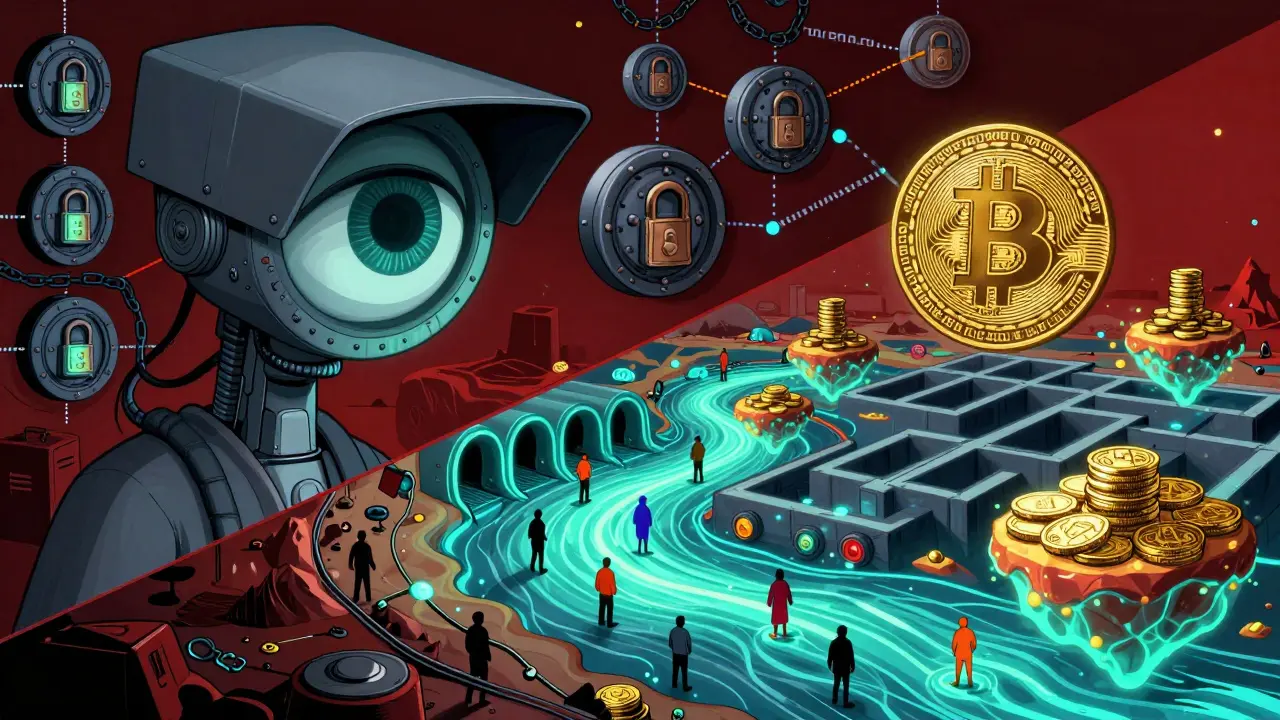
The government's approach to the software side is just as controlling. On December 27, 2024, the Central Bank blocked all crypto-to-rial payments on websites. But by early 2025, they opened a backdoor: a government API system. This allows the state to selectively let certain traders operate, provided they give the government full access to their user data. It's a move from total blockage to total surveillance.
How Ordinary Iranians Cope
Despite the crackdown, the Iranian people are resourceful. Many use VPNs to bypass local filters and access foreign exchanges like Nobitex. This creates a strange paradox: the state uses crypto to hide its money from the world, while the citizens use crypto to hide their money from the state.
For the average Iranian, cryptocurrency isn't about high-tech investing or military strategy; it's about survival. With the rial losing value and the economy struggling, digital assets are often the only way to preserve the purchasing power of their savings. They are fighting the same battle as the IRGC-escaping the limitations of the local financial system-but they are doing it without the benefit of armed guards and free electricity.
Why does the IRGC prefer mining over just buying Bitcoin?
Mining allows them to generate assets from scratch using the country's own energy resources. Buying Bitcoin would require using existing funds (which are already sanctioned) and would leave a trace of where the money came from. Mining produces "new" coins that are harder to tie back to a specific sanctioned bank account.
How does this mining affect the daily life of an Iranian citizen?
The primary impact is the energy crisis. Because these industrial farms consume massive amounts of electricity, the national grid often fails, leading to prolonged power outages in residential areas and factories, even during non-peak seasons.
Is all crypto mining in Iran illegal?
Technically, mining is legal if you have a license from the Ministry of Industry, Mines, and Trade. However, the requirements are so strict that few private miners can comply, leading to a huge amount of unlicensed activity-much of which is protected by the military.
What is the role of the Central Bank in this?
The Central Bank of Iran (CBI) acts as a controller. It attempts to monopolize the assets by requiring licensed miners to sell to them and uses API-based surveillance to monitor traders and their transactions.
Can international agencies stop these mining operations?
It is very difficult because the operations are located on military bases or in secure zones. While the U.S. and Israel can track the digital wallets associated with the IRGC, they cannot physically shut down the servers without direct intervention on the ground.
Next Steps and Scenarios
If you are tracking the impact of these operations, keep an eye on three things: the volatility of the Iranian rial, changes in energy legislation in Tehran, and reports from blockchain analytics firms regarding large movements of Bitcoin from Iranian-linked clusters. For those living in the region, the use of decentralized exchanges (DEX) is likely to increase as the government tightens its grip on centralized API-linked platforms.






Jehan ZA
April 27, 2026 AT 00:08It is truly distressing to observe how infrastructure meant for public benefit is diverted for military gain. This systemic inequality creates a precarious environment for the civilian population.
Kara Spadone
April 28, 2026 AT 05:08The duality of man is on full display here. We create tools for liberation, only for the shadows of power to swallow them whole. It's just a cycle of greed disguised as strategy 🙄✨
Bevon Findley
April 28, 2026 AT 13:25Classic power move :) 🥂
Arun Prabhu
April 29, 2026 AT 14:10The sheer audacity of this parasitic arrangement is almost breathtaking in its grotesque efficiency. While the plebeians stumble through a literal dark age, the military elite orchestrate a digital alchemy that transforms stolen wattage into clandestine wealth. It is a symphony of corruption played on the strings of a failing grid. One must marvel at the hubris required to label the most blatant theft in modern history as a strategic necessity. The intellectual vacuum in which these commanders operate is vast, yet they navigate it with a predatory precision that puts actual statesmen to shame. This isn't just a financial loophole; it is a moral void where the concept of the social contract has been shredded and used as fuel for a server rack. The juxtaposition of a formal 'crackdown' on civilians and total immunity for the Guard is the kind of farcical theater that makes one lose faith in the very notion of governance. It is an exercise in subterranean greed, a subterranean empire powered by the extinguished lights of a thousand homes. Truly, a masterpiece of state-sponsored larceny that treats the citizenry as mere batteries for a military-industrial crypto-complex. The irony is so thick it's practically tactile.
Lex Harley
April 29, 2026 AT 14:37man this is wild... the way they use ASIC rigs to basically mint sanctions-proof capital is a huge exploit of the PoW mechanism. its basically a state-level sybil attack on the energy grid lol. hope the peopel there find a way to use more DEXs and maybe some L2 soltions to save on gas and hide from the govt API surveillance. realy sad about the blackouts tho.