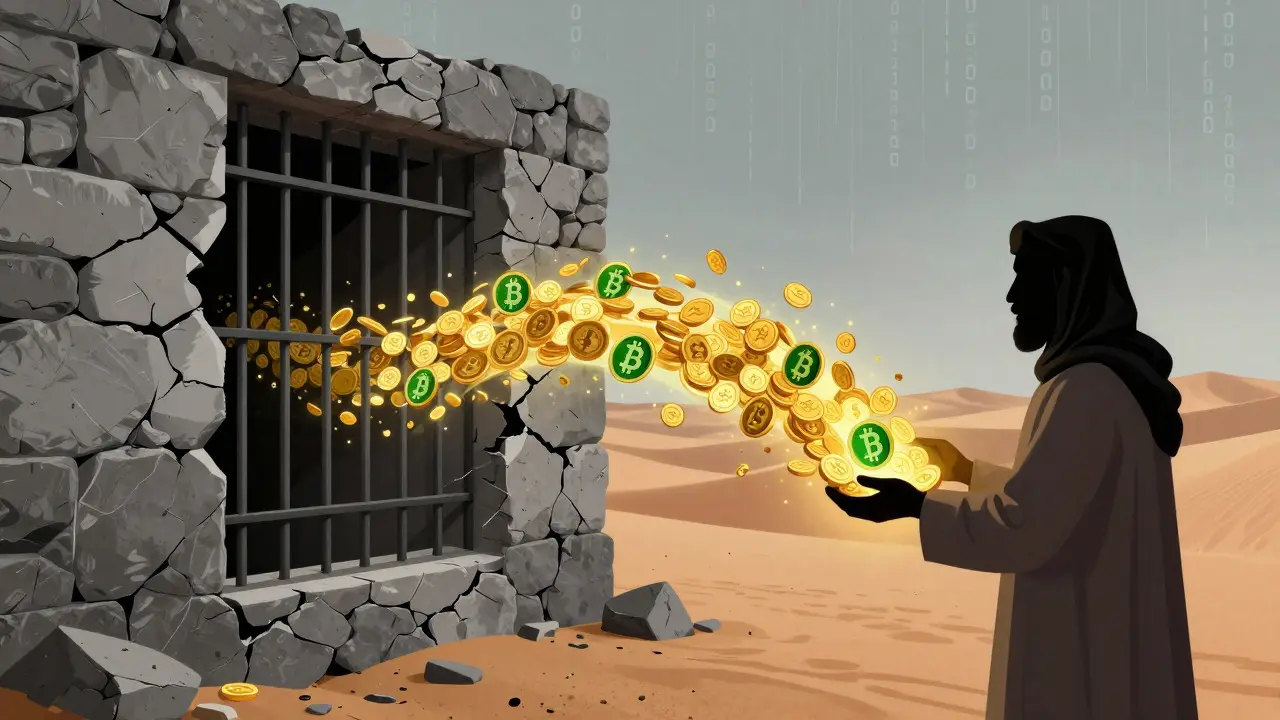
Imagine trying to send money home to your family, but every bank account is frozen, and the government says digital currency is a sin. This isn't a scene from a dystopian novel; it is daily life for millions of Afghans today. Since the Taliban returned to power in August 2021, the country has faced severe economic isolation. Traditional banking systems collapsed under international sanctions, leaving ordinary citizens with few options to access funds or conduct basic commerce. In this vacuum, cryptocurrency became a lifeline. But then came the crackdown.
In August 2022, the Taliban declared all forms of cryptocurrency trading haram (forbidden) under Islamic law. They argued that digital assets lack real-world backing and resemble speculative gambling. Despite this comprehensive ban, an underground economy has not only survived but evolved. As of mid-2026, peer-to-peer (P2P) crypto trading continues in shadows across Kabul, Herat, and even border towns like Torkham. Why? Because when 97% of a population falls below the poverty line, survival trumps regulation.
The Rise of a Digital Lifeline
To understand why crypto persists despite the ban, you have to look at the numbers before the hammer dropped. Immediately after the Taliban takeover in 2021, traditional channels for sending money abroad were severed. Foreign reserves worth billions were frozen by Western nations. For Afghan families relying on remittances from relatives in Europe, North America, and the Middle East, the tap was turned off.
Crypto stepped in. Data shows that cryptocurrency transfers into Afghanistan jumped by 80% right after the takeover. Apps like HesabPay emerged, allowing users to transfer funds between mobile phones without touching a bank. Within three months, HesabPay secured over 380,000 users. It wasn't about getting rich quick; it was about buying bread. The decentralized nature of blockchain meant no central authority could easily freeze these specific transactions, offering a sliver of financial autonomy in a highly controlled state.
| Period | Regulatory Status | Key Developments | Estimated Monthly Volume |
|---|---|---|---|
| Aug 2021 - Aug 2022 | Unregulated / Wild West | Surge in P2P adoption; apps like HesabPay launch | High (unrecorded peak) |
| Aug 2022 - 2024 | Banned | Taliban declares crypto 'haram'; exchanges shut down | Dropped to ~$80,000 (Nov 2022) |
| 2024 - Present | Strictly Illegal | Internet blackouts; P2P networks go deeper underground | Low volume, high risk |
How the Underground Market Operates
You might wonder how people trade something that is technically illegal and requires internet access, which the Taliban actively restricts. The answer lies in adaptation. The formal exchange model died quickly. Today, the market runs on trust and direct contact.
Peer-to-Peer (P2P) Trading is a method where individuals buy and sell cryptocurrencies directly with each other without using a centralized exchange platform. In Afghanistan, this often happens via encrypted messaging apps like Telegram or WhatsApp. Traders meet in person to verify identities and exchange cash for digital tokens. Bitcoin (BTC) and Tether (USDT) are the dominant assets. USDT is preferred because its value is pegged to the US dollar, protecting traders from the volatility of Bitcoin during times of extreme economic instability.
Forex dealers, who previously operated openly, now act as intermediaries. They help convert crypto received from overseas into hard currency or local Afghan Afghani. This creates a parallel financial system. Even though recorded transaction values plummeted to around $80,000 per month by late 2022 following initial arrests, the actual volume is likely higher because it is hidden. The decentralization of blockchain makes it nearly impossible for authorities to track every wallet address, especially when transactions occur offline or through mesh networks.

The Internet Blackout Weapon
If the ban didn't stop them, the Taliban escalated their tactics. By September 2024, Supreme Leader Hibatullah Akhundzada ordered sweeping internet blackouts. Initially targeting five northern provinces-Kunduz, Badakhshan, Baghlan, Takhar, and Balkh-the justification was combating "vice" and "immoral activities." However, the impact on crypto traders was devastating.
Internet connectivity in Afghanistan dropped to less than 1% of normal levels in affected areas. For a trader in Peshawar, Pakistan, trying to coordinate a sale with someone in Kabul, this is a nightmare. You cannot verify product images, check live prices, or confirm payment receipt if the network is down. These outages were not just about morality; they were effective tools for economic strangulation. With only 8.64 million out of 40 million Afghans having reliable internet access even before the blackouts, the barrier to entry for crypto trading became insurmountable for many.
This strategy highlights a key vulnerability in the underground ecosystem: infrastructure dependence. While blockchain itself is resilient, accessing it requires a stable connection. The Taliban’s control over telecommunications infrastructure gives them a powerful lever against digital dissent and finance.
Risks for the Average Trader
Trading crypto in Afghanistan is dangerous. It is not just a financial risk; it is a physical one. Authorities conduct periodic crackdowns. Arrests of miners and traders began almost immediately after the August 2022 ban. Those caught face confiscation of assets and potential imprisonment.
Furthermore, the lack of legal recourse means scams are rampant. Without regulated exchanges, there is no insurance fund if a counterparty disappears with your money. Trust is the only currency that matters, and building trust takes time in a fragmented society. Digital literacy courses, once focused on general computer skills, have quietly pivoted to teaching crypto security, warning students about phishing links and fake wallets. Yet, with high illiteracy rates and unreliable power supplies, the learning curve is steep.

Broader Context: Control Beyond Finance
The crypto ban is part of a larger pattern of restriction. In 2025, the Taliban purged books written by women from university libraries and eliminated 18 courses on democracy and human rights. They view independent thought and uncontrolled information flow as threats. Cryptocurrency represents both: it allows capital to move freely and enables communication outside state-controlled media.
International criticism has mounted, but sanctions remain in place. This isolation reinforces the need for alternative financial channels. As long as the official banking sector remains disconnected from the global SWIFT system, the demand for crypto will persist. It is a rational response to an irrational economic environment.
Future Outlook: Adaptation or Extinction?
Will underground crypto trading survive in Afghanistan? Likely yes, but in a diminished form. The economic desperation driving adoption shows no signs of fading. International aid flows slowly, and domestic governance failures continue. People need ways to save value and receive support from abroad.
However, the Taliban are learning. Their approach to internet control is becoming more sophisticated, moving from broad blackouts to targeted provincial bans. If they can monitor IP addresses more effectively or restrict data usage on specific apps, the cost of trading will rise further. We may see innovation in offline solutions, such as QR-code-based transfers that require minimal data, or increased reliance on cross-border hubs in Pakistan and Iran where internet access is freer.
For now, crypto remains a tool of resistance and survival. It is not about speculation; it is about keeping the lights on and feeding families. Until the political situation changes, the shadow market will adapt, finding cracks in the wall built by decree.
Is cryptocurrency legal in Afghanistan?
No. Since August 2022, the Taliban government has banned all forms of cryptocurrency trading, mining, and usage, declaring it forbidden under Sharia law due to its speculative nature.
Why do Afghans still use crypto if it is banned?
Traditional banking systems collapsed after international sanctions froze foreign reserves. Crypto provides a critical channel for receiving remittances from family members abroad, which is essential for survival given the high poverty rate.
Which cryptocurrencies are most popular in Afghanistan?
Bitcoin (BTC) and Tether (USDT) are the most widely used. USDT is particularly favored because its value is stable against the US dollar, reducing risk for everyday transactions.
How does the Taliban enforce the crypto ban?
Enforcement includes arresting traders and miners, revoking exchange licenses, and implementing widespread internet blackouts to disrupt digital connectivity required for trading.
What are the risks of underground crypto trading?
Risks include asset confiscation, imprisonment, scams due to lack of regulatory protection, and technical challenges caused by poor internet infrastructure and frequent outages.
Did crypto usage increase after the Taliban took power?
Yes. Immediately following the August 2021 takeover, cryptocurrency transfers into Afghanistan increased by approximately 80% as people sought alternatives to frozen bank accounts.