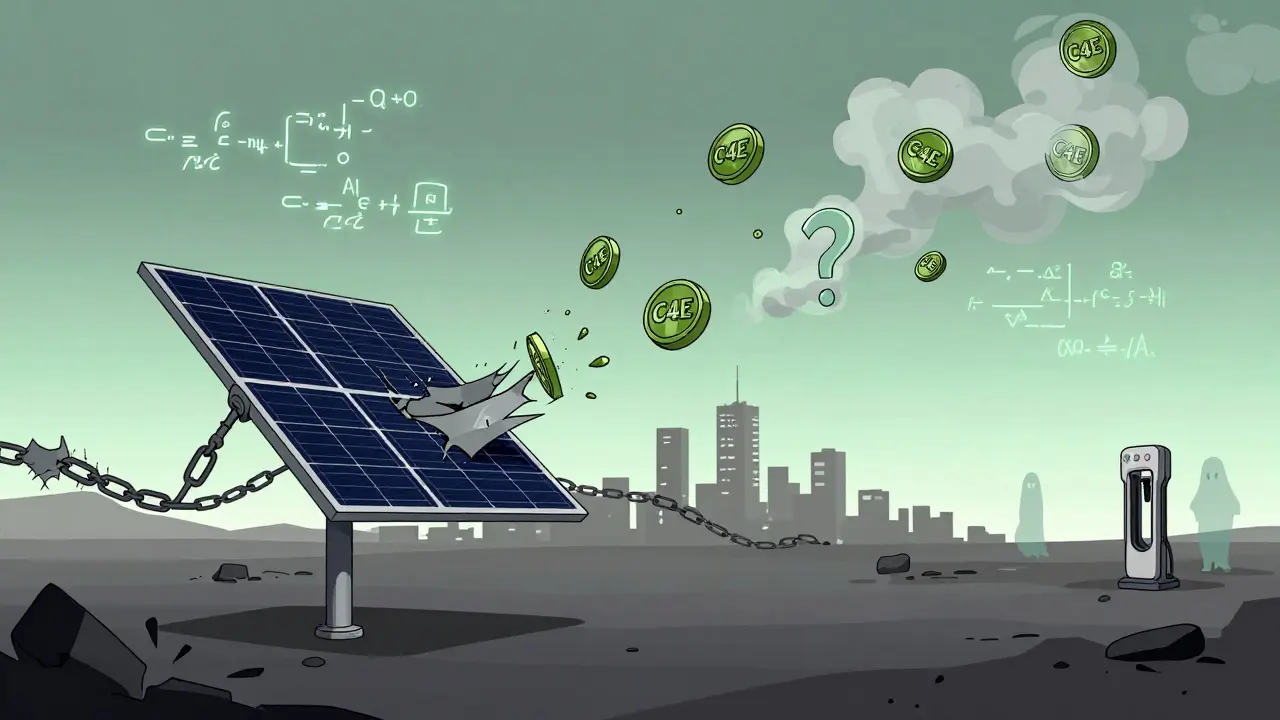
C4E is the native token of Chain4Energy, a blockchain project that claims to build a decentralized network for energy trading and electric vehicle charging. But behind the buzzwords - DePIN, AI optimization, peer-to-peer energy markets - there’s a story of low liquidity, minimal adoption, and unanswered questions. If you’re wondering whether C4E is a legitimate energy project or just another crypto gamble, here’s what actually matters.
What is C4E really?
C4E isn’t just another altcoin. It’s built on the idea that homes, solar panels, and EV chargers should trade energy directly, without middlemen. Think of it like Uber for electricity: if your solar panels make extra power, you sell it to a neighbor who needs it. The blockchain handles the payments using C4E tokens.
That sounds smart - and it’s not new. Projects like Power Ledger and Energy Web Token have been trying this for years. But Chain4Energy’s twist is its focus on DePIN (Decentralized Physical Infrastructure Network). DePIN rewards people for adding real-world hardware to the network - like smart meters or EV chargers - and getting paid in C4E tokens for helping the system grow. It’s not just about trading crypto. It’s about building infrastructure.
But here’s the catch: no one’s using it.
Market data: A token with no real trading volume
Let’s look at numbers that matter. As of late 2023:
- CoinMarketCap listed C4E at $0.002649 with a $1,768 daily volume.
- CoinGecko showed $0.00313179 and $4,560 volume.
- Binance reported $0.001979 - a 40% difference from CoinGecko.
That’s not a glitch. It’s a red flag. When prices vary so wildly across exchanges, it usually means one thing: low liquidity. There aren’t enough buyers or sellers to keep prices stable. One day, it’s $0.003. The next, it’s $0.001. That’s not volatility - it’s manipulation risk.
Market cap? Around $30,000 to $900,000 depending on the source. That’s less than 0.1% of Power Ledger’s market cap. For context: if the energy blockchain market is a $3 billion industry by 2025, C4E is a speck of dust.
Tokenomics: Infinite supply, massive dilution
C4E has a circulating supply of 12.3 million tokens - but a total supply of over 309 million. That’s not a typo. The maximum supply is infinite. That means more tokens can be created anytime, which puts constant downward pressure on price.
Here’s where it gets worse. The project raised $10.5 million in private sales during its seed round. Back then, C4E was priced at around $0.035. Today? It trades at $0.0026. That’s a 92% drop. Investors who bought early are underwater. And if the team still holds most of the supply - which they likely do - they could dump tokens anytime, crashing the price further.
Compare that to real projects. Power Ledger locked 80% of its supply for years. Chain4Energy? No clear vesting schedule. No public audit. Just a website that says “we’re building the future” - with zero proof.

Real-world use? There isn’t any
Chain4Energy’s website promises AI-driven energy optimization, EV charging orchestration, and P2P energy markets. Sounds impressive. But where’s the proof?
- No public API documentation.
- No smart contract audits on Etherscan or similar platforms.
- GitHub has only 3 repositories - all inactive for over 6 months.
- Zero documented partnerships with energy companies, utilities, or EV networks.
One user on Telegram put it bluntly: “I bought during the seed round at $0.035. Now it’s $0.0026. I don’t see any real-world implementation.”
That’s the core problem. No one is using C4E to buy or sell energy. No homes are trading solar power with it. No EV chargers are accepting it. The whole project lives on promises - not products.
Community and support: Ghost town
How many people care about C4E? Let’s check:
- Twitter: 1,200 followers. Posts get 2-3 retweets.
- Telegram: 850 members. Most are quiet.
- Reddit: 12 posts in 6 months. All questions, no answers.
- Support tickets on Telegram: take 72 hours to get a reply.
Compare that to established projects. Solana has 3 million Twitter followers. Ethereum has millions of daily active wallets. C4E? It’s barely alive.
There’s no community momentum. No developer interest. No user adoption. Just a small group of early investors hoping the price rebounds - and a handful of new buyers lured by a flashy website.
Is C4E a scam?
Not technically. There’s no evidence the team stole funds or ran off. But that doesn’t mean it’s viable.
It’s a failed project. Here’s why:
- High initial valuation ($10.5M) with zero product to show for it.
- Extremely low trading volume - under $5,000 daily.
- No technical progress in over a year.
- No enterprise adoption. No utility. No users.
- Market cap under $100,000 - below the threshold most analysts say a project needs to survive.
CryptoSlate’s analyst summed it up: “Projects with market caps under $100,000 and daily volumes under $2,000 face significant challenges in sustaining long-term development.”
C4E isn’t dead - it’s in a coma.

Should you buy C4E?
If you’re looking for a serious investment in energy blockchain - walk away.
If you’re gambling on a long shot? Fine. But know this:
- You’re not investing in energy infrastructure. You’re betting on a team that hasn’t delivered anything.
- You’re buying a token with infinite supply - meaning it can be diluted at any time.
- You’re entering a market with almost no liquidity - meaning you might not be able to sell when you want to.
There are better options. Power Ledger has real contracts with utilities. Energy Web Token is used by Fortune 500 companies. Even smaller projects like Hive (a decentralized energy network in Australia) have actual pilot programs.
C4E? It’s a concept that never left the drawing board.
What’s next for C4E?
The roadmap on c4e.io still lists “P2P energy marketplace launch” and “EV charging integration” - but no dates. No timelines. No progress updates since late 2023.
Without funding, partnerships, or technical milestones, the project has no path forward. The team may keep posting on Twitter. The token may bounce up 20% on a hype tweet. But without real infrastructure - without users - it’s just noise.
For now, C4E remains a cautionary tale: a blockchain project built on ambition, not execution.
Is C4E a good investment?
No, not as a serious investment. C4E has extremely low liquidity, no real-world use, and a market cap under $100,000. Its price has dropped 92% since its seed round. There’s no evidence of adoption, development, or partnerships. It’s a high-risk gamble with little chance of recovery.
Where can I buy C4E?
C4E is listed on decentralized exchanges like Osmosis and PancakeSwap (v2). The C4E/UOSMO pair has the highest trading volume. But be warned: trading volume is under $5,000 daily. That means slippage is high, and you may not be able to sell quickly if the price drops.
Does C4E have a working product?
No. Despite claims of AI-driven energy optimization and peer-to-peer energy trading, there are no public APIs, no smart contract audits, no real-world deployments, and no documented partnerships. The website describes features but provides zero technical details or proof of implementation.
What is DePIN, and how does C4E use it?
DePIN stands for Decentralized Physical Infrastructure Network. It’s a model where users earn tokens for contributing real-world hardware - like solar panels, smart meters, or EV chargers - to a decentralized network. C4E claims to use DePIN to build an energy trading system. But while projects like Filecoin and Hivemapper have proven DePIN works, C4E has not deployed a single device or service.
Why is C4E’s price so different on different exchanges?
Because trading volume is extremely low. With so few buyers and sellers, even small trades can swing the price dramatically. This is common in low-liquidity tokens and makes them vulnerable to manipulation. It also means price data from one exchange (like CoinGecko) can be wildly different from another (like Binance).
Final takeaway
C4E isn’t the future of energy. It’s a ghost of one. The idea was good - decentralizing energy trading. But execution failed. No users. No tech. No progress. If you’re looking to invest in energy blockchain, look at projects that have shipped, not those that just talk.





Oliver James Scarth
February 9, 2026 AT 00:51Let’s be brutally honest: C4E isn’t a project-it’s a graveyard for retail investors who mistook a PowerPoint deck for a business plan.
The ‘DePIN’ buzzword is just a shiny coat of paint over an empty shell. Real DePIN projects like Hivemapper or Filecoin have tangible hardware, verifiable data streams, and active node operators. C4E? Zero public infrastructure. Zero audits. Zero transparency.
And let’s not ignore the elephant in the room: infinite supply. That’s not innovation-that’s a legal loophole for dilution. When your tokenomics reads like a Ponzi scheme’s FAQ, you don’t get to call yourself ‘disruptive.’
The fact that Binance, CoinGecko, and Osmosis report wildly divergent prices isn’t ‘market volatility.’ It’s a sign that no one trusts the data. If liquidity is under $5K daily, you’re not trading-you’re playing Russian roulette with your portfolio.
And yet, somehow, people still buy in. Why? Because hope is cheaper than due diligence.
Walk away. There are legitimate energy blockchain projects with real contracts, real audits, and real users. C4E is the crypto equivalent of a Tesla model built out of cardboard and duct tape.
Kieren Hagan
February 9, 2026 AT 23:08As someone who’s analyzed over 200 blockchain energy projects, I can say with certainty: C4E fails on every fundamental metric.
Market cap under $100K? Daily volume under $5K? Infinite supply? No smart contract audits? No GitHub activity for six months? These aren’t red flags-they’re full-blown emergency signals.
Compare this to Power Ledger: they have active pilot programs with Australian utilities, audited contracts on Ethereum, and a locked 80% token supply. C4E has a website that looks like it was built in 2021 with a free WordPress template.
The DePIN model is sound. But execution matters. You can’t build a decentralized grid with vaporware and Twitter posts. This isn’t a ‘long-term investment.’ It’s a liquidity trap designed to lure the naive.
If you’re considering C4E, ask yourself: Would any serious energy company partner with a team that can’t even publish a technical whitepaper update? The answer is no. And that’s the end of the story.
sachin bunny
February 10, 2026 AT 15:23Olivette Petersen
February 11, 2026 AT 05:50I know how easy it is to get excited by a bold vision-decentralized energy? EV charging on the blockchain? Yes, please!
But here’s the thing: passion without progress is just noise.
C4E had the potential to be revolutionary. But potential doesn’t pay bills. Users don’t care about whitepapers-they care about functionality. Did anyone actually use it to sell solar power? No. Did a single utility integrate it? No.
I’m not here to crush dreams. I’m here to say: if you believe in decentralized energy, support the projects that are DOING the work. Not the ones just talking. There are real builders out there. Find them. Fund them. Help them.
C4E? It’s a lesson. Not a launchpad.
Michelle Anderson
February 11, 2026 AT 17:57Paul Gariepy
February 13, 2026 AT 02:02Okay, I’ve been following this space for years, and I’ve seen dozens of projects like this.
First, the idea isn’t bad-decentralized energy trading is a real need. But execution? This team just doesn’t have the discipline.
I checked their GitHub-three repos, last commit six months ago. Their website? Still says ‘coming soon’ on every major feature.
And the price discrepancies? That’s not ‘market inefficiency’-that’s market manipulation. Someone’s pumping it on low-volume DEXs to lure in new buyers.
Don’t get me wrong-I want this to work. I really do. But hope isn’t a strategy.
If you’re serious about energy blockchain, go look at Energy Web, Power Ledger, or even Hive. They’ve got code, they’ve got users, they’ve got audits.
C4E? It’s not a project. It’s a cautionary tale.
And if you’re still holding it… I’m sorry.
But you asked for the truth. Here it is.