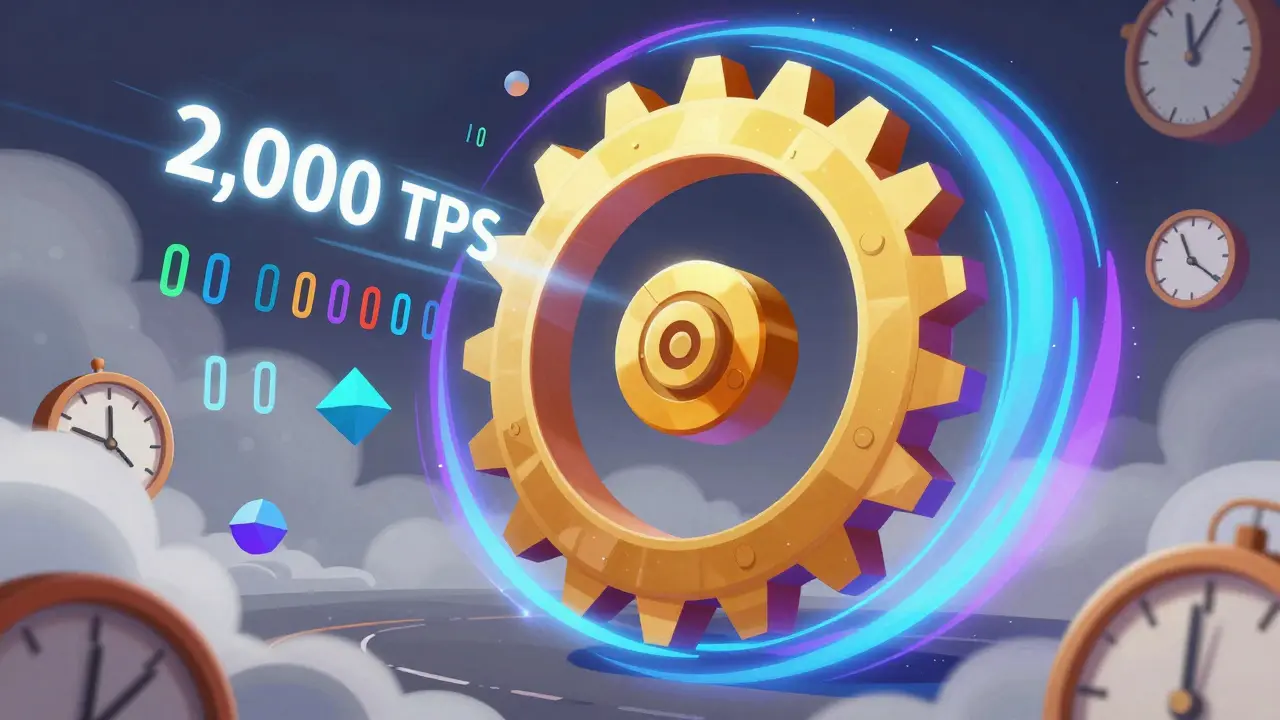
If you've been browsing the crypto markets lately, you might have stumbled across SMART crypto coin and wondered if it's just another ticker or something with actual utility. In a world where Bitcoin is often too slow for daily coffee purchases and Ethereum gas fees can sometimes cost more than the transaction itself, the Smart Blockchain network tries to fix these specific headaches. It's not trying to reinvent the wheel, but rather make the wheel spin significantly faster and cheaper.
Quick Facts: SMART at a Glance
- Current Price: Around $0.0045 - $0.0052 (Depending on the exchange)
- Market Cap: Approximately $30.19M USD
- Transaction Speed: Up to 2,000 transactions per second (TPS)
- Consensus: Delegated Proof of Stake (DPoS)
- Block Time: ~3 seconds
The Core of the Smart Blockchain Network
To understand the coin, we first have to look at the machine it powers. Smart Blockchain is a decentralized network engineered to solve the "blockchain trilemma"-the struggle to balance security, scalability, and decentralization. While legacy chains often struggle with congestion, this network focuses on high throughput.
One of the most interesting technical choices here is the use of Google Protobuf (Protocol Buffers). If you're not a developer, think of this as a highly efficient way of packaging data. Instead of using bulky formats, Protobuf allows the network to communicate and integrate tokens into existing products with lightning speed. It's a huge reason why the network can hit that 2,000 TPS mark without crashing under the pressure.
How the SMART Coin Actually Works
The SMART coin isn't just a speculative asset; it's the fuel for the entire ecosystem. It handles three main jobs:
- Asset Transfers: It allows you to move value from point A to point B almost instantly, removing the need for middle-men who take a cut of your money.
- Powering Smart Contracts: Smart Contracts are basically digital "if-then" agreements. For example, "If the package is delivered, then release the payment." SMART coins are used to execute these automated protocols, reducing the chance of human error or disputes.
- Network Security: Because the network uses a specific consensus model, the coin is tied to how the network stays honest and synchronized.
DPoS: Why it Matters for the Environment
You've probably heard about how Bitcoin mining consumes massive amounts of electricity. Smart Blockchain avoids this by using Delegated Proof of Stake (DPoS). DPoS is a consensus mechanism where users vote for a few "delegates" to validate blocks and maintain the network.
Think of it like a representative democracy. Instead of every single person in the city trying to pave the road (which is what Proof of Work does), the city elects a small team of professionals to do it efficiently. This shift makes the network incredibly energy-efficient and is the primary reason why block creation happens in just 3 seconds.
| Feature | Legacy Chains (PoW) | Smart Blockchain (DPoS) |
|---|---|---|
| Energy Use | Extremely High | Low/Efficient |
| Transaction Speed | Slow (Minutes/Hours) | Fast (~3 Seconds) |
| Throughput | Low (e.g., 7-15 TPS) | High (Up to 2,000 TPS) |
| Fees | Variable/Often High | Dynamic and Low |

Market Performance and Price Volatility
If you're looking at the price charts, you'll see that SMART has been on a wild ride. Like most mid-tier coins, it doesn't move in a straight line. On October 2, 2023, it hit an all-time high of $0.02704. However, the market is fickle; by June 6, 2025, it dipped to an all-time low of $0.0006337.
Since that low point, the coin has climbed over 700%, which shows a strong recovery. As of early April 2026, it's hovering around the $0.0045 to $0.0052 range. While some prediction models suggest a modest growth of about 5% annually, crypto rarely follows a neat spreadsheet. The moderate liquidity-with 24-hour trading volumes around $431,000-means you can buy and sell without too much trouble, but it's not yet in the "big leagues" of volume like Bitcoin or Solana.
Where and How to Trade SMART
If you've decided to pick some up, you'll find SMART on several major exchanges. Gate.io is currently one of the most active spots for this token, but it's also available on Binance, MEXC, and Bybit.
You have two main ways to play this: Spot Trading and Futures Trading. For most regular people, spot trading is the way to go. You simply buy the coin at the current price and own it. Futures trading is more of a gamble-it's for people who want to bet on whether the price will go up or down using leverage. If you're just starting out, stick to spot trading to avoid the risk of getting liquidated.
Potential Pitfalls and What's Missing
No investment is without risk. While the tech sounds great, there are a few red flags or "missing pieces" to keep in mind. For one, there's very little public information about the exact team behind the project or a detailed, transparent roadmap. In the crypto world, "anonymous" or "hidden" teams can be a risk.
Additionally, while the 2,000 TPS is impressive on paper, we haven't seen many massive enterprise-level adoption statistics yet. It's one thing to have a fast network; it's another thing to have a million people using it simultaneously. Without a clear list of corporate partners or a detailed whitepaper that's widely analyzed by third parties, it remains a high-risk, high-reward asset.
What is the main use of the SMART coin?
The SMART coin is used to facilitate fast, low-cost transfers of digital assets and to power smart contracts on the Smart Blockchain network. It essentially acts as the currency that pays for the computational power required to run the network's services.
Is SMART a Proof of Work or Proof of Stake coin?
It uses Delegated Proof of Stake (DPoS). This means instead of miners using powerful computers to solve puzzles (like Bitcoin), token holders vote for delegates to secure the network, making it much more energy-efficient.
How fast are transactions on the Smart Blockchain?
Transactions are very quick, with block creation taking an average of 3 seconds and the network capable of handling up to 2,000 transactions per second.
Where can I buy SMART tokens?
You can trade SMART on several exchanges, including Gate.io, Binance, MEXC, and Bybit. Most of these platforms offer both spot and futures trading.
What is the all-time high of SMART?
The all-time high for the SMART coin was $0.02704 USD, which was reached on October 2, 2023.
Next Steps for Investors
If you're considering putting money into SMART, don't just look at the price. Check the current trading volume on CoinMarketCap or CoinGecko to make sure there's enough liquidity for you to exit your position later. If you're a developer, you might want to experiment with their Protocol Buffers integration to see how easily you can deploy a decentralized app (dApp).
For the cautious investor, a common strategy is "dollar-cost averaging"-buying small amounts over time rather than dumping a large sum in at once. This is especially helpful for coins like SMART that have shown extreme volatility in the past, as it smooths out the entry price.



Deepak Prusty
April 6, 2026 AT 02:11DPoS is essentially just a fancy way of saying it's more centralized than traditional PoW since you're trusting a handful of delegates. The 2,000 TPS claim is likely a theoretical peak in a controlled environment, not what you'll see during a real network spike.
Diana Martín Prieto
April 7, 2026 AT 16:27If anyone is looking to get started, the dollar-cost averaging mentioned here is genuinely the safest bet for volatile assets like this. It really takes the emotional stress out of the process. Just make sure you use a hardware wallet for long-term storage to keep your assets secure from exchange hacks!
sekhar reddy
April 8, 2026 AT 11:12OMG the volatility is actually INSANE!! I can't even imagine the stress of seeing a 700% recovery after that crash. My heart would legit stop just looking at the chart lol. This is pure madness!
Earnest Mudzengi
April 10, 2026 AT 08:59Typical globalist narrative pushing another "efficient" chain. You think it's just about energy? Wake up. Protobuf is just a tool for faster data harvesting. These "anonymous teams" are probably just fronts for a shadow government operation to track every single micro-transaction using a backdoor in the DPoS voting layer. The centralization is a feature, not a bug, designed to kill financial sovereignty in favor of a programmable social credit system. This whole thing smells like a honeypot for patriotic investors who still believe in the old dream of decentralized gold. It's all a game of smoke and mirrors to keep us trapped in the digital panopticon while the elites hedge their bets with real assets. Don't trust the "speed"-speed just means they can liquidate your life savings before you even blink.
Carol Prates
April 11, 2026 AT 22:26Honestly, the recovery looks great, but let's be real: a $30M market cap is basically a rounding error in the crypto world. It's cute that they're trying, but without a real team, it's just a gambling chip with a website. Sweetie, please don't mistake a dead cat bounce for a moon mission!
Nicholas Whooley
April 13, 2026 AT 21:55It is quite encouraging to see new projects attempting to address the blockchain trilemma with such innovative approaches. Perhaps we can all look at this as a learning opportunity to understand how DPoS can potentially benefit the environment while maintaining functionality.
Suzanne Robitaille
April 14, 2026 AT 09:09There is a profound poetry in the rise and fall of these digital currencies. We are witnessing the birth of a new kind of value, one that exists only in the collective belief of thousands of strangers across the globe. It is truly a dramatic reflection of our modern obsession with speed and efficiency over stability.