NFT Metadata Availability Checker
Check Your NFT Metadata
Enter your NFT's tokenURI or IPFS hash to verify if it's stored on decentralized storage.
When you buy an NFT, you’re not just buying a picture. You’re buying a digital certificate backed by code - and that certificate only works because of something called NFT metadata. Without it, your NFT is just a number on a blockchain with no image, no name, and no meaning. It’s the hidden engine that makes your pixel art, music clip, or virtual sneaker look and act like something real.
What exactly is NFT metadata?
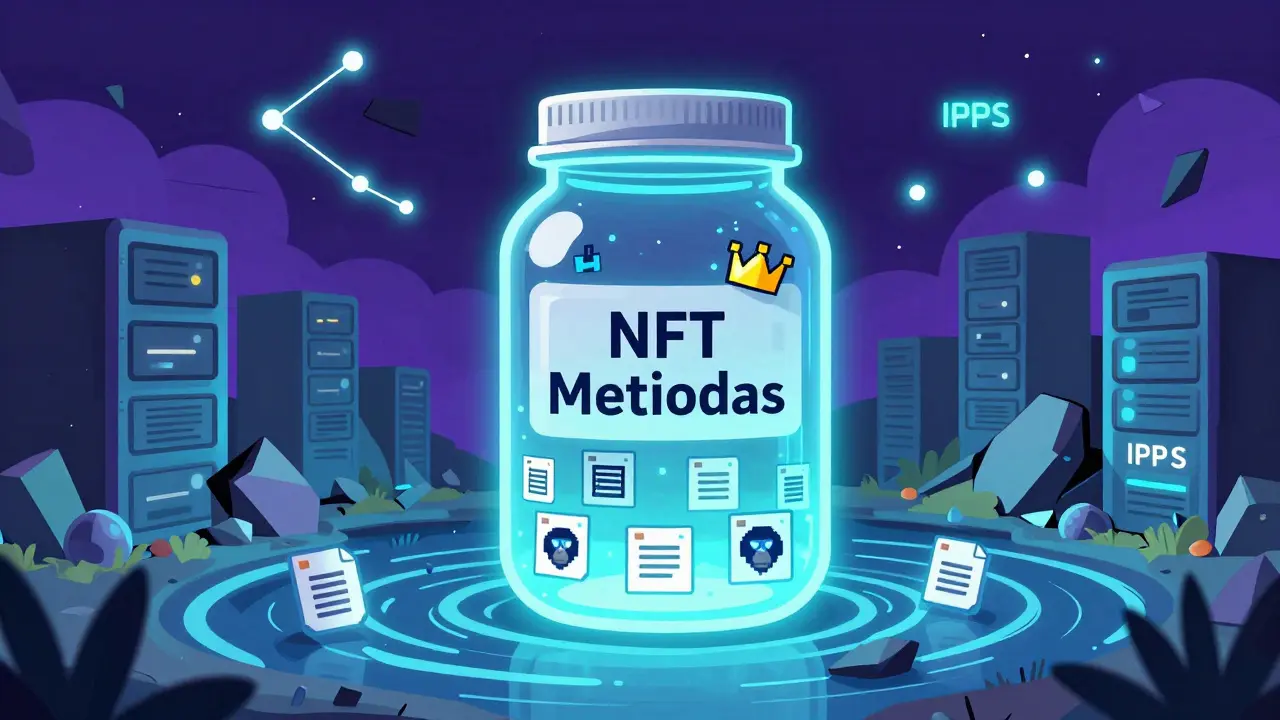
NFT metadata is the data that describes your NFT. Think of it like the label on a jar of jam - it tells you the flavor, ingredients, expiration date, and who made it. For an NFT, that label is a JSON file containing details like the name, description, image link, and special traits (like rarity or color). This data is what your wallet and marketplace use to display your NFT properly.
It’s not stored on the blockchain itself. Blockchains like Ethereum can only hold tiny bits of data - about 256 bytes per transaction. A single JPEG image is 500KB or more. So instead, the blockchain stores a pointer - a URL - that leads to the metadata file hosted elsewhere. That URL is called the tokenURI, and it’s part of the smart contract that created your NFT.
The metadata file itself is almost always in JSON format. Here’s what a basic one looks like:
{
  "name": "Bored Ape #1234",
  "description": "A rare Bored Ape with laser eyes and a gold crown.",
  "image": "https://ipfs.io/ipfs/QmXoypiz.../1234.png",
  "attributes": [
    {"trait_type": "Background", "value": "Red"},
    {"trait_type": "Eyes", "value": "Laser"},
    {"trait_type": "Hat", "value": "Gold Crown"}
  ]
}
This file tells your wallet: "This NFT is called Bored Ape #1234, here’s the picture, and here are its traits." Without this file, you’d just see a blank square or an error message.
Why does metadata matter more than you think?
Most people think the value of an NFT comes from the image. But the image is just a file. The real value comes from the metadata that links it to ownership, history, and uniqueness.
Take CryptoPunks. There are only 10,000 of them. Their metadata includes traits like "Alien," "Zombie," or "Ape." Those traits are baked into the JSON file. If the metadata disappeared, the NFT would still exist on the blockchain - but no one would know it was an Alien Punk. It would just be a number.
And here’s the scary part: if that metadata file is hosted on a company’s server - say, Amazon Web Services - and that company shuts down, your NFT becomes useless. In 2022, Nifty Gateway’s servers went offline for days. Over 12,700 NFTs vanished from users’ wallets because their metadata was stored there. People lost access to NFTs worth millions.
That’s why decentralized storage matters. IPFS (InterPlanetary File System) stores files by their content, not their location. If you upload a file to IPFS, you get a unique hash - like QmXoypiz... - and that hash becomes the permanent address. Even if one server goes down, another node somewhere in the world can serve the file. CryptoPunks, Bored Ape Yacht Club, and Foundation all use IPFS. That’s why they’re still viewable today, years after their launch.
How is metadata different across blockchains?
Not all NFTs are built the same. Ethereum’s ERC-721 standard is the most common - used by 92.7% of NFTs. It’s flexible but relies heavily on off-chain metadata. That means you’re trusting someone else’s server to keep your NFT alive.
Solana, on the other hand, is cheaper and faster. Transactions cost about $0.00025. Because of that, many Solana NFTs store more data directly on-chain - including the image itself. This reduces the risk of link rot, but it’s not perfect. Solana’s blockchain has limits too, and storing large files still isn’t ideal.
Then there’s ERC-1155, a multi-token standard used by 6.2% of projects. It lets one contract handle both fungible and non-fungible tokens. This is great for games where you have 100 identical swords and one unique legendary sword. The metadata structure is similar to ERC-721, but it’s more efficient for bulk items.
Each blockchain has its trade-offs: Ethereum gives you the most proven system but higher costs. Solana gives you speed and lower fees but less flexibility. The choice affects how permanent your NFT really is.
What happens if metadata is changed or deleted?
Most NFT metadata is immutable by design. Once you mint the NFT, the metadata link can’t be changed - unless the creator built in a way to update it. Only about 12% of NFT contracts allow updates. That’s intentional. If anyone could change your NFT’s description or image after you bought it, the whole idea of ownership would collapse.
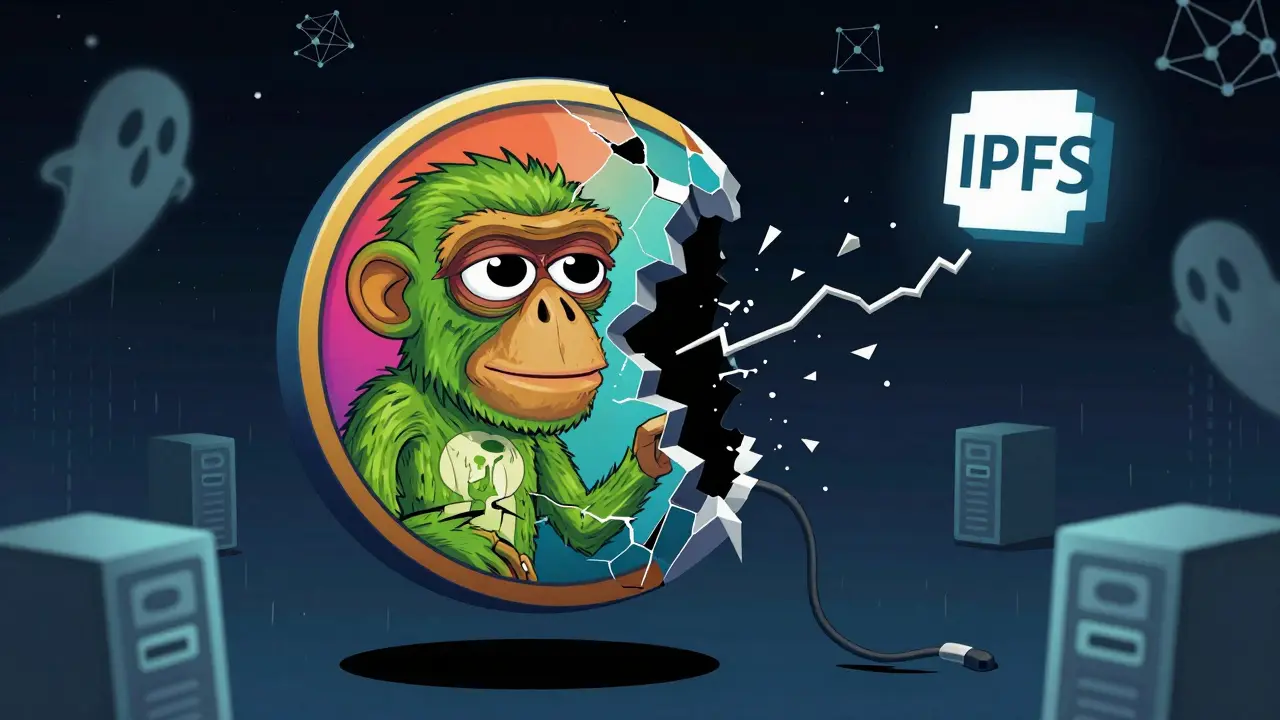
But here’s the catch: even if the metadata link can’t be changed, the file it points to can be replaced. If a developer uploads a new image to the same IPFS hash (which shouldn’t happen), or if a centralized server swaps out the file, your NFT’s appearance changes. This is called "metadata spoofing." In 2023, researchers found that 78% of NFT projects didn’t properly verify their metadata, making them vulnerable to this kind of fraud.
That’s why tools like EIP-6454 (adopted by 43% of new projects since late 2023) are important. They add a way to cryptographically verify that the metadata hasn’t been tampered with. It’s like putting a digital seal on the file - if it’s altered, the seal breaks.
Real-world examples: Successes and failures
Look at Bored Ape Yacht Club. Launched in April 2021, every Bored Ape’s metadata is stored on IPFS. Even after OpenSea, LooksRare, and other marketplaces rose and fell, the Bored Apes stayed viewable. Why? Because their data didn’t depend on any single company.
Compare that to the 2023 collapse of the NFT marketplace NFTShow. It hosted metadata on its own servers. When the company shut down, over 45,000 NFTs became unviewable. Buyers lost access to art, music, and virtual real estate. No one could prove ownership because the metadata was gone.
Marketplace ratings reflect this too. Platforms using decentralized metadata - like Foundation and KnownOrigin - average 4.6 out of 5 on Trustpilot. Platforms relying on centralized storage - like early OpenSea - average just 3.2. Users notice. They care.
How to check if your NFT’s metadata is safe
If you own an NFT, here’s how to make sure it won’t disappear:
- Go to your wallet (like MetaMask) and find the NFT.
- Click "View on Blockchain" or "View on Etherscan" (or the equivalent for your chain).
- Look for the
tokenURIfield. It should start withipfs://orarweave://. - Copy the hash after
ipfs://(like QmXoypiz...). - Paste it into https://ipfs.io/ipfs/ (add the hash after the slash).
- If you see your image or data, your NFT is safe. If you get a 404 error, it’s at risk.
If you’re a creator, always use IPFS or Arweave. Don’t rely on AWS, Google Cloud, or your own server. Use Pinata or Filecoin to pin your files. It costs a few dollars a year - but it’s the difference between your NFT lasting forever or vanishing next week.
The future of NFT metadata
The industry is shifting fast. In 2023, only 28% of high-value NFTs used decentralized storage. By 2025, Gartner predicts that number will jump to 65%. Why? Because buyers are waking up. They’re no longer buying art - they’re buying digital assets with long-term value.
Future standards like EIP-7617 will make metadata more uniform across platforms. That means your NFT could appear correctly on any marketplace, not just the one you bought it on.
Even more advanced: zero-knowledge proofs. By 2026, 80% of NFT metadata might include them. These allow you to prove ownership or traits without revealing the full data. Imagine proving your NFT has rare traits without showing the image to everyone. That’s privacy meets permanence.
Meanwhile, companies like Pinata process over 4 billion metadata requests monthly. Filecoin stores 18.7 exabytes of NFT data. This isn’t a fad anymore - it’s infrastructure.
Final takeaway: Metadata is the backbone of NFTs
NFTs are only as good as their metadata. A beautiful image means nothing if the link breaks. A rare trait is worthless if no one can see it. The blockchain records who owns the NFT. But the metadata tells you what it is.
If you’re buying, check the storage. If you’re creating, use IPFS. Don’t trust centralized servers. And don’t assume your NFT will last just because you paid for it. Its longevity depends on the quiet, invisible data behind it - the metadata.
Tara Marshall
December 7, 2025 AT 21:32Metadata is the real MVP of NFTs. I’ve seen too many people lose access to their art because they trusted a centralized server. Always check the tokenURI - if it’s not ipfs:// or arweave://, it’s a ticking time bomb. Simple as that.
Richard T
December 7, 2025 AT 23:45Really glad someone broke this down clearly. I used to think the image was the NFT - turns out it’s just the wrapper. The metadata is what gives it identity, history, and value. Even more important: knowing how to verify it. I just checked three of my NFTs using the IPFS method Tara mentioned - two were fine, one was broken. Time to re-pin that one.
Frank Cronin
December 8, 2025 AT 12:08Wow. So you’re telling me people are spending six figures on digital JPEGs that could vanish if someone forgets to pay their AWS bill? And you call this art? This isn’t blockchain innovation - it’s a glorified hyperlink scam with a fancy whitepaper. Congrats, you bought a .json file that might not load next Tuesday. Enjoy your digital dust.
miriam gionfriddo
December 9, 2025 AT 04:03OMG I JUST REALIZED MY NFT IS GONE 😭 I BOUGHT IT ON OPENSEA LAST YEAR AND NOW WHEN I CLICK ON IT I SEE A BLANK SQUARE AND A 404 AND I CRIED IN THE CAFE AND THE BARISTA GAVE ME A FREE COFFEE BUT IT DIDN’T HELP BECAUSE MY LIL’ GHOST PUNK IS JUST A NUMBER NOW AND I PAID 1.8 ETH FOR IT AND NOW I’M JUST A BROKE HUMAN WITH A BROKEN DIGITAL CHILD 💔 #NFTTRAGEDY #METADATAWASTED
Nicole Parker
December 9, 2025 AT 16:30I think what’s really beautiful about this whole thing is how it forces us to think about what we mean by ownership in the digital age. It’s not just about who holds the key - it’s about whether the thing you own can still be seen, understood, and appreciated years later. That’s why decentralized storage isn’t just technical - it’s ethical. It’s about preserving meaning, not just assets. I’ve been thinking about this a lot since I lost a digital photo of my grandma that was stored on a now-defunct site. NFTs are the same. We’re not just buying art - we’re trying to hold onto memory. And if we don’t build systems that protect that, we’re just repeating the same mistakes over and over.
Kenneth Ljungström
December 11, 2025 AT 07:09Great breakdown! 🙌 I’ve been telling my friends for months to always check the IPFS hash - but nobody listens until it’s too late. Just pinned my whole collection on Pinata last week. Only cost me $12/year. Worth it. Also, if you’re a creator - please, please use EIP-6454. It’s not hard, and it saves people from heartbreak. Let’s make this space more trustworthy, one verified metadata file at a time. 💪✨