
Imagine buying a house for $1 million, only to find out that when you try to sell it next week, the highest offer is $700,000, and there are no buyers at all. That is essentially what happened in the cryptocurrency markets during the liquidity crisis of 2025. It wasn't just a price drop; it was a breakdown in the ability to trade assets without causing massive price swings. For traders and investors who relied on deep pools of cash to enter and exit positions smoothly, the sudden evaporation of this liquidity turned manageable corrections into catastrophic freefalls.
The term "liquidity" refers to how easily an asset can be bought or sold at a stable price. In healthy markets, large orders don't move the needle much because there are plenty of buyers and sellers. In a liquidity crisis, those participants vanish. When panic sets in, everyone wants to sell, but no one wants to buy. This creates a vacuum where prices plummet not necessarily because the underlying value has changed overnight, but because there is simply no money left in the system to absorb the selling pressure. The 2025 event exposed just how fragile the digital asset ecosystem remains, despite years of institutional growth.
The Trigger: Treasury General Account Refill
To understand why the market cracked, we have to look at traditional finance. The primary spark for the 2025 crisis was the U.S. Treasury's decision to refill its Treasury General Account (TGA). Think of the TGA as the government’s checking account. When the government spends money, it deposits funds into the broader banking system, increasing liquidity. When it collects taxes or sells bonds, it pulls that money back into the TGA, draining liquidity from the financial system.
In early 2025, the U.S. Treasury executed a massive refill operation, withdrawing between $500 billion and $600 billion from the financial system. While this might sound like routine fiscal policy, the sheer volume was unprecedented in recent history. This withdrawal created an immediate downstream effect across all risk assets. Cryptocurrencies, being highly sensitive to global liquidity conditions, felt the pinch first and hardest. As banks and institutions tightened their balance sheets to accommodate this drain, speculative capital flowed out of crypto markets rapidly. The connection between macroeconomic policy and crypto prices became undeniable: when the central bank and treasury pull the rug, crypto falls with it.
The Cascade of Liquidations
Once the initial selling pressure began, the structure of modern crypto trading accelerated the decline. Unlike traditional stock markets, which rely heavily on human-driven institutional market makers, crypto markets depend significantly on algorithmic trading and leveraged derivatives. When prices started dipping due to the TGA refill, automated systems triggered stop-losses and margin calls.
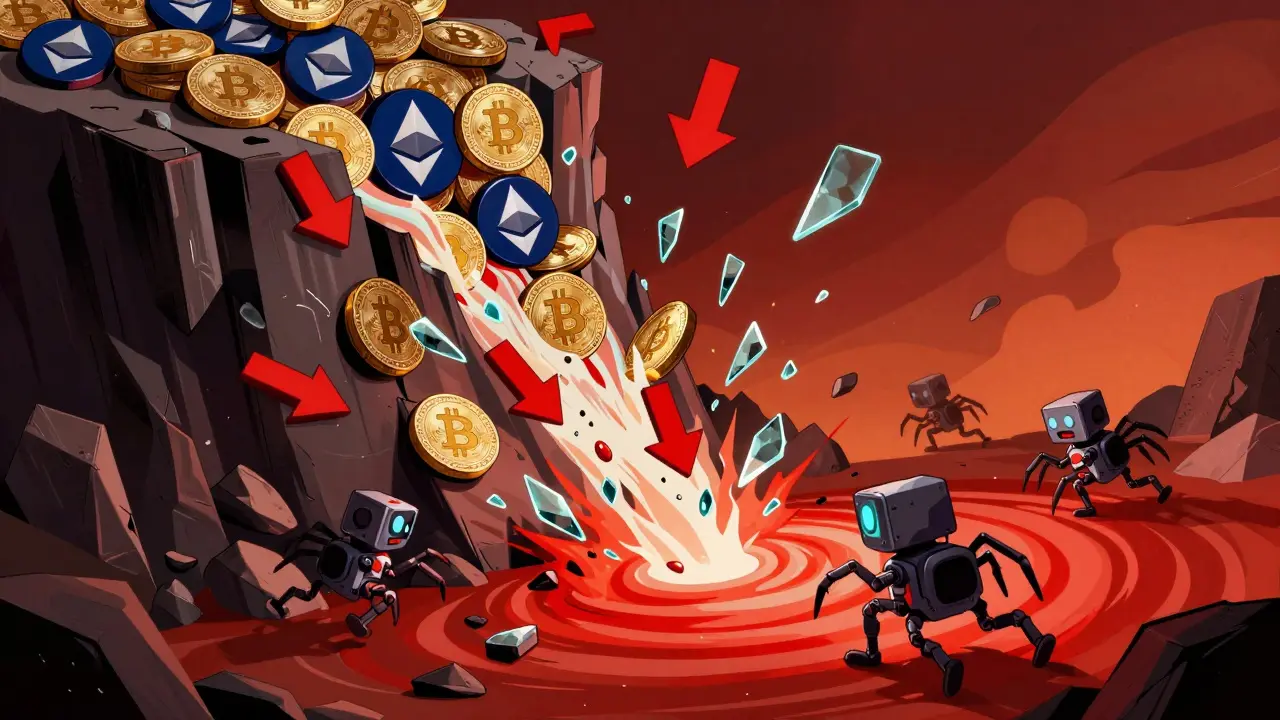
This led to a cascade of liquidations totaling approximately $2.23 billion in a short period. Of this amount, $1.88 billion consisted of long positions-bets that prices would rise-that were forcibly closed by exchanges. As these positions were liquidated, they added more sell orders to the market, driving prices down further, which triggered even more liquidations. Ben Kurland, CEO of the research platform DYOR, described this dynamic perfectly: "In crypto, conviction is high but liquidity is thin - which is why moves down feel like free falls, while recoveries grind back more slowly." The feedback loop meant that small declines became avalanches.
| Asset | Pre-Crisis High (Jan 2025) | Crisis Low (Apr 2025) | Percentage Drop |
|---|---|---|---|
| Bitcoin (BTC) | $100,000+ | $77,500 | ~22.5% |
| Ethereum (ETH) | $4,500+ | <$4,000 | ~12%+ (weekly) |
| Solana (SOL) | Highs | Low | >50% |
| Total Market Cap | $3 Trillion (Q4 2021 peak context) | $1.5 Trillion | Significant Contraction |
Structural Weaknesses in DeFi
Beyond the immediate trigger, the crisis highlighted deeper structural issues within the Decentralized Finance (DeFi) sector. Arthur Breitman, co-founder of Tezos, pointed out a critical vulnerability: the "circular" nature of the crypto economy. Many DeFi protocols do not generate revenue from external sources like traditional businesses do. Instead, they rely on self-sustaining liquidity mechanisms, such as yield farming rewards backed by newly minted tokens or fees generated within the same closed loop.
When external liquidity contracts, these circular systems struggle to maintain stability. If users withdraw funds faster than new entrants provide them, the protocol’s reserves shrink, leading to higher borrowing costs and potential insolvency. This interdependence means that a shock in one part of the DeFi ecosystem can quickly spread to others. Smart contract vulnerabilities and bridge exploits during the crisis period further undermined confidence, as hackers targeted weakened protocols, causing additional losses and panic.

Regulatory Uncertainty and Macro Pressures
While liquidity mechanics drove the technical collapse, sentiment played a crucial role. Investors had entered 2025 with optimism following Donald Trump’s election victory in November 2024, anticipating pro-crypto policies. However, the reality proved more complex. Despite campaign promises, concrete implementations like a strategic Bitcoin reserve or a dedicated crypto council remained delayed through early 2025. This gap between expectation and reality created nervousness among institutional players.
Compounding this uncertainty were broader macroeconomic pressures. Inflation rates climbed, and the introduction of new U.S. tariffs on imports from Mexico, Canada, and China in February 2025 disrupted global trade flows. These factors contributed to a general shift toward risk aversion. The Fear Sentiment Index, constructed using Google Trends data, showed a direct correlation between heightened retail anxiety and price volatility. As social media discussions highlighted widespread panic selling, many retail investors who had entered during the bullish phase found themselves facing substantial losses, forcing them to sell at unfavorable prices.
Lessons Learned and Future Resilience
The 2025 liquidity crisis serves as a stark reminder that cryptocurrency markets are not isolated from traditional finance. They are deeply interconnected, reacting swiftly to changes in monetary policy, regulatory landscapes, and global economic health. For traders, the lesson is clear: leverage amplifies both gains and losses, especially in thin markets. Overleveraged positions are vulnerable to cascading liquidations that can wipe out accounts regardless of long-term price direction.
For developers and protocol designers, the crisis underscores the need for more resilient liquidity infrastructure. Relying solely on internal tokenomics is risky. Protocols must integrate external revenue streams and robust risk management tools to withstand shocks. Institutional adoption, while growing, proved insufficient to stabilize the market during extreme stress, indicating that deeper structural reforms are necessary.
As markets adapt to reduced leverage availability and heightened regulatory scrutiny, volatility is likely to persist. However, each crisis also presents opportunities for stronger foundations. By addressing the fragilities exposed in 2025, the crypto ecosystem can build greater resilience against future external shocks. Understanding liquidity dynamics is no longer optional-it is essential for anyone participating in digital asset markets.
What caused the 2025 crypto liquidity crisis?
The primary trigger was the U.S. Treasury's refill of the Treasury General Account (TGA), which drained $500-600 billion from the financial system. This was compounded by regulatory uncertainty, rising inflation, new trade tariffs, and structural weaknesses in DeFi protocols that rely on circular liquidity models.
How did the TGA refill affect crypto prices?
The TGA refill removed significant liquidity from the banking system, causing institutions to tighten their balance sheets. Since crypto markets are sensitive to global liquidity conditions, this led to rapid selling pressure, triggering a cascade of liquidations and sharp price declines across major assets like Bitcoin and Ethereum.
Why are crypto markets more volatile than traditional stocks?
Crypto markets rely heavily on algorithmic trading and leveraged derivatives rather than deep institutional market makers. This results in thinner liquidity, meaning large sell orders can cause disproportionate price drops. Additionally, automated liquidation mechanisms create feedback loops that amplify downward movements.
What role did DeFi play in the crisis?
Many DeFi protocols operate on circular liquidity models, relying on internal tokens and yield farming rather than external revenue. When external liquidity dried up, these systems struggled to maintain stability, leading to higher borrowing costs and increased vulnerability to smart contract exploits and user withdrawals.
How much money was lost during the liquidation cascade?
During the peak of the crisis, over $3 billion in long positions were liquidated across exchanges. Specifically, $2.23 billion in liquidations occurred in a short window, with $1.88 billion representing forced closures of long bets as prices fell below key support levels.
Will crypto markets recover after a liquidity crisis?
Historically, yes, but recovery is often slower than the decline. As noted by experts, "moves down feel like free falls, while recoveries grind back more slowly." Long-term viability depends on implementing better liquidity provisioning mechanisms and reducing reliance on fragile, self-referential protocols.






mark valmart
May 30, 2026 AT 05:45Man, reading this just brings back the panic of 2018 all over again. It is honestly heartbreaking to see how many people lost their savings because they didn't understand that liquidity isn't magic. We keep forgetting that crypto is still a tiny drop in the ocean compared to traditional finance. When the big players pull out, we get crushed like ants. I really hope people take this as a lesson to hold spot assets and stop leveraging up on thin markets. It's not about being smart, it's about surviving.
Crystal Davis
May 31, 2026 AT 22:56You are clearly missing the bigger picture here if you think the TGA refill was the main culprit. That is amateur hour analysis. The real issue is the fundamental flaw in DeFi tokenomics which creates circular liquidity traps that collapse under any minor stress. Retail investors blame macro factors because they lack the intellectual capacity to understand smart contract risks and yield farming mechanics. The market doesn't care about your feelings or government accounts; it cares about supply and demand dynamics driven by sophisticated algorithmic trading bots that exploit your emotional weakness. Stop crying about 'liquidity' and start learning how order books actually work.
Eric Grosso
June 2, 2026 AT 11:17wait so ur saying the gov pulling money from the bank makes crypto go down? thats kinda wild when u think about it. i always thought crypto was supposed to be separate from fiat systems lol. but yeah i remember seeing my portfolio bleed out in minutes during that april crash. felt like watching paint dry but in reverse and with more screaming.
Edith Mair
June 3, 2026 AT 17:50Let’s cut through the noise. The article states facts, but people ignore them until they lose money. The TGA refill drained $600 billion. Do you have any idea what that does to risk assets? It’s basic economics. If you’re trading leverage in a vacuum, you deserve to get wrecked. The system is designed to flush out weak hands. If you can’t handle a 20% drop without panicking, you shouldn’t be in this space. Wake up and pay attention to macro indicators instead of chasing memes.
Bill Gunn
June 4, 2026 AT 16:38Hey folks! 🌟 Just wanted to add some context here because I’ve been tracking these metrics for years. The thing about the TGA refill is that it acts like a sponge 🧽 sucking up cash from the banking system. When banks have less excess reserves, they lend less, and speculative capital dries up fast. 💸 In crypto, where market makers are often algorithms rather than humans, this leads to those scary 'flash crashes.' It’s not personal; it’s math! 📉 My advice? Always keep a dry powder stash and never use more leverage than you can afford to lose. Stay safe out there! 🚀🛡️
Christina Pearce
June 6, 2026 AT 05:59I appreciate Bill breaking that down so clearly. It really helps to visualize the mechanism behind the crash. I was one of those who got caught up in the hype earlier this year and didn't realize how interconnected everything is. It’s scary to think that a government accounting move could wipe out billions in value overnight. I’m definitely going to stick to long-term holding now and avoid derivatives. Thanks for the gentle reminder everyone.
Miss Masquer
June 8, 2026 AT 00:42It is fascinating to observe how the global financial architecture continues to exert its gravitational pull upon decentralized networks, despite our collective aspirations for autonomy, and one must consider that the psychological impact of such sudden wealth erosion is profound, affecting not merely individual portfolios but the broader social fabric of communities that rely on digital assets for livelihoods, thereby necessitating a deeper dialogue about resilience and education within these spaces, as we navigate an era where traditional monetary policy decisions ripple through blockchain ecosystems with unprecedented speed and intensity, challenging our perceptions of security and stability in an increasingly digitized world economy.
Joshua Alcover
June 8, 2026 AT 06:11The epistemological crisis inherent in the current paradigm is exacerbated by the hegemonic dominance of centralized fiscal policies, wherein the Treasury General Account functions as a vector for systemic entropy, thereby precipitating a cascade of ontological instability within the cryptographic substrate. This phenomenon elucidates the fragility of decentralized autonomous organizations when subjected to exogenous macroeconomic shocks, suggesting that the purported sovereignty of blockchain technology is merely a simulacrum of independence, ultimately subservient to the coercive power structures of nation-states. One must interrogate the dialectical tension between state-controlled liquidity and market-driven valuation to comprehend the true nature of this financial alchemy.
Diana Morris
June 9, 2026 AT 05:40stop whining and start buying the dip guys its a sign of weakness if you cant handle volatility get out now and come back when you have spine this market rewards the bold not the timid fear is your enemy act now before prices recover and you miss out forever
Dianne Wright
June 10, 2026 AT 10:30i feel so exhausted just reading all these explanations because nobody seems to get it that we are all just pawns in a game rigged against us and its depressing to watch people argue about technicalities while the rest of us are drowning in debt and loss why do we even bother trying when the system is designed to crush us every time we think we made it