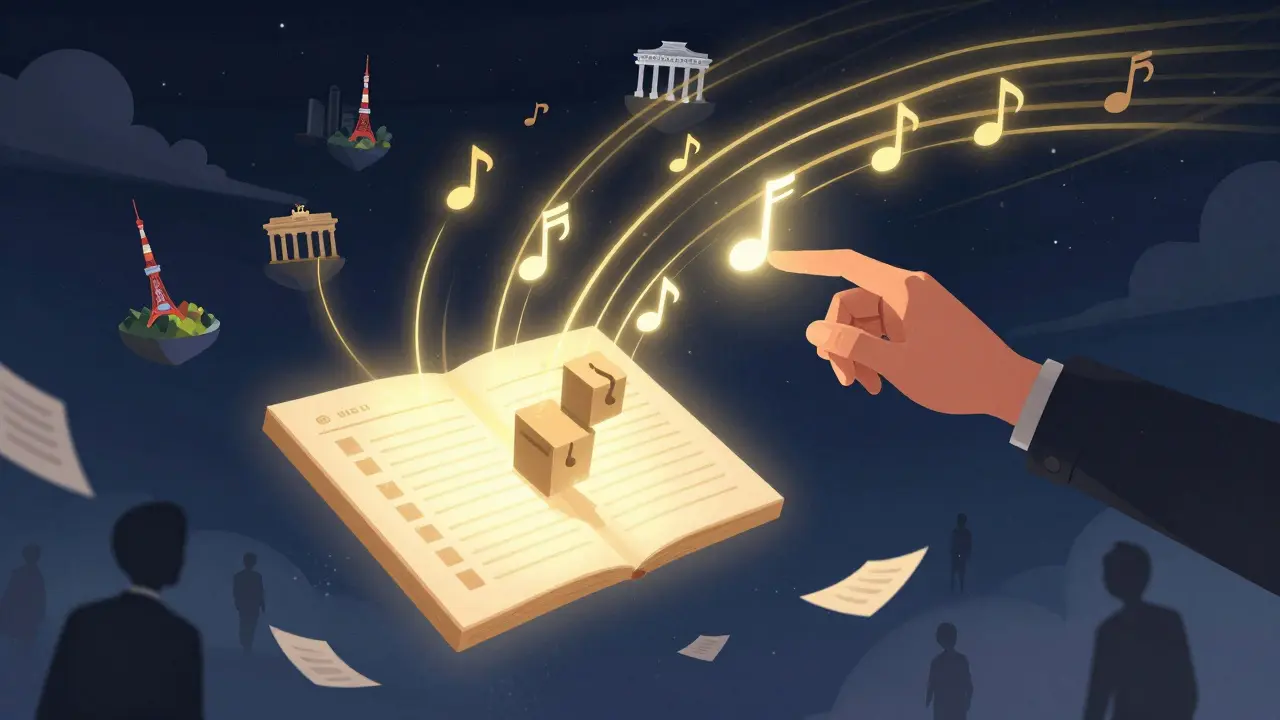
Imagine you’re a musician who just finished a new song. You upload it online, and within seconds, a blockchain record is created-timestamped, unchangeable, and linked to your digital identity. No lawyer needed. No waiting months for copyright approval. Just proof, instantly, that you created it. This isn’t science fiction. It’s happening now.
Why Traditional IP Systems Are Failing
For decades, protecting intellectual property meant filing paperwork with national offices: patents with the USPTO, copyrights with the Library of Congress, trademarks with regional bureaus. Each step cost hundreds or thousands of dollars. Each took months. And each was limited to one country. If your artwork went viral in Japan or your software was copied in Brazil, you had to start over-again and again.Today, digital content moves faster than any legal system can keep up. AI-generated images, NFT art, open-source code, and viral TikTok beats are created daily. But the legal tools to defend them? They’re stuck in the 1990s. Court cases drag on for years. Proving who created what first? Nearly impossible without a paper trail. And counterfeiters? They exploit the gaps.
How Blockchain Solves the Core Problems
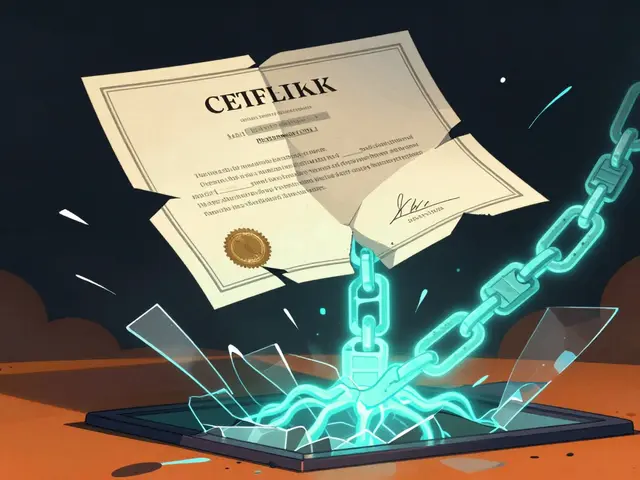
Blockchain doesn’t just digitize paperwork-it rebuilds the system from the ground up. Here’s how:- Immutable timestamps: Every creation is recorded with a cryptographic hash and time stamp. Alter it? The chain breaks. Fake it? The system rejects it.
- Decentralized registries: No single government or agency controls the records. They’re stored across hundreds of nodes worldwide. Even if one server goes down, the proof remains.
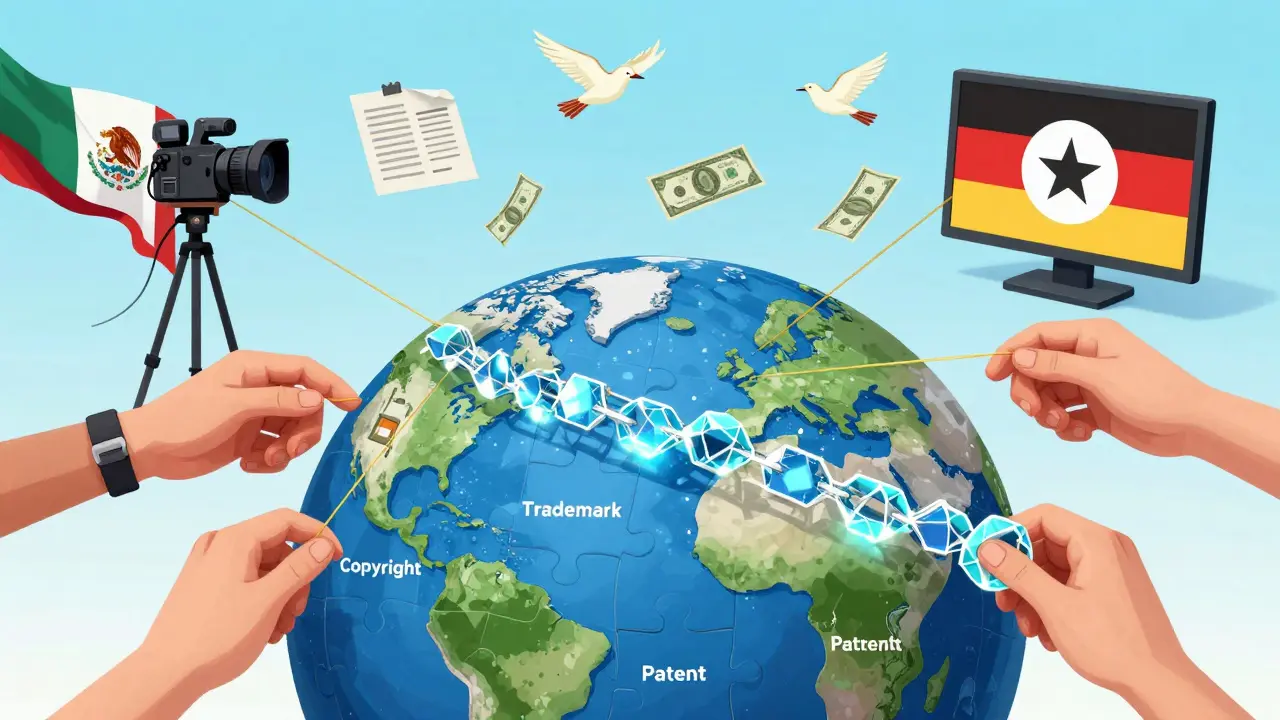
- Global access: A creator in Nairobi can register a patent and have it recognized in Berlin, Tokyo, or Santiago without filing in each country separately.
Take trademark protection. In 2025, a fashion brand in Los Angeles used blockchain to log its logo. Within hours, AI tools scanned global marketplaces and flagged 17 counterfeit listings in China, Indonesia, and Poland. The system automatically sent takedown notices via smart contract. No lawyers. No delays. Just enforcement.
Smart Contracts: The Automatic Royalty Engine
One of the biggest wins? Royalty payments. Right now, artists, writers, and inventors wait months-or never get paid-because licensing is manual, fragmented, and full of middlemen.Blockchain changes that. Smart contracts are self-executing agreements coded into the blockchain. If someone uses your song in a video game, the contract detects the usage, calculates the fee, and sends payment directly to your wallet-no bank, no invoice, no dispute.
For example, a documentary filmmaker in Mexico registered her footage on a blockchain platform. A German streaming service used a clip in a commercial. The smart contract triggered: 12% royalty, $870, sent instantly. No paperwork. No follow-up. Just clean, automatic compensation.
Tokenizing IP: Turning Ideas Into Tradeable Assets
Think of intellectual property as a house. Traditionally, you could only sell the whole thing. Now, blockchain lets you sell shares.IP tokenization turns patents, copyrights, or trademarks into digital tokens-like stocks. A startup with a unique AI algorithm can tokenize its patent and sell 10% of it to investors worldwide. No venture capital pitch. No equity dilution drama. Just a token on a blockchain.
By early 2026, platforms like IPwe and KODA are already handling thousands of tokenized IP assets. A pharmaceutical company in Boston sold 25% of a drug patent as tokens. Buyers from Singapore, Canada, and Germany bought in. The company raised $4.2 million in 72 hours. No IPO. No legal team. Just blockchain.
Patents, Copyrights, and Trademarks-All on Chain
Let’s break it down by type:| IP Type | Traditional Process | Blockchain Process |
|---|---|---|
| Copyright | File with national office. Wait 6-12 months. Pay $45-$125. Limited to one country. | Upload digital file. Get timestamped hash. Instant global proof. Cost under $5. |
| Trademark | Apply through national registry. Risk of opposition. 18-24 months. $250-$400 per class. | Register logo/name on public ledger. Real-time monitoring. Detect counterfeits automatically. |
| Patent | Submit detailed application. Wait 2-5 years. $1,000-$15,000 in fees. High rejection rate. | Record invention timeline on chain. Prove priority date. Enable open collaboration with secure audit trail. |
Patent offices are starting to take notice. In 2024, WIPO launched its Blockchain Task Force to build global standards. By 2026, over 12 countries are testing blockchain-based patent filing systems. The goal? Cut patent approval time from years to days.
The AI + Blockchain Power Combo
Blockchain alone is powerful. Add artificial intelligence? It becomes unstoppable.AI can scan millions of online files, videos, and code repositories to find copies of protected work. It learns patterns: “This 3-second melody matches a registered track.” “This logo has been altered but still infringes.” “This code snippet matches a patented algorithm.”
Companies like Vero and Verisart are already using this combo. A photographer in Berlin uploaded 8,000 images to a blockchain registry. AI tools scanned Instagram, Pinterest, and Alibaba. Within weeks, they found 214 unauthorized uses. Each one triggered a smart contract notice. The photographer collected $3,800 in royalties automatically.
Challenges Still Standing in the Way
This isn’t magic. There are real hurdles:- Legal recognition: Courts still don’t universally accept blockchain records as legal proof. A timestamp means nothing if a judge won’t recognize it.
- Interoperability: There are dozens of blockchain platforms. If your IP is on Ethereum but the licensee uses Solana, they can’t talk to each other.
- Technical access: Most creators don’t know how to use wallets, hashes, or smart contracts. The tools need to be as simple as uploading a photo.
- Enforcement: Blockchain proves ownership. It doesn’t stop a pirate. You still need courts, customs, and police to act.
But these aren’t dead ends-they’re growing pains. The same issues slowed digital payments in the early 2000s. Now, they’re routine.
The Road Ahead: What Happens Next?
By 2027, expect three big shifts:- Standardization: WIPO and the EU are drafting global blockchain IP standards. Think of them like HTTP for IP rights.
- Integration: Major platforms-YouTube, Etsy, GitHub, Adobe-will embed blockchain verification directly into their upload flows.
- Regulation: Governments will pass laws recognizing blockchain timestamps as prima facie evidence in IP disputes.
The shift isn’t about replacing lawyers. It’s about removing the friction that made IP protection a luxury for big companies. Now, a single mom in Detroit who designs jewelry, a coder in Lagos building open-source tools, a poet in Manila publishing digital poems-they all get the same tools as Apple or Nike.
The future of IP isn’t about more paperwork. It’s about less noise. More clarity. More fairness. And it’s built on code, not courtrooms.
Can blockchain really replace copyright offices?
Not replace-augment. National offices still handle legal disputes and enforce rulings. But blockchain now provides the instant, global proof of ownership that those offices used to take months to verify. Think of it as the digital receipt you get before filing the official claim. Many countries are already accepting blockchain timestamps as evidence in court.
Is blockchain IP protection only for digital content?
No. While it’s easiest for digital files like music, art, and code, blockchain is now used for physical inventions too. A pharmaceutical company can record the development timeline of a drug molecule on-chain. A mechanical engineer can timestamp blueprints for a new engine design. The blockchain doesn’t care if the invention is digital or physical-it records the proof of creation, not the object itself.
What happens if I lose my private key for my blockchain IP record?
You lose control of that specific record. That’s why reputable platforms now offer recovery options: multi-sig wallets, trusted custodians, or backup phrases stored securely. Some services even integrate with legal entities so your IP can be transferred to an heir or estate if you’re incapacitated. It’s not perfect, but it’s better than losing a paper file in a fire.
Can I use blockchain to protect my AI-generated work?
Yes, but with a caveat. Some countries (like the U.S.) still require human authorship for copyright. But blockchain can still timestamp your AI-generated work and prove when and how it was created. This matters because it helps you show your role in the process-selecting prompts, editing outputs, training models. In legal disputes, that evidence can be decisive.
Are blockchain IP records cheaper than traditional methods?
Far cheaper. Registering a copyright with the U.S. Copyright Office costs $45-$125. On a blockchain platform, it’s $1-$5. Trademark registration? $250-$400 in the U.S. Blockchain? $10-$30. And you get global coverage. The savings add up fast-especially for indie creators who register dozens of works a year.
Do I need to be a tech expert to use blockchain for IP?
No. Platforms like IPwe, KODA, and Verisart have simplified the process to just upload, click, and confirm. You don’t need to understand hashes or wallets. It’s like using PayPal-you just need to know how to press a button. The complexity is hidden under the hood.
What if two people register the same IP on different blockchains?
That’s why standardization matters. Right now, it’s a risk. But platforms are adopting interoperability protocols like IPFS and W3C standards to link records across chains. In the future, courts will look at the earliest timestamp across verified chains-not just one platform. The system is designed to favor the first authentic claim, not the loudest one.
Final Thought: This Isn’t a Trend. It’s Infrastructure.
Blockchain for IP protection isn’t about crypto hype. It’s about fixing a broken system. Every time someone has to wait six months to prove they created something, or loses money because a license wasn’t paid, the system fails. Blockchain doesn’t fix every problem-but it fixes the ones that mattered most: speed, cost, access, and proof.The next generation of creators won’t ask, “How do I register my copyright?” They’ll ask, “Which platform do I use to protect my work?” And the answer will be simple: the one that works instantly, globally, and without a middleman.