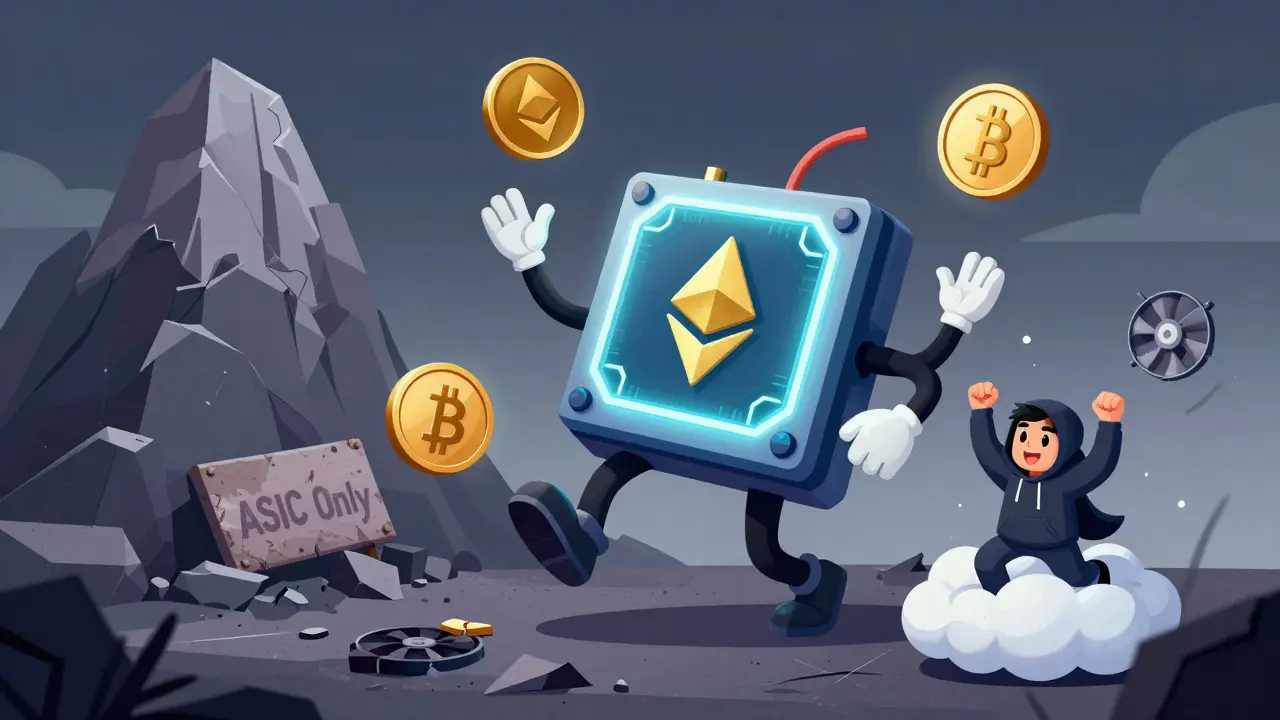
When you start mining cryptocurrency, the first big decision isn’t which coin to mine-it’s what hardware to use. Two options dominate the field: GPU mining and ASIC mining. They’re not just different tools-they’re completely different approaches to mining. One is flexible, affordable, and familiar. The other is powerful, expensive, and single-purpose. Choosing the wrong one can cost you thousands-or leave you stuck with useless hardware.
What Exactly Is ASIC Mining?
ASIC stands for Application-Specific Integrated Circuit. These are chips built for one thing only: mining a specific cryptocurrency using one algorithm. The most common example is Bitcoin mining, which uses the SHA-256 algorithm. ASICs like the Bitmain Antminer S21 Hydro can hit 335 terahashes per second (TH/s), while consuming just over 5,000 watts of power. That’s roughly 16 times more hash power than the most powerful GPU, but with a fraction of the energy per hash.ASICs aren’t computers. They don’t run operating systems or open apps. They’re essentially specialized calculators built to solve cryptographic puzzles faster than anything else. That’s why they’re so efficient. But that same specialization is their biggest weakness. If you buy an ASIC for Bitcoin, you can’t suddenly mine Ethereum Classic or Ravencoin. If Bitcoin’s algorithm changes-or if the coin becomes unprofitable-you’re stuck. Your $8,000 machine becomes a very expensive paperweight.
What Exactly Is GPU Mining?
GPUs-graphics processing units-were made for rendering video games and 3D graphics. But their ability to handle thousands of calculations at once made them perfect for mining cryptocurrencies that use memory-heavy algorithms like Ethash (used by Ethereum Classic) or Equihash (used by Zcash).A single high-end GPU like the NVIDIA RTX 4090 can generate around 120 MH/s on Ethereum Classic. That’s nowhere near ASIC speeds, but here’s the catch: you can use the same card to mine 10 different coins just by switching mining software. If Ethereum Classic’s price drops, you flip to Ravencoin. If that drops, you switch to Monero. You’re not locked in. And if mining stops being profitable? You can sell it to a gamer, use it for AI training, or run it as a home rendering rig.
Performance and Efficiency: The Numbers Don’t Lie
Let’s compare real-world numbers from 2025 hardware:| Device | Hash Rate | Power Consumption | Cost (USD) | Algorithm |
|---|---|---|---|---|
| Bitmain Antminer S21 Hydro | 335 TH/s | 5,360 W | $8,500 | SHA-256 (Bitcoin) |
| Bitmain Antminer L11 Pro | 21 GH/s | 3,612 W | $4,200 | Scrypt (Litecoin) |
| NVIDIA RTX 4090 | 120 MH/s | 450 W | $1,600 | Ethash (Ethereum Classic) |
| Bitmain Antminer Z15 | 420 KSol/s | 1,510 W | $3,800 | Equihash (Zcash) |
ASICs crush GPUs in raw power. But look at the power-per-hash ratio. The S21 Hydro mines Bitcoin at about 0.016 watts per gigahash. The RTX 4090 mines Ethereum Classic at about 3.75 watts per gigahash. That’s over 200 times less efficient. If you’re mining Bitcoin at scale, ASICs win by miles. But if you’re mining altcoins or just starting out, GPUs give you more control and lower risk.
Profitability: It’s Not Just About Hardware
Profitability isn’t just about hash rate. It’s about electricity cost, mining difficulty, coin price, and how long your hardware lasts.ASIC miners have a faster return on investment-if you have cheap power. In places like Texas, Georgia, or parts of Canada, where electricity is under $0.06/kWh, an ASIC can pay for itself in 6-9 months. But if your power bill is $0.15/kWh or higher? You’re losing money unless you’re mining at industrial scale.
GPU miners don’t have that same speed. A single RTX 4090 might take 18-24 months to break even on Ethereum Classic. But here’s the advantage: you’re not tied to one coin. You can switch to whatever’s most profitable that week. In late 2024, miners switched from Ethereum Classic to Ravencoin overnight because the price spiked. ASIC miners couldn’t react. They had to wait for the market to shift back.
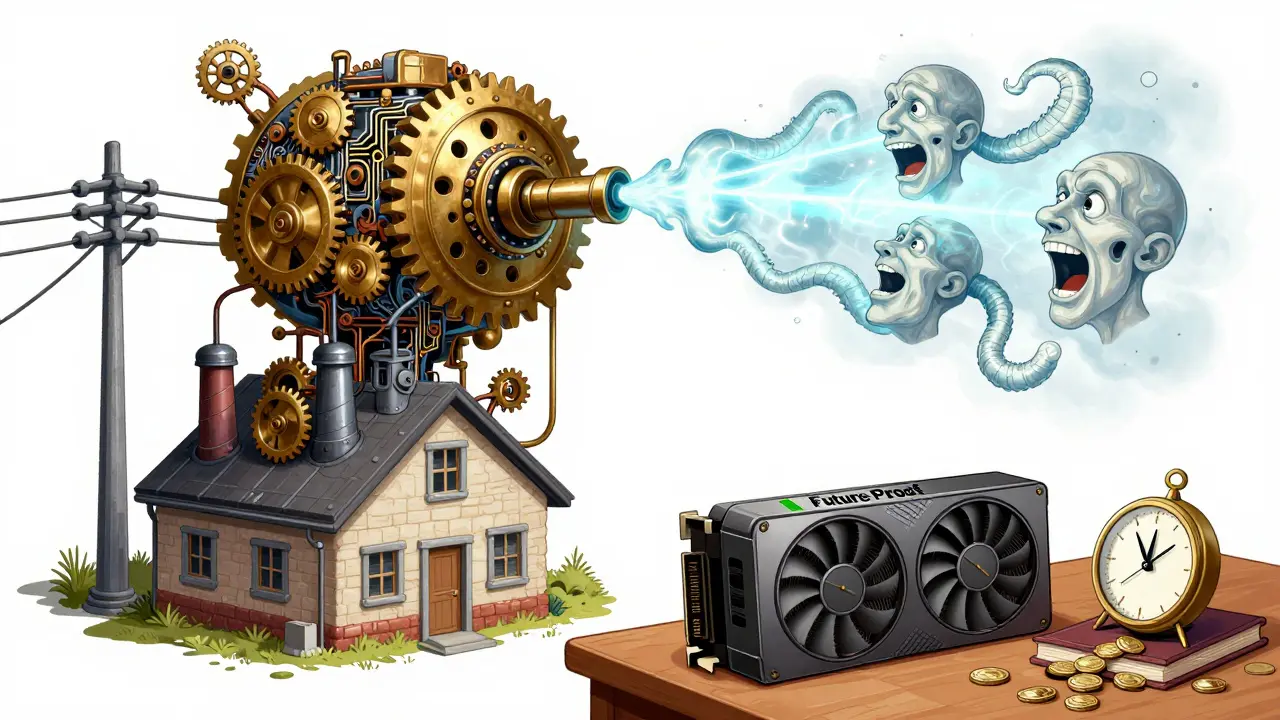
Flexibility: The Hidden Advantage of GPUs
This is where GPUs win by default. You’re not just mining-you’re using hardware that has value beyond crypto.Think about it: if you buy a $1,600 GPU and mining stops working tomorrow, you can still use it to play Cyberpunk 2077, render videos in Premiere Pro, or train a small AI model. You can even sell it on eBay for $1,200-$1,400. That’s a 20-25% loss at worst.
Now imagine buying a $8,500 ASIC for Bitcoin. If Bitcoin’s difficulty spikes too fast, or if a new ASIC model comes out that’s 30% more efficient, your machine’s resale value drops to $2,000. And good luck finding a buyer. Most people don’t want a noisy, power-hungry box that only mines one coin.
Many GPU miners even run dual mining setups-mining two coins at once using the same card. For example, mining Ethereum Classic and TON simultaneously. ASICs? No way. They’re single-purpose machines.
Infrastructure and Setup: Who Can Actually Do This?
Setting up a GPU mining rig is something you can do in your garage or spare room. You plug in 4-6 graphics cards, connect them to a power supply, install mining software, and go. Noise? Yes. Heat? Definitely. But you can manage it with fans and open windows.ASIC mining? That’s industrial. A single Antminer S21 Hydro draws over 5,000 watts. That’s more than most home air conditioners. You need a dedicated 240V circuit. You need cooling systems. You need to worry about fire codes, noise ordinances, and your electric bill jumping $500 a month. Most home miners who try ASICs end up moving their rigs to warehouses or rented server farms-adding hundreds more in monthly costs.
GPU mining is for hobbyists, small teams, and people who want to learn. ASIC mining is for companies with investors, legal teams, and data center engineers.
Obsolescence and Long-Term Risk
The crypto mining world moves fast. New algorithms. New coins. New hardware. ASICs are designed to be replaced every 12-18 months. That’s why most ASIC manufacturers release new models every 6 months. If you buy an Antminer D9 for Dash in 2025, it might be obsolete by mid-2026.GPUs? They last 3-5 years. Even after mining stops being profitable, they still work for gaming, rendering, or AI. NVIDIA and AMD keep releasing new drivers and optimizations. That’s not true for ASICs. Once a chip is outdated, there’s no upgrade path. No software update can make an old ASIC mine faster.
That’s why many experienced miners say: “Buy GPUs if you want to stay in the game long-term. Buy ASICs if you want to make money fast and get out.”

Who Should Mine With GPUs?
- You’re new to mining and want to learn without risking $10,000. - You want to mine altcoins like Ethereum Classic, Ravencoin, or Zcash. - You’re not sure which coin will be profitable next month. - You have a decent home power setup (under $0.12/kWh). - You want to use your hardware for other things later.Who Should Mine With ASICs?
- You’re mining Bitcoin, Litecoin, or another SHA-256/Scrypt coin at scale. - You have access to electricity under $0.06/kWh (industrial rates). - You can afford to invest $5,000-$10,000 upfront. - You’re okay with being locked into one coin and one algorithm. - You have space for industrial cooling and power infrastructure.The Bottom Line
There’s no single “best” choice. It depends on your goals, your budget, and your risk tolerance.If you want flexibility, lower risk, and the ability to adapt to market changes, go with GPUs. They’re the smart choice for most people who aren’t running a mining farm.
If you have cheap power, deep pockets, and you’re betting everything on Bitcoin or Litecoin, then ASICs make sense. But you’re playing a high-stakes game. One wrong move-and your hardware becomes worthless.
For 2026, the trend is clear: ASICs dominate the big coins. GPUs dominate the altcoins and the future. Most serious miners use both-but only after they’ve mastered one.
Can I mine Bitcoin with a GPU?
Technically, yes-but you won’t make any money. Bitcoin’s mining difficulty is so high that even the most powerful GPU today would take over 100 years to mine a single block. ASICs are the only practical way to mine Bitcoin profitably today. GPUs are useless for Bitcoin mining in 2026.
Can I mine Ethereum with a GPU?
No, not Ethereum. Ethereum switched to proof-of-stake in 2022 and stopped allowing mining. But you can still mine Ethereum Classic (ETC), which uses the same Ethash algorithm and remains GPU-friendly. Many miners still use GPUs for ETC, Ravencoin, and other coins that resist ASIC dominance.
Are ASICs worth it for beginners?
No. ASICs require serious upfront investment, infrastructure, and technical knowledge. If you’re just starting out, you’re better off with a single GPU. You’ll learn how mining works, test profitability, and avoid losing thousands on hardware you can’t repurpose.
How long do ASICs last before becoming obsolete?
Most ASICs are profitable for 12-18 months before newer, more efficient models hit the market. After that, their profitability drops fast. Many ASICs become unprofitable within 2 years, even if they still technically work. Resale value plummets, and finding buyers becomes difficult.
Is GPU mining still profitable in 2026?
Yes, but only if you mine the right coins and have low electricity costs. Coins like Ethereum Classic, Ravencoin, and Monero are still viable with GPUs. Profitability changes weekly, so successful GPU miners constantly switch between coins based on market conditions. It’s not passive income-it’s active trading with hardware.
Can I use my old mining GPU for gaming?
Absolutely. Mining doesn’t damage GPUs if they’re kept cool and not overclocked beyond limits. Most GPUs used for mining for 1-2 years still perform like new in games. Many gamers buy used mining cards because they’re cheaper than new ones and still have plenty of life left.
What’s the most profitable coin to mine with a GPU in 2026?
As of early 2026, Ethereum Classic (ETC) is the most consistently profitable GPU-mineable coin. It’s ASIC-resistant, has stable network difficulty, and trades at a solid price. Ravencoin and Zcash are also strong contenders, but ETC offers the best balance of profitability, stability, and community support.




george haris
January 20, 2026 AT 05:33Man, I started with a 3060 last year and just switched to ETC last month-made back my money in 11 weeks. The real win? I still play Cyberpunk on it when I’m not mining. ASICs? Nah, I’d rather not be stuck with a brick that only does one thing.
Paru Somashekar
January 21, 2026 AT 01:53Thank you for this comprehensive analysis! 🙏 Indeed, GPU mining offers remarkable adaptability in volatile markets. In India, where electricity costs hover around $0.08/kWh, GPUs remain a prudent entry point for beginners. ASICs require institutional backing-individuals are better served by flexible hardware. Keep sharing such insights! 💡
Steve Fennell
January 22, 2026 AT 16:56Love this breakdown. 🙌 I’ve got a 4090 running ETC and Zcash dual-mining in my basement-noise is a pain, but the resale value? Still 80% of what I paid. I’ve seen friends drop $8K on Antminers… then watch them sit there like fancy space heaters when Bitcoin dipped. Not worth it unless you’ve got a data center and a lawyer on speed dial.
Heather Crane
January 24, 2026 AT 03:12YES! YES! YES! This is exactly what I’ve been saying for months!! GPUs are the future-flexible, reusable, and honestly… kinder to your soul!! I switched from ASIC to GPU last year and my stress levels dropped 70%!! You’re not just mining-you’re building a portfolio of hardware that can evolve!! And if mining crashes? You’ve got a gaming rig, a rendering beast, a learning tool for AI!! I’m so glad someone finally said this out loud!! 🙌💖✨
Catherine Hays
January 25, 2026 AT 09:41GPU miners are just delusional. If you can't afford an ASIC you're not serious. Bitcoin is the only coin that matters. All these altcoin miners are just gambling with their electricity bills. Your 4090 is a glorified toaster. Stop pretending it's an investment. You're wasting time and power. Get real.
Arielle Hernandez
January 26, 2026 AT 23:57Thank you for the detailed and well-structured overview. The data presented is consistent with recent industry reports from CoinWarz and CryptoCompare. Notably, the power efficiency differential between ASICs and GPUs remains substantial, with ASICs achieving 0.015–0.020 W/GH for SHA-256, versus 3.5–4.0 W/GH for Ethash on modern GPUs. Additionally, the secondary utility of GPUs-particularly in AI inference tasks-is increasingly valuable as consumer-grade LLMs become more accessible. This dual-use capability significantly improves the TCO (total cost of ownership) for GPU miners, especially in jurisdictions with higher electricity rates. A nuanced perspective, indeed.
HARSHA NAVALKAR
January 27, 2026 AT 04:19ASICs are for big boys. I tried GPU mining. My room got hot. My bill went up. I got scared. Now I just buy Bitcoin. Easier. Less noise. No cards. No fans. No worries.
Ryan Depew
January 27, 2026 AT 17:58Guys, the real answer? Neither. Just buy the coin. Mining in 2026 is a hobby for masochists with a love for electricity bills and loud fans. I had a 3080, made $120 in three months, spent $200 on my power bill. Then I bought $1,500 worth of ETC and called it a day. The hardware? Sold it for $900 on FB Marketplace. Best decision I ever made. Don’t mine. Just HODL.