If you are hunting for the next big crypto windfall, you might have stumbled upon Genshiro is a decentralized finance platform operating on the Kusama network designed to provide comprehensive DeFi functionality with reduced risk through cross-chain interoperability. The name pops up in forums and old news feeds, often tied to promises of free tokens. But here is the hard truth: the major Genshiro airdrops happened years ago. If you are looking to claim GENS tokens right now, you need to understand exactly what went down in the past, why the price has shifted so dramatically, and whether there is any future value in this ecosystem.
We are going to break down the mechanics of the historical distributions, specifically the campaigns on MEXC and Gate.io. We will also look at the current state of the GENS token, its price action since 2022, and what the project’s roadmap actually means for users today. This isn’t just about nostalgia; it is about understanding how these distribution models work so you don’t get caught off guard by similar projects in the future.
The Big Distributions: What Actually Happened?
To understand the Genshiro airdrop landscape, we have to look back at two specific events. These were not simple "connect wallet and claim" snapshots. They required active participation, which changed who got the tokens and how much they were worth at the time.
The most documented event took place on MEXC is a cryptocurrency exchange that hosted a significant voting-based airdrop for Genshiro tokens in January 2022. In January 2022, MEXC ran a campaign where users could vote to earn rewards. The total pool was 885,000 GENS tokens. At the time, the reference price was set at $0.063 per token. That put the total value of the reward pool at roughly $55,755. It sounds like a lot, but let’s look at the rules.
You couldn’t just click a button. You had to hold MX tokens, the native utility token of the MEXC exchange. Here is how the mechanic worked:
- Voting Period: The window was tight. It opened on January 22, 2022, at 04:00 UTC and closed at 10:50 UTC. Trading started later that day at 14:00 UTC.
- Requirements: You needed a minimum of 10 votes to qualify. There was a cap of 500,000 MX tokens per user for voting purposes.
- Lock-up Mechanism: When you voted, your MX tokens were temporarily locked. They unlocked within one hour after the event ended. This allowed savvy traders to vote multiple times if they managed their liquidity carefully before the final cutoff.
This model filtered out passive holders. If you weren’t actively trading or holding MX on MEXC during that specific six-hour window, you missed out. It was an engagement-based distribution, not a passive snapshot.
Then there was the Gate.io is another major exchange that conducted a Startup Free Offering for Genshiro, distributing over 1.2 million tokens. campaign. Gate.io distributed a larger pool of 1,277,825 GENS tokens through their Startup Free Offering program. While specific voting mechanics weren’t as publicly detailed as the MEXC event, this represented a massive injection of supply into the market. Combined, these two exchanges distributed over 2.1 million GENS tokens to the public.
The Price Reality Check: From $0.06 to Pennies
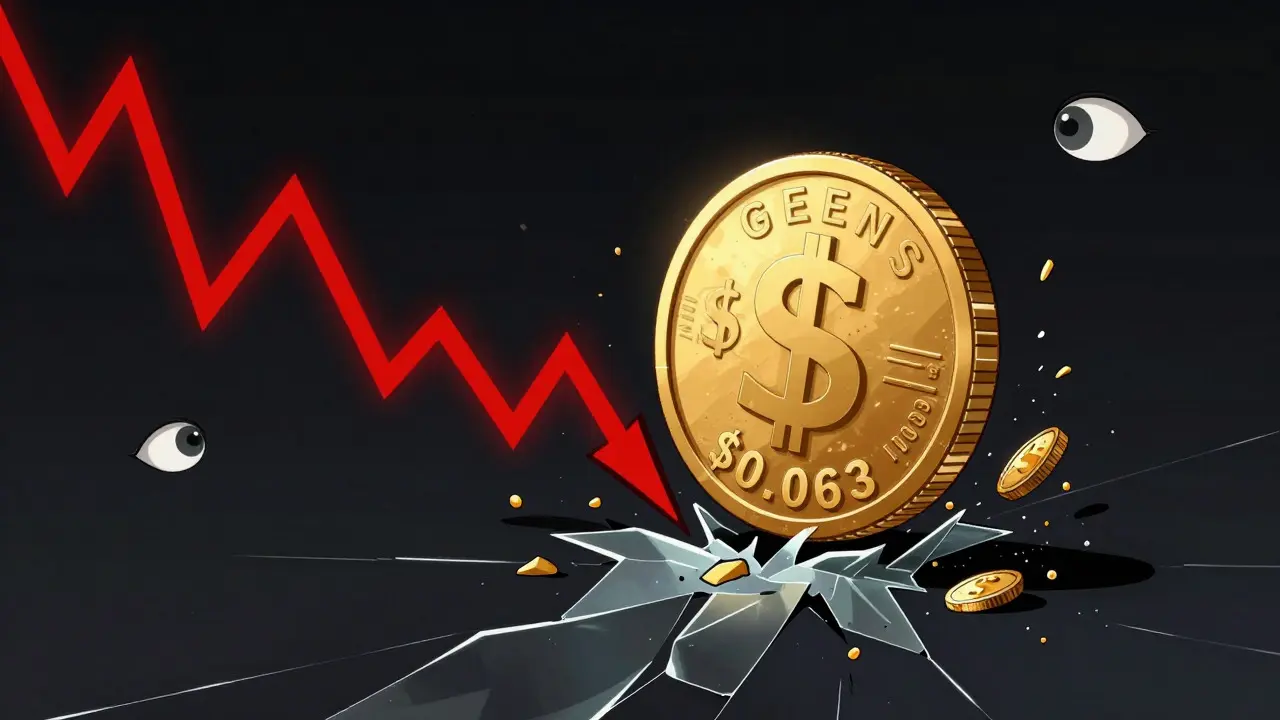
Here is where the story gets sobering. If you claimed those tokens in early 2022, you likely saw them listed at that $0.063 reference price. Fast forward to late 2025, and the picture looks very different. As of September 2025, the GENS token was trading around $0.00001301. That is a decline of approximately 99.98%.
Why did this happen? It wasn’t just bad luck. Several factors contributed to this depreciation:
- Market Conditions: The broader crypto market experienced significant volatility between 2022 and 2025. Many altcoins, especially those in the Polkadot/Kusama ecosystem, faced heavy sell pressure.
- Liquidity Issues: Despite the technical promise, trading volume dried up. Low liquidity makes it easy for small sells to crash the price further.
- Adoption Challenges: Genshiro promised to be a one-stop-shop for DeFi on Kusama. However, competing protocols on Ethereum and Solana captured more user attention and capital.
This drastic drop serves as a critical lesson for anyone chasing airdrops. Getting free tokens doesn’t guarantee profit. If the underlying project doesn’t sustain user activity and liquidity, the value can evaporate quickly. For current observers, the low price might look like a bargain, but it also signals deep challenges in market positioning.
What Is Genshiro Technically?
Beyond the price charts, what is the actual product? Genshiro is built on the Kusama Network is a canary network for Polkadot, allowing for faster experimentation and deployment of blockchain technologies with lower risk. This is important because Kusama is designed for innovation and speed, acting as a testing ground for technologies that might later move to Polkadot. Genshiro positions itself as a decentralized autonomous organization (DAO) that manages a suite of financial tools.
The architecture relies on eight core components designed to create a seamless DeFi experience:
| Component | Function | Benefit to User |
|---|---|---|
| Cross-Chain Interoperability | Enables asset transfers between different blockchains | Access assets from other networks without leaving the Genshiro interface |
| Lending & Borrowing | Allows users to lend assets for interest or borrow against collateral | Generate yield or access liquidity without selling holdings |
| Yield Farming | Rewards users for providing liquidity to pools | Earn additional tokens by supporting the market depth |
| Smart Contract Platform | Hosts complex financial instruments | Automated execution of trades and derivatives |
| Layer-2 Scaling | Handles high transaction volumes efficiently | Lower fees and faster confirmation times |
| Oracle Systems | Provides reliable price feeds | Accurate pricing for loans and trades to prevent liquidation errors |
The idea is sound. By combining these elements, Genshiro aims to reduce the friction of using multiple DeFi apps. Instead of jumping between Uniswap, Aave, and Compound, a user could theoretically do everything within Genshiro. The integration with Polkadot parachain ecosystem offers potential advantages in cross-chain functionality compared to single-chain solutions like Ethereum-based protocols.
The Roadmap: 2025 to 2030
Despite the price struggles, the development team has maintained a published roadmap extending to 2030. This suggests ongoing commitment to the technical vision, even if market reception has been lukewarm. Let’s look at what they are planning:
- 2025 Expansion: The focus is on enhancing cross-chain interoperability and launching new DeFi products. The goal is to make moving assets between chains smoother and more secure.
- 2026 Risk Management: Plans include implementing advanced risk management features. This is crucial for lending platforms to avoid the kinds of exploits that have plagued other DeFi projects.
- 2027 Staking Innovation: New staking and yield farming opportunities are scheduled to attract more capital. The hope is that better yields will draw users back into the ecosystem.
- 2030 Vision: The long-term goal is to become a leading DeFi ecosystem offering a comprehensive suite of financial services, rivaling major competitors in usability and feature set.
Regular community updates continue through official channels, indicating that the team is still working. However, roadmap execution does not always translate to token price appreciation. Investors need to watch for actual usage metrics-total value locked (TVL), daily active users, and trading volume-rather than just reading the plans.

Is There Another Airdrop Coming?
This is the question everyone wants answered. Based on the available information, there is no confirmed announcement for a new Genshiro airdrop in 2026. The major distributions via MEXC and Gate.io are closed chapters. Any claims of a "new Genshiro airdrop" circulating on social media should be treated with extreme caution. Scammers often use the names of past successful projects to lure victims into phishing sites.
If a new opportunity does arise, it will likely follow a similar pattern to the past: requiring active participation rather than passive holding. Keep an eye on official announcements from Genshiro’s verified social media accounts and partner exchanges. Never connect your wallet to an unverified link promising free tokens.
How to Evaluate Future Opportunities Like This
The Genshiro case study offers valuable heuristics for evaluating any future DeFi project or airdrop:
- Check the Distribution Model: Did the project give tokens away freely, or did it require engagement? Engagement-based models (like voting with MX tokens) often result in more committed communities but exclude casual users.
- Analyze Liquidity: Look at the trading volume. A token with a low price but zero volume is illiquid. You might own thousands of dollars worth of tokens on paper, but you won’t be able to sell them without crashing the price.
- Assess the Ecosystem Fit: Does the project solve a real problem? Genshiro’s multi-chain approach on Kusama is technically impressive, but does it offer something unique enough to steal users from established giants?
- Monitor Development Activity: Are code commits happening? Are audits being performed? Regular updates suggest a living project, while silence often precedes abandonment.
In the world of decentralized finance, technical superiority doesn’t always win. User adoption, marketing, and timing play huge roles. Genshiro has the tech, but it needs the traffic. Until then, the token remains a speculative asset with high downside risk.
When was the last Genshiro airdrop?
The most significant documented airdrops occurred in January 2022 through MEXC and Gate.io. Since then, there have been no major publicized airdrop campaigns. Users should verify any new claims through official Genshiro channels.
How much is GENS token worth in 2026?
As of late 2025, the GENS token traded at approximately $0.00001301, representing a near-total loss of value from its initial reference price of $0.063. Prices fluctuate daily, so check a live market data aggregator for the current rate.
What is Genshiro used for?
Genshiro is a DeFi platform on the Kusama network. It provides lending, borrowing, yield farming, and cross-chain asset transfer capabilities. It aims to be a one-stop-shop for decentralized financial activities.
Did the MEXC airdrop require holding MX tokens?
Yes. Participants in the January 2022 MEXC campaign needed to hold MX tokens to vote. The voting power was determined by the amount of MX held, with a cap of 500,000 MX per user.
Is Genshiro safe to use?
Genshiro employs smart contracts and undergoes regular audits. However, all DeFi platforms carry inherent risks, including smart contract bugs and market volatility. Users should always do their own research and only invest what they can afford to lose.
Can I still claim GENS tokens from the 2022 airdrop?
No. The distribution periods for both the MEXC and Gate.io airdrops ended in 2022. Any tokens earned would have been credited to participants' exchange accounts at that time. Late claims are generally not possible.
What is the relationship between Genshiro and Equilibrium?
Genshiro represents Equilibrium's decentralized finance initiative. Equilibrium is the parent project that developed the technology and framework for Genshiro to operate as a standalone DeFi hub on Kusama.




Heather Austin
July 24, 2026 AT 22:09hey look at the numbers though its pretty wild how much it dropped like 99 percent is insane but i guess thats crypto for you people just gotta be careful with these voting mechanics because if u dont hold the exchange token u get nothing which kinda defeats the purpose of decentralization imo
Ran Tao
July 25, 2026 AT 03:17You absolute peasants are missing the forest for the trees! 🌲📉 Genshiro isn't failing, it's *consolidating* value for the true visionaries who understand the nuanced architecture of cross-chain interoperability! While you cry over pennies, I am positioning myself for the 2030 moonshot! 🚀💎 The roadmap is not a suggestion, it is a prophecy written in code! Do not let your fear dictate your financial destiny! 😤🔥
Drew M
July 25, 2026 AT 20:57Ran, please tell me you aren't actually holding this bag? 🙄 It’s tragic to watch someone confuse hype with fundamental analysis. The liquidity crunch mentioned in the post is real, and pretending otherwise is just delusional theater. Most people here know that without volume, price is just a number on a screen that means absolutely nothing. Stay safe out there, or what’s left of your portfolio anyway. 💸😬
Deep Rahman
July 26, 2026 AT 05:47When we consider the philosophical implications of value in a digital vacuum, one must ask whether the token holds intrinsic worth or merely reflects the collective belief of a transient community. The decline from six cents to fractions of a cent suggests that the social contract underlying the asset has fractured beyond repair. Perhaps the true lesson lies not in the mechanics of the airdrop but in the ephemeral nature of trust in systems devoid of tangible collateral. We build castles on sand and wonder why they wash away with the tide of market sentiment. It is a meditation on impermanence disguised as financial speculation. One must observe the silence of the charts as loudly as the noise of the forums. The roadmap to 2030 feels like a distant star, beautiful but unreachable. We are all just passengers on a ship sailing toward an iceberg of our own making. The technology may be sound, but the human element remains flawed and prone to panic. This is the eternal cycle of boom and bust, repeated endlessly in new skins. We forget the past because the present promises salvation. But salvation never comes from a whitepaper. It comes from wisdom, which is rarely found in trading groups. We should perhaps step back and reflect on what we truly seek. Is it profit, or is it validation? The answer may lie in the emptiness of the wallet.
Melissa Beckwith
July 26, 2026 AT 23:13The article fails to adequately address the specific smart contract vulnerabilities that plagued similar Kusama projects during the same period, leading to a cascade of failures that were largely ignored by mainstream crypto media outlets. Furthermore, the assertion that liquidity issues were solely due to low volume ignores the structural design flaws inherent in the oracle systems used, which often resulted in inaccurate pricing feeds that triggered unnecessary liquidations for long-term holders who had no way to hedge their positions effectively. It is also worth noting that the Gate.io distribution model, while seemingly generous, was heavily skewed towards early adopters who likely sold immediately upon listing, creating a sell wall that suppressed price action for months afterward, thereby punishing those who held through the initial volatility. The comparison to Ethereum-based protocols is somewhat disingenuous given the vastly different user bases and developer ecosystems, meaning that direct competition metrics are often misleading when applied to niche networks like Kusama. Ultimately, the project's inability to secure major institutional partnerships or integrate with larger DeFi aggregators sealed its fate as a speculative relic rather than a functional financial tool. One must also consider the regulatory headwinds that emerged in 2023, which disproportionately affected smaller altcoins lacking the legal resources to navigate complex compliance frameworks across multiple jurisdictions. The roadmap items listed for 2025 and beyond appear increasingly disconnected from current technological trends, such as the shift towards modular blockchains and intent-centric architectures, suggesting a potential misalignment between development priorities and market needs. Without a significant pivot in strategy or a major injection of capital from external sources, the likelihood of meaningful recovery remains statistically negligible based on historical precedents of similar failed initiatives. Investors would do well to scrutinize the GitHub commit history more closely, as sporadic updates often mask a lack of substantial progress rather than indicating active development. The mention of risk management features in 2026 is particularly ironic given the absence of basic safeguards in earlier iterations, raising questions about the team's understanding of core DeFi principles. In conclusion, while the technical ambition was commendable, the execution fell short in every critical area necessary for sustainable growth and adoption in a highly competitive landscape.
Josephine Finlayson
July 28, 2026 AT 07:52It is quite unfortunate to see such a promising concept struggle so significantly; however, it is important to remain hopeful that the lessons learned will pave the way for future innovations. Perhaps the community can rally together to support the remaining developers, ensuring that the hard work put into the platform is not entirely in vain. Let us approach this situation with empathy and understanding, recognizing that mistakes are part of the learning process. We should encourage open dialogue and constructive feedback, fostering an environment where improvement is possible. After all, resilience is key in any endeavor, especially in the volatile world of cryptocurrency. May we all find peace in knowing that we did our best to support the ecosystem.
Tuan Nguyen
July 30, 2026 AT 06:14The sheer incompetence displayed by the Genshiro team is staggering. They promised a seamless DeFi experience but delivered a fragmented mess that barely functioned under normal load conditions. The reliance on outdated architectural patterns from 2020 shows a complete lack of innovation and foresight. It is pathetic that anyone still believes in their roadmap when the fundamentals are so broken. The market has spoken, and the verdict is guilty of negligence. Wake up and smell the coffee, or whatever it is you degens drink.
Hazel Fruitman
August 1, 2026 AT 01:42its really sad how people fall for these scams over and over again u think its gonna be diffrent but its never is just save ur money and buy some gold or something real instead of chasing ghosts on the internet