
Getting registered to run a crypto business in the UK isn’t just paperwork-it’s a make-or-break hurdle. Since January 2020, any company handling cryptocurrency exchanges or custodial wallets must register with the Financial Conduct Authority (FCA) under strict Anti-Money Laundering (AML) rules. And as of 2026, those rules are changing again. If you’re running a crypto business in the UK, or planning to, you need to know exactly what’s required, what’s coming, and what’s tripping up most firms.
Who Has to Register and Why
It’s simple: if your business handles crypto assets-whether you’re trading them, storing them for clients, or moving them on behalf of others-you must register with the FCA. This isn’t optional. The legal basis comes from the Money Laundering, Terrorist Financing and Transfer of Funds (Information on the Payer) Regulations 2017 (MLR 2017), which was updated to include crypto firms after Brexit. The goal? Stop criminals from using digital assets to hide money. The UK treats crypto the same way it treats banks: if money moves through your system, you’re responsible for knowing where it came from and where it’s going.By June 2025, only 147 crypto firms were registered in the UK. That’s down from 184 in early 2024. Why? Because nearly 9 out of 10 companies failed their first registration attempt. Common reasons? Poor risk assessments, weak oversight from leadership, and transaction monitoring systems that couldn’t catch suspicious activity. The FCA doesn’t just want you to say you’re compliant-they want proof.
The Core Rules: What You Must Do
There are three non-negotiable pillars to UK AML rules for crypto businesses:- Customer Due Diligence (CDD) - You must verify every customer’s identity using at least two independent sources. This isn’t just asking for a passport. You need to cross-check their name, address, date of birth, and other details against official databases. For higher-risk customers-like those from sanctioned countries or politically exposed persons (PEPs)-you need Enhanced Due Diligence (EDD), which means deeper checks and ongoing monitoring.
- The Travel Rule - Since 2022, any transaction over £1,000 must carry full originator and beneficiary information. That means if someone sends £1,500 in Bitcoin to another wallet, you must collect and share their full name, account number, and address. This rule mirrors the FATF’s global standard, but the UK enforces it more strictly than many other countries.
- Transaction Monitoring - Your systems must scan every transaction in real time against sanctions lists, blacklisted wallets, and known criminal addresses. The FCA expects you to use tools that update automatically. In 2025, 41.6% of firms failed because their systems weren’t connected to real-time sanctions feeds from HM Treasury’s Office of Financial Sanctions Implementation (OFSI).
And you can’t just set it and forget it. Records must be kept for five years. Staff need 35 hours of AML training every year. And if anything changes in ownership-like a new investor buying 10% or more of your company-you have to notify the FCA immediately. That’s a drop from the old 25% threshold, and it’s catching many firms off guard.
The Coming Change: FSMA and What It Means
Right now, crypto firms operate under a temporary registration system. But by early 2026, the Financial Services and Markets Act (FSMA) 2025 will replace it entirely. This isn’t just a tweak-it’s a full overhaul.Under FSMA, the FCA will issue formal licenses instead of registrations. That means:
- Dual registration (MLR + FSMA) will disappear. You’ll go straight to the new licensing system.
- Counterparty due diligence (CPDD) becomes mandatory. Even if you’re transacting with another crypto firm, not a customer, you still need to verify them. This is new, and it’s complex.
- The 10% ownership change rule becomes permanent. No more gray area.
Industry experts warn this transition is messy. The Bank of England noted in May 2025 that UK crypto investment dropped 17.3% in Q1 2025 because some firms are delaying action, waiting to see how FSMA shakes out. But waiting could cost you. The FCA says you must complete registration within three months of starting operations. The average processing time? Over nine months. If you’re not already halfway through the process, you’re behind.
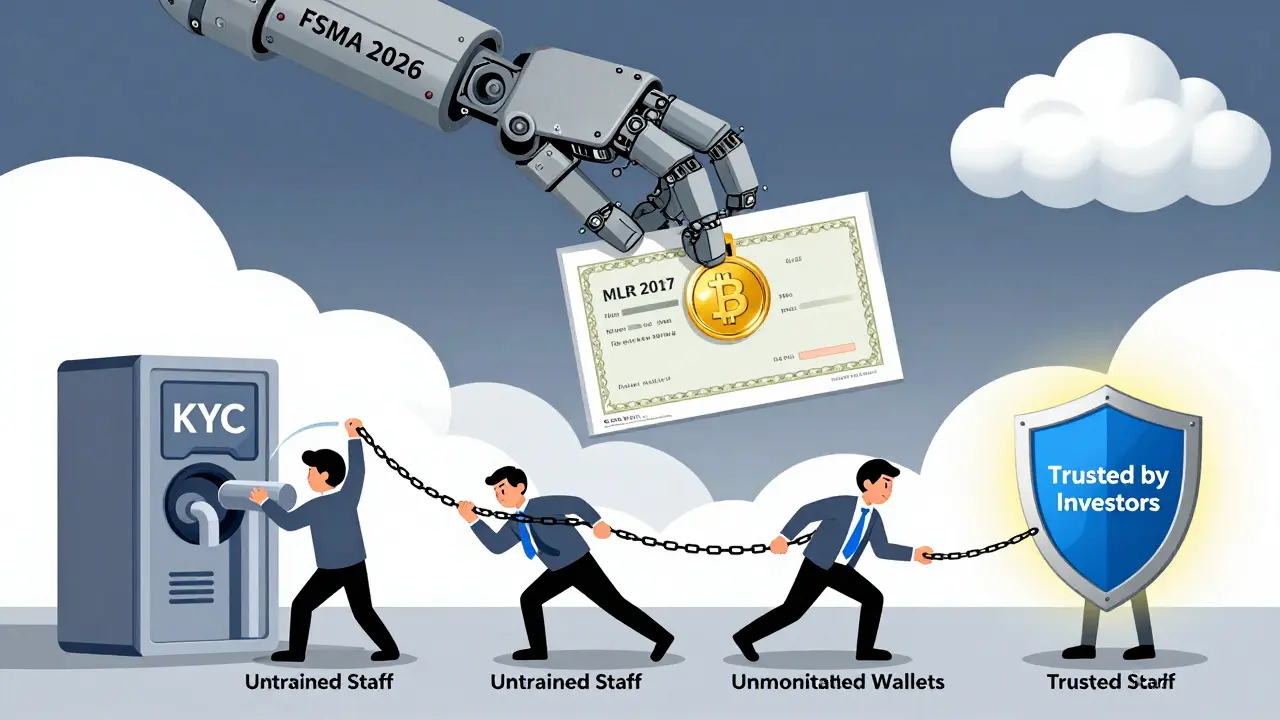
What’s Really Breaking Firms
Most companies don’t fail because they’re trying to cheat the system. They fail because they underestimate the technical and financial burden.- Costs are brutal. The average firm spends £287,500 just to get registered. After that, annual compliance costs hit £142,300. For startups, that’s a huge chunk of runway.
- Technology is the biggest wall. Integrating blockchain analytics with traditional KYC systems is hard. One firm told Reddit they spent £185,000 just to connect their tools. False positives in transaction monitoring? 28.7% of alerts are wrong-compared to 12.3% in traditional banking. That means more staff time, more frustration.
- Marketing rules are tight. The FCA cracked down on crypto ads in 2025. If your website says “guaranteed returns” or hides the risks, you’re flagged. 63.2% of firms failed their first ad review.
And then there’s the human factor. One user on Reddit said they spent 14 months and over £500,000 in legal and consultancy fees just to get approved. Another, who succeeded, said the process was grueling-but once they cleared it, their credibility with investors and partners shot up. That’s the trade-off: pain now, trust later.
How the UK Compares to the Rest of the World
The UK’s approach is tougher than most.- vs. EU - The EU’s MiCA framework creates a single license for crypto firms. The UK’s system is fragmented, with overlapping rules. But the UK’s 10% ownership threshold is stricter than the EU’s 20%.
- vs. US - The US has five different agencies regulating crypto (FinCEN, SEC, CFTC, etc.). The UK has one: the FCA. Simpler? Maybe. But the FCA’s standards are higher and more consistent.
- vs. Singapore - MAS (Singapore’s regulator) approves 38.4% of applicants on first try. The UK? Only 12.7%. That’s the starkest difference.
The UK isn’t trying to be the easiest place to start a crypto business. It’s trying to be the safest. And that means higher barriers.

What’s Working: Success Stories
Despite the pain, some firms are thriving.One London-based exchange, BlockchainComply, posted on LinkedIn in May 2025: “Once through the process, the clarity of FCA expectations has actually streamlined our international expansion.” They now operate in 12 countries because their compliance is audited and trusted.
HMRC data shows crypto tax receipts jumped from £147 million in 2021-22 to £483 million in 2024-25. That’s not just more users-it’s more legitimate business. The UK’s crackdown is filtering out bad actors, and the market is responding with real growth.
Industry body CryptoUK found that 73.4% of registered firms say their investor confidence improved after approval. That’s the hidden upside: legitimacy.
What You Should Do Now
If you’re a crypto business operating in the UK:- Check your status. Are you registered? If not, you’re operating illegally.
- Review your tech stack. Can your system handle real-time sanctions screening? Does it track Travel Rule data? If not, fix it now.
- Prepare for FSMA. Start gathering documents for licensing. Don’t wait until 2026.
- Train your team. 35 hours of AML training per compliance officer isn’t optional. Do it.
- Get expert help. 78.3% of successful firms hired external consultants. It’s not a sign of weakness-it’s a smart investment.
The UK isn’t shutting down crypto. It’s cleaning it up. The firms that survive this transition won’t just be compliant-they’ll be the most trusted in the world.
Do I need to register if I only trade crypto for myself?
No. Personal trading-buying and selling crypto for your own account-is not regulated under UK AML rules. The rules apply only to businesses that provide services to others, like exchanges, custodians, or payment processors. If you’re not offering a service, you’re not required to register.
What happens if I don’t register with the FCA?
Operating without FCA registration is illegal. The FCA can issue fines, freeze your assets, and shut down your business. You could also face criminal charges if your platform is used for money laundering. Even if you think you’re small or invisible, the FCA monitors blockchain transactions and can trace your operations. The risk far outweighs any short-term savings.
How long does FCA registration take?
On average, it takes 9.2 months from submission to approval, based on 2024 data. But you have only three months from when you start operating to apply. Many firms spend 6-9 months preparing documents before submitting. If you wait until the last minute, you’ll likely miss deadlines and face enforcement action.
Is the Travel Rule really enforced for £1,000 transactions?
Yes. The UK enforces the Travel Rule at £1,000, matching FATF’s global standard. This applies to both fiat-to-crypto and crypto-to-crypto transfers. If you’re a business and you process a transaction over that amount without collecting and sharing the required details, you’re in violation. The FCA audits this actively, and non-compliance is one of the top reasons for registration rejection.
Will FSMA make registration easier or harder?
It will make the process more rigorous but more stable. FSMA replaces the temporary registration system with a full licensing regime, which means more upfront work but clearer, long-term rules. The FCA says it will reduce regulatory burden by 40% for compliant firms by 2027. But to qualify, you’ll need to meet higher standards now. If you’re already struggling under MLR 2017, FSMA will be harder. If you’re close to compliance, it’s your path to legitimacy.






Drago Fila
March 6, 2026 AT 19:32Issack Vaid
March 8, 2026 AT 11:53Shawn Warren
March 8, 2026 AT 19:40Jackson Dambz
March 9, 2026 AT 02:18jonathan swift
March 10, 2026 AT 07:24Datta Yadav
March 11, 2026 AT 03:12Lydia Meier
March 12, 2026 AT 23:28jay baravkar
March 14, 2026 AT 01:07Ian Thomas
March 14, 2026 AT 13:48