
On January 1, 2026, if you try to send money to a Bitcoin exchange using Alipay or WeChat Pay in mainland China, the transaction won’t just fail-it’ll vanish. No warning. No refund. Just a quiet, automated rejection. That’s not a glitch. It’s policy. And it’s working.
China’s Payment Giants Are the Enforcers
Alipay and WeChat Pay aren’t just apps. They’re the financial nervous system of over a billion people. Together, they handle more than 90% of China’s mobile payments. When the People’s Bank of China banned cryptocurrency trading in 2021, it didn’t need to shut down exchanges directly. It told Alipay and WeChat Pay: block it all. These platforms don’t just filter keywords. They watch behavior. If you suddenly start sending small, frequent payments to the same merchant-say, a fake "gaming item" seller that’s actually an OTC crypto broker-the system flags it. If your profile shows you’ve been visiting crypto forums or using VPNs to access foreign exchanges, your account gets reviewed. And if you’ve been sending money to wallets linked to known crypto platforms? Your account gets frozen. It’s not about catching one big transaction. It’s about spotting patterns. A 2025 internal report from the National Administration of Financial Regulation showed that over 87% of attempted crypto-linked payments were blocked before they cleared, thanks to real-time AI monitoring built into these apps.How the Blockade Works
The system is layered. First, transaction names are scanned. Any mention of "BTC," "ETH," "exchange," or "mining" triggers an automatic block. But that’s just the start. The real power comes from behavioral analysis.- If you regularly pay a merchant who’s also listed as a crypto OTC dealer, your account gets flagged.
- If your spending spikes after midnight-when crypto markets are active overseas-your activity gets tagged for review.
- If you use the same phone number or ID to open multiple accounts, you’re automatically added to a watchlist.
WeChat Pay’s Hidden Problem: Messaging
Here’s where things get messy. WeChat Pay isn’t just a wallet. It’s a messaging app. And that’s a loophole criminals learned to exploit. You can’t send crypto through WeChat Pay. But you can send a photo of a QR code. You can type a wallet address in a private chat. You can say, "Send 0.5 BTC to this address, I’ll pay you RMB through WeChat." And because WeChat encrypts messages and doesn’t share data with foreign authorities, law enforcement can’t see it. Criminal groups in Guangdong and Yunnan now run crypto OTC rings using WeChat groups. They use the app to coordinate trades, share wallet addresses, and arrange cash pickups. The actual payment happens through WeChat Pay-but the crypto transfer happens outside China, on decentralized platforms. It’s not illegal to send money to a friend. It’s not illegal to chat. But when those two things combine to move crypto? That’s a gray zone regulators can’t fully plug.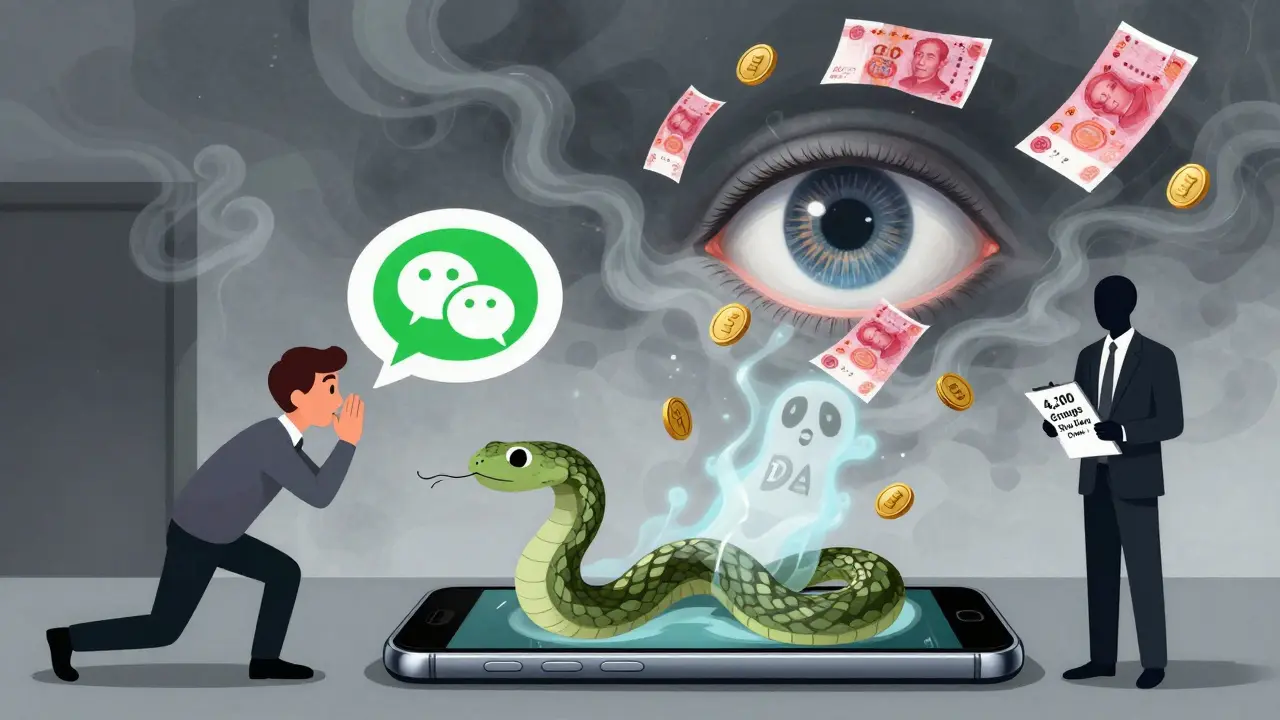
What About Cross-Border Transactions?
If you’re outside China, you can still buy crypto with Alipay or WeChat Pay-sort of. Foreign platforms that accept Chinese payment methods are under pressure. In 2025, Binance, Kraken, and others stopped accepting direct deposits from these apps for Chinese users. But some smaller exchanges still do, especially those based in Southeast Asia. The problem? If you’re a Chinese citizen using a foreign exchange and paying via Alipay, you’re breaking Chinese law-even if the transaction happens overseas. The State Administration of Foreign Exchange (SAFE) tracks outbound payments. If you send more than $50,000 annually abroad without approval, you could face fines, asset freezes, or even criminal charges. Some users try to get around this by using relatives abroad to buy crypto for them. But even that’s risky. In 2025, Shanghai authorities prosecuted 12 people for acting as "crypto money mules"-helping others move funds overseas to buy digital assets.The e-CNY Is China’s Answer
China isn’t against digital money. It just wants control. That’s why the e-CNY, the central bank’s digital currency, is expanding fast. By 2026, over 300 million people are using it for daily purchases, from street vendors to public transit. The e-CNY is not blockchain-based. It’s not decentralized. It’s not anonymous. Every transaction is tracked by the central bank. And guess what? Alipay and WeChat Pay are now the main distribution channels for it. This is the real endgame. Instead of banning crypto, China is replacing it. The government wants people to use its own digital currency-because it can monitor spending, control capital flow, and prevent tax evasion. Private crypto? It’s seen as a threat to financial stability and state control.
What Happens If You Get Caught?
Most people who accidentally trigger a block just get a warning. But if you’re flagged repeatedly, your account can be suspended for 30 days. If you’re caught running a crypto OTC business? You could face up to five years in prison under China’s anti-money laundering laws. In 2025, the Ministry of Public Security announced it had shut down 4,200 crypto-related OTC groups operating through WeChat. Over 1,800 people were arrested. The charges? Illegal fund-raising, unauthorized foreign exchange, and operating an unlicensed financial service. Even if you’re not trading, just holding crypto in a wallet? You’re not breaking the law-but if you try to move it through Alipay or WeChat Pay, you’re asking for trouble.Is There Any Way Around It?
Technically, yes. But it’s dangerous. Some users use peer-to-peer apps like LocalBitcoins or Paxful, then pay via cash or bank transfer. Others use crypto ATMs in Hong Kong or Macau. But these methods require travel, cash, and trust in strangers-all high-risk. There’s no legal way to buy Bitcoin with Alipay or WeChat Pay in mainland China. Any service claiming otherwise is either a scam or a trap.What’s Next?
The enforcement isn’t slowing down. In fact, it’s getting smarter. By late 2026, Alipay and WeChat Pay will start using facial recognition and device fingerprinting to detect users who try to bypass blocks with fake IDs or new phones. The government is also testing AI that can predict crypto intent based on app usage. If you spend 70% of your time on crypto news sites and 30% on trading forums, even without making a payment, your profile might get flagged. China’s stance isn’t changing. Not now. Not next year. The e-CNY is the future. Private crypto? It’s a relic they’re determined to erase.Can I still use Alipay or WeChat Pay if I own cryptocurrency?
Yes, you can still use Alipay and WeChat Pay for everyday payments like groceries, transit, or bills. But if you try to send money to a crypto exchange, OTC dealer, or wallet address linked to digital assets, the transaction will be blocked. Owning crypto isn’t illegal-but moving it through these apps is.
Why doesn’t China just let people use crypto if they want to?
China sees private cryptocurrencies as a threat to its financial control. Crypto could let people bypass capital controls, evade taxes, or fund underground activities. The government prefers its own digital currency, the e-CNY, which it can monitor, limit, and manage. Allowing Bitcoin or Ethereum would mean giving up that control.
Are Alipay and WeChat Pay the only platforms enforcing this ban?
They’re the main ones, but not the only ones. All licensed payment processors in China must follow the same rules. UnionPay, JD Pay, and other platforms also block crypto transactions. But Alipay and WeChat Pay handle so much traffic that they’re the primary enforcement tool.
Can I use a VPN to bypass the crypto block?
Using a VPN won’t help you send crypto payments through Alipay or WeChat Pay. The block happens at the payment level, not the network level. Even if you connect to a foreign server, the app still checks the recipient’s wallet or merchant code. If it’s flagged as crypto-related, the transaction fails.
What happens if I accidentally send money to a crypto address?
The transaction will be blocked before it completes. You’ll get a notification saying the payment couldn’t be processed due to "regulatory restrictions." Your funds will be returned. But if this happens more than twice in 30 days, your account may be reviewed for suspicious activity.
Is there any chance China will legalize crypto in the future?
Unlikely. While the government is testing blockchain for supply chains and cross-border settlements (like the mBridge project), it has no plans to allow retail crypto trading or private digital assets. The e-CNY is the official digital money-and it’s designed to replace, not coexist with, Bitcoin or Ethereum.






Elisabeth Rigo Andrews
January 1, 2026 AT 10:58Let me tell you, this isn't just about crypto-it's about digital sovereignty. Alipay and WeChat Pay aren't apps, they're surveillance tools wrapped in convenience. The AI doesn't just block transactions-it builds behavioral profiles. I've seen people get flagged for using VPNs to check CoinMarketCap. That's not security, that's preemptive social control. And the e-CNY? It's not digital cash, it's digital obedience.
They're not banning crypto because it's risky. They're banning it because it's untrackable. And that terrifies a regime that needs to know where every yuan goes. This is the future of financial authoritarianism, and it's already here.
Don't be fooled by the 'no warning' thing. That's not a bug-it's the feature. Silent erasure is more effective than public crackdowns. You don't need to arrest people when you make their money disappear before they even realize it's gone.
Adam Hull
January 2, 2026 AT 17:46What's truly staggering is the operational precision of this system. The 94% detection accuracy isn't just impressive-it's dystopian. The machine learning models were trained on 2.3 billion transactions, meaning the state has essentially reverse-engineered the behavioral signatures of dissent. This isn't regulation; it's predictive policing of financial behavior.
The WeChat messaging loophole? A classic case of institutional blind spots. Criminals exploit the app's encryption not because it's weak, but because the state refuses to politicize private communications-even when they're facilitating capital flight. The irony? The same regime that censors WeChat groups for political dissent turns a blind eye to crypto OTC rings. Why? Because crypto is economic, not ideological. And economic threats can be monetized. Hence, the e-CNY.
This is the endgame: not prohibition, but replacement. The state doesn't want to destroy crypto-it wants to become the only crypto.
Mandy McDonald Hodge
January 3, 2026 AT 03:25ok but like... i just want to buy some btc with my alipay so i can support my friend in shanghai who's into it 😭
why does everything have to be so complicated?? i just want to send money to someone i trust and not get flagged for being a "suspicious actor" because i looked up ethereum last week
also the e-cny thing is kinda wild? like... if the gov can track every coffee purchase, why not just let us have crypto too??
they're not banning tech, they're banning freedom to choose. and that just sucks.
also i'm gonna start using cash for everything now. no more apps. no more tracking. peace out 🙏
Bruce Morrison
January 4, 2026 AT 20:07People keep talking about this as if it's a new development. It's not. China has controlled capital flows since the 1990s. Crypto is just the latest vector. The real story is how effectively private companies became state enforcers without public outcry. Alipay and WeChat Pay didn't rebel. They complied because compliance is profitable.
The e-CNY rollout is the logical endpoint. Centralized digital currency gives the state everything it wants: control, traceability, programmability. Private crypto offers none of that. It's not about fear of volatility. It's about fear of decentralization.
If you want to understand this, stop thinking about money. Think about power. The state doesn't want to ban Bitcoin. It wants to make Bitcoin irrelevant.
Johnny Delirious
January 6, 2026 AT 08:43It is imperative to recognize that the People's Republic of China has implemented a meticulously structured, technologically advanced, and legally codified framework to preserve monetary sovereignty and financial stability. The integration of AI-driven behavioral analytics into payment infrastructure represents a paradigmatic shift in regulatory enforcement, wherein compliance is not merely encouraged but rendered functionally inevitable.
The e-CNY is not an alternative currency; it is the institutional embodiment of state authority in the digital financial domain. Any attempt to circumvent this architecture through pseudonymous transactions or decentralized protocols constitutes a direct challenge to the constitutional and economic order.
It is not a question of whether such measures are draconian. It is a question of whether the collective interest in financial integrity outweighs individual speculative autonomy. The answer, in the context of China's developmental trajectory, is unequivocal.
Bianca Martins
January 7, 2026 AT 17:38Just saw a guy in Chengdu get his account frozen for sending $20 to a friend who used a crypto wallet address as a QR code for a "donation". The friend was just trying to help him buy a new phone. No crypto involved. Just a weird coincidence.
They don't care about intent. They care about patterns. One wrong transaction and your whole digital life gets flagged.
Also, the WeChat chat loophole? Real talk-my cousin in Guangzhou uses it all the time. Sends wallet addresses in voice notes. Pays in RMB. Crypto moves offshore. It's wild how the system can block payments but can't touch private messages.
They're building a wall around money. But people? They're just gonna keep finding cracks.
And honestly? I don't blame them. 🤷♀️