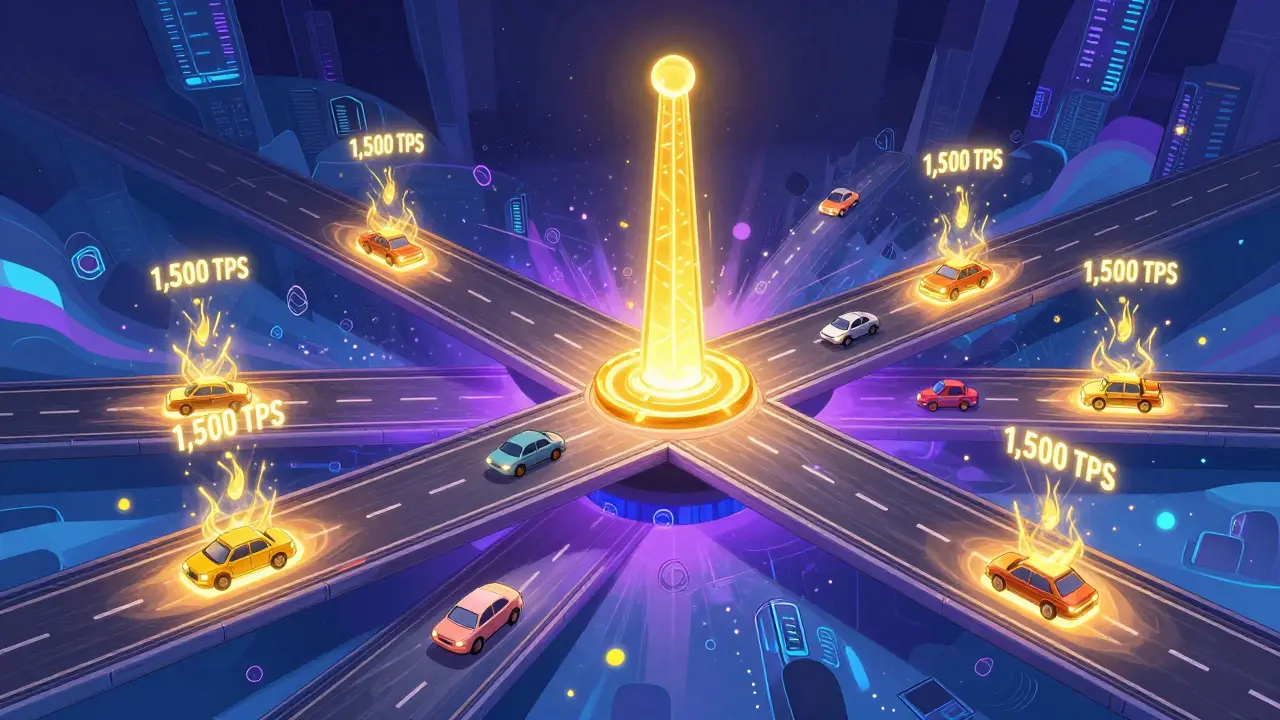
Imagine a highway that only allows 15 cars per second to pass through. Now imagine that same highway suddenly needs to handle 100,000 cars per second. That’s the problem blockchain networks like Ethereum faced. Transactions piled up. Fees skyrocketed. Users waited minutes-or even hours-for their trades to confirm. The solution? Sharding.
What Is Sharding, Really?
Sharding isn’t magic. It’s not a new algorithm or a fancy consensus mechanism. It’s a simple idea borrowed from old-school databases: split the work. Instead of every node in the network processing every transaction, sharding divides the blockchain into smaller pieces called shards. Each shard handles its own set of transactions and stores its own portion of the ledger. Think of it like having 64 separate cash registers at a busy store instead of one. Customers don’t all line up at the same counter. They spread out. Wait times drop. Throughput skyrockets. In blockchain terms, this means each shard can process transactions in parallel. If one shard can handle 1,500 transactions per second, and you have 64 shards, you’re looking at nearly 100,000 TPS-up from Ethereum’s original 15 TPS. That’s not a 10% improvement. That’s a 6,600% jump.Why Does This Matter for Scalability?
Scalability in blockchain isn’t just about speed. It’s about keeping the network cheap, fast, and open to everyone. Without sharding, every node has to store the entire history of the blockchain and verify every transaction. That’s fine when you have 1,000 users. It’s impossible when you have 100 million. Sharding solves this by reducing the load on each node. Instead of downloading and validating the whole blockchain, a node only needs to handle its assigned shard. This makes it easier for regular users to run nodes on consumer hardware-phones, laptops, Raspberry Pis. More nodes mean more decentralization. More decentralization means more security. Ethereum’s shift to sharding isn’t just about scaling up. It’s about scaling out. Traditional scaling methods like bigger blocks (Bitcoin Cash) or faster consensus (Proof of Stake alone) only go so far. They still force every node to do everything. Sharding changes the game by distributing the work.How Sharding Works: The Mechanics
Here’s how it actually works under the hood:- The blockchain is split into multiple shards-Ethereum plans for 64 initially.
- Each shard has its own set of validators who process and confirm transactions within that shard.
- Transactions between shards (cross-shard) require special protocols to ensure consistency and prevent double-spending.
- A central beacon chain coordinates the shards, assigns validators, and maintains the overall state.
- Data availability is ensured through Data Availability Sampling (DAS), where nodes randomly check small pieces of data to confirm it’s there-without downloading everything.
Danksharding: The Next Evolution
Early sharding designs had a big flaw: communication between shards was slow and expensive. If you wanted to send ETH from Shard 3 to Shard 47, you had to wait for confirmation from the beacon chain. That created bottlenecks. Enter Danksharding. Named after Ethereum researcher Dankrad Feist, this updated version merges the beacon chain and shard block production into a single structure. Instead of separate shard blocks, data is bundled into “blobs”-large chunks of transaction data attached to each main block. These blobs are then verified by validators using DAS, not full downloads. The Dencun upgrade in March 2024 introduced proto-danksharding (EIP-4844), which allows up to 16 blobs per block-each holding up to 1 MB of data. That’s 16 MB of extra transaction space per block, dramatically lowering Layer 2 rollup costs. This isn’t full sharding yet, but it’s the critical first step. By 2025-2026, Ethereum aims to roll out full Danksharding with 64 shards, unlocking the full 100,000 TPS potential.
Tradeoffs: What Sharding Doesn’t Solve
Sharding isn’t a silver bullet. It brings new risks:- Security per shard: If a shard has too few validators, it becomes vulnerable to takeover. Ethereum’s solution? Random validator assignment and frequent shard rotation.
- Cross-shard communication: Moving value or data between shards still requires coordination. Delays and complexity remain.
- Data availability: If validators lie about data being available, the whole network could be compromised. That’s why DAS is non-negotiable.
How Sharding Compares to Other Scaling Solutions
- Bigger blocks: Bitcoin Cash tried this. It increased block size to 32 MB. Result? Centralization. Only powerful servers can run full nodes. Sharding avoids this by keeping individual node requirements low.
- Proof of Stake (PoS): Ethereum’s move to PoS boosted throughput from 10 to 32 TPS. Helpful, but nowhere near enough. Sharding is what gets us to 100,000 TPS.
- Layer 2s (Rollups): Optimistic and zk-rollups handle most Ethereum transactions today. But they still rely on the base layer to store data. That’s where sharding comes in-it gives rollups cheap, abundant data space.
- Parachains (Polkadot): Polkadot uses a different model: independent blockchains (parachains) connected by a relay chain. It’s more like a network of blockchains than a single sharded one. Sharding keeps everything under one chain, simplifying interoperability.
Real-World Impact: What This Means for Users
By 2025, if Ethereum’s sharding rollout goes as planned:- Transaction fees could drop from $5-$20 to under $0.10.
- DeFi apps, NFT marketplaces, and gaming platforms will handle thousands of users simultaneously without lag.
- Mobile wallets will become viable for everyday use-no need for high-end hardware.
- Developers will build new apps that were previously impossible due to cost and speed limits.

Challenges and Risks
The road to full sharding hasn’t been smooth. Ethereum’s development team spent over three years just designing and testing the protocols. Documentation is still evolving. Some projects, like Zilliqa, launched sharding in 2019 but only did transaction sharding-not full state sharding. That means they couldn’t store account balances or smart contract states across shards, limiting their usefulness. Enterprise users have been cautious. One blockchain CTO on HackerNews said they abandoned sharding for their project because cross-shard latency was too high. They switched to sidechains instead. Regulatory pressure is also growing. The EU’s MiCA regulation, effective in 2024, requires blockchains to ensure data reconstructability-meaning sharding must be designed so that data isn’t lost or hidden. That’s why DAS isn’t optional. It’s a legal requirement in major markets.What’s Next?
By late 2025, Ethereum should have full Danksharding live. Other chains will follow. Solana, near, and others are exploring similar designs. The goal isn’t just to handle more transactions. It’s to make blockchain feel as fast and seamless as the apps on your phone. The future of blockchain isn’t about bigger blocks or faster miners. It’s about smarter distribution. Sharding is the key to unlocking that future. It turns a single, overloaded highway into a vast, efficient network of lanes-each moving at full speed, none holding the others back.Will Sharding Work?
Gartner predicts that by 2030, blockchains without effective scaling like sharding will be relegated to niche uses. The ones that succeed? Those that balance decentralization, security, and speed-not by choosing two, but by solving all three. Ethereum’s version isn’t perfect. But it’s the most ambitious, best-documented, and most widely tested. If it works, it won’t just scale a blockchain. It will scale the entire concept of decentralized digital ownership.What is sharding in blockchain?
Sharding is a technique that splits a blockchain into smaller pieces called shards, each processing its own transactions and storing its own data. This allows the network to handle many transactions at once in parallel, instead of making every node process everything. It’s how Ethereum plans to scale from 15 to 100,000 transactions per second.
How does sharding improve scalability?
Sharding improves scalability by distributing the workload across multiple shards instead of forcing every node to handle every transaction. This parallel processing increases total throughput dramatically. For example, 64 shards each handling 1,500 TPS can achieve nearly 100,000 TPS combined. It also reduces storage and computational demands on individual nodes, making it easier for more people to run them and keep the network decentralized.
Is sharding the same as Layer 2 scaling?
No. Layer 2 solutions like rollups process transactions off the main chain and only post summaries back to it. Sharding is a Layer 1 upgrade-it changes how the base blockchain itself works. In fact, sharding makes Layer 2s cheaper and more efficient by giving them affordable, high-capacity data storage on the main chain.
What’s Danksharding?
Danksharding is Ethereum’s updated sharding design that combines the beacon chain and shard blocks into one structure. It uses data blobs to store transaction data efficiently and relies on Data Availability Sampling (DAS) to verify data without full downloads. This reduces cross-shard communication delays and lowers costs for rollups. Proto-danksharding was activated in March 2024, with full Danksharding expected by 2025-2026.
Does sharding make blockchains less secure?
It can-if not implemented correctly. A shard with too few validators is vulnerable to attacks. Ethereum mitigates this by rotating validators randomly between shards and using Data Availability Sampling to ensure no data is hidden. The security of the entire network depends on the integrity of the beacon chain and the reliability of DAS. Poorly designed sharding can weaken security, but Ethereum’s approach is built to prevent that.
Why hasn’t sharding been implemented sooner?
Sharding is one of the most complex upgrades in blockchain history. It requires solving problems like cross-shard communication, validator assignment, data availability, and consensus across shards-all without breaking the network. Ethereum spent over three years on research, testing, and code reviews before even launching proto-danksharding in 2024. Rushing it could have caused catastrophic failures.






Daniel Verreault
December 28, 2025 AT 09:29Sharding is literally the only way this shit scales. Ethereum was drowning in gas fees like a drunk guy in a bathtub. Now with danksharding, L2s can finally breathe. 16MB blobs per block? That’s not an upgrade, that’s a goddamn revolution. And DAS? Fuck full nodes - I’ll sample my way to freedom. This isn’t tech, it’s magic with math.
Jacky Baltes
December 30, 2025 AT 04:14The elegance of sharding lies not in its novelty, but in its fidelity to the original distributed systems principles. By decentralizing validation rather than centralizing computation, Ethereum preserves the core ethos of permissionless participation. The tradeoffs are nontrivial - cross-shard latency, validator distribution, data availability - yet each is addressed with cryptographic rigor, not brute force. This is systems engineering at its most thoughtful.
Rick Hengehold
December 31, 2025 AT 11:42Stop pretending sharding is new. Databases did this in the 90s. The real win is making rollups affordable. Gas fees dropping to pennies? That’s the only metric that matters to users. Everything else is academic.
Brandon Woodard
January 1, 2026 AT 02:59Let me get this straight. We’re now relying on probabilistic sampling - not full verification - to secure trillions of dollars in value. And we call this "security."
How is this not just trusting the network to not lie? Because we sampled 10 random pieces out of 10,000? That’s not a safety net. That’s a game of Russian roulette with a blockchain.
Bravo. The future of finance is now a statistical approximation.
Ryan Husain
January 2, 2026 AT 15:20Sharding is the missing link between blockchain’s theoretical potential and real-world utility. The fact that Ethereum is solving for horizontal scaling - not just vertical - demonstrates a deep understanding of systemic resilience. The integration of DAS as a mandatory component ensures data integrity without burdening users. This isn’t just an upgrade; it’s a redefinition of what a public ledger can be. The implications for DeFi, identity, and digital ownership are profound and long-term.
Jack and Christine Smith
January 4, 2026 AT 13:17ok but like… when can i buy an nft without my credit card getting charged $12 in fees? also i think they misspelled "dank" in the article lol