
When you hear about Bitcoin mining, you’re really hearing about miner revenue from block rewards. It’s the engine that keeps the entire network running. Every 10 minutes, a new block is added to the blockchain, and whoever solves it gets paid. That payment? It’s not just one thing-it’s two parts: newly created Bitcoin (the block subsidy) and the transaction fees from users sending coins. Together, they make up what miners earn. And right now, this system is at a turning point.
How Block Rewards Work
Bitcoin’s block reward started at 50 BTC per block when the network launched in 2009. That number doesn’t stay the same. Every 210,000 blocks-roughly every four years-it cuts in half. This is called a halving. The last one happened in April 2024, dropping the reward from 6.25 BTC to 3.125 BTC. Before that, it was 12.5 BTC in 2020, and 25 BTC in 2016. This pattern is built into Bitcoin’s code. It’s not arbitrary. It’s designed to mimic the scarcity of precious metals like gold.
Each halving reduces the number of new Bitcoins entering circulation. By the time the 21 million BTC cap is reached-projected around 2140-no more new coins will be minted. At that point, miners will rely entirely on transaction fees to get paid. That’s a massive shift. Right now, block subsidies still make up the vast majority of miner income. But as fees grow, that balance is slowly changing.
What Miners Actually Earn Today
Let’s break down the numbers. With 3.125 BTC per block and 144 blocks mined each day, the network issues about 450 BTC daily through block rewards alone. At a Bitcoin price of $65,000, that’s roughly $29.25 million per day in subsidy revenue. Add transaction fees, and total miner revenue hits around $33 million daily. Fees now make up 12-15% of total income, up from under 7% before the 2024 halving.
But here’s the catch: not every miner gets paid the same. Your earnings depend on your hardware, electricity cost, and even where you live. A top-tier ASIC miner like the AntMiner S21e XP Hyd 3U (860 TH/s) might earn about 0.000472 BTC per day-roughly $39 at $65,000/BTC. But if your electricity costs $0.12 per kWh, you’re eating into that profit fast. A miner in Texas with access to 3.5 cents/kWh power might clear $25/day in net profit. One in Germany paying 30 cents/kWh? They’re likely losing money.
Hardware: ASICs Dominate, GPUs Are Dead
Early Bitcoin miners used CPUs and GPUs. Today, those are relics. Modern Bitcoin mining is all about ASICs-specialized chips built for one thing: solving SHA-256 hashes. The AntMiner S21e, WhatsMiner M50, and other industrial-grade machines dominate the network. They’re efficient, hitting 15-30 joules per terahash (J/TH). Compare that to an NVIDIA RTX 4090 GPU, which uses 100-300 J/TH. The GPU might earn $0.50 per day. The ASIC? $39. That’s a 78x difference.
Why does this matter? Because ASICs are expensive. A single unit costs $3,000-$5,000. And they’re useless for anything else. If Bitcoin’s price crashes or mining becomes unprofitable, you can’t repurpose the machine. You’re stuck with a very expensive paperweight. That’s why miners are increasingly tied to long-term power contracts and institutional backing. You don’t just need hardware-you need energy deals, cooling systems, and permits.
The Role of Network Difficulty
It’s not enough to have good hardware. Bitcoin adjusts its difficulty every two weeks-exactly every 2,016 blocks-to keep block times at 10 minutes. If more miners join the network, difficulty rises. If miners shut down, it drops. In 2023, difficulty grew an average of 10-15% per month. That means even if your machine was profitable last month, it might not be this month.
Imagine you bought an AntMiner S19 Pro for $4,000. At the time, it earned 0.00028 BTC daily. But over three months, difficulty jumped 40%. Now, your daily output drops to 0.00017 BTC. Your revenue falls by 37%, but your electricity bill didn’t change. That’s why many miners report sudden profit drops-even with stable BTC prices. The network is fighting back.
Electricity Costs: The Real Boss
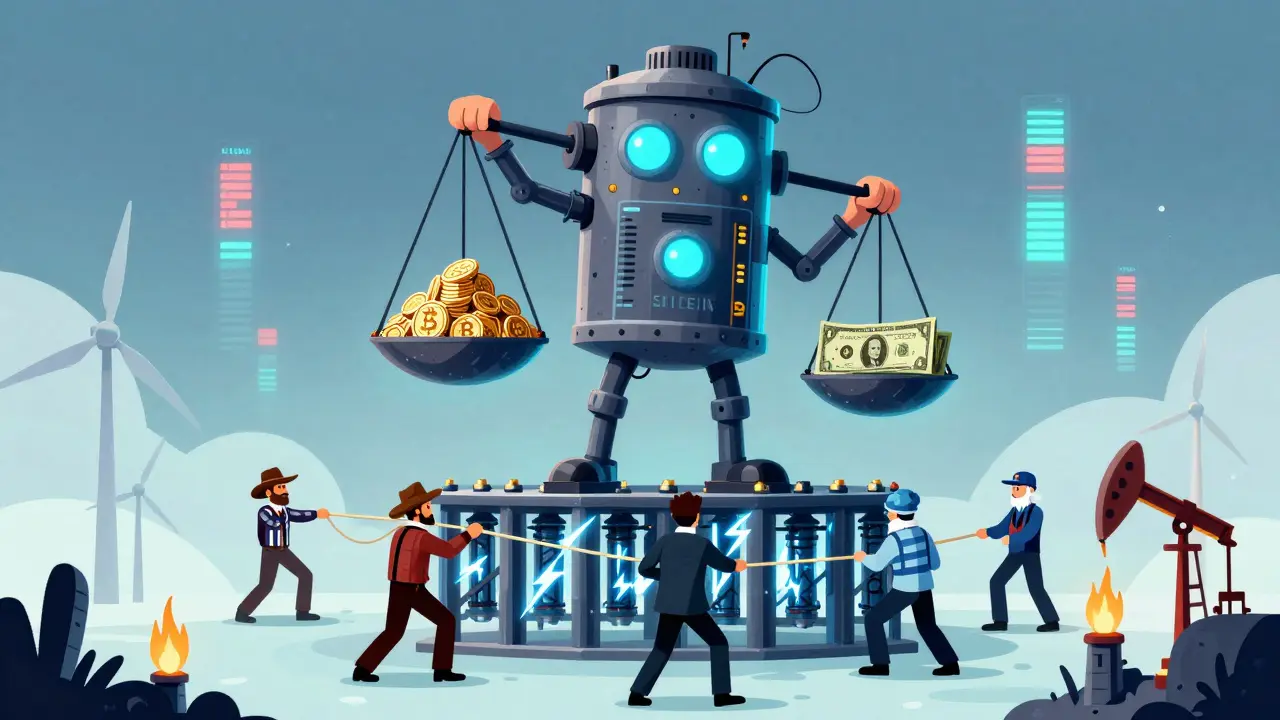
Miner revenue from block rewards means nothing if your power bill eats it all. Industrial electricity rates range from 1.5 cents/kWh in parts of Texas to over 30 cents/kWh in Europe. The break-even point? Around $0.05 per TH/s per day. That means if your machine runs at 100 TH/s, you need at least $5 in daily revenue just to cover power. If you’re making $8, you’re okay. If you’re making $6, you’re barely surviving.
Some miners are turning to stranded energy-wind farms in North Dakota, hydro plants in Quebec, flared gas from oil fields in Texas. These sources are cheap because they’re otherwise wasted. Companies like Marathon Digital and Riot Platforms are building entire data centers next to these sources. It’s not just smart-it’s survival.
Transaction Fees: The Future?
Everyone talks about the day Bitcoin stops minting new coins. Will transaction fees be enough? Experts are split. Fidelity Digital Assets says yes-because as Bitcoin adoption grows, so will demand for fast, secure transactions. More users mean more fees. Bitbo.io argues that by 2140, fees will naturally rise to $50-75 per block, matching today’s subsidy levels. J.P. Morgan’s 2023 report backs this: fee revenue has doubled since 2021.
But there’s a problem. Right now, most Bitcoin transactions still pay under $1 in fees. Even during peak congestion, fees rarely top $5. To replace today’s $29 million daily subsidy, fees would need to average $180 per block. That’s 36x higher than current levels. Can Bitcoin scale to that? The Lightning Network helps, but it’s still a small slice of activity. The real test is whether users are willing to pay more for security.
Who’s Mining Now? The Rise of Corporations
Remember when Bitcoin mining was done in basements and garages? That’s mostly gone. In 2017, individual miners controlled 68% of the network. Today? Only 12%. The rest? Big companies. Publicly traded firms like Marathon Digital, Riot Platforms, and Core Scientific now control nearly 30% of global hashpower. They have access to capital, legal teams, and power contracts that individuals can’t touch.
This shift has consequences. When a corporation shuts down a mine because of low prices, it’s not just one machine. It’s hundreds of thousands of TH/s vanishing overnight. That can trigger a difficulty drop, giving smaller miners a temporary reprieve. But it also means mining is becoming more centralized-not just in hardware, but in ownership. And that raises questions about Bitcoin’s decentralization.
The Risk: Price Drops and Difficulty Spikes
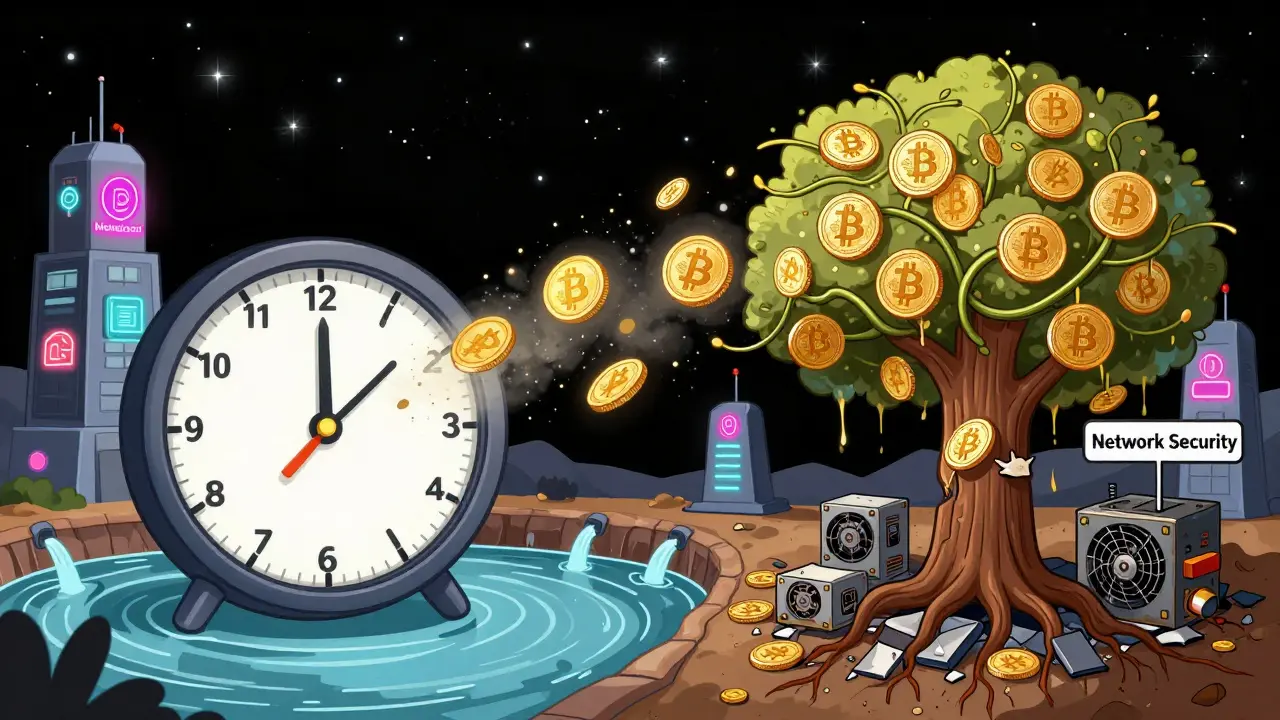
Miner revenue from block rewards is fragile. If Bitcoin’s price drops below $35,000 while difficulty climbs above 15% per month, 40-60% of current miners could go offline within months. That’s not speculation-it’s what mining firms modeled in stress tests. In 2022, when BTC fell from $69,000 to $16,000, over 100 mining operations shut down. Many never came back.
That’s why the smart miners don’t just buy hardware. They lock in power deals for 5-10 years. They buy insurance against price crashes. They diversify into other cryptocurrencies or even sell their excess heat. Some even become energy traders. Mining isn’t just tech anymore. It’s finance, logistics, and risk management rolled into one.
Getting Started? It’s Not What You Think
If you’re thinking of starting Bitcoin mining today, here’s the truth: unless you have access to sub-4 cent/kWh power, you’re probably not going to make money. Entry-level ASICs cost $3,000. Power infrastructure? Another $500. Cooling? Add 15-20% more to your electricity bill. Payback time? 8-14 months at current rates. And that’s if nothing changes.
Most beginners underestimate cooling. They underestimate difficulty growth. They overestimate how long their machine will last. ASIC fans fail every 6-12 months. Replacement parts cost $50. Firmware updates? They’re critical. One wrong update and your machine bricked. That’s why experienced miners use Braiins OS+-it’s more stable, more efficient, and better documented than factory firmware.
The Bottom Line
Miner revenue from block rewards is the backbone of Bitcoin’s security. But it’s also a high-stakes game. The halving of 2024 didn’t kill mining-it just exposed who was really prepared. The winners now are those with cheap power, efficient hardware, and long-term strategy. The losers? Those who thought mining was a quick way to get rich.
Bitcoin’s design ensures that miners will always be paid. But how much they earn, and whether they survive, depends on far more than just the block subsidy. It’s about electricity, difficulty, price, and foresight. The next halving is in 2028. If you’re still mining then, you’ll need more than a rig. You’ll need a plan.
How much do miners earn from block rewards today?
As of March 2026, the Bitcoin block reward is 3.125 BTC per block. With 144 blocks mined daily, miners earn roughly 450 BTC from subsidies alone. At a Bitcoin price of $65,000, that’s about $29 million per day. Transaction fees add another $3-4 million daily, bringing total miner revenue to around $33 million per day.
What happens after Bitcoin’s 21 million coin limit is reached?
Once the 21 million BTC cap is reached-projected around 2140-no new Bitcoin will be created. Miners will rely entirely on transaction fees for income. Experts debate whether fees will be high enough to maintain network security. Some models suggest fees must rise to $50-75 per block, which would require a massive increase in transaction volume. Others believe adoption and layer-2 solutions like Lightning Network will naturally drive fee growth.
Why are ASIC miners better than GPUs for Bitcoin mining?
ASICs are custom-built chips designed solely for Bitcoin’s SHA-256 algorithm. They’re 40-100x more efficient than GPUs, using as little as 15-30 joules per terahash (J/TH) compared to 100-300 J/TH for GPUs. This efficiency translates to higher daily revenue and lower power costs. A top ASIC like the AntMiner S21e earns $39/day, while an RTX 4090 GPU earns less than $0.50. GPUs are no longer viable for Bitcoin mining due to this massive efficiency gap.
How often does Bitcoin’s mining difficulty change?
Bitcoin adjusts its mining difficulty every 2,016 blocks, which takes about two weeks on average. The goal is to keep block times at 10 minutes. If the network’s total hashpower increases, difficulty rises to make mining harder. If hashpower drops, difficulty falls. In 2023, difficulty grew an average of 10-15% per month, making it one of the biggest challenges for miners.
Can you still mine Bitcoin with a regular computer?
No. Mining Bitcoin with a CPU or GPU is no longer profitable. Even the most powerful consumer hardware, like the AMD Threadripper 3990X or NVIDIA H100, earns less than $1 per day in Bitcoin. The network’s difficulty is too high, and ASIC miners are too efficient. Any attempt to mine Bitcoin with non-ASIC hardware will cost more in electricity than you earn.
What’s the biggest risk to Bitcoin mining profitability?
The biggest risk is a combination of falling Bitcoin prices and rising network difficulty. If BTC drops below $35,000 while difficulty climbs over 15% per month, up to 60% of miners could become unprofitable. Many would shut down, causing a temporary difficulty drop-but only after they’ve already lost money. This is why professional miners lock in long-term power contracts and hedge against price volatility.






Jerry Panson
March 20, 2026 AT 23:50From an operational standpoint, the economics of Bitcoin mining are now fundamentally institutional. The days of home miners turning a profit are over unless they have access to subsidized or stranded energy. The data is clear: at $0.12/kWh, even an S21e barely breaks even. At $0.30/kWh, you’re subsidizing the network with your own capital. This isn’t speculation-it’s arithmetic. The real question isn’t whether mining is profitable, but who can afford to play the long game with power contracts, cooling infrastructure, and risk hedging. The network’s security depends on it.
Katrina Smith
March 21, 2026 AT 22:27Anastasia Danavath
March 22, 2026 AT 23:57anshika garg
March 24, 2026 AT 06:45There’s something deeply poetic about how Bitcoin’s design mirrors nature itself-scarcity, adaptation, decay. The halvings are not just code; they are seasons. Miners, like trees in winter, shed their leaves when the sun fades. Some survive by storing energy. Others wither. The network doesn’t care. It only asks: are you still here? And if you are, what are you willing to sacrifice? I wonder if the first miner who shut down their rig in 2022 felt like they were watching their child leave home. No one thanked them. No one saw them. But the chain kept moving. That’s the quiet dignity of infrastructure.
Bruce Doucette
March 25, 2026 AT 19:22Let’s be real-anyone still trying to mine Bitcoin with non-ASIC hardware is either delusional or running a scam. You think your RTX 4090 is ‘cool’? It’s a space heater that costs you $12 a day to run while earning $0.45. That’s not mining, that’s financial self-harm. And don’t even get me started on ‘beginners’ who think they can ‘get in early’-you’re not early, you’re late, and you’re about to fund Marathon Digital’s next yacht. Wake up. The game changed in 2016. If you didn’t adapt by 2020, you’re just a donation machine for the real players.
Marie Vernon
March 26, 2026 AT 19:17It’s beautiful how this whole system forces us to think beyond profit. Mining isn’t just about hardware-it’s about energy ethics, geographic equity, and long-term resilience. The miners in Texas using flared gas? They’re turning waste into security. The ones in Quebec using hydro? They’re powering a global ledger with renewable energy. Even the corporations, as centralized as they seem, are creating infrastructure that benefits everyone. Maybe Bitcoin’s real innovation isn’t the blockchain-it’s the way it’s quietly redefining how we value energy, labor, and cooperation across borders. We don’t need to love the corporations. We just need to understand they’re part of the ecosystem now. And that’s okay.