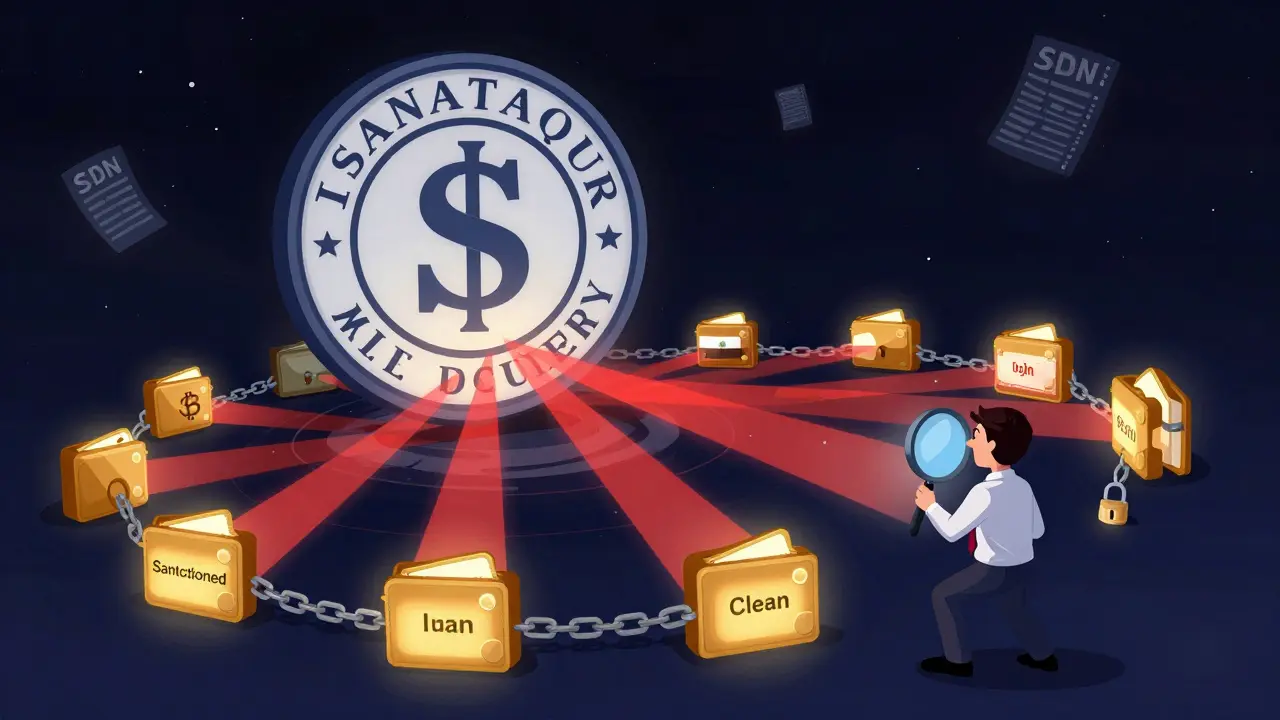
When you send or receive cryptocurrency, you might think it’s private, anonymous, and outside the reach of U.S. government rules. That’s a dangerous assumption. Since 2018, the Office of Foreign Assets Control (a division of the U.S. Department of the Treasury that enforces economic sanctions against foreign threats to national security) has been actively targeting digital assets. By 2025, OFAC had issued 17 enforcement actions against crypto firms, totaling over $48 million in penalties. This isn’t about catching drug dealers-it’s about every exchange, wallet provider, DeFi protocol, and even individual businesses that touch U.S. dollars or U.S. persons. If you’re operating in crypto and you’re connected to the U.S. financial system, OFAC’s rules apply to you-no exceptions.
How OFAC Targets Cryptocurrency
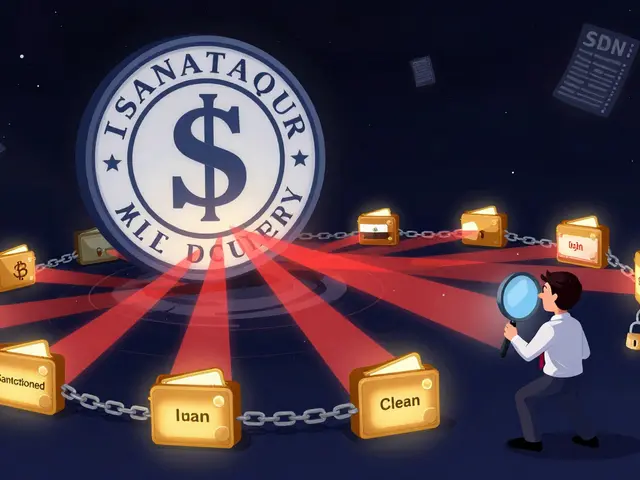
OFAC doesn’t just block bank accounts. It blocks wallet addresses. Since 2018, the agency has added over 1,247 cryptocurrency addresses to its Specially Designated Nationals (SDN) List (a public database of individuals, entities, and digital wallets blocked by U.S. sanctions). These aren’t random addresses. They’re linked to sanctioned countries like Iran, Syria, Cuba, and Russia-or to entities involved in ransomware, money laundering, or terrorist financing. The list updates constantly. In Q2 2025 alone, OFAC added 37 new crypto addresses. If your platform processes a transaction to or from one of these addresses-even once-you’re in violation.
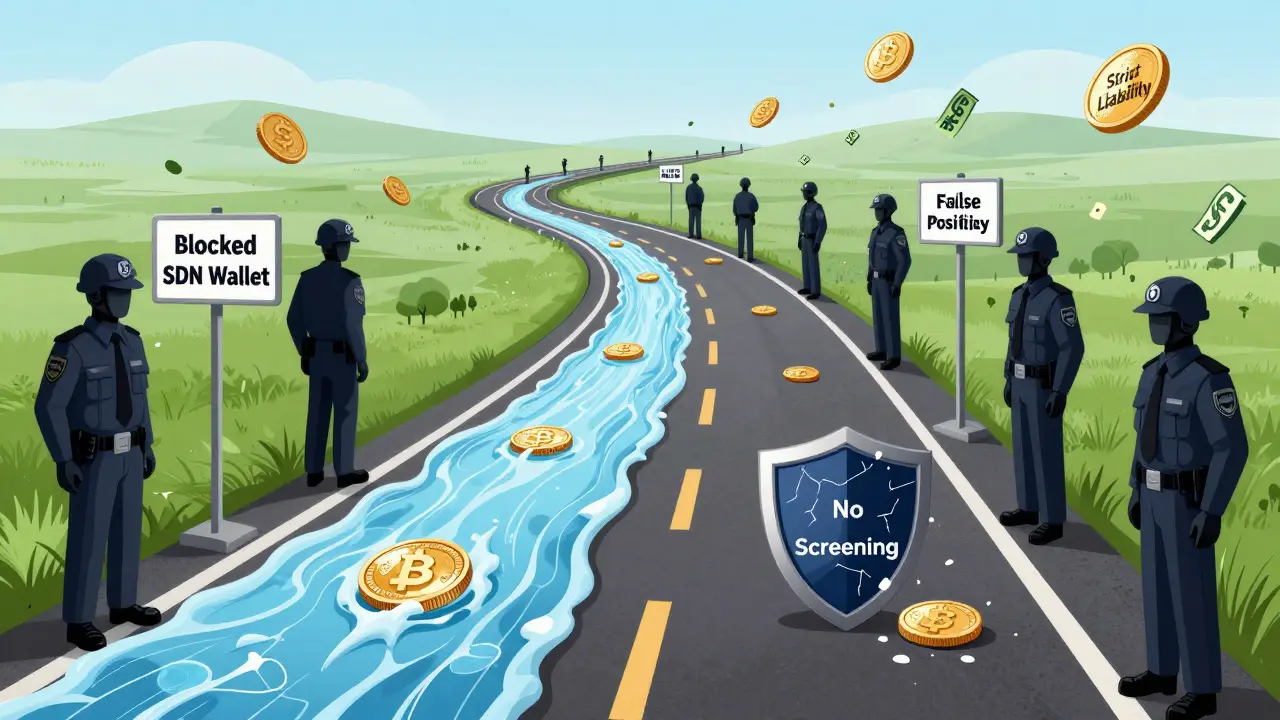
OFAC’s 2021 guidance made it crystal clear: it doesn’t matter if you didn’t know. The agency operates under strict liability. That means if a user on your platform sends $50 to a sanctioned wallet, and your system didn’t block it, you’re liable-even if you had no idea the address was blocked. There’s no defense of "I didn’t know," "I thought it was safe," or "It was just one transaction."
What Businesses Must Do: The Five Pillars of Compliance
OFAC doesn’t just warn companies-it tells them exactly what to build. The Virtual Currency Industry Compliance Guidance (OFAC’s official framework for digital asset compliance) outlines five mandatory components for any crypto business handling U.S. customers or transactions:
- Management Commitment - The board or executive team must formally approve the compliance program. No more "it’s the compliance officer’s job." Someone at the top must sign off, allocate budget, and be accountable.
- Risk Assessment - You must document how you identify risks. Are you a high-volume exchange? Do you support privacy coins? Do you serve users in high-risk jurisdictions? Your assessment must be updated quarterly and tied to real data, not guesswork.
- Internal Controls - This is where technology kicks in. You need automated systems that screen every transaction against the SDN list. This isn’t a one-time setup. It requires real-time integration with blockchain analytics tools like Chainalysis (a leading blockchain intelligence platform used by regulators and crypto firms to trace transactions), Elliptic (a blockchain analytics provider specializing in compliance and risk detection), or TRM Labs (a crypto compliance firm offering transaction monitoring and risk scoring).
- Testing and Auditing - An independent third party must audit your system at least once a year. Internal checks aren’t enough. Regulators want proof that your controls actually work.
- Training - Every employee who touches customer transactions, support, or compliance must be trained. A 2025 ACAMS survey found compliance officers need an average of 147 hours of specialized training just to handle crypto sanctions correctly.
Companies that skip even one of these pillars get hit hard. ShapeShift paid $750,000 in 2025 because it didn’t block users from Cuba or Iran-even though it had the technical ability to do so. Their mistake? No geolocation controls. Simple. Avoidable. Costly.
How Screening Tools Actually Work
Blockchain analytics tools don’t just look up wallet addresses. They track the entire history of every transaction. If a wallet received funds from a sanctioned address six months ago, even if it’s now clean, the tool flags it. These systems use machine learning to detect patterns: mixing services, chain hopping, address clustering. They’re not perfect. False positives are common. Coinbase’s compliance team reported 12-15% false positives in 2025. That means for every 100 flagged transactions, 12-15 are innocent users.
But here’s the key: you still have to block them. OFAC doesn’t care if it’s a false positive. If the system flags it, you must freeze the funds until you can prove the user isn’t sanctioned. Some firms, like Kraken, reduced false positives from 18% to 4.3% by building custom risk rules-like ignoring small transactions from low-risk wallets or applying stricter rules to privacy coins like Monero and Zcash. But that took months of tuning and $450,000 in tooling costs.
Privacy coins are the biggest headache. Monero, Zcash, and others are designed to hide transaction details. OFAC’s October 2025 update says you must still take "reasonable measures" to prevent these from being used by sanctioned parties. But how? Most tools can’t trace them. Many firms simply refuse to support them. Others block all transactions involving privacy coins entirely.
What Happens When You Get Caught
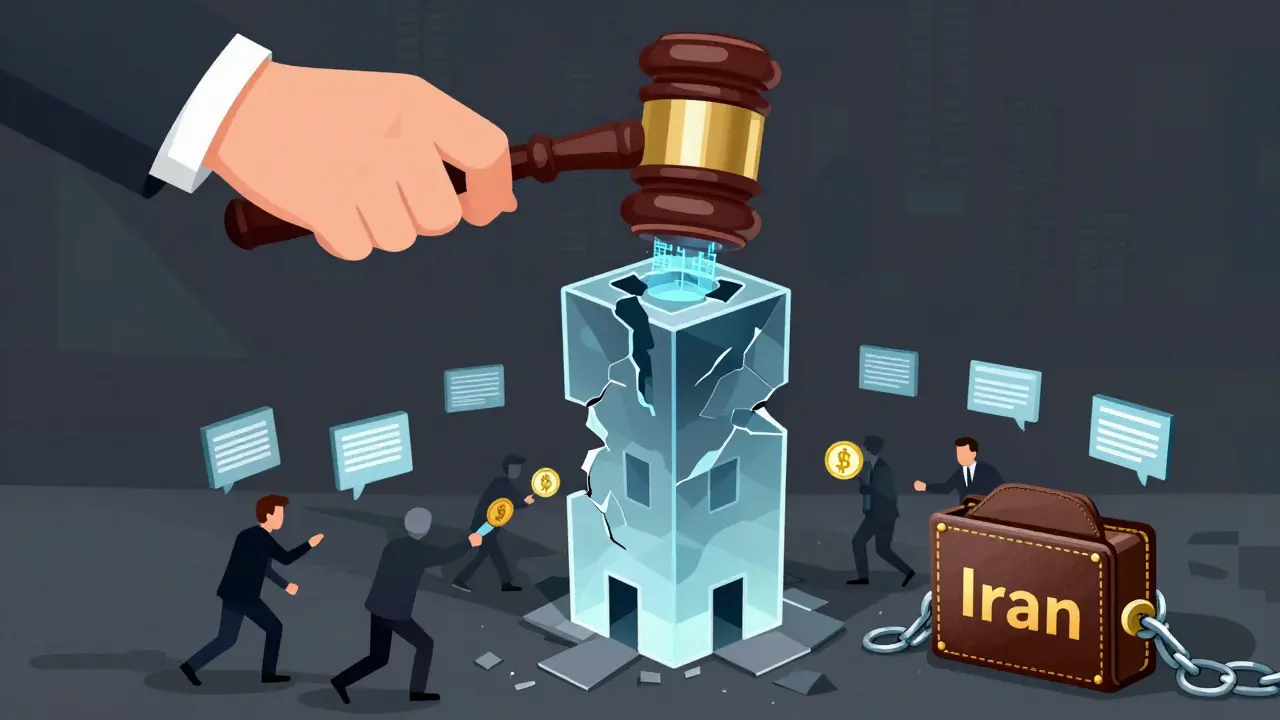
ShapeShift’s $750,000 fine? That was light. Garantex got hit harder. In August 2025, OFAC not only fined Garantex Europe OU for processing over $100 million in illicit transactions since 2019-it also designated its successor company, Grinex, and six related entities across Russia and Kyrgyzstan. This was a new tactic: network sanctions. Instead of just punishing one company, OFAC went after its entire ecosystem. That’s the new normal.
Penalties aren’t just financial. They’re operational. Firms that violate OFAC rules often lose access to U.S. banking services. Payment processors cut them off. Investors pull out. In 2025, two smaller exchanges shut down after OFAC enforcement because they couldn’t find a bank willing to work with them anymore.
And it’s not just exchanges. A DeFi protocol that allows users to swap tokens without identity checks? If a user from a sanctioned country uses it, the protocol’s developers could be held liable-even if they’re not based in the U.S. OFAC’s jurisdiction is global. If a U.S. person uses it, or if the protocol interacts with the U.S. financial system, you’re in scope.
Why This Is Harder Than Traditional Finance
Traditional banks have KYC: you show ID, they verify you. Crypto is different. You don’t need an ID to generate a wallet. You can send funds peer-to-peer without a middleman. This breaks the old compliance model.
DeFi protocols make it worse. Liquidity pools, automated market makers, smart contracts-none of these have a CEO, a legal team, or a customer service line. Who’s responsible when a wallet in Iran swaps ETH for USDC on Uniswap? OFAC says the protocol operator. But many DeFi projects are decentralized by design. That’s why experts like Professor Sarah Bloom Raskin argue the system is fundamentally broken: "You can’t enforce sanctions on something you can’t control."
Yet OFAC isn’t backing down. In September 2025, Director Andrew Hallman announced a new Digital Asset Sanctions Task Force (a specialized unit within OFAC dedicated to enforcing crypto sanctions with 35 full-time specialists). This isn’t a temporary crackdown. It’s a permanent escalation.
What You Should Do Today
If you run a crypto business-even a small one-here’s your checklist:
- Check if you’re in scope - Do you serve U.S. users? Accept U.S. dollars? Use U.S.-based payment processors? If yes, OFAC applies.
- Start with a risk assessment - Map out where your users are, what coins you support, and how transactions flow. Don’t skip this.
- Implement blockchain screening - Even if you’re small, use a tool like Crystal Explorer or Chainalysis. The cheapest plans start at $10,000/year. It’s cheaper than a fine.
- Block privacy coins - If you can’t screen them reliably, don’t support them. It’s not worth the risk.
- Train your team - One person who doesn’t understand the rules can cost you everything.
- Document everything - Auditors will ask for proof. If you don’t have logs, policies, or training records, you’re already in violation.
There’s no shortcut. You can’t rely on "we’re too small to matter." OFAC doesn’t care about your size. It cares about your connection to the U.S. financial system. The 2025 Deloitte survey found that 42% of small exchanges (under $100 million monthly volume) still don’t have any screening tools. They’re just waiting to get caught.
The Future: More Rules, More Tech
By 2027, Forrester predicts 65% of all crypto transactions will be screened in real time-up from 38% in 2025. The Treasury Department’s 2026 budget request includes $28 million for crypto enforcement, a 40% increase. The Ethereum Foundation’s proposed EIP-7594, which would add on-chain sanction checks to the protocol itself, has sparked fierce debate. Some see it as necessary. Others call it a threat to decentralization.
One thing is clear: compliance isn’t optional anymore. The days of "crypto is lawless" are over. The U.S. government has built the tools, the legal framework, and the enforcement teams. The only question left is: are you ready?
Does OFAC only target U.S.-based companies?
No. OFAC’s jurisdiction extends to anyone who engages in transactions involving U.S. persons, U.S. financial institutions, or U.S.-based systems-even if the company is based overseas. For example, a crypto exchange registered in Singapore that allows a U.S. citizen to send ETH to a sanctioned wallet is still subject to OFAC rules. The key factor is the connection to the U.S. financial system, not physical location.
Can I just rely on customer KYC to comply with OFAC?
No. KYC (Know Your Customer) only tells you who the user is, not where their funds came from or where they’re going. OFAC requires you to screen every transaction against the SDN list-including transfers between wallets. A user might be perfectly verified but still be sending money to a blocked address. That’s why blockchain analytics tools are mandatory, not optional.
What if I don’t know a wallet address is sanctioned?
OFAC operates under strict liability. Ignorance is not a defense. Even if you had no reason to believe an address was on the SDN list, if your system failed to block a transaction to that address, you’re still in violation. This is why automated, real-time screening is non-negotiable.
Do I have to convert blocked crypto into U.S. dollars?
No. OFAC explicitly states that blocked digital assets do not need to be converted into fiat currency. You can keep them in crypto form, as long as they’re locked in a "Blocked SDN Digital Currency" wallet and cannot be moved or accessed. This preserves the asset’s digital nature while ensuring compliance.
Are decentralized finance (DeFi) platforms exempt from OFAC rules?
No. OFAC has made it clear that DeFi platforms are not exempt. If a U.S. person uses a DeFi protocol to transact with a sanctioned address, the protocol’s developers or operators can be held responsible-even if they don’t control the code. OFAC’s 2025 guidance says firms must take "reasonable measures" to prevent such transactions, regardless of how decentralized the system appears.
How often does the OFAC SDN list update?
The SDN list is updated daily. In 2025, OFAC added an average of 12 new cryptocurrency addresses per week. Compliance systems must connect to real-time feeds from blockchain analytics providers like Chainalysis or Elliptic to stay current. Manual checks are insufficient and risky.
What’s the cost of implementing OFAC compliance for a small crypto business?
For a small exchange processing under $10 million monthly, initial setup typically costs $150,000-$300,000, including software, integration, and staff training. Annual maintenance runs $50,000-$100,000. Skipping compliance may seem cheaper, but OFAC penalties start at $250,000 per violation-and can go much higher.
Can I use open-source tools instead of paid blockchain analytics platforms?
The OFAC Sanctions List API on GitHub is publicly available and free, but it’s not sufficient alone. It only provides static lists of addresses, not real-time transaction monitoring, clustering analysis, or risk scoring. Most regulators require automated, dynamic screening with false positive management-something open-source tools can’t reliably deliver. Relying solely on free tools increases compliance risk significantly.





Brittany Meadows
February 12, 2026 AT 11:45next they'll be tracking your btc wallet like your social security number. why not just put a microchip in everyone's phone while they're at it? 🤖💸
they say 'strict liability' like it's a feature, not a dystopian nightmare. i'm starting to think 'decentralized' was just a marketing term for 'you're on your own'.
Santosh kumar
February 14, 2026 AT 04:24Will Lum
February 15, 2026 AT 18:42if you're touching us dollars or us persons you gotta play by the rules
it's not about crushing crypto
it's about not letting bad actors turn it into a laundering playground
blockchain analytics aren't perfect but neither is any system
and yeah false positives suck but better than letting a terrorist move funds undetected
Elijah Young
February 16, 2026 AT 06:48Donna Patters
February 18, 2026 AT 00:34Michelle Cochran
February 18, 2026 AT 15:14monique mannino
February 19, 2026 AT 04:15seriously, even $10k/year for screening is nothing compared to getting shut down. better safe than sorry!
Lindsey Elliott
February 21, 2026 AT 02:20blake blackner
February 22, 2026 AT 08:37Elizabeth Choe
February 23, 2026 AT 22:05do the thing. spend the money. train your team. document everything.
your future self will hug you for it. seriously. no cap.