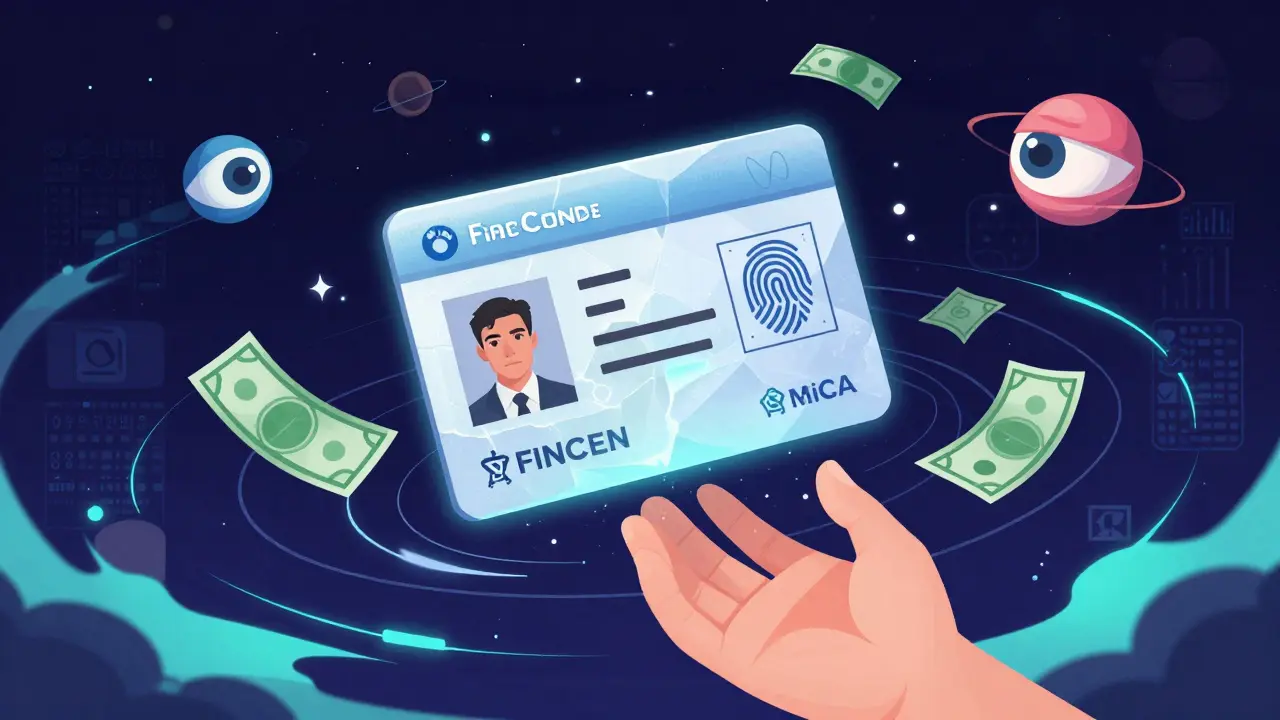
When you sign up for a crypto exchange like Coinbase or Binance, you’re asked to upload a photo of your ID, take a selfie, and confirm your address. It feels invasive. It feels slow. But it’s not optional - it’s KYC, and it’s the reason most crypto platforms still exist today.
What Exactly Is KYC in Crypto?
KYC stands for Know Your Customer. It’s a legal process that forces crypto exchanges to confirm who you are before letting you trade, deposit, or withdraw money. It’s not new. Banks have used it since the 1970s under the U.S. Bank Secrecy Act. But in crypto, it became unavoidable after 2013, when the U.S. Treasury’s FinCEN ruled that crypto exchanges are money transmitters - meaning they fall under the same anti-money laundering rules as banks.Today, 98% of the top 50 crypto exchanges require KYC. Without it, they risk fines up to $500,000 per violation, or even losing their license. In places like Singapore and Switzerland, non-compliance means shut down. The goal? Stop criminals from using crypto to launder money, fund terrorism, or run scams.
What Information Do You Need to Submit?
It’s not just a name and email. KYC asks for real, verifiable identity data:- Your full legal name (exactly as it appears on your ID)
- Your date of birth
- Your current residential address
- A government-issued photo ID (passport, driver’s license, or national ID card)
Some platforms also ask for proof of address - like a recent utility bill or bank statement - especially if you’re planning to deposit large sums. For corporate accounts, they’ll demand business registration documents and details about anyone owning 25% or more of the company (called Ultimate Beneficial Owners).
Advanced exchanges use AI to scan your ID. They check for fake watermarks, altered photos, or expired documents. Some even use 3D facial recognition to make sure you’re a live person, not a photo or video trying to trick the system. These tools catch 99.5% of spoofing attempts, according to Veriff’s 2023 report.
How Does KYC Work Step by Step?
The process is mostly automated, but here’s what actually happens:- Identification: You enter your name, birthdate, and address.
- Document Upload: You take a photo of your ID. Most apps let you do this in-app - it’s faster and clearer than uploading from a computer.
- Liveness Check: You’re asked to blink, turn your head, or smile. The system uses your camera to confirm you’re physically there.
- Document Verification: AI compares your ID to government databases. It checks for tampering, fake holograms, or mismatched data.
- Address Verification: If needed, you upload a bill or bank statement. The system checks the date, name, and address match your profile.
- Risk Scoring: Based on your location, transaction history, and ID quality, the system assigns a risk level. Higher risk = more questions.
Most people finish in 15-25 minutes. But during busy periods - like after a big price surge - verification can take 24 to 72 hours. Reddit users complain about this constantly. One person, u/CryptoNewbie87, waited 72 hours for their ID to be approved - even though everything was perfect.
Tiered KYC: Why Your Limits Change
Not all accounts are the same. Most exchanges use a tiered system:- Basic Tier: Name, DOB, ID. Daily limit: $500-$1,000. Good for small traders.
- Intermediate Tier: Add address proof. Daily limit: $10,000-$25,000.
- Verified Tier: Source of funds, employment proof, maybe a video call. Daily limit: $50,000+. Required for institutional investors.
Why? Because regulators treat big transactions differently. If you’re moving $10,000, they need to know where that money came from. If you’re buying $50 worth of Bitcoin? Not so much.

KYC vs. No-KYC: What’s the Real Difference?
There are crypto platforms that don’t require KYC. Decentralized exchanges like Uniswap and PancakeSwap let you trade without ID. Bitcoin ATMs in the U.S. often allow up to $900 without verification.But here’s the catch: 92% of all crypto-to-fiat transactions happen on KYC platforms. Why? Because only KYC exchanges let you deposit U.S. dollars, euros, or yen. No-KYC platforms only work with crypto-to-crypto trades. If you want to cash out to your bank account? You need KYC.
Also, no-KYC options are shrinking. The EU’s 6th Anti-Money Laundering Directive (2020) and U.S. crackdowns on mixing services have shut down dozens of anonymous platforms since 2020. Today, only 55% of the no-KYC services that existed in 2020 are still active.
Why Do People Hate KYC?
Privacy is the big complaint. In a 2023 CoinLedger survey, 68% of crypto users said they avoid KYC because they don’t want to hand over personal data. Reddit threads are full of stories: IDs rejected because of a shadow on the photo, delays because the system flagged their address as “high risk,” or accounts frozen after a simple typo in their name.One user on Trustpilot lost two weeks because their driver’s license had a tiny glare - the system flagged it as “tampered.” They had to resubmit three times. Another said their account was locked because their last name was spelled “Smith” in their ID but “Smyth” in their bank account. No one called. No one explained. Just frozen.
And yet, 63% of users still accept KYC as necessary. Why? Because it saved them. u/SecureTrader55 on Reddit said KYC helped recover $12,000 after their Kraken account was hacked. The exchange tracked the thief’s identity through the verified profile and worked with law enforcement to freeze the funds.
Is KYC Even Effective?
Critics say it’s flawed. Dr. Marion Laboure from Harvard found that 72% of illicit crypto funds still move through KYC exchanges - using fake IDs, stolen documents, or synthetic identities. The FATF admits that while KYC reduced obvious money laundering by 37% since 2019, sophisticated criminals now jump between platforms to avoid detection.But the data also shows something else: 83% of transactions involving sanctioned entities (like terrorist groups or Russian oligarchs) were flagged because of KYC checks, according to a 2022 Treasury report. Former FinCEN Director James H. Freis calls KYC the “most effective frontline defense” in crypto.
The truth? KYC isn’t perfect. But without it, crypto would be a lawless wild west. Banks wouldn’t work with exchanges. Payment processors like Stripe or PayPal would refuse to connect. And retail investors? They’d have no safe way to buy Bitcoin with their credit card.

What’s Changing in 2025?
The rules are tightening. In the U.S., the IRS will require all crypto exchanges to report 1099-DA forms starting in 2026 - meaning every taxable transaction must be tied to a verified identity. That’ll kill off most remaining no-KYC on-ramps for Americans.In Europe, MiCA (Markets in Crypto-Assets) regulation went live in June 2024. It forces every crypto service provider operating in the EU to implement full KYC - no exceptions.
But there’s hope for privacy. Projects like Microsoft’s ION and the W3C’s Verifiable Credentials are testing decentralized identity systems. Imagine proving you’re over 18 without showing your passport. Or confirming your address without handing over a utility bill. These are still in pilot stages, but 23 European programs are testing them right now.
How to Get Verified Without Getting Rejected
If you’re submitting your ID, follow these rules:- Use your phone’s camera, not a scanner. Better lighting = fewer rejections.
- Make sure your ID isn’t expired. Most platforms won’t accept IDs older than 5 years.
- Match your name exactly. If your license says “Robert J. Smith,” don’t type “Bob Smith.”
- Take the photo in good light. No shadows, no glare, no sunglasses.
- Don’t crop or edit the image. The system checks for tampering.
- For address proof, use a recent bill (under 3 months old) with your full name and address.
Gemini’s internal data says using the mobile app cuts rejection rates by 62%. Coinbase offers 24/7 chat support for verification issues - average response time: 8 minutes. Smaller exchanges? You’re stuck waiting days for an email reply.
Who Needs KYC - And Who Doesn’t?
- You need KYC if: You want to buy crypto with a credit card, cash out to your bank, trade over $1,000/month, or use a major exchange like Coinbase, Binance, or Kraken.
- You might skip KYC if: You only trade crypto-to-crypto on Uniswap, use a Bitcoin ATM under $900, or hold crypto long-term without ever converting to fiat.
But here’s the reality: 99.2% of the $3.1 trillion in crypto volume processed through centralized exchanges in 2023 happened on KYC platforms. If you’re serious about crypto, you’re going to need it.
Final Thoughts: Is KYC Worth It?
KYC feels like a hassle. It’s slow, invasive, and sometimes unfair. But it’s also the reason you can buy Bitcoin with your debit card and sleep at night knowing your exchange isn’t a front for drug dealers.The system is broken in places - fake IDs slip through, rejections are arbitrary, and support is terrible on small platforms. But it’s working. Illicit activity in crypto has dropped. Banks are slowly returning. And regulators are finally catching up.
Privacy-focused alternatives are coming. But for now, KYC is the price of entry. If you want to play in the big leagues of crypto, you don’t get to stay anonymous. You get to be verified.
Is KYC mandatory for all crypto exchanges?
No, but nearly all major exchanges require it. Decentralized exchanges like Uniswap and PancakeSwap don’t require KYC because they don’t hold your funds or handle fiat transactions. However, 98% of top exchanges by trading volume enforce KYC due to legal pressure. If you want to deposit dollars or euros, you’ll need to go through KYC.
What happens if my KYC gets rejected?
Most rejections happen because of poor photo quality, expired IDs, or name mismatches. You’ll usually get an email explaining why. Common fixes: retake the photo in bright, even lighting; make sure your ID is current; and double-check your name spelling matches your government document exactly. Some exchanges let you appeal or resubmit. Others lock your account until you fix it.
Can I use crypto without doing KYC?
Yes, but only in limited ways. You can trade crypto-to-crypto on decentralized exchanges like Uniswap. You can buy small amounts (under $900) at some Bitcoin ATMs. But you won’t be able to deposit or withdraw fiat currency. Most wallets don’t require KYC - but if you want to buy crypto with a bank transfer or credit card, KYC is unavoidable.
How long does crypto KYC take?
Usually 15-25 minutes if everything’s correct. But during high traffic - like after a major price surge - it can take 24 to 72 hours. Automated systems process most applications fast, but manual reviews happen when the system flags something unusual. Smaller exchanges often take longer because they lack AI tools and rely on human reviewers.
Why do I need to prove my address?
Address verification helps prevent fraud and ensures you’re not using a fake identity from a high-risk country. It’s also required by global anti-money laundering rules. Exchanges use utility bills, bank statements, or official government letters with your name and current address. The document must be under 3 months old and match your profile exactly.
Will KYC ever go away in crypto?
Unlikely. Regulators worldwide are moving toward stricter rules. The U.S. IRS’s 2026 1099-DA reporting rule will force exchanges to tie every taxable transaction to a verified identity. The EU’s MiCA regulation already requires full KYC. While privacy-focused tech like decentralized identity is being tested, it’s not ready to replace KYC yet. KYC isn’t going away - it’s just getting smarter.
Do I need KYC if I’m just holding crypto?
No - if you never trade, deposit, or withdraw funds through an exchange. You can buy crypto with cash, send it to a hardware wallet, and hold it forever without ever verifying your identity. But if you ever want to sell it, convert it to fiat, or use a centralized exchange, you’ll need KYC. Holding alone doesn’t trigger it - transactions do.
Are there any crypto exchanges that don’t do KYC?
Yes, but they’re limited. Decentralized exchanges like Uniswap, PancakeSwap, and SushiSwap don’t require KYC. Some Bitcoin ATMs allow small purchases without ID. However, these platforms don’t support fiat on-ramps. You can’t deposit dollars or euros. And since 2020, over 45% of no-KYC platforms have shut down due to regulatory pressure. Most are no longer viable for serious users.






Sammy Tam
December 16, 2025 AT 01:18KYC is such a weird hybrid of dystopian bureaucracy and necessary evil, you know? Like, I get why it exists - nobody wants their exchange to be a front for Nigerian prince scams - but the way some platforms reject your ID because of a shadow on your chin is just absurd. I once had my passport flagged for ‘possible digital manipulation’ because my phone’s camera caught a reflection in my glasses. Took three tries. Three. And no one at support even apologized. Just ‘try again.’
Still, I’ll take the hassle over losing my crypto to a hack. My buddy lost $8k on a no-KYC exchange last year. No recourse. No paper trail. Just gone. Now he uses Kraken and swears by KYC. Funny how that works.
Bradley Cassidy
December 16, 2025 AT 18:49bro why do they need my utility bill again?? i just wanna buy some btc not apply for a mortgage. i uploaded my license, did the blink thing, they even matched my face to the id - why the hell do i need a 2 month old gas bill?? i live with my parents and they dont send bills in my name. so now im stuck. 48 hours and still pending. this system is so broken it hurts.
Greg Knapp
December 17, 2025 AT 00:08you guys are making this way too complicated its just a stupid ID check stop crying about it if you dont like it dont use crypto i mean seriously why do you think banks ask for this same crap for 50 years because its the only thing keeping the whole thing from collapsing into a dumpster fire of fake identities and rug pulls
and dont even get me started on the no kyc crowd theyre just crypto anarchists who think blockchain is magic pixie dust that makes crime disappear its not theyre just hiding behind decentralization to move dirty money and you know it
if you want privacy go use monero or something but dont act like kyc is the enemy its the firewall keeping your portfolio from getting wiped by a botnet
Shruti Sinha
December 17, 2025 AT 03:39While I understand the necessity of KYC, I find the implementation inconsistent across platforms. In India, many exchanges request additional documentation - such as Aadhaar verification - which is not required elsewhere. This creates a fragmented user experience, especially for global traders. Moreover, the lack of standardized protocols means one’s personal data is stored in varying security environments, some of which are not transparent about their data retention policies. A unified, decentralized identity framework would be ideal, but until then, I comply - albeit with caution.
Heather Turnbow
December 18, 2025 AT 15:10The necessity of KYC in the cryptocurrency ecosystem cannot be overstated. While the process may appear intrusive, it serves as a critical safeguard against illicit financial activity, which, if left unchecked, would severely undermine public trust in digital assets. The regulatory frameworks established by FinCEN, the FATF, and now MiCA, reflect a global consensus on the imperative to align crypto with traditional financial compliance standards. That said, the user experience remains suboptimal - particularly for those with non-standard documentation or minor discrepancies in identity records. The industry must invest in more intuitive, human-centered verification interfaces, and prioritize clear communication during rejections. Privacy-preserving technologies, such as verifiable credentials, offer a promising path forward - but until they are widely adopted, KYC remains the only viable bridge between decentralized innovation and institutional legitimacy.