
The Myth of Crypto Anonymity
There is a persistent belief in digital asset circles that cryptocurrencies offer a shield against government oversight. People often assume that because transactions don't involve a bank manager checking IDs, they remain invisible to authorities. This assumption is dangerous and increasingly outdated. In reality, Cryptocurrency Sanctions Compliance is the adherence to international laws and regulations governing the use of digital assets to prevent financing prohibited activities. Governments have caught up with the technology, and the consequences for non-compliance are severe.
When you look at the landscape as of early 2026, the narrative has shifted completely from "regulation coming soon" to "enforcement is active." Regulatory bodies like the U.S. Treasury Department and European Union agencies treat digital currency addresses the same way they treat bank accounts linked to sanctioned entities. If you attempt to bypass these financial restrictions, you aren't just risking your funds; you are opening yourself up to criminal prosecution and permanent asset freezes.
Global Regulatory Frameworks
The rules governing cryptocurrency restrictions aren't created in a vacuum. They stem from established international bodies that monitor financial crimes. The Financial Action Task Force (FATF) plays a massive role here. FATF sets the global standard for anti-money laundering (AML) and counter-terrorism financing. Their stance is clear: virtual asset service providers must know their customers. They explicitly stated that virtual assets are far from anonymous.
In the United States, the primary authority is the Office of Foreign Assets Control (OFAC). OFAC is a U.S. Treasury bureau that administers and enforces economic and trade sanctions programs. In October 2021, they published specific compliance guidance for the virtual currency industry. This wasn't a suggestion; it established formal expectations for operators and users. Any transaction involving addresses on the Specially Designated Nationals and Blocked Persons List (SDN List) is illegal under U.S. law.
Across the Atlantic, the European Union implemented the Markets in Crypto-Assets Regulation (MiCA). MiCA is a comprehensive regulatory framework adopted in April 2023 to govern the provision of crypto-asset services across the EU. By December 2024, these rules mandated that all crypto-asset service providers install transaction monitoring systems. These systems must identify wallet addresses associated with sanctioned entities automatically.

Technical Traceability and Analytics
A critical misunderstanding revolves around the technical nature of blockchain ledgers. Unlike traditional banking, where internal records might be deleted or inaccessible, a blockchain ledger is public and immutable. Every transaction ever made on a chain like Bitcoin or Ethereum is permanently recorded. This creates a digital paper trail that is often more robust than traditional banking records.
Cryptocurrency Type Estimated Traceability Rate Analysis Tool Capability Bitcoin (BTC) 98% High - Full node tracking + heuristics Ethereum (ETH) 98% High - Smart contract interaction mapping Tether (USDT) 99% Very High - Centralized issuer control Monero (XMR) 65% Medium - Ring signatures hide sender details Zcash (ZEC) 70% Variable - Shielded pool visibility
Data from 2023 indicated that blockchain analytics firms could trace approximately 98% of transactions on major blockchains. Companies like Chainalysis and Elliptic provide these insights directly to law enforcement and compliance teams. While privacy-focused coins like Monero present challenges, the traceability rate still sits significantly higher than one might hope for if planning illicit activity. For regulated stablecoins like Tether, the centralization actually aids enforcement, as the issuer can freeze tokens instantly if flagged.
By 2026, experts project that traceability for major cryptocurrencies has reached nearly 99.8% due to coordinated international regulatory efforts. The tools used to analyze these chains are sophisticated, linking IP addresses, device fingerprints, and wallet behaviors to real-world identities.
Real-World Consequences of Evasion
The penalties for attempting to circumvent crypto restrictions go far beyond losing a few dollars. We are seeing a distinct shift toward criminal liability rather than just civil fines. In November 2023, the U.S. Department of Justice charged two Russian nationals with attempting to evade over $1.3 billion in sanctions using cryptocurrency. This marked a significant milestone as it was the first criminal prosecution specifically targeting crypto-based sanctions evasion attempts.
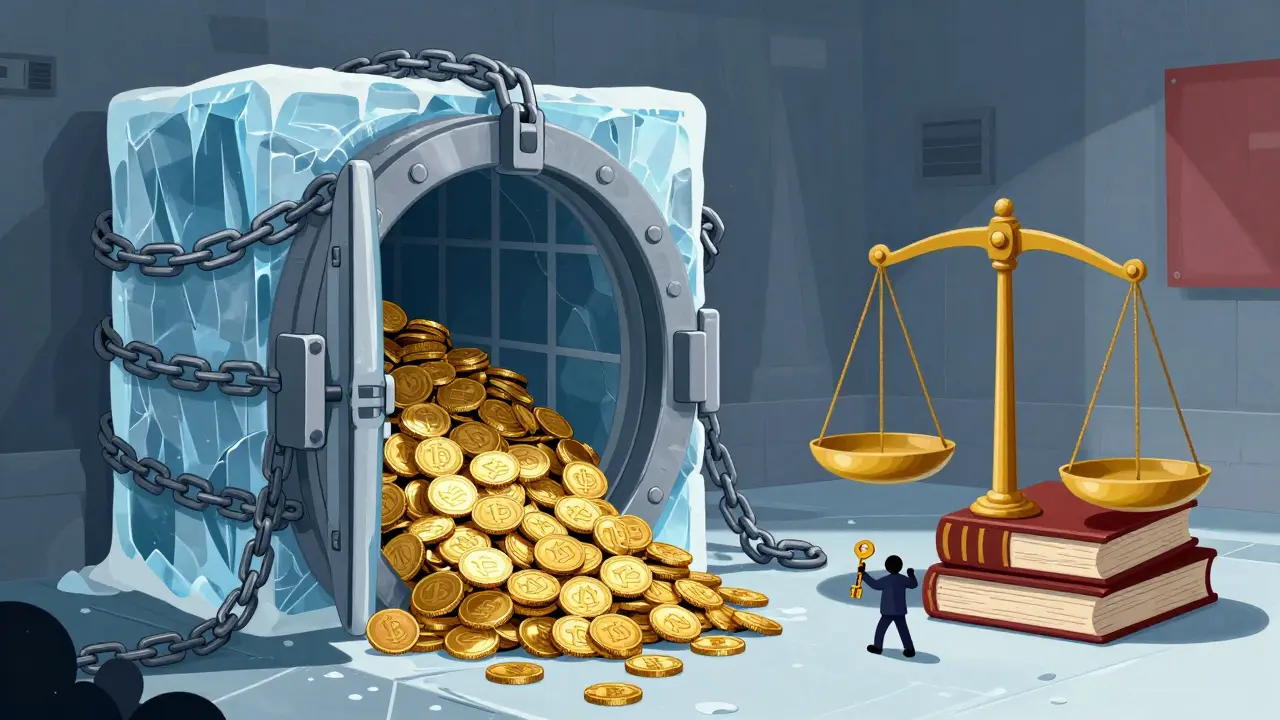
For businesses, the risk includes asset freezes. When sanctions were imposed on Russia in 2022, approximately $1.2 billion worth of Russian crypto assets were frozen. During the first three months of those sanctions, the volatility of these values caused fluctuations of up to 35%. Owners couldn't access their funds, and the value could evaporate overnight while waiting for legal resolution. Furthermore, major exchanges like Coinbase took decisive action, freezing 25,000 Russian accounts containing roughly $225 million in assets within 48 hours of the invasion.
If you operate a business that facilitates crypto transfers, failing to screen for these risks invites massive litigation costs. Nexo Inc., for instance, settled with five state coalitions for $22.5 million after accusations of offering unregistered securities and lacking proper oversight. For individuals, being caught on the wrong side of these laws means potential prison time, depending on the jurisdiction and severity of the violation.
Compliance Strategies for Operators
Legitimate industry players are investing heavily to stay ahead of these risks. OFAC's guidance recommends five specific compliance measures that serious companies follow: comprehensive risk assessments, real-time sanctions screening of counterparties, geolocation monitoring tools, blockchain transaction monitoring systems, and specialized staff training. Implementing these isn't cheap. Coinbase documented that developing these systems took 18 months and cost $47 million initially, with ongoing quarterly compliance costs hitting $12.3 million.
However, the technology improves efficiency. Kraken's system, for example, reduced false positives in sanctions screening from 22% to just 3.7% between 2021 and 2023 while increasing detection rates of sanctioned entities from 68% to 94.2%. This shows that while the burden is high, the effectiveness of filtering out risky transactions is getting better. As we approach late 2026, the expectation is that even decentralized finance (DeFi) protocols will face stricter scrutiny, with proposed legislation aiming to extend sanctions requirements directly to decentralized applications.
Frequently Asked Questions
Is using a non-KYC exchange safe for avoiding sanctions?
Using non-KYC (Know Your Customer) exchanges poses significant legal risks. Even if you don't provide ID, your transaction history on the blockchain is public. Authorities can track wallet movements. If funds interact with any monitored address later, you may lose them or face investigation regardless of your initial entry point.
Do privacy coins guarantee anonymity?
No, they do not guarantee full anonymity. While coins like Monero make tracing harder, they are not invisible. Many centralized exchanges prohibit depositing privacy coins, forcing users to reveal their identity elsewhere. Additionally, forensic tools are improving at de-anonymizing transaction clusters.
Can I accidentally violate crypto sanctions?
Yes. You might unknowingly transact with a blocked address. Blockchain wallets can change ownership without your knowledge. If you send funds to a mixtup or service that inadvertently routes money through a sanctioned entity, you could be liable. Screening tools are essential before every transfer.
What happens if my assets are frozen by an exchange?
Once an exchange flags an account for sanctions violation, funds are usually locked immediately. Unfreezing requires legal documentation proving no involvement with sanctioned entities. In many cases, especially involving designated countries, the assets are transferred to government authorities rather than returned.
Navigating crypto restrictions requires treating digital assets with the same caution as traditional financial instruments. The era of regulatory arbitrage-moving between weak jurisdictions to avoid rules-is closing rapidly as global standards align. Compliance is no longer optional for those wanting long-term security.






Elizabeth Akers
April 2, 2026 AT 04:41honestly most people are overthinking the whole situation and worrying too much right now
Alex Lo
April 2, 2026 AT 11:02Honestly i think peopel are forgetting how hard it has become to stay hidden online these days. The givernment has tools now that track everything we do on the chain. You cant just use a mixer and expect nobuddy to notice your movement of funds anymore. It was different back in two thousand twenty when things were wild west. But now every single wallet address is linked to an ip address somehow. Even if you try to hop between coins they know where you started from. My friend tried seling assets last month and got flagged imediatly. He thought he was smart using a privacy coin but still lost acess. Banks are just another layer of survelliance actually working against us. They share data with the treasury department on demond. Compliance teams cost millons but they catch little errors constently. If you are running a business you really need to worry about frozen accounts. Losng twenty five million is a nighmare for any startup foundr. Just stick to the rules and dont test the system boundries. Trusst me i read the full document and it sounds scary af.
Katrina Tate
April 3, 2026 AT 13:27The assumption that blockchain provides actual privacy is delusional given current analytics capabilities. Regulatory bodies have integrated sophisticated monitoring software to flag suspicious activity patterns instantly. Most individuals fail to realize that heuristic clustering allows investigators to identify specific wallet owners with high accuracy. Transparency is the core design feature of these systems not a bug that can be exploited freely.
Liam Robertson
April 4, 2026 AT 19:33I completely agree that the technical reality often gets misunderstood by new participants entering the market. We need to respect the legal frameworks established because ignoring them puts communities at risk unnecessarily. While decentralization offers freedom it does not grant immunity from international laws regarding financial crimes. Everyone benefits when operators maintain transparency and follow due diligence standards properly.
Sean Carr
April 5, 2026 AT 07:33Focus on implementing proper screening tools early before issues arise. Small businesses can get hit hard with frozen assets if they miss blocked lists. Training staff on compliance saves money compared to settling lawsuits later.
Disha Patil
April 6, 2026 AT 05:08It is terrifying to think about how quickly my life could fall apart over a single transaction mistake. I feel like the stakes are just too high for normal people to manage alone. Nobody talks about the emotional toll of waiting months for assets to be reviewed. We are being treated like criminals before anyone even proves anything wrong happened. The stress alone could destroy relationships within families just trying to understand finances.