If you've been searching for a Sky crypto exchange review, you've probably noticed something confusing: there isn't actually a traditional "exchange" by that name. Instead, you'll find a massive DeFi powerhouse, a niche internet project, and some very dangerous scams. It's easy to get these mixed up, but confusing a decentralized protocol with a Ponzi scheme can cost you everything.
To clear the air, we need to talk about Sky Protocol is a decentralized finance (DeFi) ecosystem that manages a tokenized money market fund, providing yield-generating stablecoins. It was formerly known as Maker, and it's widely considered a "blue chip" project in the crypto world. If you are looking for a place to trade coins using an app and a customer support chat, Sky Protocol isn't that-it's a set of smart contracts that let you earn interest and govern a financial system.
Understanding the Sky Ecosystem: Protocol vs. Token
Most people searching for a review are actually looking for the SKY token is the governance token of the Sky Protocol, allowing holders to vote on system changes and earn rewards. . If you held Maker tokens in the past, you might have already upgraded them; the conversion rate was 24,000 SKY for every single Maker token. This wasn't just a name change; it was a strategic shift to make the protocol more inclusive and scalable.
The real engine here is USDS is a stablecoin pegged to the US dollar that serves as the primary liquidity vehicle for the Sky Protocol. . Unlike a standard stablecoin that just sits there, the Sky ecosystem offers sUSDS, which is essentially a yield-bearing version of the coin. By 2025, USDS grew its supply by 74%, hitting a massive $9.2 billion. When you put those numbers next to a 10% revenue increase (reaching $338 million in 2025), it's clear that the protocol is thriving even when the rest of the market is flat.
How it Actually Works (The Non-Custodial Edge)
Since this isn't a centralized exchange, you don't "deposit" money into an account managed by a company. Instead, you interact with Smart Contracts are self-executing contracts with the terms of the agreement directly written into lines of code. . This means you keep your private keys in your own wallet. You aren't trusting a CEO; you're trusting the code.
The protocol creates a "money market fund" effect. It allocates capital across various yield sources-some in crypto and some in traditional public or private markets-and wraps that yield into the stablecoin. For those who want to move in and out of the system, Sky has built a massive cushion of USDC liquidity (over $4 billion as of 2025), meaning you can swap between USDS and USDC with virtually zero slippage. If you've ever tried to swap a large amount of a low-cap coin and watched the price tank, you know why zero slippage is a big deal.
| Feature | Sky Protocol (SKY) | Skycoin (SKY) | SkyCryptoTrading |
|---|---|---|---|
| Nature | DeFi Money Market | Decentralized Internet | Investment Site |
| Primary Goal | Yield & Stability | Infrastructure/Privacy | "High Yield" Returns |
| Trust Level | High (Blue Chip) | Niche/Speculative | Scam/Danger |
| Custody | Non-Custodial | Non-Custodial | Custodial (Dangerous) |
The Governance and Rewards Model
If you hold SKY tokens, you aren't just speculating on the price. You're essentially a shareholder in a digital bank. Through on-chain voting, you decide how the protocol evolves. This is the heart of decentralized governance: the users, not a board of directors, steer the ship.
Then there's the passive income. By staking your SKY tokens, you earn rewards based on your level of participation. It's a loop that encourages long-term holding rather than day-trading. While most of the market struggled in late 2025, SKY showed surprising strength, partly because its fundamentals-the actual money it makes-were improving while other projects were just burning cash to survive.

Wait, What About Skycoin?
You might see another token called SKY associated with Skycoin is a cryptocurrency project focused on decentralized internet infrastructure and the Bone blockchain. . This is a completely different animal. Skycoin isn't about stablecoins or money markets; it's about things like the CX programming language and Skywire for decentralized internet. It uses the CoinJoin is a privacy-enhancing method that combines multiple transactions from different users into one large transaction. protocol to hide transaction paths. While it's an interesting technical feat with sub-2-second transaction times, it doesn't have the institutional weight of the Sky Protocol.
Warning: The "SkyCryptoTrading" Scam
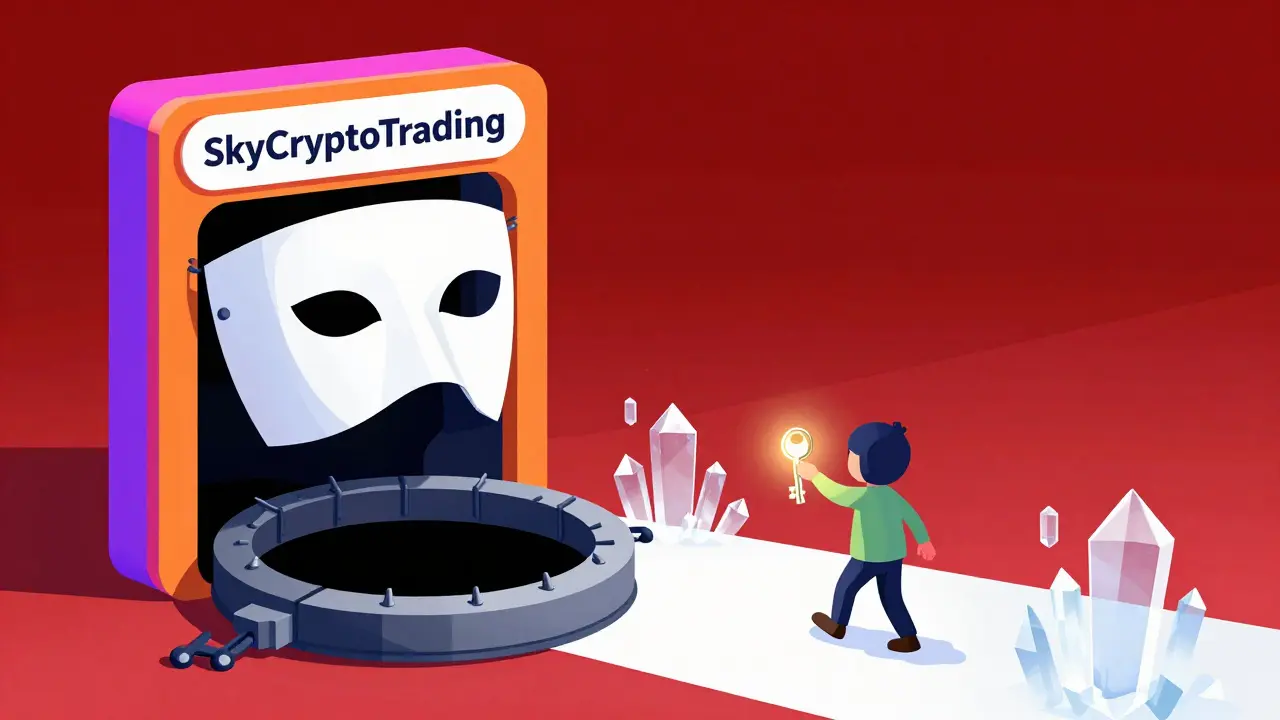
This is the most important part of this review. There is a site called SkyCryptoTrading.com. It describes itself as a high-yield investment program (HYIP). In the world of finance, "HYIP" is almost always a synonym for "Ponzi Scheme." Reports from platforms like Forex Peace Army confirm that this entity is a scam. They promise huge returns, take your money, and then the website simply disappears. If you see a site asking you to send crypto to a central address with a promise of guaranteed daily returns, run the other way. The real Sky Protocol will never ask you to send your coins to a random address for a guaranteed 10% daily return.
Is the Sky Protocol a Good Bet for 2026?
Looking at the data, the Sky Protocol is positioned as a high-conviction play. Its P/E ratio (around 8) suggests it's undervalued given its growth. The move to integrate Tether is the largest stablecoin by market cap (USDT), used globally for liquidity and trading. could be the next major catalyst. If Sky can capture even a fraction of Tether's massive capital, the growth of USDS could accelerate exponentially.
However, the risks are still there. DeFi is only as strong as its smart contracts. While Sky is audited and transparent, a bug in the code is always a theoretical possibility. That's why using a non-custodial wallet is non-negotiable. You should never keep your life savings in a single protocol, no matter how "blue chip" it is.
Is Sky Crypto Exchange a real exchange?
No. There is no legitimate centralized exchange called "Sky." What people usually mean is Sky Protocol, which is a DeFi platform for stablecoins and yield, or they are mistakenly looking for Skycoin, which is a separate infrastructure project.
What is the difference between USDS and sUSDS?
USDS is the base stablecoin pegged to the US dollar. sUSDS is the "savings" version-a yield-generating wrapper that allows you to earn a return on your holdings within the Sky ecosystem.
How do I get SKY tokens from Maker?
Maker token holders can upgrade their tokens to SKY. The conversion rate is 24,000 SKY tokens for every 1 Maker token. This process is optional, and you can convert them back if needed.
Is SkyCryptoTrading.com safe?
Absolutely not. It has been identified as a Ponzi scheme/HYIP scam. It is not affiliated with Sky Protocol or Skycoin. Never send funds to this platform.
How are SKY tokens used for governance?
SKY token holders can participate in on-chain voting. This means they can vote on proposals regarding the protocol's risk parameters, fee structures, and overall development direction.
Next Steps for Users
If you're just starting out, don't jump straight into staking. First, set up a secure non-custodial wallet (like MetaMask or Rabby) and familiarize yourself with the Sky Protocol's official documentation. If you are moving from Maker, decide if the governance utility of SKY outweighs your preference for the original token.
For those looking at the price action, keep an eye on the Tether integration. That's the key variable that could push USDS from a "large" stablecoin to the "dominant" one. As always, verify every URL you visit; if a site promises you "guaranteed" returns on your SKY tokens, it's a scam. The real protocol is about transparency and code, not sales pitches.


Michael Harms
April 16, 2026 AT 10:38Glad someone finally laid this out clearly! It's so easy for beginners to get tricked by those fake "exchange" sites. Definitely a great move to stick with non-custodial wallets to keep your assets safe.
Shantal Sanjur
April 17, 2026 AT 10:21Oh, wow, a "blue chip" project. How original.
I'm sure the "code" is perfectly fine and definitely not a backdoor for some institutional shadow government to track every single cent we move into sUSDS. It's almost like they want us to believe the transition from Maker was for "inclusivity" and not just a giant rebranding exercise to hide the bodies of the old system. But sure, just trust the smart contract, because we all know those never get exploited, right? Absolute joke.
Michael Harms
April 19, 2026 AT 02:50I totally get the skepticism, but the transparency of DeFi is actually its strongest point! It's all about learning how to verify the contracts yourself so you can feel more secure about where your money is.
Gillian Kent
April 19, 2026 AT 23:36The diffrence between the protcol and the scams is realy importnt to mention. I almos fell for one of those high yield sites last year so thnx for the warnign. It is just wild how many peple try to steal from others in this space.
Karen Mogollon Gutierrez
April 20, 2026 AT 22:46It is absolutely imperative that we acknowledge the sheer audacity of these fraudulent entities masquerading as legitimate financial platforms. The level of deception employed by SkyCryptoTrading is nothing short of abhorrent, and it is a tragedy that innocent investors are lured into such predatory traps by the promise of unrealistic returns.
One must wonder why there is so little regulatory oversight to prevent such blatant theft in the digital age. The psychological toll of losing one's life savings to a Ponzi scheme is a burden no one should ever have to bear. Furthermore, the transition from Maker to Sky, while strategically sound from a corporate perspective, introduces a layer of complexity that may inadvertently confuse the less tech-savvy user, thereby creating more opportunities for scammers to exploit that very confusion. We must demand a higher standard of security and a more rigorous approach to verifying these protocols before any capital is committed. The risks associated with smart contract vulnerabilities, however slim they may appear to some, are a constant shadow over the entire DeFi landscape. It is simply unacceptable that the burden of security rests entirely on the individual's ability to manage private keys without error. One single mistake with a seed phrase and your entire portfolio vanishes into the ether, which is an utterly terrifying prospect for the average person. This systemic instability is precisely why many remain hesitant to enter the crypto space despite the alluring yields. We are essentially gambling on the hope that the developers were meticulous in their coding, which is a precarious foundation for a global financial system. The industry must evolve past this "wild west" phase if it ever hopes to achieve true mainstream adoption. Until then, we are all just walking a tightrope over a pit of digital sharks, hoping for the best while the scammers cheer us on from the sidelines. It is an absolute disgrace.