The United Arab Emirates has moved from being a curious experiment in digital finance to the world’s most serious contender for the title of global cryptocurrency capital. If you are looking at where to base your exchange, launch your token, or simply manage your portfolio with legal certainty, the answer increasingly points south. By May 2026, the UAE isn’t just welcoming crypto companies; it is actively building the infrastructure to host them. This shift is driven by a clear regulatory framework, strategic government backing, and a business environment that understands speed without sacrificing security.
For years, the industry struggled with ambiguity. Regulators in many major economies were slow to define what virtual assets actually were. The UAE took a different path. It decided early on that clarity was better than caution. Today, the country offers a multi-layered regulatory structure that covers everything from simple wallet providers to complex institutional custodians. This guide breaks down exactly how this system works, who regulates whom, what it costs to get licensed, and what new tax rules mean for your bottom line in 2026 and beyond.
Why the UAE Won the Race for Crypto Clarity
The reason so many top-tier players have flocked to the UAE comes down to one word: legitimacy. In the past, crypto businesses often operated in gray zones. That era is over here. The UAE established a comprehensive regulatory framework through Cabinet Resolution No. (111) of 2022, which is a federal law establishing regulations for virtual assets and service providers across all emirates and free zones. This resolution didn't just suggest guidelines; it created binding rules for Virtual Asset Service Providers (VASPs).
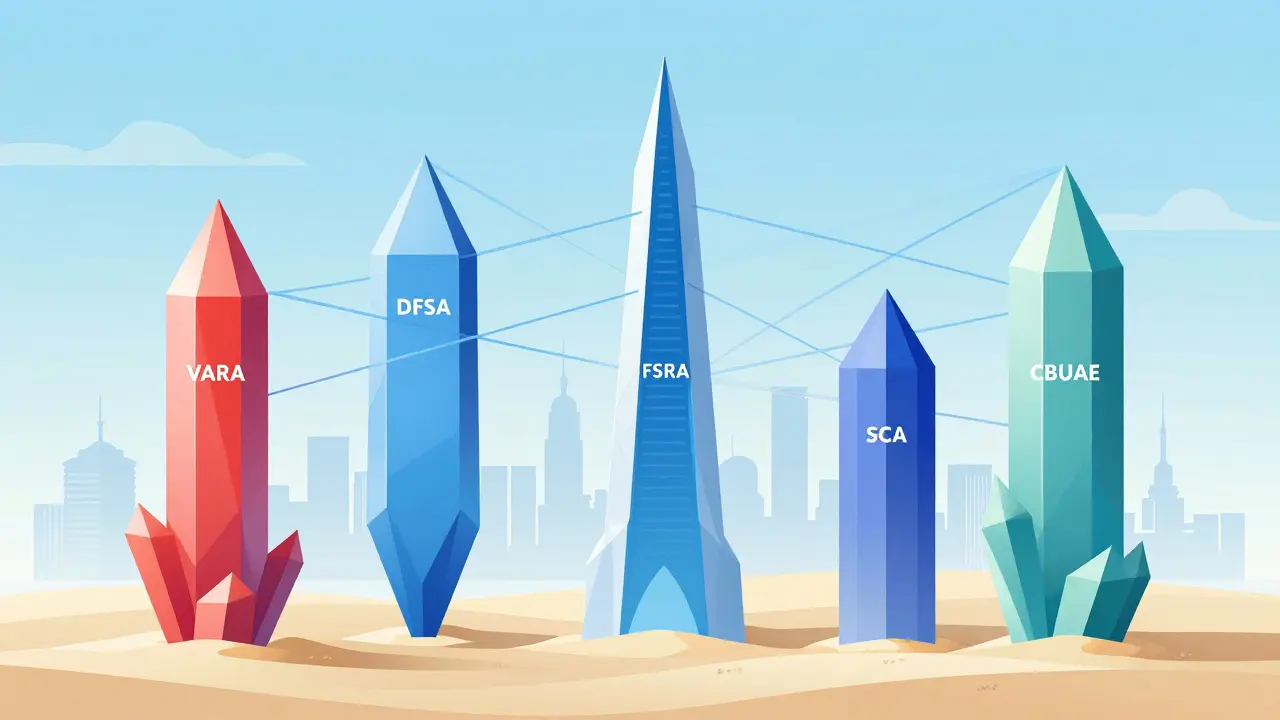
This federal oversight is paired with specialized local regulators. You don't have to navigate a single, monolithic bureaucracy. Instead, you choose the jurisdiction that fits your business model. This flexibility is rare. Most countries force every crypto company into the same box. The UAE provides five distinct jurisdictions, each with its own regulator. This allows a small startup in Dubai Media City to operate under different rules than a massive hedge fund in Abu Dhabi Global Market. The result is an ecosystem that feels tailored rather than forced.
Major international exchanges like Binance, Crypto.com, and Bybit are leading cryptocurrency platforms that have established official operations in the UAE to comply with local regulations have set up shop here. Institutional custodians like BitGo and Laser Digital have followed suit. Their presence signals to investors and partners that the UAE is safe, stable, and ready for business. It’s not just about hype; it’s about operational reality.
Navigating the Five Regulatory Jurisdictions
Understanding who regulates you is the first step in doing business in the UAE. The landscape is divided between federal authorities and free zone regulators. Knowing the difference can save you months of compliance headaches.
| Regulator | Jurisdiction | Primary Focus | Best For |
|---|---|---|---|
| VARA (Virtual Assets Regulatory Authority) | Dubai (Mainland) | Bespoke crypto licensing, consumer protection | Exchanges, brokers, token issuers targeting retail |
| DFSA (Dubai Financial Services Authority) | DIFC (Free Zone) | International financial standards, institutional focus | Institutional trading, wealth management, fintech |
| FSRA (Financial Services Regulatory Authority) | ADGM (Abu Dhabi) | Common law-based regulation, innovation sandbox | Web3 startups, DeFi protocols, institutional custody |
| SCA (Securities and Commodities Authority) | Federal | Investment-related virtual assets, securities | Tokenized securities, public offerings |
| CBUAE (Central Bank of the UAE) | Federal | Payment tokens, fiat conversions | PBFTs (Payment Token Service Providers), remittances |
VARA is the primary regulator for virtual asset activities in Dubai mainland, known for its strict but clear licensing categories stands out as the most popular choice for pure-play crypto businesses. Established in 2022, VARA operates a bespoke licensing regime. Unlike traditional financial regulators who try to fit crypto into old banking boxes, VARA was built specifically for this industry. They understand blockchain technology, smart contracts, and decentralized finance. This technical competence makes the application process smoother for tech-native teams.
On the other hand, if your business involves high-net-worth individuals or institutional clients, the DIFC (Dubai International Financial Centre) regulated by the DFSA might be more suitable. The DIFC operates under common law, similar to London or New York, which provides familiar legal protections for international banks and funds. Similarly, Abu Dhabi’s ADGM (Abu Dhabi Global Market) supervised by the FSRA offers a robust environment for Web3 innovation, particularly for decentralized autonomous organizations (DAOs) and real-world asset tokenization.
VARA Licensing: Costs, Categories, and Requirements
If you choose Dubai mainland, you will likely deal with VARA. Their licensing framework is detailed and transparent. There are six primary activity categories:
- Exchange services
- Broker-dealer services (fiat-to-virtual and virtual-to-virtual)
- Transfer services
- Custody services
- Wallet provision
- Token issuance
Token issuance is split into two sub-categories. Category 1 requires both a license and specific approval, typically for utility tokens or those with significant economic rights. Category 2 requires distribution through a licensed entity, though some closed-loop tokens may be exempt while still remaining under VARA oversight. This nuance matters because it determines how much scrutiny your token sale will face.
The financial barriers to entry are substantial but predictable. Paid-up capital requirements range from AED 100,000 (approx. $27,000 USD) for simpler wallet providers to over AED 1.5 million (approx. $408,000 USD) for full-service exchanges. Application fees sit between AED 40,000 and AED 100,000. Annual supervision fees are set between AED 80,000 and AED 200,000. These costs reflect the UAE’s positioning as a premium jurisdiction. They are filtering out fly-by-night operators and attracting serious businesses willing to invest in compliance.
Beyond money, you need substance. VARA requires incorporation in Dubai, fit-and-proper person assessments for directors and shareholders, comprehensive business plans, robust compliance frameworks, and stringent technology and security standards. You must demonstrate insurance coverage and detailed record-keeping capabilities. Anti-money laundering (AML) and counter-financing of terrorism (CFT) checks are rigorous. The SCA also conducts enhanced due diligence for investment-related assets, ensuring that the entire ecosystem maintains high integrity.

Tax Changes: CARF and VAT Exemptions
One of the biggest shifts in 2026 is the evolution of tax transparency. The UAE introduced the Crypto-Asset Reporting Framework (CARF), which is a global standard for automatic exchange of information on crypto-assets, implemented in the UAE starting September 2025. Effective September 20, 2025, the Ministry of Finance announced measures to align with global standards. This doesn’t mean higher taxes for everyone, but it does mean less secrecy.
Under CARF, entities providing crypto services-including exchanges, brokers, custodians, and wallet providers-must collect and share comprehensive data. This includes buying/selling histories, account balances, transaction records, and customer identification/residency status. The goal is to create a secure ecosystem that discourages tax evasion. The implementation timeline extends through 2028. Public consultation ended in November 2025, final regulations arrived in 2026, and actual reporting begins January 1, 2027. The first automatic exchange of data happens in 2028. This phased approach gives businesses time to upgrade their systems.
However, there is good news for daily operations. Effective November 15, 2024, most transactions involving virtual assets are exempt from the standard 5% Value Added Tax (VAT). This exemption applies to cryptocurrencies, NFTs, and other digital assets. For exchanges and merchants, this removes a significant friction point. It lowers costs for users and simplifies accounting for businesses. While income tax may still apply depending on corporate structures, the removal of VAT on crypto trades keeps the UAE competitive against other hubs.
Real-World Assets and Future Growth
The UAE isn’t just focused on Bitcoin and Ethereum. It is heavily investing in Real-World Asset (RWA) tokenization. This involves taking physical assets-like real estate, gold, or bonds-and representing them as tokens on a blockchain. The regulatory framework is evolving to support these institutional-grade projects. VARA and ADGM have both shown particular interest in this sector, recognizing it as a bridge between traditional finance and Web3.
This focus attracts institutional investors who want exposure to digital assets but require the stability and legal recourse of traditional markets. The UAE’s proximity to Asia, Europe, and Africa adds geographic value. Time zones allow for near-24-hour coverage of global markets. Government backing ensures that policy won’t flip-flop overnight. Strategic initiatives continue to roll out, reinforcing the country’s position as a premier destination for blockchain innovation.
As we move further into 2026, the message is clear. The UAE has moved past the speculation phase. It is now in the execution phase. With clear licenses, defined tax rules, and strong anti-money laundering controls, it offers a level of certainty that few other jurisdictions can match. Whether you are a developer, an investor, or a corporation, the UAE provides a structured path to participate in the future of finance.
Is it legal to trade crypto in the UAE?
Yes, it is legal to trade cryptocurrency in the UAE, provided you use licensed platforms. The Central Bank of the UAE has previously warned against unlicensed activities, but the introduction of Cabinet Resolution No. (111) of 2022 and regulators like VARA has created a fully legal framework for VASPs. Retail users should ensure they trade on exchanges that hold valid licenses from VARA, DFSA, or FSRA to protect their funds.
How much does a VARA license cost?
The cost varies by activity type. Application fees range from AED 40,000 to AED 100,000. Annual supervision fees are between AED 80,000 and AED 200,000. Additionally, paid-up capital requirements range from AED 100,000 for simple services to over AED 1.5 million for full exchanges. These figures exclude legal, consulting, and office setup costs, which can add significantly to the initial investment.
What is CARF and how does it affect me?
CARF (Crypto-Asset Reporting Framework) is a global standard for tax transparency. In the UAE, it requires crypto service providers to report user data, including transaction history and account balances, to tax authorities. Starting January 1, 2027, this data will be collected, with automatic exchange between countries beginning in 2028. For individual users, this means greater tax transparency. For businesses, it requires upgraded compliance and reporting systems.
Is crypto subject to VAT in the UAE?
No. Since November 15, 2024, most transactions involving virtual assets, including cryptocurrencies and NFTs, are exempt from the standard 5% VAT. This exemption helps reduce costs for traders and businesses operating in the digital asset space, making the UAE more competitive globally.
Which regulator is best for my crypto startup?
It depends on your business model. If you are a pure-play crypto exchange or broker targeting retail customers in Dubai, VARA is likely the best fit. If you are serving institutional clients or high-net-worth individuals, the DFSA in DIFC or FSRA in ADGM may offer better alignment with traditional financial standards. Consult with a legal expert to analyze your specific activities and target market before applying.