
The UAE was officially removed from the FATF grey list on February 23, 2024-and for crypto businesses operating there, this wasn’t just a bureaucratic win. It was a signal to the world that the country’s financial system now meets global standards for transparency, accountability, and security. For crypto exchanges, wallet providers, and token issuers, this change meant one thing: the path to international banking, institutional investment, and cross-border liquidity just got a lot clearer.
What the FATF Grey List Actually Means for Crypto
The Financial Action Task Force (FATF) isn’t a bank. It’s the global watchdog that sets rules to stop money laundering and terrorist financing. When a country lands on its grey list, it means regulators worldwide see serious gaps in how that country monitors financial transactions. For crypto, this is a big deal. FATF’s 2019 guidance specifically targeted virtual asset service providers (VASPs)-exchanges, custodians, and OTC desks-with rules requiring them to collect and share customer data (Know Your Customer and Travel Rule compliance). Before the UAE’s removal, international banks were hesitant to process transactions involving UAE-based crypto firms. Why? Because if a transaction passed through a grey-listed jurisdiction, the bank itself could be flagged for inadequate due diligence. This meant delays, higher fees, and sometimes outright account closures for crypto startups trying to move money between Dubai and Europe or the U.S. Now, with the UAE off the list, those barriers are crumbling. Banks no longer have to treat UAE-based crypto firms as high-risk by default. That’s a game-changer for liquidity and growth.How the UAE Fixed Its AML/CFT System
The UAE didn’t just tweak a few forms. It rebuilt its entire financial crime defense system from the ground up. Between 2022 and 2024, the country:- Created a dedicated financial crimes court to fast-track prosecutions of money laundering cases
- Expanded the powers of its Financial Intelligence Unit (FIU), giving it more staff, better tech, and direct access to bank and crypto transaction data
- Required all Designated Non-Financial Businesses and Professions (DNFBPs)-including gold traders, real estate agents, and now crypto platforms-to file suspicious activity reports or face license suspension
- Introduced jail time (up to five years) for corporate employees who take bribes to ignore compliance rules
- Increased outbound mutual legal assistance requests by over 200%, showing it’s willing to cooperate with foreign regulators
Why Crypto Exchanges in Dubai Are Now More Attractive
Before 2024, Dubai was already a crypto hub-but it operated under a cloud. Companies like Binance, Bybit, and OKX had licenses, but their ability to connect with global banks was limited. Now, those same companies are seeing real changes:- Banking access: HSBC, Standard Chartered, and Emirates NBD have reopened correspondent banking relationships with UAE-based VASPs. One exchange reported a 60% drop in transaction processing times.
- Institutional interest: Hedge funds and family offices from Europe and Asia are now willing to allocate capital to UAE-based crypto funds. Previously, legal teams would block the deals outright.
- Token listings: Major global exchanges are now more willing to list tokens issued by UAE-based projects. The UAE’s regulatory clarity means less legal risk for listing teams.
- Regulatory partnerships: The UAE’s Virtual Assets Regulatory Authority (VARA) is now in direct dialogue with the SEC, FCA, and MAS-not just as a jurisdiction under watch, but as a peer.
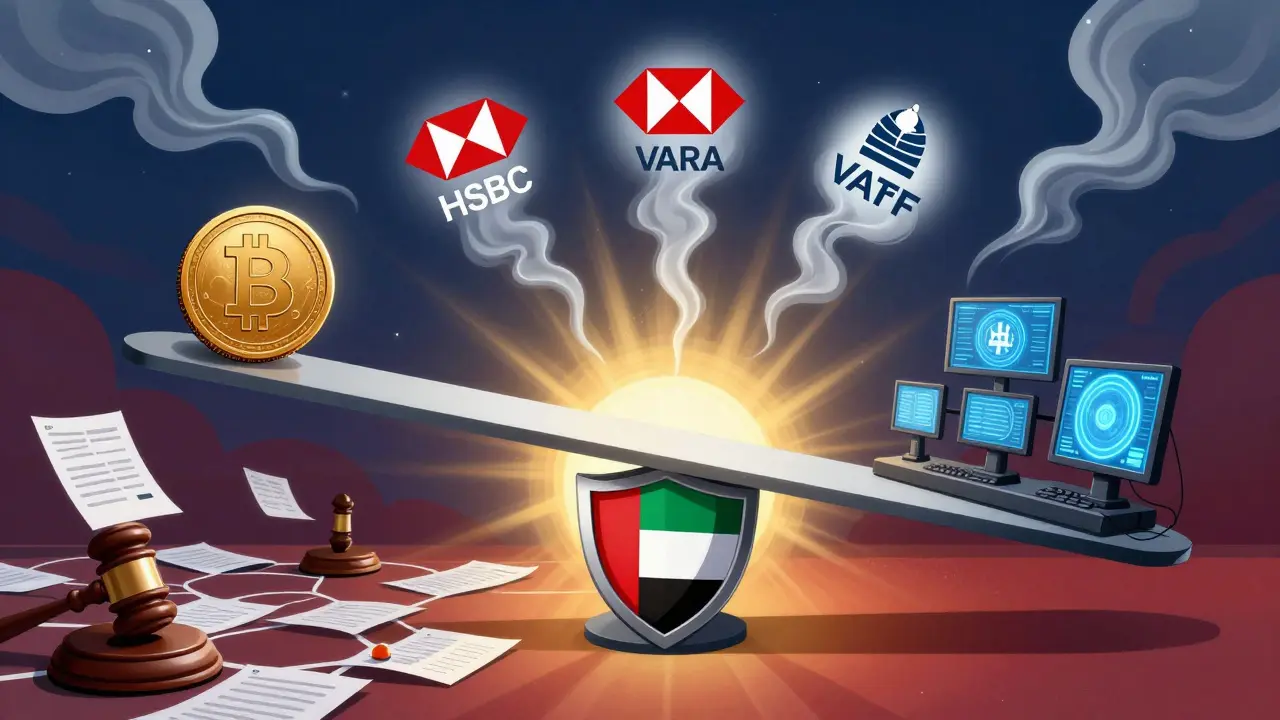
The EU’s Sudden Alignment Was a Big Deal
Here’s something most people missed: even after FATF removed the UAE in February 2024, the European Union kept it on its own grey list for over four months. Why? Because the EU had its own, stricter internal rules. This created a weird situation-UAE crypto firms could bank in the U.S. but not in Germany or France. That changed in June 2025, when the EU finally removed the UAE from its list alongside Barbados, Panama, and the Philippines. This wasn’t just symbolic. It meant EU-based banks could now legally process crypto payments to and from Dubai without fear of penalties. For crypto firms with European users, this was critical. Suddenly, SEPA transfers to UAE wallets became routine. Withdrawals to EU bank accounts that used to take 5-7 days now clear in under 48 hours.What This Means for Crypto Investors and Users
If you’re holding crypto in a UAE-based wallet or exchange, here’s what changes for you:- Lower fees: Fewer intermediary banks mean fewer conversion and transfer fees.
- Faster withdrawals: No more waiting weeks for KYC approvals from overseas banks.
- More stable platforms: With better access to banking, exchanges are less likely to freeze assets during liquidity crunches.
- More legal protection: UAE courts now have the tools and authority to freeze fraudulent crypto accounts and return stolen funds.

The Bigger Picture: A Model for Other Countries
The UAE didn’t just clean up its own house-it showed the world how to do it. Countries like Nigeria, Kenya, and Indonesia are watching closely. The UAE’s playbook is simple: enforce rules, invest in enforcement, and don’t wait for pressure to act. By 2025, Croatia, Mali, and Tanzania had followed suit and were removed from the FATF list. South Africa is expected to join them soon. For crypto, this matters because the more jurisdictions that adopt FATF standards, the less fragmented the global market becomes. No more patchwork regulations. No more “crypto haven” loopholes. Just clear, consistent rules that protect users and legitimize the industry.What’s Next? The Real Test Starts Now
Being off the grey list isn’t the finish line-it’s the starting line. The FATF will begin its next round of evaluations in 2026. That means the UAE has to keep improving. The Virtual Assets Regulatory Authority (VARA) is already working on new rules for DeFi protocols, NFT marketplaces, and stablecoin issuers. They’re also building a blockchain-based registry to track all VASP transactions in real time. The goal? To become the first country to have a fully auditable, FATF-compliant crypto ecosystem. If they pull it off, they won’t just be a crypto hub-they’ll be the global gold standard.Final Thought: Trust Is the New Currency
Crypto’s biggest problem has never been technology. It’s been trust. The UAE didn’t fix its crypto laws to attract traders. It fixed its entire financial system to attract the world. And that’s why this removal matters more than any new exchange launch or token surge. It’s proof that regulation and innovation aren’t enemies. When done right, they work together. The days of crypto being seen as a wild west are over. The UAE didn’t tame it with bans. It tamed it with rules-and the market is responding.Was the UAE ever on the FATF grey list?
Yes. The UAE was placed on the FATF grey list in March 2022 due to weaknesses in its anti-money laundering and counter-terrorism financing systems. It was officially removed on February 23, 2024, after implementing major legal and regulatory reforms.
How did FATF removal affect crypto exchanges in Dubai?
Crypto exchanges in Dubai saw improved access to international banking, faster transaction processing, and reduced fees. Major banks like HSBC and Standard Chartered reopened correspondent accounts. Licensing applications from global crypto firms surged by 89% in 2024, and institutional investors began allocating capital to UAE-based crypto funds for the first time.
Did the EU also remove the UAE from its grey list?
Yes. Despite removing the UAE from its own list four months after FATF, the European Union officially followed suit in June 2025. This ended a period of regulatory misalignment and allowed EU banks to process crypto transactions with UAE firms without legal risk.
What specific changes did the UAE make to comply with FATF?
The UAE created a specialized financial crimes court, strengthened its Financial Intelligence Unit, mandated Travel Rule compliance for all crypto firms, introduced jail time for bribery in financial institutions, and increased enforcement actions-suspending licenses and issuing over $50 million in fines to non-compliant businesses between 2022 and 2024.
Is the UAE now considered safe for crypto investments?
Yes, relative to most jurisdictions. The UAE now has one of the most transparent and enforceable crypto regulatory frameworks in the world. Its licensing system under VARA is detailed, its enforcement is active, and its alignment with FATF and EU standards makes it one of the safest places globally to operate or invest in crypto-provided you choose licensed entities.
What happens if the UAE fails its next FATF review in 2026?
If the UAE doesn’t maintain its compliance standards, it risks being re-listed. That would trigger renewed banking restrictions, loss of investor confidence, and potential delisting of UAE-based crypto assets from global exchanges. The government is already preparing for the 2026 review by building real-time blockchain monitoring tools and expanding oversight to DeFi and NFT platforms.






Harshal Parmar
January 24, 2026 AT 00:38Man, this is actually one of those rare wins where regulation didn’t kill innovation-it gave it legs. I’ve been watching crypto in Dubai since 2021, and back then, even getting a bank account for a crypto startup felt like trying to convince a monk to use Bitcoin. Now? My cousin’s startup in Sharjah just landed a $20M Series A from a Swiss family office, and they didn’t even need to move headquarters. The Travel Rule compliance they built? It’s so smooth now, their API handles 80% of KYC checks automatically. Honestly, I think the UAE just redefined what ‘crypto-friendly’ means-not by being lax, but by being *serious*. No more sketchy offshore shells. Just clean, auditable, transparent ops. And yeah, the EU finally catching up in June 2025? That was the cherry on top. SEPA transfers to Dubai wallets used to take a week. Now? Sometimes under 24 hours. This isn’t luck. This is strategy.
Matthew Kelly
January 26, 2026 AT 00:20So happy for them 😊 I’ve been holding some tokens from a Dubai-based DeFi project and honestly, the withdrawals finally feel reliable. No more ‘pending for 10 days’ nonsense. Banking access is huge-my buddy’s exchange got a corporate account with Emirates NBD last month, and they were crying tears of joy. This is what crypto needs: not chaos, but clarity. Keep it up, UAE! 🙌
Clark Dilworth
January 26, 2026 AT 13:37Let’s not romanticize this. The UAE’s move was purely strategic capital allocation masked as regulatory reform. They didn’t ‘clean up’ because they suddenly cared about AML/CFT-they did it because they realized that without FATF alignment, they couldn’t access institutional capital or integrate with SWIFT-based correspondent banking. The FIU expansion? Necessary, but reactive. The jail time for bribery? A PR play. The real win here is that Dubai positioned itself as the compliant alternative to Singapore and Switzerland. And now, with VARA’s blockchain registry in beta, they’re not just catching up-they’re trying to own the next-gen compliance stack. This is state-led crypto infrastructure development at scale. The ‘trust’ narrative? It’s a product. And they’re selling it hard.
Andy Simms
January 27, 2026 AT 20:17Actually, the EU delay was the most telling part. They kept the UAE on their grey list for four months after FATF removed them because their own rules were more restrictive-specifically around VASP licensing and cross-border data sharing. That’s why it took until June 2025 for EU banks to fully reopen. The UAE didn’t just meet FATF standards-they had to *exceed* them to satisfy the EU’s internal compliance bar. That’s not easy. Most countries just do the bare minimum. The UAE built a real-time transaction monitoring system that links crypto exchanges, gold traders, and real estate firms under one FIU dashboard. That’s not just compliance. That’s systemic integration. And yeah, the $12M fine on those two exchanges? That was the moment the market realized: no more loopholes. This is the new baseline.
Shamari Harrison
January 27, 2026 AT 23:04It’s worth noting that the UAE’s success isn’t just about laws-it’s about enforcement culture. Before, compliance was seen as a cost center. Now, it’s a competitive advantage. Exchanges that invested early in AML tech got first-mover advantage in banking relationships. The ones that dragged their feet? They got frozen out. The 89% spike in licensing applications in 2024? That’s not random. That’s the market reacting to predictability. And the fact that VARA is already building real-time blockchain monitoring for DeFi and NFTs? That’s the next frontier. Most regulators are still figuring out how to tax crypto. The UAE is figuring out how to *secure* it. That’s leadership. And honestly? It’s the only way crypto scales without collapsing under its own weight.
Nadia Silva
January 28, 2026 AT 12:39Canada and the EU did it right. UAE? They just copied the playbook. No innovation here-just obedience.