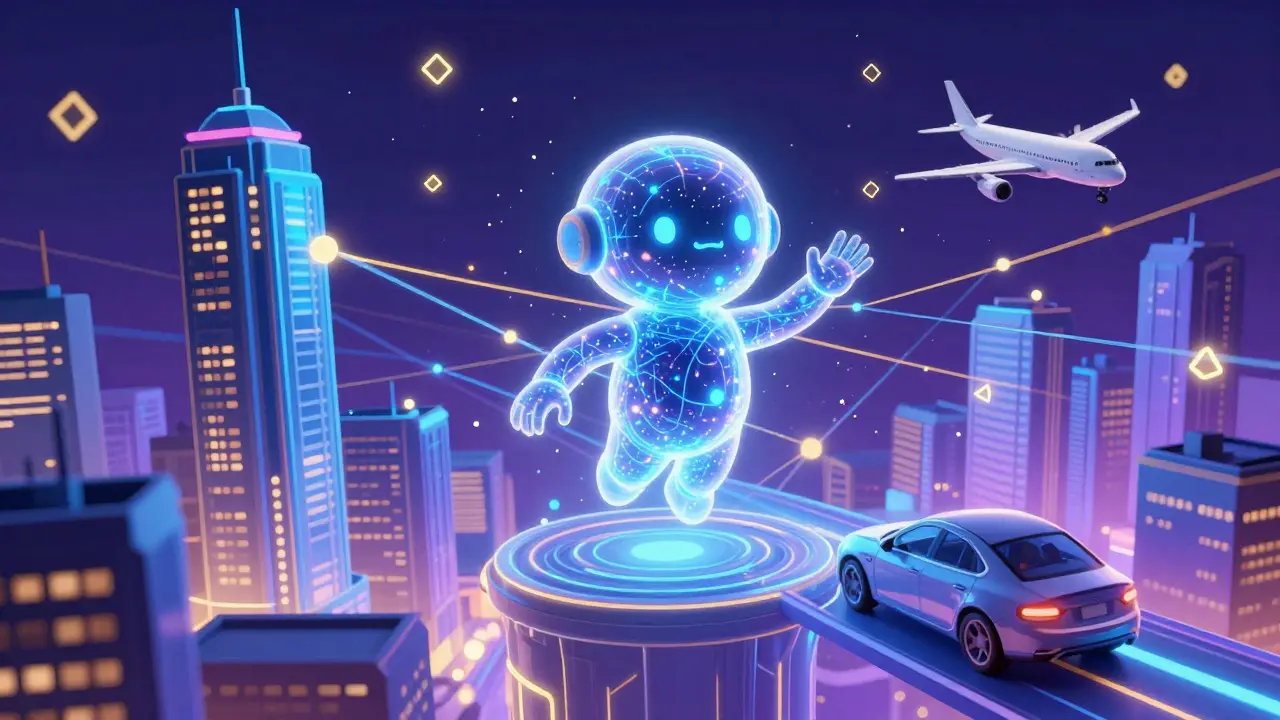
Imagine a world where your AI assistant doesn't just suggest a flight but actually negotiates the price, books the hotel, and arranges a ride-all without you lifting a finger and without a single centralized company owning your data. That is the goal of the Artificial Superintelligence Alliance (ASI), a massive collaboration designed to strip the power of AI away from giants like Google and OpenAI and give it back to a decentralized network. If you've seen the FET crypto ticker on an exchange, you're looking at the fuel for this ambitious machine.
The Big Merger: From Fetch.ai to ASI
For a long time, you probably knew this project as Fetch.ai. Launched in 2017, Fetch.ai focused on "autonomous agents"-tiny pieces of software that can perform tasks independently. However, the AI landscape changed quickly. In early 2024, Fetch.ai teamed up with SingularityNET and Ocean Protocol to form the ASI Alliance. They also brought in CUDOS to handle the heavy lifting of computing power.
Why bother with a merger? Because AI needs three things to survive: intelligence (models), data, and hardware. By combining, the alliance created a full stack. SingularityNET brought the AI marketplace, Ocean Protocol brought the data exchange, and Fetch.ai brought the agent framework. Even though they are now one alliance, the market still mostly recognizes the FET ticker, though there are plans to fully transition to the ASI ticker to better reflect this new, larger identity.
How the ASI Ecosystem Actually Works
To understand the tech, you have to look at the three pillars the alliance has built. First is ASI-1 mini, a Web3-native large language model. With 7 billion parameters, it's designed to be efficient and decentralized, avoiding the "black box" nature of corporate AI. As of early 2026, v2.1 of this model has hit an 86.4% accuracy on the MMLU benchmark, making it a serious contender for decentralized tasks.
Then there is ASI Data, which lets users buy and sell data securely, and ASI Compute, a distributed system that prevents any one company from owning all the GPUs. The network currently runs on a Delegated Proof of Stake (DPoS) mechanism. If you're thinking of running a node, be prepared: you'll need at least 4GB of RAM and a 100GB SSD to keep things humming.
| Feature | ASI Alliance (FET) | Bittensor (TAO) | OpenAI (Centralized) |
|---|---|---|---|
| Architecture | Decentralized Full Stack | Decentralized Network | Centralized Closed Source |
| Data Ownership | User-Controlled | Distributed | Corporate-Owned |
| Inference Speed | ~850ms | Variable | ~220ms |
| Agent Framework | Native Autonomous Agents | Incentivized Intelligence | API-Based |
The Economics of FET: Tokenomics and Value
The FET token isn't just a speculative asset; it's the currency used to pay for AI services within the network. The maximum supply is capped at 2.71 billion tokens. To keep the value stable, the alliance uses a "burn" mechanism. They have a quarterly program and an "Earn & Burn" system where 35% of ecosystem fees are used to buy back and destroy tokens, creating a net deflation rate of about 1.2% annually.
But is it a good investment? The price has been volatile, sitting around $0.22 in early 2026-a far cry from its 2024 highs. However, the utility is growing. We're seeing real-world use cases, like Maersk using these autonomous agents to cut shipping inefficiencies by over 37%. When a global logistics giant finds value in the tech, it suggests the token has a purpose beyond just trading on Binance.
Real-World Use Cases and Performance
One of the coolest features is the Digital Twin Metropolis. This is essentially a virtual mirror of the real world where AI agents make immutable agreements using WASM-based virtual machines. Right now, it processes about 12,500 transactions a day. For comparison, Chainlink's AI-oriented services handle significantly fewer agent-to-agent interactions.
In the healthcare sector, developers are using ASI-1 mini to build apps that reduce HIPAA compliance costs by over 60% because the data is processed decentrally. However, it's not all sunshine. If you need ultra-low latency-like for high-frequency trading-ASI's 850ms response time is too slow compared to Solana-based projects that hit the 400ms mark. It's a tool for complex orchestration, not for millisecond-level speed.

The Hurdles: Complexity and Governance
If you're a developer, be warned: the learning curve is steep. While a seasoned blockchain pro might get the hang of the API in 20 hours, a total beginner is looking at 65 to 80 hours of study. Common frustrations include gas fee estimation errors and the 47-second lag when moving tokens between Ethereum and the Fetch.ai mainnet.
There's also a political problem. The Governing Council handles the big decisions, but only 7 of the 21 seats are elected by token holders. This has led some analysts, like those at Messari, to give their governance a "C+" grade. It's a bit of a contradiction: a project fighting for decentralization is currently run by a somewhat centralized council.
Future Outlook: What's Next for ASI?
The roadmap for 2026 is packed. The most anticipated event is the launch of the dedicated ASI Chain mainnet in Q3. This should streamline transactions and potentially lower those annoying gas fees. We're also looking at the development of ASI-2, a massive 70 billion parameter model scheduled for late 2026, which would put them in a different league of intelligence.
The partnership with NVIDIA is also a huge deal. By giving developers access to the Omniverse platform, the alliance is making it much easier to build digital twins. If they can capture even 15-20% of the decentralized AI market by 2028, the current price fluctuations might look like a small blip in a much larger growth story.
Is FET the same as ASI?
Essentially, yes. The Artificial Superintelligence Alliance was formed by merging Fetch.ai (FET), SingularityNET (AGIX), and Ocean Protocol (OCEAN). While the ticker is still predominantly FET on many exchanges, the project is moving toward a unified ASI token identity.
How do I start using the ASI network?
You'll need a compatible wallet like MetaMask, Ledger, or Trust Wallet. From there, you can acquire FET tokens from an exchange like Binance and access the ASI Developer Portal using GitHub authentication to start building agents.
What are the risks of investing in FET/ASI?
The main risks include regulatory uncertainty regarding AI agent liability and the high technical complexity of the platform. Additionally, some critics point to the centralized nature of the Governing Council as a risk to true decentralization.
What is ASI-1 mini?
ASI-1 mini is a decentralized large language model with 7 billion parameters. It is designed to provide AI inference without relying on centralized servers, ensuring better data privacy and sovereignty for the user.
How does the token burn work?
The alliance uses a quarterly burn program and an 'Earn & Burn' system. In the latter, 35% of the fees generated by the ecosystem are used to buy back FET tokens and destroy them, reducing the overall supply and creating a deflationary effect.

Anna Grealis
April 19, 2026 AT 05:35The Governing Council is obviously just a front. They talk about decentralization but keep the real power in a tiny room of twenty-one people. It is the same old game where they lure you in with the promise of freedom while they build a new digital panopticon. Why would we trust this merger when it just concentrates the 'intelligence' under one alliance banner? It smells like a coordinated effort to track every single autonomous agent interaction under the guise of a 'full stack' solution. Don't be fooled by the burn mechanism, it's just a way to manipulate the price while they solidify control. The whole thing is a trap for the gullible.
Tracy Sperandio
April 20, 2026 AT 03:24This is an absolute powerhouse of a move! Combining those three projects is a total game-changer that puts the old guard on notice. The synergy here is electric, and the prospect of a 70 billion parameter model is just mind-blowing. We are witnessing the birth of a digital revolution that will shatter the corporate monopoly on AI. Let's get hyped for that Q3 mainnet launch because it's going to be a complete blast-off for the ecosystem! It's time to stop playing it safe and embrace the decentralized future with everything we've got!
Robert Preston
April 21, 2026 AT 14:07For anyone struggling with the API, I suggest looking into the documentation for WASM virtual machines first. The 65-80 hour learning curve mentioned is quite realistic for beginners, but you can shave that down if you understand how autonomous agents interact with the data layer. It is important to be patient with the gas fee estimation errors; they are a known issue in the current bridge between Ethereum and the mainnet. Just make sure you are using a hardware wallet like Ledger for your FET tokens if you plan on holding long-term. The technical complexity is high, but the utility in logistics, like the Maersk example, proves the framework is solid.
Alex Long
April 22, 2026 AT 06:45boring. just another coin that crashes.
Gillian Kent
April 24, 2026 AT 00:41i think the idea of a digitall twin city sounds so cooly. it would be grat to see more peple use it for real things instead of just trading. hope the new chain fixs the slow speed stuff becouse waiting 47 seconds is way too long lol