Imagine a cryptocurrency that doesn't rely on government bonds or cash reserves but instead promises its value is tied to physical diamonds. That is the pitch for Diment Dollar, also known as DD. It claims to be a stablecoin backed by real-world assets, specifically gemstones. But does this shiny promise hold water, or is it just another speculative token in a crowded market?
If you have stumbled upon DD while scrolling through crypto listings, you likely have questions. Is it safe? Can you actually buy it? And why do some sites say it is worth $1.00 while others show it trading at less than ten cents? Let’s cut through the marketing noise and look at what Diment Dollar actually is, how it works, and whether it belongs in your portfolio.
The Core Concept: Diamonds Meets Blockchain
To understand Diment Dollar, you first need to grasp the idea of a commodity-backed stablecoin. Most popular stablecoins like USDT or USDC are pegged to the US dollar. They hold cash and treasury bills in reserve to ensure one token equals one dollar. Diment Dollar takes a different route.
Diment Dollar is designed as a stablecoin backed by a reserve of diamonds valued in US dollars. According to its whitepaper and project documentation, each unit of DD is linked in a 1:1 ratio to the USD value of these diamonds. The goal is to offer "real-value backing" by anchoring the digital token to a tangible luxury asset rather than fiat currency.
This model aims to combine two worlds: the transactional speed and global accessibility of blockchain technology with the perceived long-term value retention of physical diamonds. Proponents argue that diamonds have historically held value across centuries, making them a unique hedge against inflation compared to traditional fiat-backed tokens. However, this also introduces a layer of complexity. Unlike cash, which has a clear, liquid market price, diamonds require appraisal, certification, and secure storage.
Origins and Market Position
Diment Dollar is a relatively new player in the crypto space. The token was launched in October 2023. In the fast-moving world of cryptocurrency, that makes it a toddler. Established stablecoins like Tether (USDT) and Circle (USDC) have years of operational history, regulatory scrutiny, and massive liquidity behind them. DD, by contrast, is still finding its footing.
When you look at market capitalization rankings, Diment Dollar sits around position #6696 among all cryptocurrencies. This places it firmly in the micro-cap category. For context, top-tier coins often rank within the top 50. A rank near 7,000 indicates extremely low adoption and limited trading volume. This isn't necessarily a death sentence for a niche project, but it is a significant warning sign for anyone looking for stability. Low liquidity means you might struggle to sell your holdings quickly without drastically affecting the price.
| Feature | Diment Dollar (DD) | USDT / USDC |
|---|---|---|
| Backing Asset | Diamonds (appraised in USD) | Cash & Treasury Bills |
| Launch Date | October 2023 | 2014 (USDT), 2018 (USDC) |
| Market Cap Rank | ~#6696 | Top 10 |
| Liquidity | Very Low / Fragmented | Extremely High |
| Peg Stability | Unstable (Data varies widely) | Highly Stable (~$1.00) |
The Price Paradox: Why Is DD Worth So Little?
Here is where things get confusing-and concerning. If DD is supposed to be a stablecoin pegged to the value of diamonds, why does the price data look so messy?
On some major price-tracking platforms, Diment Dollar is listed at exactly $1.00. However, if you dig deeper, you will see that the 24-hour trading volume is often $0.00, and the circulating supply is reported as 0. This suggests that the $1.00 price is a nominal placeholder because there is no active trading to establish a real market value.
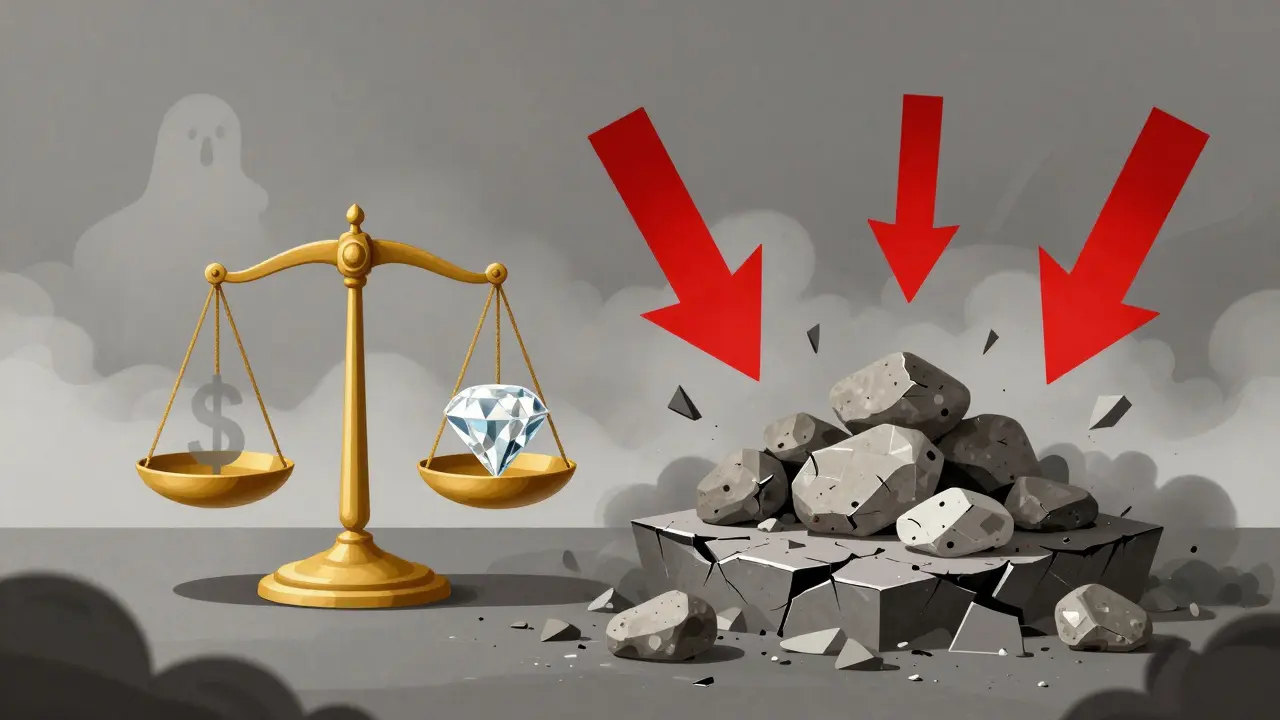
In contrast, other data aggregators and decentralized exchange interfaces show DD trading at approximately $0.09. That is a 91% discount from its intended $1.00 peg. Such a massive deviation signals either severe illiquidity, a lack of confidence in the underlying diamond reserves, or simply stale data feeds. In a healthy stablecoin market, prices rarely deviate more than 1% from the peg because arbitrageurs step in to correct the difference. The fact that DD trades at $0.09 on some venues implies that buyers are skeptical about their ability to redeem the token for its full diamond-backed value.
How Does the Backing Actually Work?
The project describes itself as "pre-audited and pre-backed." This terminology suggests that audits of the diamond collateral occur before tokens are issued, ensuring every DD in circulation has verified assets behind it. This is a crucial distinction from algorithmic stablecoins, which can collapse if trust evaporates.
However, transparency remains a major hurdle. While the whitepaper mentions "diamond-value anchoring," public sources do not provide detailed breakdowns of:
- The names of independent auditing firms verifying the diamond reserves.
- The frequency of these audits (monthly? quarterly?).
- Where the physical diamonds are stored and who insures them.
- The specific methodology used to appraise the diamonds' current USD value.
Without this granular data, investors are essentially trusting the issuer's word. In the wake of past crypto collapses involving opaque reserves, such ambiguity is a red flag. You cannot verify what you cannot see.
Buying and Trading Diment Dollar
If you decide to proceed despite the risks, acquiring DD requires navigating both centralized and decentralized ecosystems. Here is how the process generally works based on current platform guides.
Option 1: Centralized Exchanges (CEXs)
Some centralized exchanges list DD for spot trading. To buy it here, you would create an account, complete KYC (Know Your Customer) verification, deposit funds (like USDT or BNB), and swap them for DD. However, availability is inconsistent. One major US exchange lists the price but explicitly states the token is not tradable on their platform. Always check the specific exchange's supported pairs before depositing funds.
Option 2: Decentralized Exchanges (DEXs)
This is the more common route for micro-cap tokens. You will need a Web3 wallet (such as MetaMask or Trust Wallet). Here is the step-by-step flow:
- Fund your Web3 wallet with a base asset like ETH, BNB, or USDT on a supported network (e.g., Ethereum or BNB Chain).
- Connect your wallet to a decentralized exchange interface (like Uniswap or PancakeSwap).
- Search for the DD token contract address. Be careful-always verify the address on official project channels to avoid scams.
- Execute the swap, adjusting slippage tolerance if necessary due to low liquidity.
Keep in mind that using DEXs involves gas fees and the risk of interacting with unverified smart contracts. Since DD operates on multichain infrastructure, ensure you are on the correct network to avoid losing funds.

Risks You Cannot Ignore
Before you spend even a single dollar on Diment Dollar, consider these critical risks:
- Liquidity Risk: With zero volume on major trackers and fragmented pricing, selling large amounts of DD could crash the price further or prove impossible.
- Valuation Opacity: Diamonds are not standardized like gold. Their value depends on cut, clarity, color, and carat. Appraising a bulk reserve accurately and transparently is notoriously difficult.
- Regulatory Uncertainty: Commodity-backed tokens face evolving regulations. If authorities scrutinize the reserve management practices, the project could face legal hurdles.
- Smart Contract Vulnerability: There is no public evidence of comprehensive third-party security audits for the DD smart contracts themselves, only claims regarding the collateral.
Diment Dollar occupies a high-risk, low-liquidity niche. It is an experiment in tokenizing luxury goods, but it lacks the institutional trust, deep liquidity, and transparent reporting required for a reliable store of value.
Is Diment Dollar Right for You?
For the average investor seeking stability, the answer is likely no. If you want a stablecoin to park funds, pay for services, or hedge against volatility, established options like USDC or DAI offer far greater safety and liquidity. Diment Dollar is better suited for speculative traders who understand the risks of micro-cap assets and are interested in the novelty of commodity-backed crypto experiments.
Always do your own research. Never invest money you cannot afford to lose, especially in assets with unclear backing mechanisms and volatile pricing data. The crypto market rewards caution and punishes blind faith.
What is Diment Dollar (DD) used for?
Diment Dollar is marketed as a stablecoin for storing value and transferring wealth, backed by a reserve of diamonds. However, due to low liquidity and limited exchange support, its practical use cases are currently very restricted compared to major stablecoins.
Is Diment Dollar safe to invest in?
DD carries significant risk. It is a micro-cap asset with inconsistent pricing data, low trading volume, and limited transparency regarding its diamond reserves. It should only be considered by experienced investors willing to accept high potential losses.
Why is the price of DD different on various websites?
The price discrepancy (ranging from $1.00 to $0.09) reflects extreme illiquidity. Some sites show a nominal $1.00 peg because there is no active trading, while others reflect actual market trades on decentralized exchanges where supply exceeds demand, causing the price to drop significantly.
Can I redeem Diment Dollar for physical diamonds?
While the whitepaper mentions backing by diamonds, public documentation does not clearly outline a straightforward redemption process for individual holders to receive physical gems. Most stablecoins are designed for digital transfer rather than physical asset retrieval.
Which blockchains support Diment Dollar?
DD is described as a multichain token, meaning it likely exists on networks like Ethereum and BNB Chain. However, specific contract addresses and supported chains should always be verified via official project announcements to avoid scams.