
Buying Bitcoin used to feel like a high-stakes gamble reserved for tech wizards. Then came Robinhood, a platform that promised commission-free trading and an interface so simple it felt like ordering lunch. Fast forward to 2026, and the landscape has shifted. Is Robinhood still the go-to spot for your digital assets, or is it just a shiny wrapper hiding serious limitations? If you are looking for a place to park $5 worth of Ethereum without thinking twice, this might be your new favorite app. But if you are planning to stake tokens, trade altcoins, or move funds to a private wallet quickly, you need to read this carefully before signing up.
This review cuts through the marketing hype. We will look at what Robinhood actually offers in terms of coins, costs, and control, and compare it against dedicated crypto giants like Coinbase and Kraken. By the end, you will know exactly whether Robinhood fits your specific trading style or if you should keep looking.
The Core Promise: Simplicity Over Power
Robinhood Markets was founded in 2013 by Vladimir Tenev and Baiju Bhatt with a mission to democratize finance. They started with stocks and ETFs, but the real explosion happened when they added cryptocurrency trading in February 2018. The appeal is obvious: one app for everything. You don't need a separate login for your stock portfolio and your Bitcoin holdings. It’s all there, unified under one roof.
The user experience is designed for speed and clarity. There are no complex charts cluttering the screen unless you ask for them. The interface uses a single trade ticket metaphor for options, stocks, and crypto alike. This consistency reduces friction. You search for "BTC," click buy, enter an amount, and confirm. It feels snappy and predictable. For someone who treats crypto as a long-term hold similar to gold or index funds, this simplicity is a feature, not a bug. You aren't trying to day-trade; you are trying to own a piece of the future without learning a new software language.
However, this design choice comes with a trade-off. Power users often find the lack of granular controls frustrating. There are no post-only orders, no reduce-only settings, and limited routing nuances. If you are used to the depth-of-market views on professional platforms, Robinhood will feel stripped down. It is built for retail investors who want a streamlined interface, not for traders who need multi-leg conditional orders or advanced technical analysis tools.
What Can You Actually Trade?
One of the first questions new users ask is about selection. Unlike dedicated exchanges that list hundreds of obscure tokens, Robinhood takes a conservative approach. As of early 2026, the platform supports between 15 and 22 cryptocurrencies. The core lineup includes the heavy hitters:
- Bitcoin (BTC)
- Ethereum (ETH)
- Solana (SOL)
- Ripple (XRP)
- Dogecoin (DOGE)
- Litecoin (LTC)
This list covers the vast majority of what average investors care about. If you are interested in niche DeFi tokens or new meme coins launching on Solana, you won't find them here. Coin Bureau notes that Robinhood adds new tokens much more slowly than competitors like Coinbase, focusing strictly on mainstream demand. This curation protects users from some of the volatility and scams associated with low-cap projects, but it also limits diversification opportunities.
A critical limitation for many crypto enthusiasts is the absence of crypto-to-crypto trading pairs. On most exchanges, you can sell Bitcoin to buy Ethereum directly. On Robinhood, you must sell your Bitcoin for US dollars (fiat), and then use those dollars to buy Ethereum. This two-step process can be inefficient during fast-moving markets and may expose you to additional spread risks. Furthermore, the platform currently lacks staking capabilities. This means if you hold Ethereum or other proof-of-stake assets, you cannot earn passive rewards while holding them. Your assets sit idle unless you actively trade them.
Fees and Costs: The Hidden Realities
"Zero commission" sounds too good to be true, and in the world of finance, it usually is. Robinhood advertises $0 trading fees and transaction fees across all supported digital assets. This is a significant advantage over traditional brokers that charge per-trade fees. However, the cost structure is nuanced.
While there are no explicit commissions, Robinhood makes money through the spread-the difference between the bid price (what buyers are willing to pay) and the ask price (what sellers are asking). In volatile markets, spreads can widen, effectively increasing your cost basis. Additionally, while Robinhood claims no markups or markdowns, third-party verified research from August 2025 showed subtle differences in execution quality compared to competitors. For example, in a test scenario involving Ethereum trades, Robinhood users received 0.002290 ETH, while Coinbase Advanced users received 0.002283 ETH. While the difference seems small (only 0.32%), it compounds over time for frequent traders.
Let's look at how Robinhood stacks up against its main rivals in terms of effective cost and yield:
| Platform | Trading Fees | Crypto Selection | Staking Available | Crypto-to-Crypto Pairs |
|---|---|---|---|---|
| Robinhood | $0 (Spread-based) | 15-22 Assets | No | No |
| Coinbase | Variable (0.4%-3.99%) | 200+ Assets | Yes | Yes |
| Kraken | Low (0.16% maker) | 200+ Assets | Yes | Yes |
| Crypto.com | Variable (0.4%-1.48%) | 250+ Assets | Yes | Yes |
For casual investors buying large amounts infrequently, Robinhood's zero-commission model is hard to beat. But if you are trading frequently or holding assets that offer staking rewards, the hidden costs of missing out on yields and wider spreads might outweigh the savings on commissions.

Security and Custody: Who Holds Your Keys?
In crypto, there is a famous saying: "Not your keys, not your coins." When you buy crypto on Robinhood, you do not hold the private keys. Robinhood acts as the custodian. This provides convenience-you don't have to worry about losing a seed phrase-but it also introduces counterparty risk. If Robinhood were to face insolvency or a security breach, accessing your funds could become complicated.
Historically, Robinhood has faced regulatory fines and data breaches, though these have been relatively minor compared to major industry collapses. The platform operates under traditional securities regulations rather than specialized crypto exchange frameworks. This offers certain consumer protections, such as SIPC insurance for cash balances, but SIPC does not cover cryptocurrency losses due to market fluctuation or hacking.
A rare positive feature among traditional brokers is Robinhood's allowance for crypto transfers. StockBrokers.com highlights this as a standout capability. You can withdraw your crypto to an external wallet, giving you self-custody options. However, the process is not always seamless, and withdrawal minimums or delays can occur. For users who prioritize absolute control, this feature is essential, but it requires you to manage the security of your own wallets, which brings its own set of responsibilities.
Robinhood vs. The Dedicated Exchanges
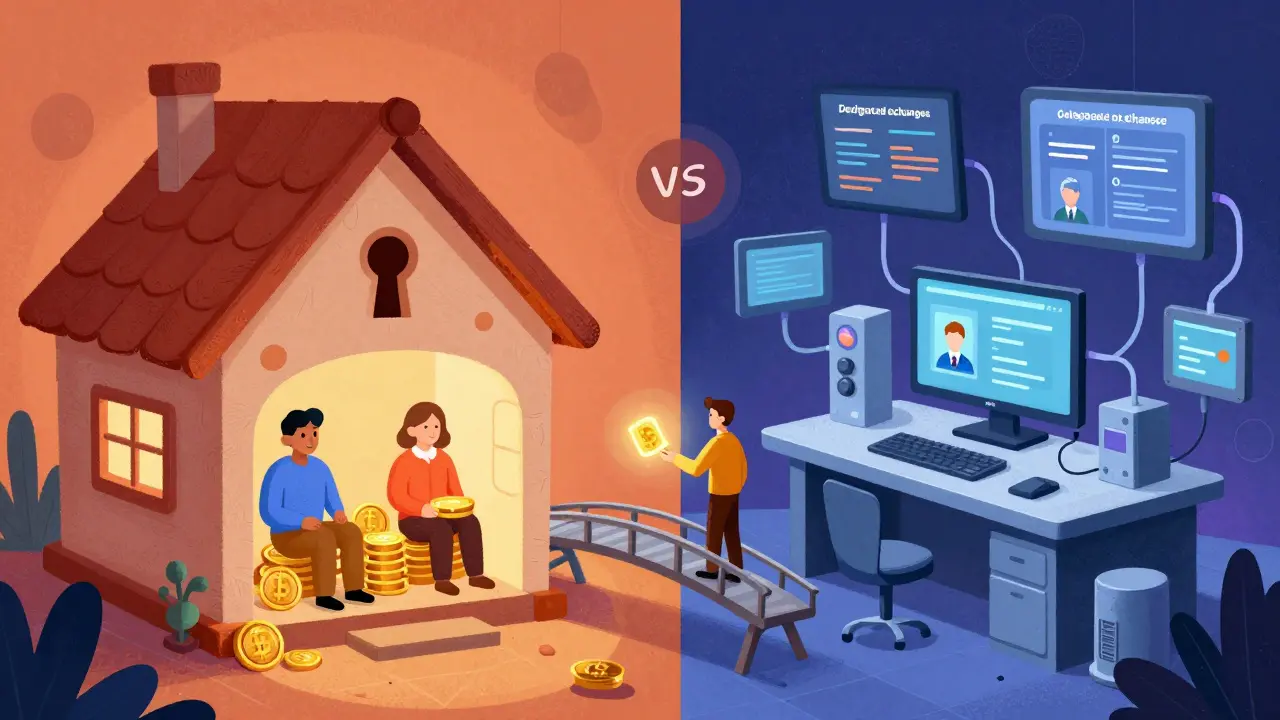
To understand where Robinhood fits, we must compare it to the specialists. NerdWallet's 2025 comparison gives Coinbase the upper hand for several reasons. Coinbase is a full-service crypto exchange, whereas Robinhood is a traditional stockbroker that added crypto as a side feature.
If you view crypto as a speculative asset class alongside stocks, Robinhood wins on integration. You see your entire net worth in one dashboard. If you view crypto as a distinct technological ecosystem with its own tools and communities, Coinbase or Kraken wins on functionality. They offer advanced order types, deeper liquidity, and broader asset selection. For instance, if you want to trade stablecoins or participate in governance votes for DAOs, you need the flexibility that dedicated exchanges provide.
Geographic expansion is another factor. Robinhood expanded into the European Union in December 2023 and plans to enter the Asian market via Singapore by late 2025. This global reach is impressive for a company that started in Menlo Park, California. However, availability varies by region. Always check if your local jurisdiction is supported before attempting to sign up.
Who Should Use Robinhood for Crypto?
Based on the features and limitations, Robinhood is ideal for:
- Beginners: Those taking their first steps into investing who want a familiar, stock-like interface.
- Long-Term Holders: Investors who plan to buy Bitcoin or Ethereum and forget about them for years.
- Unified Portfolio Managers: Users who refuse to juggle multiple apps and prefer seeing stocks, ETFs, and crypto together.
It is likely not suitable for:
- Active Traders: Those who need limit orders, stop-losses, and real-time charting.
- Altcoin Hunters: Investors looking for high-risk, high-reward smaller projects.
- Yield Seekers: Users who want to earn interest through staking or lending.
Final Verdict
Robinhood remains a powerful tool for introducing people to cryptocurrency because it removes the intimidation factor. The zero-commission promise is genuine for basic trades, and the interface is unmatched in its simplicity. However, it is not a comprehensive crypto solution. The lack of staking, limited coin selection, and inability to trade crypto-to-crypto are significant hurdles for anyone beyond the beginner stage.
If your goal is to build a simple, diversified portfolio that includes a slice of Bitcoin and Ethereum alongside your S&P 500 index fund, Robinhood delivers excellent value. If you are serious about the crypto space, treating it as a primary investment vehicle, you will eventually outgrow the platform. In that case, consider using Robinhood for initial purchases and transferring assets to a dedicated exchange or hardware wallet for active management and security.
Is Robinhood safe for storing cryptocurrency?
Robinhood uses standard security measures including encryption and cold storage for a portion of assets. However, like any centralized exchange, it carries counterparty risk. For maximum security, experts recommend withdrawing larger amounts to a personal hardware wallet where you control the private keys.
Can I stake my crypto on Robinhood?
As of 2026, Robinhood does not offer staking services for cryptocurrencies. This means you cannot earn passive rewards on assets like Ethereum or Solana while holding them on the platform. You would need to transfer your assets to a staking-enabled exchange or validator service to earn yields.
Why can't I trade Bitcoin for Ethereum directly?
Robinhood only supports crypto-to-fiat trading pairs. This means you must sell your Bitcoin for US dollars first, and then use those dollars to buy Ethereum. This limitation exists because Robinhood operates primarily as a securities broker rather than a dedicated crypto exchange, simplifying compliance but reducing trading flexibility.
Are there really no fees on Robinhood?
Robinhood charges no explicit commission fees for trades. However, they make money through the bid-ask spread, which is the difference between the buy and sell price. In volatile markets, this spread can widen, effectively acting as a hidden cost. Additionally, depositing funds via ACH transfer is free, but instant deposits may incur fees depending on your account type.
Can I withdraw my crypto to a private wallet?
Yes, Robinhood allows users to withdraw cryptocurrency to external wallets. This is a rare feature among traditional brokers. However, there may be network fees associated with the withdrawal, and processing times can vary based on blockchain congestion and internal verification processes.






Terry Hyland
June 16, 2026 AT 17:50These companies are stealing from you every time you click buy. They lie about zero fees but take money from the spread which is just a hidden tax on poor people who dont know better. You are giving them your data and they sell it to advertisers while pretending to help democracy. It is a scam designed to keep you poor and dependent on their system. Wake up before they take everything.
Monica Pathammavong
June 18, 2026 AT 11:42i mean if u really want security u should probly use a hardware wallet but honestly most ppl cant even remember their passwords so why bother? also the article says robinhood has no staking which is super annoying for eth holders like me who want passive income. i tried coinbase advanced but the interface is kinda messy compared to robinhoods simplicity even though robinhood lacks features. its a tradeoff i guess unless u r a pro trader then go kraken or something. just dont leave ur coins on any exchange thats basic crypto 101.
Tim Lefebvre
June 19, 2026 AT 08:14hey guys just wanted to add that if u are holding long term the spread doesnt matter as much as the convenience factor. i moved my btc to a ledger after buying on robinhood because keeping it there felt risky despite the sipc insurance not covering crypto. the withdrawal process was actually pretty smooth last time i checked but network fees can be high during congestion so timing matters. also yeah no staking is a big miss for eth but if u just want exposure without learning complex charts it works fine for beginners. hope this helps someone out there
Grace Newman
June 21, 2026 AT 07:54It is imperative to consider the regulatory implications of centralized custody solutions in an era of increasing governmental scrutiny over digital assets. The assertion that Robinhood provides adequate protection is fundamentally flawed when one examines the historical precedents of exchange insolvencies such as FTX. Users must exercise extreme diligence and perhaps avoid these platforms entirely to preserve financial sovereignty against potential state-sponsored surveillance or asset seizure protocols that may emerge in the near future given the current geopolitical climate surrounding decentralized finance technologies.
Annemarie Fitzgerald
June 22, 2026 AT 11:56the tragedy of modern man is his desire for ease over truth. we trade our freedom for the illusion of security provided by these corporate giants. i sit here watching the markets fluctuate and realize that none of us truly own anything anymore. it is all just numbers on a screen controlled by algorithms we do not understand. why do we participate in this charade? perhaps it is because we fear the void of true responsibility. i feel alone in seeing this clearly.
Kenneth Riley
June 22, 2026 AT 19:13you guys are missing the point completely. this platform is garbage for anyone who actually understands trading mechanics. the lack of limit orders and stop losses is criminal negligence towards retail investors who get wrecked by slippage during volatility spikes. i have seen friends lose thousands because they could not set proper exit strategies on robinhood. it is not an investment tool it is a casino with a friendly face. stop defending mediocrity and demand better technology from your brokers or move to a real exchange like binance or kraken where professionals operate.
Sonya O'Brien
June 24, 2026 AT 14:22I think we can all agree that while Robinhood has its limitations, it serves a specific demographic very well, namely those who are just starting out and find the complexity of other exchanges overwhelming. I personally appreciate the unified dashboard feature because it allows me to view my entire financial picture in one place without having to switch between multiple applications, which saves me time and reduces cognitive load during busy workdays. However, I do see the validity in the arguments regarding the lack of staking rewards and the inability to trade crypto-to-crypto pairs directly, which are significant drawbacks for more active participants in the cryptocurrency ecosystem who seek to maximize their returns through various yield-generating opportunities and efficient portfolio rebalancing strategies.
Filbert Reeves
June 26, 2026 AT 11:30actually the whole concept of fiat currency backing these trades is a sham because the dollar itself is losing value daily so you are not really gaining anything by buying bitcoin on robinhood you are just swapping one depreciating asset for another while paying hidden spreads that enrich the elite. plus they probably front run your orders using high frequency trading bots that exploit the delay in execution which is illegal but they get away with it because regulators are asleep at the wheel. i say dump the whole system and go full self custody on decentralized exchanges only otherwise you are part of the problem.
Nick Rice
June 27, 2026 AT 09:49Listen up everyone! You need to take control of your financial destiny today! Do not let these big corporations dictate your future with their limited features and hidden costs. If you are serious about building wealth in crypto you must educate yourself on self-custody and advanced trading strategies immediately. Stop making excuses and start taking action by moving your assets to secure wallets and exploring decentralized finance options that offer true freedom and transparency. The market waits for no one so seize the opportunity now and become the master of your own economic fate!