
You’ve probably seen it on your feed. A cute, anime-style mascot representing the "Holy Year" of the Catholic Church, paired with a ticker symbol that screams volatility: LUCE. It’s one of those tokens that pops up out of nowhere, grabs headlines for being tied to the Vatican, and then disappears into the noise of the crypto market just as quickly. But what exactly is this thing? Is it a legitimate religious project, a scam, or just another speculative gamble on the Solana blockchain?
If you are looking at LUCE right now, you need to understand that you are not buying into a church initiative. You are buying into a meme coin built on high-speed infrastructure designed for rapid trading. This guide breaks down what LUCE actually is, where its value comes from (spoiler: it doesn't come from utility), and why the numbers look so different depending on which website you check.
The Origin Story: Pump.fun and the Holy Year
To understand LUCE, you have to look at how it was born. Unlike major cryptocurrencies like Bitcoin or Ethereum, which had whitepapers and years of development, LUCE launched on Pump.fun, a platform known for allowing anyone to create a token in minutes without coding skills. It went live on October 28, 2024.
The theme? The upcoming Holy Year 2025 Jubilee celebration. The mascot, named "Luce" (Italian for light), was designed by Simone Legno, the co-founder of the pop-culture brand Tokidoki. The design bridges traditional religious symbolism with an anime aesthetic aimed at younger demographics. Within six hours of launch, the market cap hit nearly $53 million. That is insane speed. But here is the catch: the creator was anonymous. In fact, data shows the creator bought 67 million tokens for 2 SOL immediately after launch and sold them all for 2.73 SOL, making a quick profit before handing the project over to the community.
This is a classic "rug pull" adjacent move-not technically illegal in the wild west of meme coins, but it sets the tone. There is no team behind this. There is no roadmap. There is just a community trying to keep the momentum alive.
Technical Specs: Why Solana Matters
LUCE operates exclusively on the Solana network. This isn’t random. Solana is famous for two things: incredible speed and dirt-cheap fees. We are talking about transaction costs averaging around $0.00025 and the ability to process 65,000 transactions per second.
For a meme coin, this is essential. If LUCE were on Ethereum, every trade would cost you dollars in gas fees, killing the small-scale traders who drive these markets. On Solana, you can buy and sell fractions of a cent worth of LUCE without worrying about fees eating your profits. However, this also means the token moves fast. Prices can swing wildly in seconds because there are no barriers to entry or exit.
Technically, LUCE is a standard SPL token (Solana Program Library). It has no smart contract complexity. It does not offer staking rewards. It does not offer governance rights. It is purely a medium of exchange for speculation.
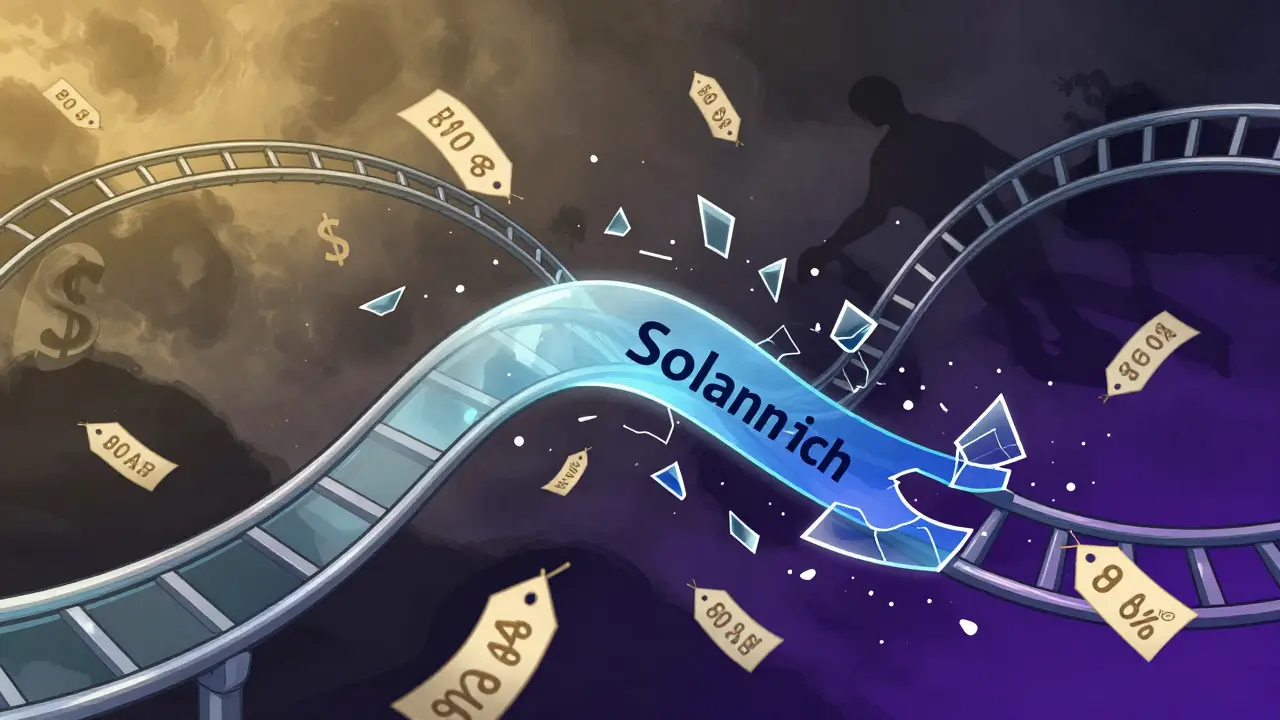
Price Volatility: The Rollercoaster Reality
Let’s talk numbers, because they are messy. When researching LUCE, you will see conflicting prices across different platforms. This is normal for low-cap meme coins but dangerous for investors.
| Platform | Reported Price | Market Cap Estimate |
|---|---|---|
| CoinMarketCap | $0.000910 | ~$964K |
| Coinbase | $0.0038 | Varies |
| Liquidity Finder | $0.000836 | N/A |
Why the difference? Liquidity. LUCE trades primarily against SOL (the native Solana token) on decentralized exchanges like Raydium. Because the total supply is massive-1 billion tokens-the price per token is tiny. Small amounts of buying or selling pressure cause huge percentage swings. At its peak in November 2024, LUCE hit $0.32. Today, it is down roughly 99% from that high. That is not a typo. That is the reality of meme coin trading.
Is LUCE Officially Endorsed by the Vatican?
No. This is the most important question to answer early. While the mascot was designed by a professional artist and ties into the cultural theme of the 2025 Jubilee, the Catholic Church has made no official statement endorsing LUCE as a currency or investment vehicle. The token is community-managed. Any suggestion that the Vatican backs this financially is false.
This distinction matters because it affects long-term viability. Coins backed by institutions or clear utility tend to survive bear markets. Coins backed only by hype usually fade away once the novelty wears off. Right now, LUCE falls squarely into the latter category.

Risks and Red Flags You Should Know
Before you connect your wallet, consider these specific risks associated with LUCE:
- Extreme Volatility: As shown above, the price can drop 99% in weeks. If you invest money you cannot afford to lose, you likely will.
- No Utility: LUCE does not generate revenue. It does not pay dividends. Its value is derived entirely from other people believing it is worth more than you paid.
- Community Management Only: With the original developer having exited, there is no central authority fixing bugs or managing security. If a vulnerability is found in the broader Solana ecosystem, LUCE holders have no support team to call.
- Regulatory Uncertainty: The U.S. SEC has been cracking down on meme coins lacking clear utility. While enforcement actions vary, tokens like LUCE exist in a gray area that could become black overnight.
How to Trade LUCE Safely
If you still want to participate, treat it like a casino bet, not an investment. Here is the practical setup:
- Get a Wallet: Use Phantom or Solflare. These are the standard wallets for Solana assets.
- Fund with SOL: Buy Solana on a major exchange (like Coinbase or Binance) and send it to your wallet. You cannot buy LUCE directly with USD on most platforms.
- Use a DEX: Connect your wallet to Raydium or Jupiter. These are decentralized exchanges where LUCE pairs with SOL.
- Set Limits: Never use market orders during high volatility. Set limit orders to control the price you pay. Slippage can eat your profits if you aren’t careful.
Remember, liquidity is thin. Exiting a large position might crash the price further. Always start small.
Is LUCE a scam?
Not necessarily a scam in the legal sense, as the code is transparent on the blockchain. However, it exhibits many characteristics of high-risk speculative assets: anonymous creators, no utility, and extreme price manipulation potential. The original creator profited immediately upon launch, which is a red flag for sustainability.
Can I stake LUCE for rewards?
No. LUCE is a pure meme coin with no staking mechanism, lending protocol, or governance features. It holds value only through market demand.
Why is the price different on Coinbase vs CoinMarketCap?
Price discrepancies occur due to varying liquidity pools and trading volumes across different exchanges. LUCE has low liquidity, meaning small trades can significantly impact the price on specific platforms, leading to inconsistent reporting.
Does the Vatican support LUCE?
No. The Vatican has not endorsed LUCE. The token uses a mascot related to the Holy Year 2025 theme, but it is an independent, community-run project on the Solana blockchain with no institutional backing.
What is the maximum supply of LUCE?
The maximum supply is 1 billion LUCE tokens. Approximately 99.99% of these are currently in circulation, meaning inflation is not a factor; the scarcity is fixed.







Yogendra Dwivedi
June 9, 2026 AT 08:49I've been looking into Solana meme coins lately and this LUCE thing is fascinating from a pure data perspective. The fact that the creator dumped their entire bag within hours of launch is just textbook behavior for these pump-and-dump schemes. It makes me wonder how many people actually read the whitepaper or even the basic tokenomics before jumping in. Most folks just see the anime mascot and think it's cute without realizing they are buying a liability. The volatility is insane though, dropping 99% is not something you recover from easily. I guess it serves as a good lesson in doing your own research rather than trusting hype.
verna kennedy
June 9, 2026 AT 17:04It is absolutely ridiculous that people still fall for this Vatican-themed nonsense. There is zero utility here and calling it an investment is laughable at best. You are literally gambling on whether someone else will pay more for a digital sticker next week. The church has nothing to do with it and anyone claiming otherwise is either lying or deluded. Stop wasting your time on these trash tokens and learn actual finance.
Kelly Tenney
June 10, 2026 AT 04:48I totally get why people are skeptical but we have to remember that crypto culture is evolving rapidly. It might look like chaos now but there is a community trying to build something meaningful out of the noise. Let's support each other in learning how to navigate these spaces safely instead of just tearing down new projects immediately. We can all grow together if we keep an open mind about different forms of value exchange.
Caralee Robertson
June 11, 2026 AT 14:01honestly i tried buying some luke when it first came out and lost my shirt lol. the fees on solana are cheap yeah but the slippage was killer. im glad i didnt put in too much money cause it went straight to zero basically. dont listen to the hype guys its just a casino with better graphics.
Greg Lewis
June 12, 2026 AT 20:26you see what happens when you detach currency from divine order? chaos. the vatican theme is ironic because money used to be backed by faith and now its backed by memes. we are living in the end times really. the light is fading fast and all we have left is speculative bubbles bursting over and over again until nothing remains but dust
aaliyah zahid
June 14, 2026 AT 13:38Oh please, Greg, save the philosophical monologue for your diary. This isn't about the end times; it's about greed and bad coding practices. And Kelly, while I appreciate the positivity, telling people to 'support' a rug pull adjacent project is dangerous advice. Verna is right, it's trash, but let's not act like everyone who bought it is stupid. They were just caught in a marketing trap designed by professionals.
Mark Corpuz
June 15, 2026 AT 12:32The technical analysis provided in the article is spot on regarding the liquidity issues. It is crucial to understand that price discrepancies across platforms like CoinMarketCap and Coinbase are not errors but reflections of fragmented liquidity pools. Traders must utilize limit orders strictly to avoid unfavorable execution during high volatility periods. The lack of institutional backing further exacerbates the risk profile for any retail investor considering exposure to this asset class.
Steven Jacobowitz
June 16, 2026 AT 16:52Look at the numbers! The spread is massive! Why are you guys talking about feelings when the chart is screaming sell? The original dev sold out instantly which means the smart money is already gone. You need to check the contract address on Etherscan or whatever Solana equivalent exists and verify the holder distribution. If top wallets hold more than 5 percent you are dead in the water. Do not buy the dip unless you want to catch a falling knife. The market cap is fake because liquidity is thin. Wake up!