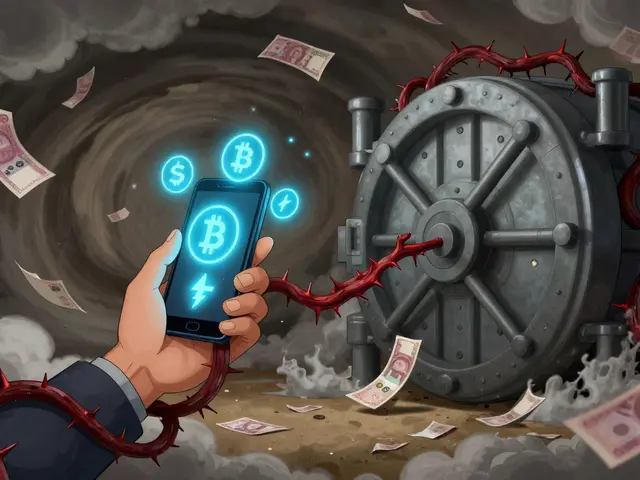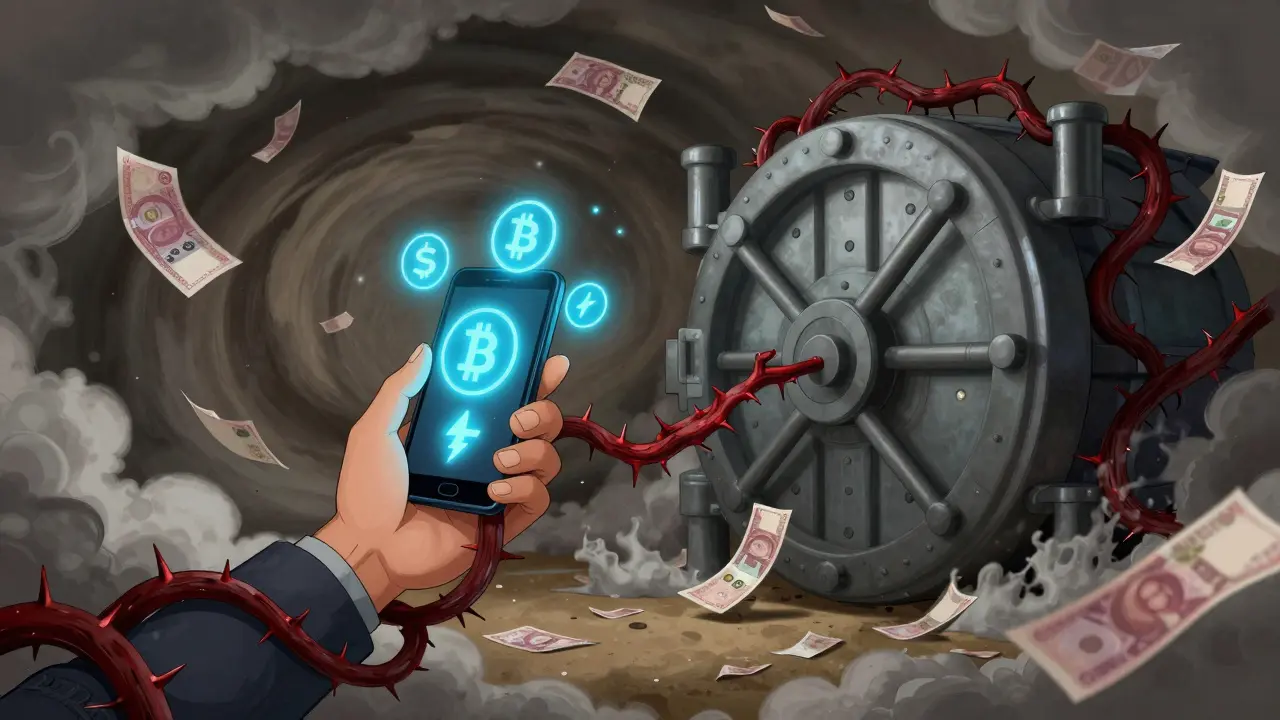
You might think that trading Bitcoin or holding Tether (USDT) on your phone is a private matter. In Myanmar, that assumption can cost you everything. The Central Bank of Myanmar has made it clear: if they catch you using cryptocurrency, they will close your bank accounts. This isn't just a warning; it is an active enforcement strategy that has left many citizens financially stranded.
If you are living in Myanmar or have ties there, understanding these penalties is not optional-it is survival. The regulatory landscape shifted dramatically from passive warnings to aggressive crackdowns between 2024 and 2025. With the introduction of strict anti-money laundering laws and the push for a state-controlled digital currency, the risks for individual users have never been higher. Let’s break down exactly what happens when the authorities decide to act.
The Shift from Warning to Action
For years, the message from Yangon was ambiguous. Back in May 2020, Notification No. 9/2020 told people that engaging in digital currency transactions was done at their own risk. It sounded like a cautionary note, not a threat. Many interpreted this as a gray area where they could operate with minimal fear of immediate consequences.
That changed completely on May 24, 2024. The Central Bank of Myanmar (CBM) issued a public notice that removed all doubt. They explicitly warned against buying, selling, exchanging, or transferring unregulated digital currencies. More importantly, they stated their readiness to enforce regulations by closing bank accounts and pursuing legal action. This marked a pivot from observation to intervention. The CBM began targeting specific activities, including unauthorized hundi money transfers facilitated by cryptocurrencies like Tether (USDT).
This escalation wasn't random. It coincided with broader efforts to control capital flight and stabilize the kyat amid political instability. By threatening the primary financial lifeline-bank accounts-the CBM created a powerful deterrent. For anyone relying on formal banking for daily life, the threat of account closure is often more terrifying than the prospect of a fine.
What Happens When Your Account Is Closed?
When the CBM decides to penalize a user, the first step is usually financial isolation. Bank account closure is the most immediate penalty. Here is what that looks like in practice:
- Immediate Freezing: Access to funds is cut off instantly. You cannot withdraw cash, pay bills, or receive salary deposits.
- Reputational Blacklisting: Once flagged for crypto-related violations, opening a new account becomes nearly impossible. Banks share compliance data, and your name may be blacklisted across major financial institutions.
- Asset Seizure Risk: While less common than account closure, authorities can freeze assets linked to illegal conversions under the Anti-Money Laundering Law.
This disruption affects more than just your crypto holdings. It paralyzes your ability to function in the modern economy. If your salary is deposited directly into your account, you are effectively unemployed until the issue is resolved-which, in many cases, means indefinitely. There is no simple appeal process. The burden of proof lies with the user, but proving innocence in a system designed to criminalize the activity itself is incredibly difficult.
Beyond Account Closure: Legal Penalties
Account closure is just the beginning. The legal framework in Myanmar treats cryptocurrency activities as serious offenses under multiple laws. These include:
- Central Bank of Myanmar Law: Grants the CBM sole authority to issue currency. Any attempt to use alternative currencies undermines this monopoly.
- Financial Institutions Law: Regulates how banks and financial entities operate. Facilitating crypto trades violates these standards.
- Anti-Money Laundering Law: Used aggressively to prosecute those involved in "unauthorized" currency exchanges, even if no actual laundering occurred.
Violations can result in imprisonment, heavy fines, or both. The CBM has specifically targeted widely recognized cryptocurrencies such as Bitcoin (BTC), Ethereum (ETH), Litecoin (LTC), and Perfect Money (PM). Enforcement actions have included shutting down personal Facebook pages used for trading and arresting individuals caught facilitating P2P transactions.
The severity of these penalties reflects the government's priority: maintaining strict control over financial flows. In a country facing economic sanctions and internal conflict, any tool that allows citizens to move money outside the state's reach is viewed as a national security threat.

The Underground Economy: Telegram, USDT, and Hundi
Despite the risks, demand for cryptocurrency in Myanmar remains high. Why? Because the official banking system is unreliable, and the kyat has suffered significant devaluation. Citizens need a way to save value and send remittances abroad. This has fueled a massive underground economy.
Between 2024 and 2025, peer-to-peer (P2P) transactions exploded on platforms like Telegram. Users bypass traditional exchanges entirely, connecting directly with traders who offer better rates and anonymity. Stablecoins, particularly USDT on the Tron network, dominate this space. They are preferred because they maintain a stable value relative to the US dollar, protecting users from kyat inflation.
This underground market operates in direct defiance of CBM regulations. Participants accept the risk of account closure because the alternative-losing purchasing power through inflation-is worse. However, this creates a dangerous cycle. As more people turn to informal channels, the CBM intensifies its surveillance and enforcement, leading to more closures and greater distrust in the formal banking sector.
| Activity | Legal Status | Primary Penalty | Secondary Consequences |
|---|---|---|---|
| Buying/Selling BTC/ETH | Illegal | Bank Account Closure | Fines, Potential Imprisonment |
| Using USDT for Remittance | Illegal (Unauthorized Exchange) | Account Freeze | AML Investigation |
| Crypto Mining | Illegal | Equipment Seizure | Criminal Prosecution |
| P2P Trading via Telegram | Illegal | Account Closure | Social Media Bans |
The Digital Kyat: A State-Controlled Alternative
While banning private cryptocurrencies, the Myanmar government is not ignoring digital finance. On June 24, 2025, the CBM established the Central Committee for the Issuance of Central Bank Digital Currency. Approved by the State Administration Council earlier that year, this committee is tasked with developing a "digital kyat."
This move signals a strategic shift. The government wants to harness the efficiency of blockchain technology without losing control. A central bank digital currency (CBDC) would allow the state to monitor every transaction, preventing capital flight and enforcing monetary policy directly. Unlike decentralized coins like Bitcoin, the digital kyat would be fully regulated and traceable.
For ordinary citizens, this offers little relief. The digital kyat is designed to serve the state's interests, not provide financial freedom. Until it launches-and assuming it does-it will likely coexist with the strict ban on private crypto assets. This dual approach creates confusion but reinforces the core message: only state-approved digital money is safe.

Political Complexity: NUG vs. Junta Regulations
The situation is further complicated by the political divide in Myanmar. Following the 2021 coup, the opposition National Unity Government (NUG) declared Tether (USDT) legal tender in regions under its control. This was a pragmatic move to circumvent junta currency controls and fund resistance activities.
This created a bizarre regulatory paradox. In some areas, using USDT is supported by local authorities; in others, it carries the threat of prison. For someone traveling between regions or communicating with family across the country, navigating these conflicting rules is a minefield. The CBM, representing the military-led government, maintains that its bans apply nationwide, regardless of local NUG policies.
This fragmentation makes compliance impossible for many. You cannot easily know which jurisdiction applies to your transaction. The safest advice? Assume the stricter rule always applies. If the CBM says it’s illegal, treat it as illegal everywhere.
How to Protect Yourself (If You Must Engage)
I am not giving legal advice, but I am offering practical observations based on how these systems work. If you are exposed to cryptocurrency in Myanmar, consider these steps to minimize risk:
- Separate Accounts: Never link your primary salary or savings account to crypto activities. Use a separate, low-balance account for any necessary transactions, though even this is risky.
- Avoid Traceable Methods: Using personal Facebook pages or identifiable web addresses for trading is a fast track to detection. The CBM actively monitors social media for ads related to BTC, ETH, and USDT.
- Understand Hundi Risks: Informal money transfer networks (hundi) are heavily scrutinized. Combining hundi with crypto increases suspicion of money laundering.
- Stay Off Mainstream Exchanges: Local exchanges face intense pressure. International offshore exchanges are harder for the CBM to touch directly, but withdrawing fiat currency back into Myanmar banks remains the weak point.
Remember, the goal of the CBM is deterrence. They do not need to catch everyone; they just need to make enough examples to scare the rest. Account closure is their most effective tool because it hits where it hurts most: daily financial survival.
Future Outlook: Will Things Change?
As of mid-2026, there is no sign of relaxation. The CBM continues to emphasize strict enforcement. The migration of miners to Thailand and Laos suggests that domestic operations are becoming unsustainable due to heat, electricity costs, and legal risks. Meanwhile, the development of the digital kyat proceeds slowly, indicating long-term commitment to state-controlled digital finance rather than open markets.
For investors and expats, the message is clear: keep your crypto activities outside Myanmar’s borders. Do not attempt to convert crypto to kyat through local banks. The penalties outweigh any potential gains. For locals, the choice remains between accepting the risks of the underground economy or suffering the erosion of wealth through inflation. Neither option is ideal, but understanding the rules helps you navigate the danger zones.
Is cryptocurrency completely illegal in Myanmar?
Yes. As of 2025, mining, trading, and all related activities involving decentralized cryptocurrencies like Bitcoin and Ethereum are illegal under the Central Bank of Myanmar Law. Only the state-issued digital kyat (in development) is permitted.
Can my bank account be closed for using USDT?
Absolutely. The CBM has explicitly stated that participating in the sale, purchase, or exchange of unregulated digital currencies like Tether (USDT) can lead to immediate bank account closure and legal prosecution.
What is the difference between the 2020 and 2024 CBM notices?
The 2020 notice warned users to proceed at their own risk without active enforcement. The 2024 notice escalated this to a direct threat, announcing active enforcement measures including account closures and legal action against violators.
Are there any exceptions for remittances?
No. Using cryptocurrency for remittances is considered an unauthorized currency conversion and falls under the same illegal category. Authorities view this as a method to bypass capital controls.
Will the digital kyat replace Bitcoin?
The digital kyat is intended to be a state-controlled alternative, not a replacement for global crypto markets. It aims to provide digital payment efficiency while maintaining full government oversight, unlike decentralized assets.