
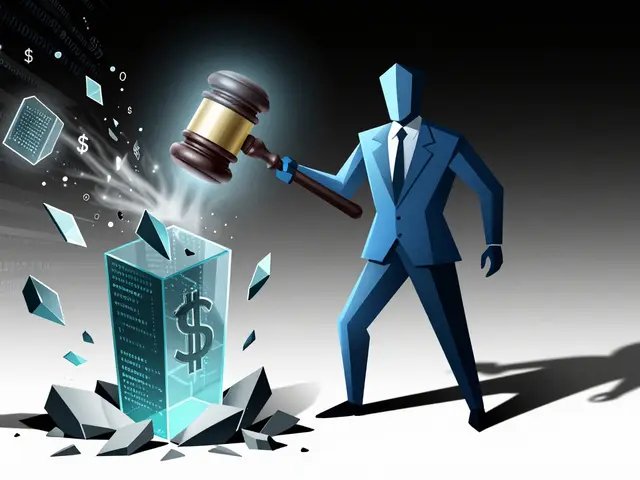
The message is clear if you look at the numbers. In just the first half of 2025, regulatory bodies worldwide issued over $6 billion in Anti-Money Laundering (AML) fines against digital asset platforms. This isn't a slow trickle of warnings; it's a coordinated global hammer drop on companies with weak oversight. For anyone running or investing in a cryptocurrency exchange, the era of "move fast and break things" is officially over. The new reality is compliance or closure.
We are seeing a shift from experimental regulation to systematic prosecution. Agencies like the Department of Justice (DOJ), Securities and Exchange Commission (SEC), and Financial Industry Regulatory Authority (FINRA) have stopped guessing how to handle crypto. They now have specialized teams, dedicated resources, and a playbook that includes criminal charges, massive civil penalties, and personal liability for executives. If your platform serves U.S. users or touches the U.S. financial system, you need to understand exactly what triggered these record-breaking penalties and how to avoid them.
The OKX Precedent: How $500 Million Changes Everything
To understand the severity of the current landscape, you have to look at the biggest enforcement action of 2025. On February 24, 2025, the Seychelles-based exchange OKX was hit with a staggering settlement. Founded in 2017 by Star Xu, OKX had long claimed to ban U.S. users. However, the U.S. Department of Justice uncovered internal documents showing a different story. Staff members were actively instructing American customers to falsify identification documents to bypass geo-restrictions.
The consequences were existential. The investigation revealed that OKX facilitated over $5 billion in suspicious transactions due to inadequate Know Your Customer (KYC) and AML frameworks. The final settlement required OKX to pay $84 million in civil fines and forfeit $420 million in illegal proceeds after pleading guilty. This case set a terrifying precedent: geographic bans mean nothing if your internal controls don't enforce them. It also highlighted that failing to register as a money service business with the U.S. Treasury is no longer a minor technicality-it’s a felony-level offense when combined with sanctions screening failures.
| Entity | Agency | Violation Type | Penalty Amount |
|---|---|---|---|
| OKX | DOJ | AML/KYC Failures, Sanctions Evasion | $504 Million ($84M fine + $420M forfeiture) |
| MCC International Corp., CPTLCoin, Bitchain | SEC | Fraud, Unregistered Securities, Ponzi Scheme | $46 Million Default Judgment |
| PGI Global (Ramil Palafox) | SEC | Anti-fraud violations, Misappropriation | $57 Million Misappropriated (Charges Filed) |
| Unicoin Executives | SEC | Registration Violations, Fraud | Charges Filed (Amount Pending) |
| Unnamed Broker-Dealers (2 cases) | FINRA | Disclosure Failures, Unregistered Affiliate Risks | $85,000 per case |
SEC Focus: Fraud, Ponzi Schemes, and Hidden Control
While the DOJ handles criminal aspects, the Securities and Exchange Commission has doubled down on investor protection through civil enforcement. The agency’s strategy in 2025 focused heavily on exposing fraud and unregistered securities offerings disguised as legitimate trading opportunities.
A prime example occurred on August 26, 2025. The SEC secured a combined $46 million default judgment against MCC International Corp., CPTLCoin Corp., and Bitchain Exchanges. The scheme was complex: defendants induced investors to buy mining packages, promising profit-sharing deposited into back-office wallets. Crucially, they failed to disclose that the liquidation process required withdrawing via a crypto asset created by MCC itself, which was traded on Bitchain-a platform they controlled. This allowed them to block investors from cashing out. The court ordered the disgorgement of nearly $28.5 million plus $7.8 million in prejudgment interest.
This case highlights a critical red flag for regulators: hidden control. If an exchange or platform controls the liquidity, the token, and the withdrawal mechanism without full disclosure, it’s viewed as a fraudulent security offering. Similarly, the April 2025 charges against Ramil Palafox of PGI Global showed the SEC targeting classic Ponzi structures where guaranteed high returns were paid using new investor funds rather than actual trading profits.

Market Manipulation: The DOJ’s War on Wash Trading
Beyond individual company failures, regulators are attacking systemic market manipulation. The District of Massachusetts has emerged as a key venue for these prosecutions. In October 2024, authorities charged 17 individuals with crypto-related crimes involving automated trading bots. These actors allegedly used match trading and wash trading to artificially inflate volumes for alternative and meme coins.
Why does this matter for exchanges? Because exchanges are often the unwitting platforms for this activity. If your order book is filled with fake volume generated by bots owned by the same entity, you’re facilitating market abuse. The DOJ’s focus here suggests that future enforcement will target not just the manipulators, but the exchanges that fail to detect and prevent these algorithmic abuses. Robust transaction monitoring systems are no longer optional; they are a legal requirement to avoid being seen as complicit.
Traditional Finance Meets Crypto: FINRA’s Role
You might think FINRA only regulates traditional stocks, but their reach extends into crypto products offered by broker-dealers. Under its FINRA Forward program, led by CEO Robert Cook, the agency is ensuring fair and transparent enforcement for firms expanding into digital assets.
In July 2025, FINRA settled with a broker-dealer for $85,000 because the firm failed to clearly disclose that retail crypto offerings were provided through an unregistered affiliate. They also didn’t fairly present the risks. This wasn’t an isolated incident; a similar $85,000 settlement occurred in May 2025. The pattern is clear: traditional financial firms cannot simply slap a crypto product onto their website without rigorous compliance checks. The risk of misleading retail investors is being treated with zero tolerance.

Compliance Checklist: Avoiding the Next Fine
Based on the 2025 enforcement trends, here is what every crypto business must prioritize immediately:
- Real-Time KYC Verification: Geo-bans are insufficient. You need active verification that prevents U.S. users from creating accounts, even if they try to spoof their location. Use biometric checks and document validation that flags inconsistencies.
- Sanctions Screening Integration: Integrate real-time screening against OFAC lists. Every transaction must be checked before execution. Lagging screens are a major failure point cited in the OKX case.
- Transaction Monitoring Algorithms: Deploy AI-driven tools to detect wash trading, layering, and other AML red flags. Manual review is too slow for modern crypto volumes.
- Treasury Registration: If you facilitate transfers between fiat and crypto, ensure you are registered as a Money Service Business (MSB) with FinCEN. Ignorance of this requirement is no longer a defense.
- Transparent Disclosure: If you offer staking, mining pools, or proprietary tokens, disclose all conflicts of interest. Investors must know who controls the liquidity and the exit ramps.
The Future: Project Crypto and Political Headwinds
Looking ahead, the regulatory pressure shows no signs of easing. SEC Chairman Paul Atkins announced "Project Crypto," a commission-wide initiative dedicated to digital assets. This signals that the SEC is building permanent infrastructure for crypto oversight, not just reacting to scandals.
However, there are political headwinds. House Republicans have proposed cutting the SEC’s budget by 7% and restricting funds for certain enforcement actions. Additionally, the Eleventh Circuit Court struck down the SEC’s 2023 rule on funding the Consolidated Audit Trail, calling it arbitrary. While this may slow some bureaucratic expansions, it hasn’t stopped the core enforcement machinery. The DOJ continues its criminal prosecutions independently of SEC budget constraints.
For businesses, the takeaway is simple: treat compliance as a strategic priority, not a cost center. The $6 billion in fines issued in 2025 proves that regulators are willing to bankrupt non-compliant entities. Whether you are a startup or a legacy exchange, your survival depends on how well you implement AML, KYC, and transparency measures today.
What was the largest crypto fine in 2025?
The largest fine was levied against OKX by the U.S. Department of Justice. The exchange agreed to a total settlement of $504 million, consisting of an $84 million civil penalty and the forfeiture of $420 million in illegal proceeds. This was due to severe AML violations and facilitating over $5 billion in suspicious transactions.
How can a crypto exchange avoid DOJ enforcement actions?
To avoid DOJ actions, exchanges must implement robust AML frameworks, including real-time sanctions screening and accurate KYC processes. Crucially, they must register as Money Service Businesses with the U.S. Treasury if serving relevant markets and ensure that geo-bans are technically enforced, not just policy statements.
What is the SEC's main concern with crypto exchanges?
The SEC primarily focuses on investor fraud and unregistered securities offerings. They target schemes where investors are promised guaranteed returns, such as Ponzi-like mining operations, and cases where exchanges hide their control over liquidity or withdrawal mechanisms, misleading investors about the nature of the assets.
Does FINRA regulate cryptocurrency?
Yes, but indirectly. FINRA regulates traditional broker-dealers that offer crypto products. They enforce rules requiring clear disclosure of risks and ensuring that crypto offerings are not provided through unregistered affiliates without proper warning to retail investors.
Are executives personally liable for crypto compliance failures?
Yes. Recent enforcement actions show that senior executives face personal penalties, including fines and potential criminal charges, if they fail to oversee adequate AML and compliance programs. The trend is moving toward holding leadership accountable for corporate negligence.
What is "wash trading" and why is it targeted?
Wash trading is a form of market manipulation where traders simultaneously buy and sell the same asset to create false volume and price movements. The DOJ targets this because it deceives investors about market liquidity and demand, often using automated bots to execute trades at scale.






Ryan Robinson
July 30, 2026 AT 10:35honestly this is just the gov trying to crush innovation again. like yeah okx messed up but they were basically forced into a corner by unclear rules. its not fair to punish everyone for one bad apple. we need more clarity not less freedom 🙄
Earl Kott65
July 30, 2026 AT 23:04Oh wow! 😱 You really think it's about 'innovation'? Please. It’s about accountability! 💥 These guys were literally telling Americans to lie on their IDs! That’s not innovation, that’s fraud! 🚨 And don’t get me started on the wash trading bots. It’s a rigged game and now the house is finally cleaning up its own mess. 🧹✨ The DOJ isn't crushing anything; they're just enforcing the law that existed all along! Who else is tired of these cowboy exchanges? 🤠📉
Aryan MISHRA
August 1, 2026 AT 21:00The regulatory paradigm shift is unequivocal. Compliance is no longer optional; it is existential. The OKX settlement exemplifies the severe consequences of negligent AML frameworks. Geo-restrictions are futile without robust KYC integration. Executives must prioritize fiduciary responsibility over speculative growth. The era of deregulation is definitively over.
Jack Delasquez
August 3, 2026 AT 04:34guys stop crying abt fines. if u run an exchange u should know better. its basic bsnes sense. also why does every post have to be so long?? just tell us what to do. im gonna go buy some memecoins before the bots eat em all lol. hope my wallet doesnt get frozen next week. life is wild rn.
Ethan Yuwono
August 3, 2026 AT 11:48it seems we are witnessing a necessary correction in the market structure. while the penalties are harsh they serve as a deterrent against systemic risk. the focus on hidden control mechanisms is particularly insightful. transparency is key to trust. perhaps we can view this not as oppression but as maturation of the industry. what are your thoughts on the long term implications for decentralization?
Harman Singh
August 4, 2026 AT 20:40i feel like nobody cares about the small investors here. they just want their money back. its so sad how these big corps ruin everything for regular people. i lost so much in that mcc scheme. why does it always have to be us who suffer while the execs fly away. its just unfair and depressing. i dont even know if crypto is worth it anymore after reading this. feels like a scam fest.
Qolbina Islami
August 6, 2026 AT 19:28THIS IS AMERICA!!! 🇺🇸 The SEC and DOJ are doing their jobs to protect OUR economy from foreign scammers!! If you can't follow the rules, GET OUT! We don't need weak compliance or shady dealings in our financial system! Strong enforcement makes us stronger! Anyone complaining is just jealous of the stability we're building! MAKE AMERICA SECURE AGAIN! 🔒💪🇺🇸