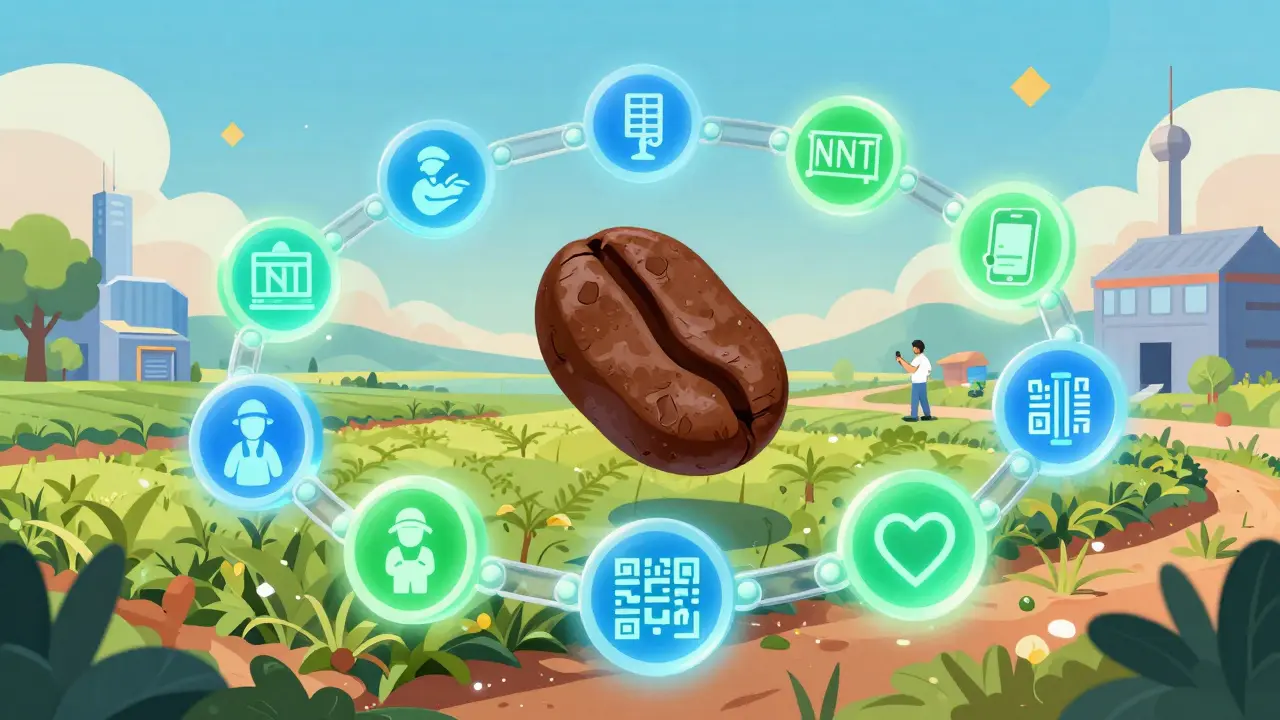
Imagine you buy a bag of coffee labeled "fair trade" and "organic." But how do you really know it’s true? What if the farmer never got paid fairly? What if the beans were mixed with cheaper ones halfway across the world? This isn’t just a suspicion-it’s a common problem in global supply chains. That’s where blockchain NFTs come in. They’re not just digital art or collectibles. They’re turning supply chains into open, tamper-proof ledgers that anyone can verify.
What Exactly Are NFTs in Supply Chains?
Most people think of NFTs as digital paintings or profile pictures. But an NFT is really just a unique digital certificate stored on a blockchain. It can’t be copied, changed, or deleted. In supply chains, each product-whether it’s a single pair of shoes, a batch of medicines, or a ton of cocoa beans-gets its own NFT. That NFT holds all the history: where it came from, who handled it, when it was shipped, what tests it passed, and even the environmental conditions during transport. This isn’t a digital version of a paper receipt. It’s a living record that updates every time the product changes hands. A farmer scans a QR code when harvesting coffee beans and logs the harvest date, soil conditions, and labor practices. The next handler-say, a cooperative in Colombia-adds their own data when they process the beans. Then an exporter, a shipping company, a customs agent, and finally a retailer all add their entries. Each step is permanently recorded on the blockchain. No one can erase it. No one can fake it.Why This Beats Traditional Tracking
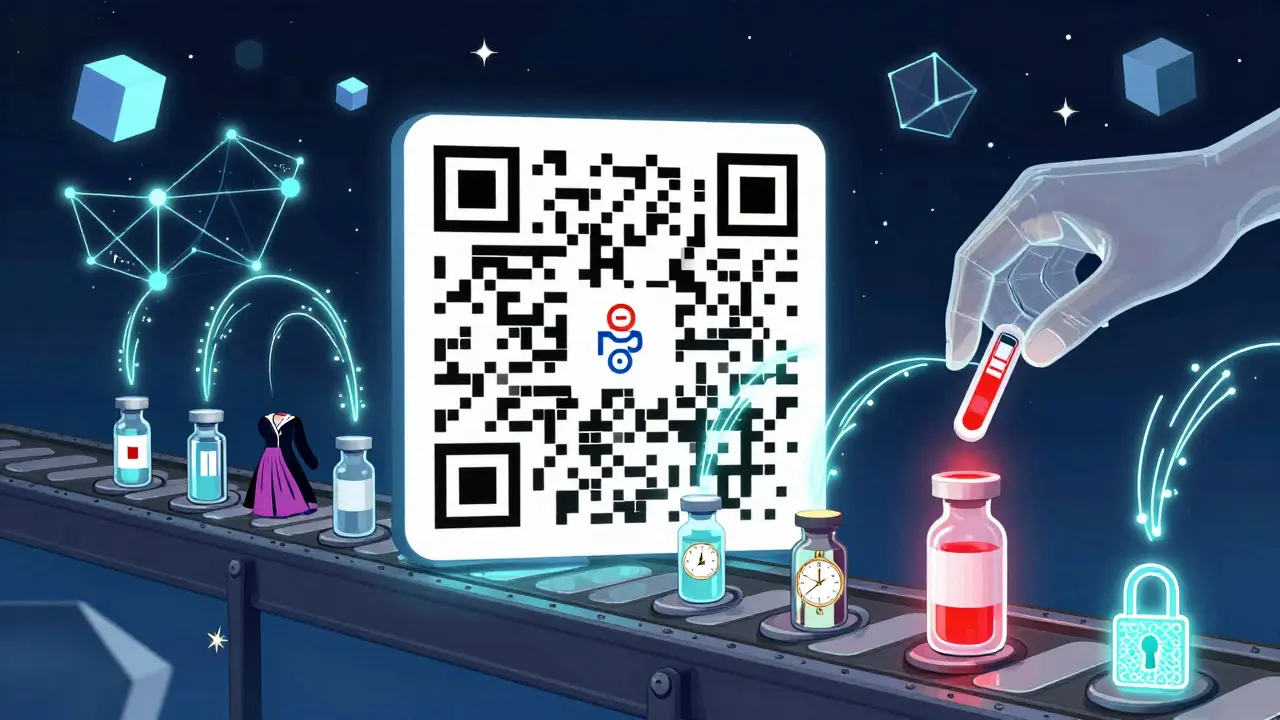
Before blockchain NFTs, supply chains relied on spreadsheets, PDFs, and third-party audits. These systems are slow, expensive, and full of holes. A company might claim its wool is sustainably sourced, but without real-time data, there’s no way to prove it. Audits happen once a year. By then, damage is done. Fraud is easy. A 2023 report from the World Economic Forum found that 30% of luxury goods and 10% of pharmaceuticals are counterfeit. That’s billions in lost revenue and real health risks. NFTs fix this. Every transaction is time-stamped and verified by multiple nodes on the blockchain. If someone tries to alter a record, the system flags it immediately. Retailers, regulators, and even customers can scan a QR code on the product and see the full journey. No middleman. No paperwork. Just proof. Take the pharmaceutical industry. A patient in Berlin gets a bottle of insulin. Scanning the NFT shows the drug was manufactured in India, shipped through Singapore, cleared customs in Rotterdam, and stored at 4°C the whole time. If the batch is later recalled due to contamination, the system instantly pinpoints every single vial affected-down to the lot number. Before NFTs, that could take weeks.How It Works: From Farm to Fridge
Here’s how a real NFT supply chain works step by step:- Origin: A coffee farmer in Ethiopia uses a mobile app to create an NFT for their harvest. They input GPS coordinates, harvest date, organic certification ID, and labor compliance records.
- Processing: The cooperative that buys the beans attaches their own data: washing method, drying temperature, moisture content. This gets added to the NFT.
- Export: The exporter logs shipment details, container ID, and port of departure. Temperature sensors on the shipping container automatically update the NFT if the cold chain breaks.
- Import & Distribution: At the U.S. port, customs scans the NFT. The importer logs warehouse storage conditions. A retailer adds shelf placement info.
- Consumer: You buy the coffee. You scan the QR code on the bag. In seconds, you see the entire journey-verified by blockchain.
This isn’t theory. Companies like IBM and Walmart already use similar systems for food. In 2025, a recall of contaminated spinach in California was traced to a single farm in 2.3 seconds using blockchain NFTs. Before, it took 7 days.
Private vs. Public Blockchains
Not all blockchains are the same. Some supply chains use public blockchains like Ethereum or Polygon. These are open to anyone. That’s great for consumer trust-you can verify a product without needing special access. But businesses often need privacy. A company might not want competitors to see their shipping routes or supplier costs. That’s where private blockchains like Hyperledger Fabric come in. Only authorized partners can view or update the data. The NFT still holds the full history, but sensitive details are encrypted or hashed. Think of it like a locked journal: anyone can see that a transaction happened, but only insiders know what was written. Smart contracts automate the process. For example, if a shipment’s temperature rises above 10°C, the smart contract triggers an alert and automatically notifies the buyer. No human intervention needed.Real Industries Winning With NFTs
- Food & Beverage: Companies like Nestlé and Carrefour track organic produce, seafood, and dairy. Consumers see if fish was caught legally or if milk came from pasture-raised cows. - Pharmaceuticals: The EU now requires NFT-style tracking for all prescription drugs. Counterfeit insulin, cancer meds, and vaccines are being slashed. - Luxury Goods: Louis Vuitton and Rolex use NFTs to prove authenticity. If you buy a $10,000 watch, you get a digital twin that proves it’s not a knockoff. - Fashion: Brands like Stella McCartney track recycled materials from ocean plastic to finished garments. Customers see exactly how much waste was diverted. - Electronics: Apple and Samsung use NFTs to verify components. A smartphone’s processor can be traced back to the factory in Taiwan, ensuring no forced labor was involved.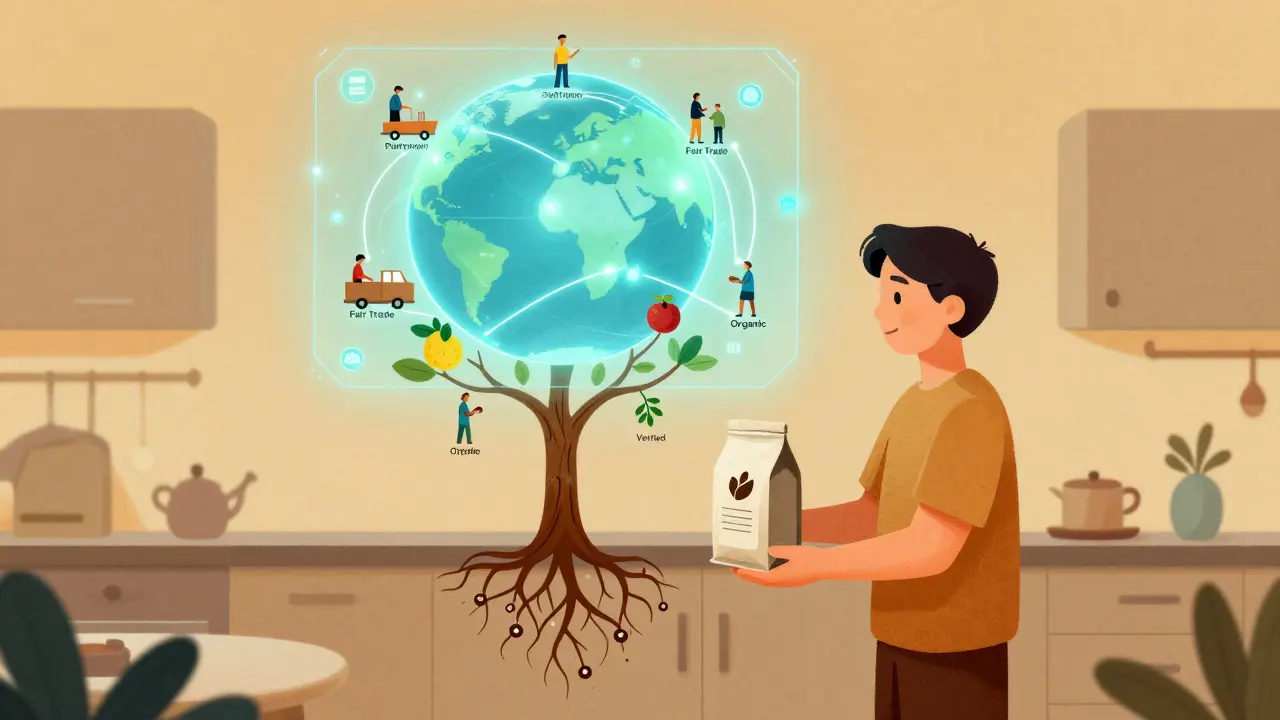
The Challenges
It’s not perfect. There are real hurdles. First, data quality. If a farmer doesn’t input accurate info, the whole chain is flawed. Training is key. Companies are now hiring blockchain literacy trainers to teach workers how to use mobile apps and scan codes. Second, integration. Most factories still use 20-year-old ERP systems. Connecting those to blockchain isn’t plug-and-play. It takes months of work and custom software. Third, energy use. Ethereum used to be a big energy hog. But since switching to proof-of-stake in 2022, its energy use dropped 99.95%. Modern NFT supply chains use low-energy blockchains like Polygon or Solana, making them greener than paper records. Fourth, adoption. If only 10% of suppliers use NFTs, the system fails. The industry is moving fast, though. The EU’s new due diligence laws require traceability for everything from palm oil to lithium batteries. Companies that don’t adapt will lose contracts.What’s Next?
The next leap is combining NFTs with IoT sensors and AI. Imagine a shipment of avocados. Sensors track humidity, vibration, and temperature. The NFT updates in real time. AI analyzes the data and predicts spoilage risk. If the fruit is likely to go bad, the system reroutes it to a nearby discount store instead of letting it rot in a warehouse. Zero-knowledge proofs are also emerging. These let companies prove a product met standards-like "no child labor"-without revealing the supplier’s name or location. Privacy and transparency, together. By 2028, experts predict over 60% of global supply chains for high-value goods will use NFT-based tracking. The cost? It’s dropping fast. A startup can now set up a full system for under $5,000 using cloud-based blockchain platforms.What This Means for You
If you’re a consumer, you’re getting real power. No more trusting logos. You can scan, verify, and choose products based on actual data-not marketing. If you’re a business, you’re getting trust. Proof of sustainability isn’t a PR stunt anymore. It’s a competitive edge. Customers pay more for verified ethics. Regulators won’t fine you if you can show compliance. And if you’re in logistics, manufacturing, or retail? This isn’t a future trend. It’s happening now. The question isn’t whether to adopt it. It’s whether you’re ready to catch up.Can NFTs really prevent counterfeit products?
Yes. NFTs make counterfeiting nearly impossible because each product has a unique, unchangeable digital record tied to its physical form. If someone tries to replicate a product, they can’t copy the blockchain record. Luxury brands like Gucci and Hermès already use this to block fake handbags. In pharma, the EU’s FMD system has cut counterfeit drugs by 78% in two years using similar blockchain tracking.
Do I need to understand blockchain to use NFT supply chain tracking?
No. End users just scan a QR code with their phone. Suppliers and handlers use simple apps to log data. The blockchain works in the background. It’s like using GPS-you don’t need to know how satellites work to get directions.
Are NFT supply chain systems expensive to set up?
Not anymore. Early adopters spent millions. Today, cloud platforms like AWS Blockchain Templates or Azure Supply Chain Solutions offer pre-built NFT tracking for under $10,000. Small businesses can start with a single product line for under $2,000. The real cost is training staff-not tech.
What happens if the blockchain goes down?
Blockchains don’t "go down" like websites. They’re distributed across hundreds or thousands of computers worldwide. Even if half the nodes fail, the data stays intact. Public blockchains like Polygon have over 10,000 active nodes. Private ones use enterprise-grade networks with backup servers. It’s far more reliable than a single company’s server.
Can NFTs track non-physical things too?
Yes. NFTs can track digital assets tied to physical ones-like software licenses for industrial machines, maintenance records for wind turbines, or even carbon credits earned by sustainable farming. The NFT links the digital proof to the real-world object, making audits and compliance automatic.

Mara Alves Mariano
March 11, 2026 AT 22:37And don’t even get me started on ‘verified by blockchain.’ I scanned a QR code on my avocado toast last week. It showed me the farmer’s name, his goat’s birth certificate, and the exact wind speed on harvest day. Meanwhile, my paycheck got direct deposited from a shell corporation in the Caymans. Which one’s the real fraud?
Zephora Zonum
March 13, 2026 AT 13:46Also, ‘low-energy blockchains’? Polygon? Solana? Those are just Ethereum’s cousins who moved to a smaller apartment and still run the same AC. Energy isn’t the issue. The entire model is. Paper records are dumb. But so is this.
Anthony Marshall
March 15, 2026 AT 11:34Lindsay Girvan
March 15, 2026 AT 20:16Tina Keller
March 17, 2026 AT 03:33What we need isn’t more tech. It’s better contracts. Fair wages. Legal protections. Tech is a tool, not a solution. And if we’re going to build this, we build it with them-not for them.
vasantharaj Rajagopal
March 18, 2026 AT 06:21