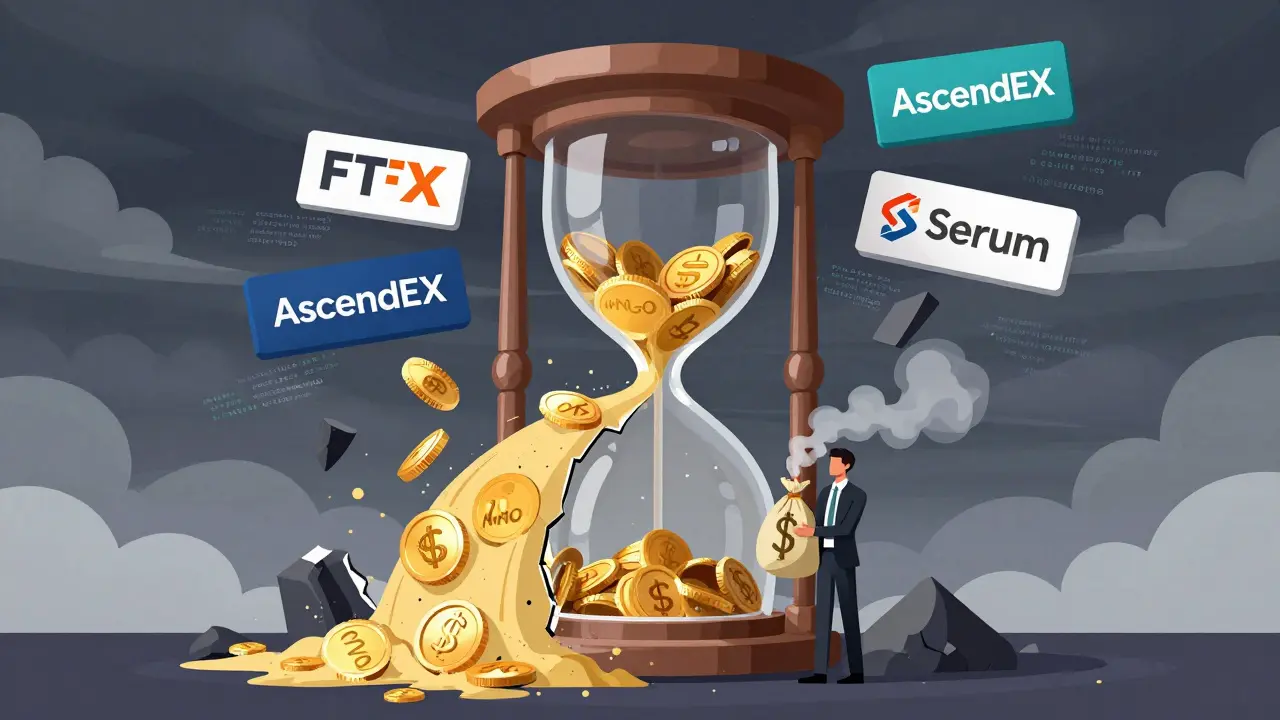
When Mango Markets launched in 2021, it looked like the future of decentralized trading. Built on Solana, it promised fast trades, low fees, and powerful tools like 10x leverage, margin trading, and perpetual futures-all without giving up control of your crypto. For traders tired of centralized exchanges like Binance or Coinbase, Mango Markets felt like the perfect middle ground: DeFi transparency with CEX-level functionality. But by January 2025, the platform was gone. No more trading. No more lending. No more MNGO rewards. Just a shutdown notice and a $116 million hole in its vaults.
How Mango Markets Worked
Mango Markets wasn’t just another DEX. Unlike Uniswap, which relies on simple automated market makers (AMMs), Mango used an order book model-something you’d normally find on Binance or Kraken. That meant users could place limit orders, set stop-losses, and trade directly with other users. It also offered margin trading with up to 10x leverage, allowing traders to borrow funds to amplify positions. You could deposit USDC, SOL, or other tokens, use them as collateral, and borrow more to go long or short on assets like MNGO, SRM, or ETH.The platform’s biggest selling point was its open-source architecture. Anyone could audit the code. Developers could build tools on top of it. Liquidity providers earned MNGO tokens as rewards. And unlike centralized exchanges, you never had to send your crypto to a company’s wallet. Your funds stayed in your own Solana wallet.
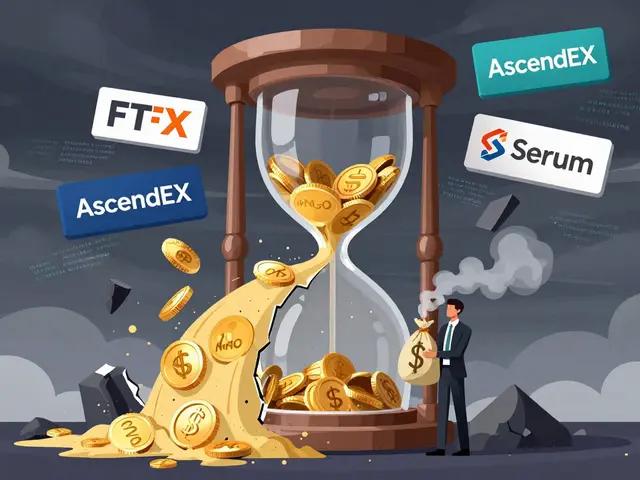
But behind the scenes, Mango relied on a single oracle to price assets-especially MNGO, its native token. That oracle pulled price data from just a few exchanges: FTX, AscendEX, and Serum. That one flaw became the platform’s undoing.
The October 2022 Exploit
On October 11, 2022, a trader named Avraham Eisenberg pulled off one of the most brazen attacks in DeFi history. He started with $5 million in USDC. He opened two accounts on Mango Markets. Then he did something simple but devastating: he bought massive amounts of MNGO on FTX and AscendEX, driving the price up. Because Mango’s oracle used those exchanges as its only price sources, the platform thought MNGO was worth far more than it really was.With that inflated price as collateral, Eisenberg borrowed over $100 million in other tokens from Mango. He then dumped his MNGO back onto the market, crashing the price. Suddenly, his collateral was worthless. But he’d already withdrawn the borrowed funds. Mango’s system couldn’t react fast enough. The liquidation engine was too slow. The oracle had no time-weighted average pricing. No circuit breakers. No backup data sources.
The result? Over $116 million in assets vanished from Mango’s lending pools. Users who had deposited funds suddenly saw their loans undercollateralized. Liquidity providers lost money. Traders who had gone long on MNGO were wiped out. And the platform’s reputation-built on transparency and community-was shattered overnight.
Legal Fallout and the Conviction That Vanished
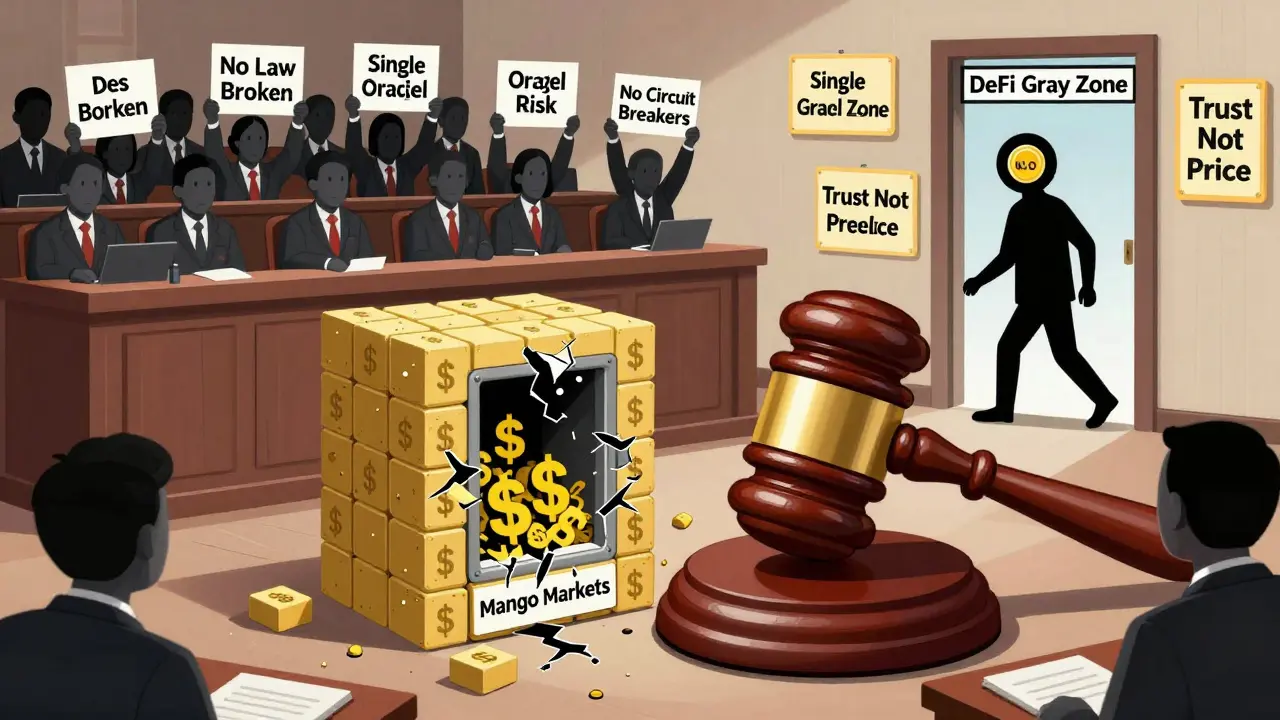
Eisenberg was arrested in December 2022. He faced charges of commodities fraud, market manipulation, and wire fraud. In April 2024, a jury found him guilty. He was facing up to 20 years in prison. The SEC and CFTC were preparing civil actions. It looked like justice had been served.But on May 23, 2025, everything changed. U.S. District Judge Arun Subramanian overturned the conviction. In a 35-page ruling, he found that the prosecution failed to prove Eisenberg acted with intent to defraud. The judge noted that while the trade was aggressive, it didn’t violate any existing laws at the time. DeFi was still a legal gray zone. No clear rules existed for oracle manipulation. The court couldn’t say Eisenberg knew he was breaking the law.
The ruling sent shockwaves through DeFi. If a $100 million exploit isn’t fraud under U.S. law, what is? It didn’t bring back the lost money. But it did make it clear: regulators are still catching up. And platforms like Mango Markets were built on assumptions that the law would protect them-when it never did.
Why Mango Markets Couldn’t Recover
After the exploit, Mango tried to recover. A community DAO was formed. A settlement was negotiated. Eisenberg returned $67 million. But the damage was done. Trust evaporated. Liquidity dried up. Users pulled out. Even the most loyal traders didn’t want to risk another oracle attack.The platform’s team announced a wind-down in late 2024. By January 2025, all services were shut down. Mango v4 and Boost were discontinued. No new deposits. No new loans. No trading. The MNGO token, once a governance and fee-discount tool, became worthless. The open-source code remains on GitHub, but no one is maintaining it.
What killed Mango Markets wasn’t just the exploit. It was the lack of safeguards. No multi-oracle system. No price deviation limits. No emergency pause buttons. Even the most advanced DeFi platforms can’t survive without these basics. Mango had the features. It just didn’t have the security.
How It Compared to Other Exchanges
At its peak, Mango Markets competed with Serum (also on Solana) and dYdX (on Ethereum). Unlike Serum, which focused on spot trading, Mango offered full margin and futures. Compared to dYdX, it had lower leverage (10x vs. 20x) but lower fees thanks to Solana’s speed.It wasn’t as user-friendly as centralized exchanges. You needed a Solana wallet (like Phantom or Backpack), understood collateral ratios, and knew what liquidation meant. But for experienced DeFi users, it was one of the best tools available. The problem? It attracted too many experienced users-and not enough security engineers.
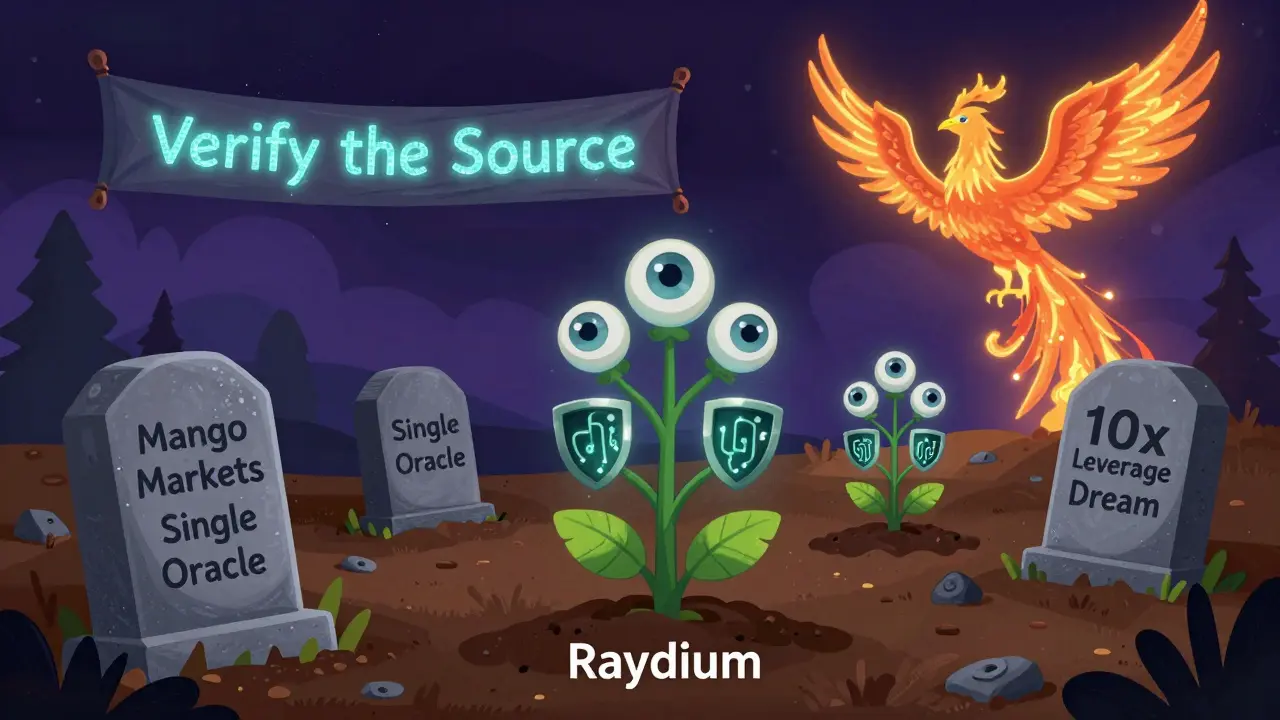
Today, Solana-based DEXs like Raydium and Orca have learned from Mango’s mistakes. They use multiple oracles, time-weighted prices, and circuit breakers. Even small projects now include “oracle redundancy” as a standard feature. Mango’s failure didn’t kill Solana DeFi-it forced it to get smarter.
Lessons from the Collapse
Mango Markets was a cautionary tale wrapped in a tech marvel. It showed what DeFi could do: offer institutional-grade trading without middlemen. But it also exposed how fragile that system can be.Here’s what you need to remember:
- Oracles are the weakest link. If a DeFi platform relies on one or two exchanges for pricing, it’s vulnerable. Always check how many data sources it uses.
- Leverage isn’t free. 10x sounds great until your collateral crashes. Never trade more than you can afford to lose.
- Open source doesn’t mean safe. Just because code is public doesn’t mean it’s been audited. Look for third-party audits from firms like CertiK or Trail of Bits.
- Regulation is coming. The fact that a judge overturned a conviction doesn’t mean DeFi is lawless. It means the rules are still being written. Be ready for changes.
Mango Markets didn’t fail because it was too ambitious. It failed because it was too trusting. It trusted price feeds. It trusted users. It trusted the market to behave rationally. In crypto, that’s never enough.
What’s Left Today?
As of January 2026, Mango Markets is a ghost. The website is offline. The Discord is quiet. The MNGO token trades for pennies on rare decentralized exchanges. There’s no recovery plan. No airdrop. No resurrection.If you held MNGO or deposited funds, you likely lost money. The $67 million returned was distributed among creditors, but most users received only a fraction of what they lost. Some walked away. Others are still waiting for legal action that may never come.
But Mango’s legacy lives on-in the codebases of newer DeFi projects, in the way developers now design oracles, and in the warnings shouted by veterans to newcomers: Don’t trust the price. Verify the source.
Is Mango Markets still operational?
No. Mango Markets shut down completely in January 2025. All trading, lending, and borrowing services have been terminated. The platform no longer accepts deposits or processes withdrawals.
What happened to the MNGO token?
The MNGO token lost nearly all its value after the platform’s shutdown. It’s still listed on a few decentralized exchanges, but trading volume is minimal. It no longer serves any governance or utility function. Most holders consider it effectively worthless.
Was the Mango Markets exploit a hack or a legal trade?
It was technically a legal trade under U.S. law-at least according to a federal judge. The trader exploited a flaw in the platform’s oracle system, not a software bug. While it caused massive losses, the court ruled in May 2025 that the actions didn’t meet the legal definition of fraud because no explicit rules prohibited such manipulation at the time.
Could this happen again on other DeFi platforms?
Possibly, but it’s much less likely now. After Mango’s collapse, nearly every major DeFi protocol upgraded its oracle systems. Most now use multiple data sources, time-weighted average prices, and circuit breakers that pause trading during extreme volatility. Platforms like Raydium and Serum have incorporated these fixes. Still, any DeFi project relying on a single price feed remains at risk.
Should I avoid Solana-based DeFi platforms because of Mango?
No. Solana’s speed and low fees still make it one of the best blockchains for DeFi. The issue wasn’t Solana-it was poor oracle design. Today, many Solana-based DEXs have strong security practices. Always check if a platform uses multi-oracle pricing, has been audited, and has clear risk controls before depositing funds.
Did anyone get their money back from Mango Markets?
Some did, but not everyone. After the exploit, a community-led DAO negotiated a settlement with the attacker, who returned $67 million. That money was distributed to affected users and liquidity providers based on claim amounts. Most users recovered only a portion of their losses-often between 10% and 40%. The rest was lost permanently.



Kevin Thomas
February 1, 2026 AT 20:23Man, I remember when Mango was the hype train-everyone was stacking MNGO like it was free money. But looking back, the oracle setup was a joke. One exchange dip and boom-$116M gone? That’s not a hack, that’s negligence. If you’re running a platform with 10x leverage, you don’t rely on FTX and AscendEX as your only price feeds. That’s like building a bridge out of duct tape and hoping no heavy trucks drive over it.
Jerry Ogah
February 2, 2026 AT 01:47THIS IS WHY WE CAN’T HAVE NICE THINGS. Some guy makes $100M off a loophole and the judge says ‘eh, not fraud’? That’s not justice, that’s capitalism with a wink and a nod. They should’ve jailed him for life. Now everyone’s gonna think DeFi is a free-for-all where you can just steal millions and call it ‘smart trading.’ What’s next? Robbing ATMs and saying ‘I didn’t break any laws because there’s no sign saying ‘don’t’?’
Nickole Fennell
February 3, 2026 AT 18:16Okay but can we talk about how heartbreaking it is that people lost their life savings? I had a friend who put her entire tax refund into Mango because she trusted the ‘community’ vibe. She cried for weeks. And now? The whole thing’s just… gone. Like a ghost town. And the guy who did it? He’s probably sipping margaritas on a beach somewhere while the rest of us are stuck cleaning up the mess. I hate that this is what crypto has become.
Gurpreet Singh
February 4, 2026 AT 23:38From India, I watched this unfold with caution. We’ve seen too many ‘too good to be true’ crypto projects here-Ponzi schemes disguised as DeFi. Mango was different. It looked real. That’s why it hurt so much. But the lesson? Always check the oracle. Always. Even if the UI looks slick and the team has fancy LinkedIn profiles. If they use one source for pricing, walk away. I now only use platforms with at least three oracles and a 15-minute TWAP. It’s boring. But it keeps my money alive.
Christopher Michael
February 5, 2026 AT 08:48Kevin, you’re 100% right-this wasn’t a hack, it was a design failure. But let’s be real: the entire DeFi space is still in the Wild West. No one’s auditing for oracle manipulation because… nobody thought it was possible? The code was open, sure-but open doesn’t mean secure. And the devs? They were too busy adding new features to fix the foundational risk. That’s the tragedy: innovation outpaced safety. Now, every new Solana DEX has multi-oracle, TWAP, circuit breakers… because Mango died so we wouldn’t have to.
Parth Makwana
February 5, 2026 AT 09:46Let us not forget the macroeconomic context: in 2022, the crypto winter was already in full swing. Mango’s collapse was not merely a technical failure-it was a systemic failure of risk governance, liquidity architecture, and regulatory foresight. The absence of a decentralized oracle network, coupled with the absence of a robust liquidation engine, rendered the entire protocol vulnerable to adversarial arbitrage. While the legal outcome was lamentable, the technical legacy endures: today’s DeFi protocols implement fail-safes that Mango ignored. The MNGO token may be dead-but its corpse taught us how to build better.