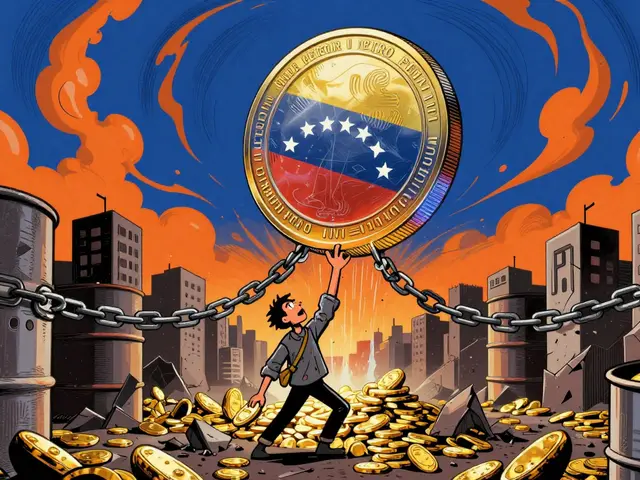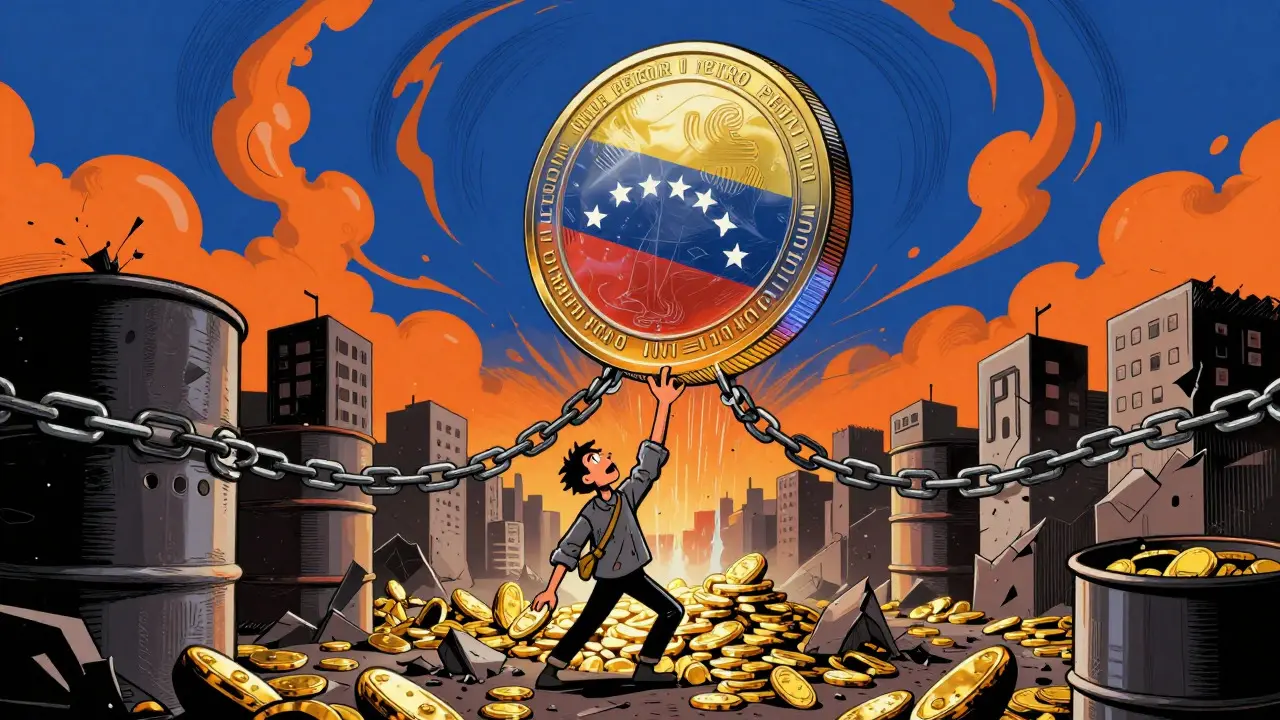
Imagine trying to buy a loaf of bread with a currency that the government says is worth $60, but the black market insists it's worth less than half that. That is the reality for many Venezuelans dealing with the Petro, a sovereign cryptocurrency issued and backed by the Bolivarian Republic of Venezuela. Launched in February 2018 under President Nicolás Maduro, the Petro was designed to bypass international sanctions and stabilize the economy using oil reserves as collateral. Yet, nearly a decade later, it remains a niche instrument rather than a global success story.
The core problem isn't just technology; it's trust. While the government mandates its use for specific services, citizens often look elsewhere for financial safety. Understanding how this program works, where it fails, and what restrictions apply requires looking beyond the official narrative into the legal and economic realities on the ground.
What Is the Petro and How Does It Work?
At its heart, the Petro is a digital token created through Presidential Decree 3196 in December 2017. Unlike Bitcoin, which runs on a decentralized network of thousands of independent nodes, the Petro operates on a federated blockchain. This means a specific group controls who can verify transactions. In practice, this gives the Venezuelan state significant oversight over the asset's movement and validation.
The government claims each Petro is backed by reserves of oil, gasoline, gold, and diamonds. The initial issuance plan called for 100 million tokens, valued at approximately $6 billion, or $60 per token. However, this valuation has never been validated by open market trading. Instead, the asset circulates primarily within controlled environments. The regulatory body overseeing this system is the Superintendence of Crypto Assets and Related Activities (SUPCACVEN). Established in April 2018, SUPCACVEN handles everything from maintaining miner registries to ensuring exchanges function correctly. It acts as the gatekeeper for all legitimate crypto activity recognized by the state.
The Legal Framework and Regulatory Bodies
Navigating the legal landscape of the Petro is complex because two parallel systems exist. On one side, you have the executive branch, which created the asset. On the other, the National Assembly, which was controlled by the opposition Democratic Unity Roundtable at the time of launch. In March 2018, just one month after the Petro’s debut, the Assembly declared it illegal, labeling it an unauthorized debt issuance by a cash-strapped government.
This conflict creates ongoing legal uncertainty. Despite this, the government pushed forward with the Cryptoassets Constituent Decree. This decree established a general legal framework allowing both individuals and legal entities to create, circulate, and exchange crypto assets. It empowered the National Executive to regulate the market and authorize virtual exchanges. Key entities involved in this structure include:
- SUPCACVEN: The primary regulator responsible for control and protection of crypto assets.
- Treasury of Cryptoassets: A state-owned company under the Vice-Presidency that handles issuance, custody, and distribution.
- PDVSA: Venezuela's state-owned oil company, which was encouraged to incorporate cryptocurrencies in foreign dealings.
Carlos Vargas serves as the Superintendent of Cryptocurrencies, playing a central role in enforcing these rules. For anyone interacting with the Petro, understanding which entity holds authority in a given transaction is crucial, as the answer often depends on whether you are dealing with state institutions or private parties.

Petro Zones: The Strategy for Local Adoption
To boost usage, the government didn't just issue tokens; they designated specific geographic areas known as Petro Zones. In March 2018, Decree 3,333 created four such zones: Margarita Island, the Los Roques Archipelago, the Paraguaná peninsula, and the Ureña-San Antonio area near the Colombian border.
These zones were intended to be hubs for virtual mining and domestic commerce. The government offered tax incentives to attract miners and businesses, including exemptions from importation duties for two years on electronic equipment, software, hardware, and power generation plants. The idea was simple: if you mine or trade Petros in these areas, you save on taxes and equipment costs.
| Feature | Petro Zones | General Venezuelan Market |
|---|---|---|
| Import Duties on Mining Gear | Exempt for 2 years | Standard tariffs apply |
| Legal Status of Payments | Mandated for local goods/services | Optional / Mixed usage |
| Primary Use Case | Mining and government services | Hyperinflation hedge (using BTC/Stablecoins) |
| Market Liquidity | Limited / State-controlled | Higher via informal channels |
However, reports on actual mining activity within these zones remain scarce. While the infrastructure exists, the economic impact has not been widely documented. Many citizens view these zones more as bureaucratic checkpoints than thriving tech hubs.
International Sanctions and Market Skepticism
The biggest hurdle for the Petro isn't internal politics; it's external isolation. The United States has imposed strict sanctions targeting Venezuelan cryptocurrency activities. Congressional measures, such as S.37, aim to codify financial sanctions on Venezuelan debt and crypto-related technologies. These restrictions make it difficult for international investors to participate without risking penalties.
Market skepticism ran deep even before the sanctions fully tightened. A document leaked to Reuters revealed that VIBE, the government's cryptocurrency advisory group, recommended selling $2.3 billion worth of Petros in a private offering at discounts of up to 60%. If the official price was $60, a 60% discount implies the market believed the true value was closer to $24. This massive gap between official valuation and market reality signaled early doubts about the asset's viability.
VIBE proposed a two-phase approach: first, sell privately at steep discounts, then offer the remainder to the public a month later. They also suggested accepting tax payments in Petros and allowing PDVSA to use crypto in foreign deals. While these strategies aimed to force liquidity, they also highlighted the lack of organic demand. Without major international listings, the Petro’s convertibility remains limited, keeping it trapped in a closed loop of state-approved transactions.

User Adoption vs. Forced Mandates
There is a distinct difference between people choosing to use a currency and being required to do so. By January 2020, President Maduro decreed it mandatory to pay with Petro for government document services and airplane fuel. This wasn't a choice; it was a requirement for accessing basic state functions.
For everyday citizens, however, adoption has been minimal. Faced with hyperinflation and a falling bolívar, most Venezuelans gravitated toward established cryptocurrencies like Bitcoin and stablecoins (such as USDT) to protect their savings. These assets have deeper liquidity, broader global acceptance, and no direct link to the political instability of the Venezuelan state. The Petro, conversely, is tied directly to the government's performance. If the government falters, the asset suffers. This correlation makes it a risky store of value compared to decentralized alternatives.
The "forced adoption" model has led to mixed results. While some small businesses in Petro Zones accept the token due to tax benefits, widespread voluntary usage in retail or services is rare. The crypto community generally values decentralization, a feature the Petro lacks by design. This philosophical mismatch limits its appeal among crypto enthusiasts who prefer assets not controlled by a single sovereign power.
Current Status and Future Outlook
As of 2025, the Petro remains primarily a government-controlled instrument. Its future viability hinges on three main factors: Venezuela's broader economic recovery, changes in international sanctions, and political stability. If the sanctions regime loosens, the Petro might gain some traction in energy trades. If the political situation worsens, its utility may shrink further to just a few mandated government services.
The opposition’s continued non-recognition of the Petro adds another layer of risk. Until there is a consensus on its legality within Venezuela, the asset will struggle to gain full legitimacy. For now, it serves as a case study in how state-backed cryptocurrencies can fail to capture market share when trust and decentralization are missing. It is not dead, but it is certainly not the revolutionary financial tool it was promised to be.
Is the Petro a good investment for foreigners?
Generally, no. Due to U.S. sanctions and limited liquidity on international exchanges, the Petro carries high regulatory and counterparty risks. Most experts recommend sticking to major cryptocurrencies like Bitcoin or Ethereum for diversification unless you have specific exposure to Venezuelan energy sectors.
Can I use the Petro to buy goods outside Venezuela?
It is extremely difficult. The Petro is not listed on major global exchanges like Coinbase or Binance. To use it abroad, you would likely need to find a private buyer willing to accept it, often at a significant discount, or convert it through a trusted intermediary in a Petro Zone.
What is the difference between the Petro and Bitcoin?
Bitcoin is decentralized, meaning no single entity controls it, and its supply is fixed by code. The Petro is centralized, controlled by the Venezuelan government via a federated blockchain, and its value is theoretically backed by state reserves like oil. Bitcoin relies on global peer-to-peer networks, while the Petro relies on state-mandated usage and specific regulatory bodies like SUPCACVEN.
Are there tax benefits for mining the Petro?
Yes, but only within designated Petro Zones. Miners in these areas benefit from exemptions on import duties for electronic equipment, software, and hardware for a period of two years. Outside these zones, standard Venezuelan import taxes apply.
Why did the National Assembly declare the Petro illegal?
The opposition-controlled National Assembly viewed the Petro as an illegal debt issuance by the executive branch. They argued that creating a new monetary instrument without proper legislative approval violated constitutional norms, especially given the country's existing foreign debt burden and economic crisis.