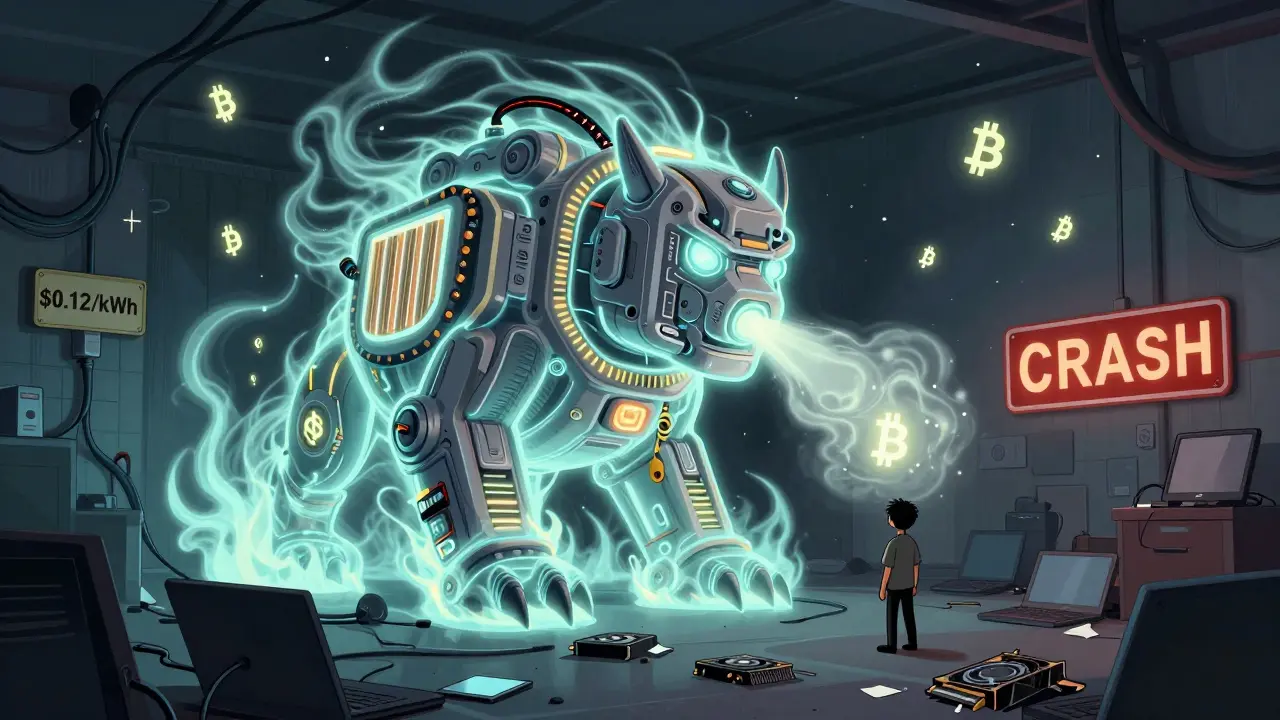
Setting up a crypto mining operation isn’t like buying a stock or downloading a wallet. It’s more like starting a small factory-except your factory runs 24/7, gets hotter than an oven, and only pays you if the price of Bitcoin doesn’t crash tomorrow. If you’re thinking about diving in, here’s the truth: most people lose money. Not because it’s impossible, but because they skip the hard parts. Let’s walk through what actually matters.
Hardware: You Can’t Mine Bitcoin with a Laptop
The first mistake beginners make? Thinking they can mine Bitcoin on a gaming PC or even a high-end GPU. In 2026, that’s like trying to power a city with a AA battery. Bitcoin mining is dominated by ASIC miners-specialized machines built for one thing: solving SHA-256 hashes. The two most common models right now are the Antminer S21 Pro and the Whatsminer M66S. These machines cost between $2,000 and $17,000 each. You’re not buying a gadget-you’re buying industrial equipment.Don’t forget the extras. You’ll need a power supply unit (PSU) rated for at least 20% more wattage than your miner pulls. A 3,000-watt miner needs a 3,600-watt PSU. Cheap PSUs fail. And when they fail, they take your miner with them. Then there’s cooling. A single ASIC can output as much heat as a space heater. Basic fans cost $50-$500. If you’re running more than three units in a garage, you’re looking at $2,000-$10,000 for immersion cooling or industrial air handlers. Noise? Those machines sound like a jet engine. Soundproofing adds another $100-$1,000.
GPUs still have a place-for mining Ethereum Classic, Ravencoin, or other altcoins that use memory-hard algorithms. But for Bitcoin? ASICs are the only game in town. And if you’re buying used hardware, check the hours. A miner with 15,000+ operating hours is a ticking time bomb.
Software: Free, But Not Simple
The good news? Mining software is free. The bad news? Getting it right is messy. You’ll need three things: an operating system, mining software, and a wallet.For beginners, Windows 10 works fine. It’s familiar, easy to install on, and supports most mining programs. But if you’re serious, ditch Windows. Linux-based systems like HiveOS or RaveOS are built for mining. They’re lighter, more stable, and let you manage dozens of miners from a single dashboard. You can reboot a failed rig remotely. You can monitor temperature and hash rate in real time. You can even set alerts when a miner drops off the network.
Popular mining software includes CGMiner (open-source, powerful, clunky), NiceHash Miner (easy, auto-switches coins), and Awesome Miner (great for multi-rig setups). Pick one that matches your skill level. Don’t overcomplicate it on day one.
Your wallet? Don’t use an exchange wallet. Use a hardware wallet like Ledger or Trezor. Mining rewards go directly to your wallet address. If you lose access to that address, your coins are gone forever.
Electricity: The Real Cost Killer
Here’s the number that decides whether you make money or not: your electricity rate. A single Antminer S21 Pro pulls 3,250 watts. That’s 3.25 kW. Run it 24/7 for a month? That’s 2,340 kWh. If your electricity costs $0.12 per kWh, your monthly bill is $281. If you’re in California at $0.35/kWh? That’s $819. No miner on Earth can turn a profit at that rate.Most profitable miners operate in places with cheap power: Texas (where excess wind energy is dumped), Washington (hydroelectric), or parts of Canada and Scandinavia. Some even use stranded gas or flared methane. If your power bill is over $0.15/kWh, you’re already fighting an uphill battle.
Use a mining profitability calculator-there are dozens online. Plug in your hardware model, your electricity rate, and the current Bitcoin price. Watch what happens when you increase the difficulty or drop the price by 20%. That’s not hypothetical. That’s what happened in 2022. And it’ll happen again.

Join a Mining Pool-Don’t Go Solo
Solo mining? Only if you have 50+ ASICs and a direct line to a power plant. The Bitcoin network’s difficulty is so high that even a 100-terahash miner might wait 6 months to find a block. That’s not a business. That’s gambling.Joining a mining pool changes everything. You combine your hash power with hundreds or thousands of others. When the pool finds a block, rewards are distributed based on your contribution. Pools like F2Pool, Antpool, and Foundry USA handle the complexity. You just need to set your worker name, pool address, and password in your mining software.
Look for pools with low fees (under 1.5%), reliable payouts, and transparent statistics. Avoid pools that don’t show their hashrate or have frequent downtime. A good pool pays out daily or every 24 hours. If it’s weekly or monthly, you’re risking cash flow.
Cooling: It’s Not Optional
Heat kills miners. Not slowly. Fast. ASICs are designed to run at 70-80°C. But if ambient temps hit 30°C and airflow is poor, the chip can hit 90°C. That’s when thermal throttling kicks in. Your hash rate drops. You earn less. Then the chip degrades. A miner that used to pull 100 TH/s now pulls 85. And it’s only six months old.Basic fans won’t cut it for more than one or two units. If you’re running five or more, you need forced air ducting, exhaust fans, or-ideally-immersion cooling. That’s when you submerge your ASICs in a non-conductive fluid. It’s expensive upfront ($5,000+), but it cuts cooling costs by 70% and extends hardware life by years.
Measure your room temperature. If it’s over 25°C, you’re already losing money. Install a thermometer. Monitor it. Set up alerts. Treat your mining rig like a newborn baby: too hot, it dies.

Profitability Isn’t Static
Mining isn’t a set-it-and-forget-it gig. The network difficulty adjusts every two weeks. Bitcoin’s price swings 20% in a day. Electricity rates change with season and policy. Your ROI timeline? It’s not 6 months. It’s not even 12. If you bought a miner in late 2024, you’re still paying it off in 2026.Here’s what you must do monthly:
- Check your miner’s hash rate and compare it to factory specs. A 10% drop means it’s wearing out.
- Review your electricity bill. Did your rate go up?
- Check Bitcoin’s price and mining difficulty on Blockchain.com.
- Use a calculator to re-estimate your break-even point.
If your miner isn’t profitable for 18+ months at current conditions, sell it. Don’t wait. That’s how people get stuck with $10,000 in scrap.
What to Avoid
- Phone or laptop mining apps: They’re scams. Or they use your device to mine for someone else. - Buying from unknown sellers on eBay: You’ll get a brick. Or worse, a miner with hidden firmware. - Buying altcoins just because they’re “easier”: If the coin’s price crashes, your hardware is useless. - Ignoring taxes: Mining income is taxable. Keep records of every dollar earned and every dollar spent.And don’t fall for the “get rich quick” YouTube videos. The guy in the video with 200 ASICs in his warehouse? He’s got a 5-year power contract at $0.03/kWh. You don’t. He’s not selling you a system-he’s selling you a fantasy.
Final Reality Check
Crypto mining in 2026 is a business for people who understand energy, hardware, and risk. It’s not a side hustle. It’s not a hobby. If you’re doing it to make a quick buck, you’ll lose. If you’re doing it because you believe in decentralized networks and you’re willing to treat it like a factory-with maintenance, monitoring, and margins-you might just break even.Most people quit within 6 months. The ones who stick around? They’re not miners. They’re operators. And they know that the real asset isn’t the ASIC. It’s the low-cost power.
Can I mine Bitcoin with a regular computer?
No. Regular computers, even high-end gaming PCs with powerful GPUs, can’t compete with ASIC miners. Bitcoin’s network difficulty is too high. Mining on a CPU or GPU today uses more electricity than the value of the Bitcoin you’d earn. It’s not just unprofitable-it’s a waste of power.
How much does it cost to run a Bitcoin miner 24/7?
A typical Antminer S21 Pro uses 3,250 watts. Running it nonstop for a month consumes about 2,340 kWh. At $0.12 per kWh, that’s $281/month. At $0.35/kWh, it’s $819. Your electricity cost is the #1 factor in whether you make or lose money.
Do I need to join a mining pool?
Yes, unless you’re operating a large-scale farm with dozens of ASICs. Solo mining means you might wait months-or years-to find a block. Pools combine your hash power with others, giving you small, regular payouts instead of rare, huge ones. It’s the only practical way for individual miners to earn consistent income.
Is crypto mining legal?
In the U.S., crypto mining is legal at the federal level. Some states, like New York and Vermont, have proposed restrictions on energy use, but none have banned it outright. Always check local ordinances-some cities restrict industrial equipment in residential zones due to noise or power demands.
How long does a Bitcoin miner last?
Most ASIC miners are designed to last 3-5 years under ideal conditions. But in practice, many fail within 18-24 months due to heat stress, power surges, or poor cooling. The key to longevity is keeping your miner cool, stable, and clean. Replace fans, clean dust, and monitor temperatures daily.
What’s the best cryptocurrency to mine right now?
For ASICs: Bitcoin. For GPUs: Ethereum Classic, Ravencoin, or Monero. Bitcoin is the most stable and has the highest network value, but it requires massive upfront investment. Altcoins are easier to mine with GPUs but carry higher risk-if the coin’s price crashes, your hardware becomes useless. Always calculate profitability before buying hardware.
Can I mine crypto in my apartment?
Technically, yes-but practically, no. A single ASIC miner produces noise levels above 80 decibels (like a vacuum cleaner) and generates enough heat to raise room temperature by 10-15°F. Most apartments have power limits of 15-20 amps. A miner alone can draw 20-30 amps. You’ll trip breakers, annoy neighbors, and likely violate your lease. It’s not worth the risk.
Are mining profits taxable?
Yes. In the U.S., the IRS treats mined cryptocurrency as ordinary income. You must report the fair market value of the coins on the day you received them. If you later sell them, you may owe capital gains tax. Keep detailed records of every mining reward, including date, amount, and USD value at receipt. Use crypto tax software like Koinly or CoinTracker.


Becky Chenier
January 11, 2026 AT 21:34Most people don’t realize how much of this is just energy arbitrage. You’re not really mining Bitcoin-you’re buying electricity cheap and selling it as hash power. If your power bill is over $0.15/kWh, you’re already in the red before you turn on the first ASIC. I’ve seen guys spend $15k on hardware and then get crushed by summer rates in Texas. It’s not the tech that fails-it’s the math.
Also, immersion cooling isn’t just for pros anymore. There are DIY kits under $2k now that work surprisingly well. Just don’t use mineral oil unless you want to clean your garage for the next three years.
Staci Armezzani
January 12, 2026 AT 03:33One thing no one talks about: noise complaints. I know a guy who ran three S21s in his garage and got fined by HOA for ‘industrial noise violation.’ They made him install soundproofing, which cost more than the miners. If you’re thinking of doing this from home, talk to your neighbors first. And get a decibel meter. 80dB isn’t ‘loud’-it’s ‘your dog starts howling and the kid next door cries.’
Tracey Grammer-Porter
January 12, 2026 AT 09:16I started mining with a single used Antminer S19 in my basement last year. It was a disaster. The heat made my AC bill spike, the noise kept me up, and after three months, it started throttling at 85°C. I thought I was being smart buying used-but I didn’t check the hours. 18,000+ and it was already worn out.
Switched to mining Ethereum Classic on a used 3080 instead. Lower upfront cost, way quieter, and I actually made a little profit after electricity. Not life-changing, but it pays for itself. Point is: don’t go all-in on Bitcoin unless you’ve got a power deal or a warehouse. Start small, test the waters.
Also, use HiveOS. Way easier than wrestling with Windows mining software. And backup your wallet seed. I’ve seen too many people lose coins because they wrote it on a sticky note.
sathish kumar
January 12, 2026 AT 14:55While the technical aspects of cryptocurrency mining are indeed well articulated, one must not overlook the broader socio-economic implications of energy consumption in developing nations. The global demand for computational power to sustain blockchain networks often exacerbates energy inequities, where surplus electricity in regions like Texas or Scandinavia is diverted toward speculative mining operations rather than community infrastructure. Furthermore, the environmental externalities of heat waste and electronic disposal remain inadequately regulated. A responsible miner, therefore, must not only optimize profitability but also advocate for sustainable practices, such as utilizing stranded or flared methane, and supporting circular hardware economies. The true measure of success lies not in hash rate, but in ethical stewardship.
jim carry
January 12, 2026 AT 19:22YOU GUYS ARE ALL WRONG. I MADE $470,000 IN THREE MONTHS. I’M NOT EVEN KIDDING. I BOUGHT 120 ASICs FROM A GUY ON INSTAGRAM. HE SAID THEY WERE ‘RECONDITIONED’ BUT I THINK THEY WERE NEW. I RAN THEM IN MY BACKYARD WITH A GENERATOR. THE NEIGHBORS CALLED THE POLICE. I GOT ARRESTED. BUT THEN I SOLD THE MINERS TO A CHINESE COMPANY FOR $800K. I’M LIVING ON A BEACH IN THAILAND NOW. THE IRS IS AFTER ME. I DON’T CARE. THIS IS THE ONLY WAY TO GET RICH. IF YOU’RE NOT MINING, YOU’RE LOSING. JUST BUY THE HARDWARE. DON’T THINK. JUST DO IT.
PS: I’M NOT A SCAMMER. I’M A VISIONARY. YOU’RE JUST AFRAID.