
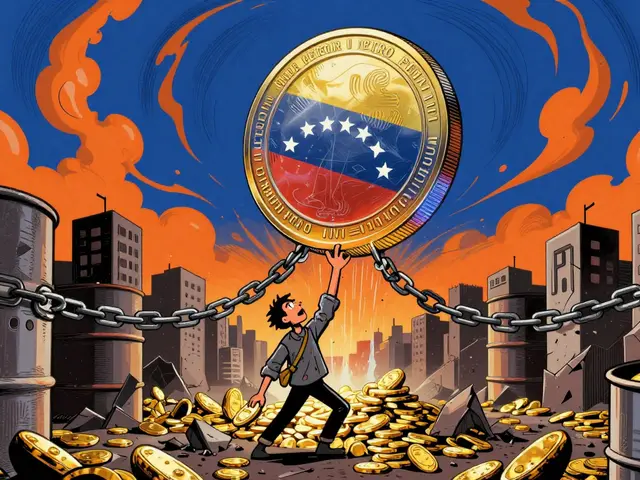
Imagine trying to buy a loaf of bread, but the shopkeeper only accepts a coin that exists mostly on paper. That is the reality for many Venezuelans dealing with the Petro, a sovereign cryptocurrency issued by the Venezuelan government and backed by oil, gold, and diamond reserves. Launched in early 2018 under President Nicolás Maduro, the Petro was designed to bypass international sanctions and stabilize a crumbling economy. However, eight years later, it remains a niche tool driven more by state mandate than market demand. The core issue isn't just technology; it's restriction. Who controls it? Who can use it? And why do citizens often ignore it in favor of Bitcoin?
The Origin Story: A Response to Sanctions
To understand the current restrictions, you have to look at why the Petro was created in the first place. In December 2017, Venezuela faced a hyperinflation crisis and heavy U.S. sanctions that blocked access to global financial markets. Maduro announced the Petro via Presidential Decree 3196, valuing each token at roughly $60, backed by proven oil reserves. The goal was simple: create an alternative currency that couldn't be easily frozen by foreign banks.
The launch happened in February 2018. The government planned to issue 100 million tokens, aiming for a total valuation of over $6 billion. But the market didn't bite immediately. A leaked document from VIBE, the government’s own advisory group, revealed they expected to sell the tokens at discounts of up to 60% in private deals. This signaled early skepticism about whether the "oil-backed" value held up against open market forces.
How the Petro Works: Federated Blockchain vs. True Decentralization
Most cryptocurrencies like Bitcoin rely on a decentralized network where thousands of independent nodes verify transactions. The Petro takes a different approach. It runs on a federated blockchain, a type of distributed ledger controlled by a specific group of authorized participants rather than the public.
This structure gives the government significant control. Here is how the system operates:
- Central Oversight: The Superintendence of Crypto Assets and Related Activities (SUPCACVEN) manages the network. They maintain registries of miners and ensure exchanges function correctly.
- Limited Participation: Not everyone can join the verification process. Only approved entities participate in validating blocks.
- State Backing: The Treasury of Cryptoassets, a state-owned company, handles issuance and custody.
For a typical user, this means less censorship resistance. If the government wants to freeze your account or restrict transfers, the federated structure makes it much easier than on a permissionless chain like Ethereum or Bitcoin.
Legal Restrictions and Political Conflict
The biggest restriction on the Petro isn't technical; it's political. When the opposition-controlled National Assembly declared the Petro illegal in March 2018, it created a dual legal reality in Venezuela. On one side, the executive branch mandates its use. On the other, the legislative branch refuses to recognize it.
This conflict has real consequences for businesses and individuals. If you are a merchant accepting Petros, you operate under executive decrees. But if you hold assets in Petros, their legal standing can be challenged based on which branch of government you appeal to. This uncertainty discourages long-term holding and investment. Most Venezuelans prefer stablecoins or Bitcoin because these assets exist outside the direct jurisdiction of Venezuelan courts.

Mandatory Usage: Forced Adoption Zones
In an attempt to boost usage, the government established four "Petro Zones" in 2018. These areas were chosen for their strategic economic importance:
- Margarita Island: A major tourist destination.
- Los Roques Archipelago: Remote islands with limited banking infrastructure.
- Paraguaná Peninsula: Home to significant oil refining operations.
- Ureña-San Antonio Area: Near the Colombian border, facilitating cross-border trade.
Within these zones, the government offered tax incentives for mining equipment and encouraged local commerce to accept Petros. By January 2020, it became mandatory to pay for certain government services and airplane fuel using the cryptocurrency. However, "mandatory" doesn't always equal "popular." Reports suggest that while compliance is enforced for official transactions, everyday retail adoption remains low. Citizens often find ways to convert Petros back into cash or other cryptos quickly, treating them as a temporary bridge rather than a store of value.
International Barriers and U.S. Sanctions
You can't discuss the Petro without mentioning the United States. Washington has imposed strict sanctions on Venezuela's financial sector, and these restrictions directly impact the cryptocurrency. Congressional measures, such as S.37, aim to codify financial sanctions on Venezuelan debt and related technologies. For any foreign investor or exchange considering listing the Petro, the risk of secondary sanctions is a major deterrent.
This isolation means the Petro lacks liquidity on major global platforms. Unlike Bitcoin, which trades 24/7 on hundreds of exchanges, the Petro is largely confined to domestic venues or private deals. This limits its utility as a remittance tool or a hedge against inflation for diaspora communities, who would need a seamless way to send and receive funds without fear of asset freezes.

Comparison: Petro vs. Established Cryptocurrencies
To see why the Petro struggles, let's compare it with the alternatives Venezuelans actually use. The table below highlights key differences in control, backing, and accessibility.
| Feature | Petro (PTR) | Bitcoin (BTC) | USDC (Stablecoin) |
|---|---|---|---|
| Issuance Model | Sovereign / Government | Decentralized / Permissionless | Private / Corporate |
| Backing Asset | Oil, Gold, Diamonds | None (Market Value) | USD Reserves |
| Control Authority | SUPCACVEN (Venezuela) | Global Network Nodes | Circle (USA) |
| Sanction Risk | High (Direct Target) | Low (Censorship Resistant) | Medium (Issuer Based in USA) |
| User Adoption in VE | Low (Mandated) | High (Voluntary) | Very High (Remittances) |
The data shows a clear pattern. While the Petro offers the theoretical benefit of being backed by tangible resources, its high sanction risk and central control make it less attractive for daily savings. Bitcoin offers freedom but volatility. Stablecoins like USDC offer stability and ease of use, which is why they dominate remittance flows into Venezuela.
Current Status and Future Outlook
As of 2026, the Petro remains a functional but limited instrument. It is used for specific government payments and within the designated Petro Zones, but it has not achieved mainstream acceptance. The regulatory framework, overseen by Carlos Vargas as Superintendent of Cryptocurrencies, continues to evolve, but the fundamental issues remain: lack of international recognition, political instability, and competition from superior technological alternatives.
For investors, the Petro represents a high-risk geopolitical play. For everyday Venezuelans, it is often a bureaucratic hurdle rather than a financial solution. The future of the Petro depends less on blockchain innovation and more on whether Venezuela can resolve its diplomatic and economic crises. Until then, it will likely remain a symbol of state control rather than a revolutionary financial tool.
Is the Petro cryptocurrency legal in Venezuela?
Yes, it is legal under executive decrees issued by the President. However, the opposition-controlled National Assembly has declared it illegal, creating a legal duality. For most practical purposes, the executive branch's rules apply to government services and mandated transactions.
What backs the value of the Petro?
The Petro is officially backed by Venezuela's reserves of oil, gasoline, gold, and diamonds. Each token was initially valued at approximately $60 based on these reserves. However, market confidence in this backing varies due to the country's economic instability.
Can foreigners buy the Petro?
Technically, yes, but it is difficult. Due to U.S. sanctions and the lack of listings on major international exchanges, foreign buyers face high barriers. Most transactions occur through private offerings or domestic platforms, often requiring compliance with complex regulatory checks by SUPCACVEN.
Why don't more Venezuelans use the Petro?
Many prefer Bitcoin or stablecoins because they are decentralized and less susceptible to government interference. The Petro's federated blockchain allows for greater state control, and its limited international liquidity makes it less useful for saving wealth or sending money abroad.
What are the Petro Zones?
These are four specific geographic areas in Venezuela-Margarita Island, Los Roques, Paraguaná, and Ureña-San Antonio-where the government encourages crypto mining and mandates the use of Petros for certain commercial activities. They come with tax incentives for mining equipment.






Shawn Schaerer
August 20, 2026 AT 11:56One must observe the sheer audacity of this sovereign experiment, for it stands as a testament to the hubris of centralized power attempting to mimic the organic freedom of decentralized ledgers. The notion that a state-backed token can rival Bitcoin is not merely optimistic; it is philosophically bankrupt. We see here a federated blockchain, which is simply a database with extra steps and less trust. The opposition declaring it illegal while the executive mandates its use creates a legal schizophrenia that no rational actor can navigate. It is a dual reality that serves only to confuse and frustrate the very citizens it claims to protect. The backing by oil reserves is a mirage, for how does one verify the reserves when the auditor is the accused? This is not finance; it is theater performed on a digital stage. The international sanctions are not just barriers; they are the immune system of the global market rejecting a pathogen. Until Venezuela resolves its diplomatic crisis, this token will remain a bureaucratic hurdle. It is a symbol of control, not liberation. The future of such instruments depends not on code, but on geopolitics. And geopolitics, dear reader, is rarely kind to the weak.
Sarah Campbell
August 21, 2026 AT 00:33Ugh, another government trying to tell us what to do with our money!! 🙄💸 Why do we always have to deal with these 'innovations' that are just scams in fancy suits?? 😤
Hicham Mounir
August 21, 2026 AT 07:29It’s honestly heartbreaking to watch people get forced into using something they don’t even trust...
You can feel the desperation in the air when you read about the 'Petro Zones'. It’s like watching someone try to drink from a firehose. The fact that citizens are just converting it back to cash or BTC so quickly shows how little faith they have in the whole thing. It’s not just about the tech, it’s about the lack of basic human dignity in their financial lives. They’re just trying to survive, and this currency is making it harder. It’s a heavy burden to carry, really.
I just hope things get better for them soon. 💔
Zothana Pachuau
August 23, 2026 AT 00:46Oh, look at us, playing with fire again. 🔥
Let’s be real for a second: if your 'crypto' needs a decree to make people buy bread with it, you’ve already lost the plot. It’s like forcing your kids to eat broccoli by calling it 'super-vegetable coins'. Does it work? Sure, for a week. Do they love it? Not even close. The Petro is basically a gift card that the store owner hates accepting because they know it’s going to devalue before they can spend it. And let’s not forget the 'federated blockchain' bit. That’s just corporate-speak for 'we keep the keys and you can’t leave'. If you want to bypass sanctions, maybe don’t run the whole show through a group of guys who sign off on every block. But hey, I’m sure the tourists on Margarita Island are thrilled to pay for their cocktails in state-mandated tokens. Just sayin’. 😏
michelle aguilar
August 24, 2026 AT 01:06Well, isn't this... fascinating? Or should I say, utterly predictable?
One must appreciate the intricate dance of political maneuvering here, wouldn't you agree? The duality of legality is simply a masterclass in legislative gridlock, dressed up as economic policy. It’s almost poetic, in a tragic sort of way. The 'backing' by oil is, of course, a rather quaint concept in an era where trust is the only true currency. How delightful that the opposition chose to declare it illegal, adding a layer of complexity that surely delights the legal scholars among us. It’s not just a coin; it’s a statement. A loud, confusing, and somewhat embarrassing statement. One wonders if the average citizen, struggling to afford basic necessities, has the luxury of pondering the philosophical implications of a federated ledger. Probably not. They’re too busy trying to figure out which branch of government to sue if their assets vanish. Truly, a spectacle for the ages. 🧐✨
Linda Leeuwesteijn
August 25, 2026 AT 05:47Such a detailed breakdown! 📊 It’s wild to see how much politics actually dictates crypto adoption more than just the tech itself. I always assumed stablecoins would win out because of the simplicity, but seeing the Petro struggle makes sense now. It’s definitely a lesson in why decentralization matters for trust! 💡🚀
Phelan Deihl
August 26, 2026 AT 23:05The liquidity issue is the silent killer here. Without global exchange listings, it's just a local IOU with extra steps.