
When people talk about blockchain, they’re usually thinking about Bitcoin or Ethereum. But those two aren’t the whole story. Public blockchains are open, decentralized ledgers anyone can join-no permission needed. They’re not controlled by banks, governments, or corporations. Instead, they run on thousands of computers around the world, all verifying transactions together. This makes them resistant to censorship, tampering, and single points of failure.
Bitcoin: The Original Digital Cash
Bitcoin launched on January 3, 2009, with a single block mined by someone using the name Satoshi Nakamoto. Its purpose? To let people send money directly to each other without a middleman. That’s it. No fancy apps. No smart contracts. Just peer-to-peer digital cash.
Today, Bitcoin processes about 300,000 transactions a day. That’s not a lot compared to Visa, which handles over 170 million per day. But Bitcoin isn’t trying to be a payment processor. It’s designed to be digital gold-something to hold onto, not spend every day. Its security comes from brute force: over 200 exahashes per second of computing power securing the network. To attack it, you’d need to control more than half that power. Experts estimate that would cost $14.5 billion.
Bitcoin’s rules are simple. Blocks come out every 10 minutes. The reward for mining started at 50 BTC and cuts in half roughly every four years. After the 2024 halving, miners now get 3.125 BTC per block. Transaction fees average around $1.20, making it cheap to move value, even during busy times. There are over 15,000 full nodes running globally, which means the network is incredibly decentralized. No single country or company controls it.
Most Bitcoin users don’t interact with the blockchain directly. They use wallets like Electrum or Exodus. A University of Cambridge study found 78% of new users can set one up and send their first BTC within 20 minutes. That simplicity is part of its strength. Bitcoin doesn’t try to do everything. It does one thing well: secure, irreversible value transfer.
Ethereum: The World Computer
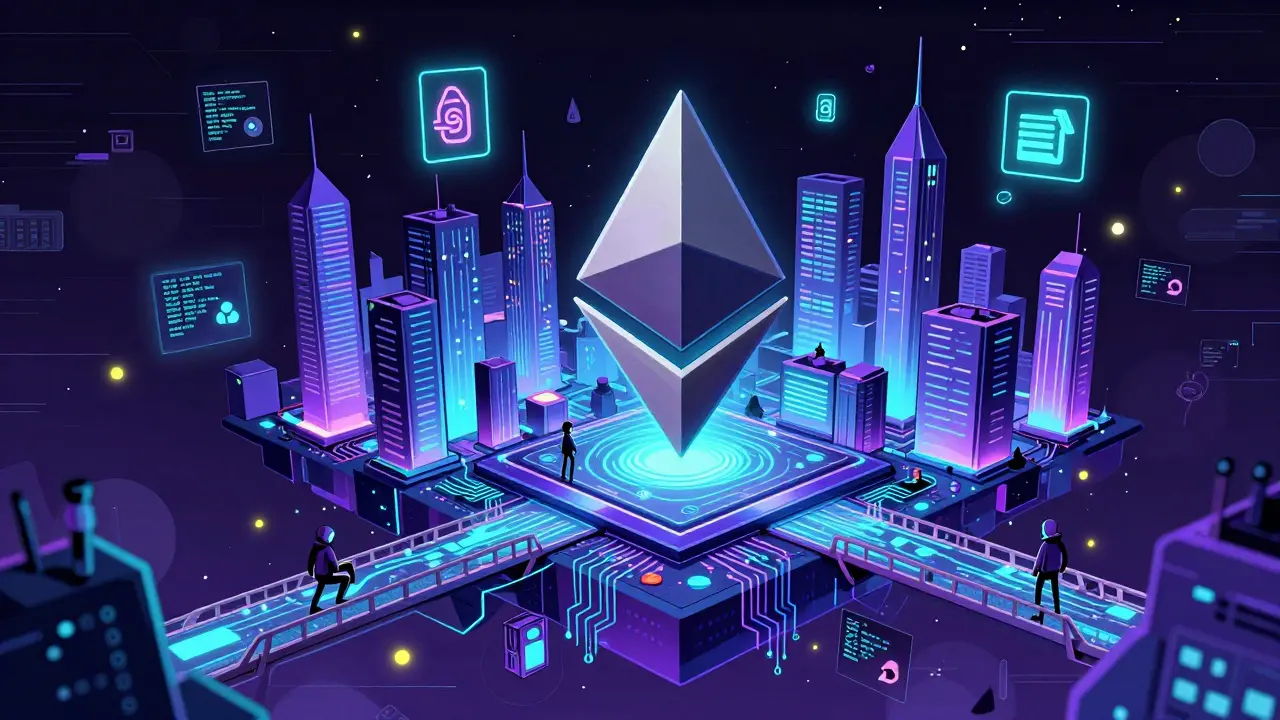
Ethereum changed everything when it launched in July 2015. Instead of just moving money, it let people run programs on the blockchain. These programs are called smart contracts-self-executing code that runs exactly as written, without interference.
Ethereum’s blockchain isn’t just a ledger. It’s a global computer. Developers write apps (called dapps) using Solidity, a programming language built for Ethereum. These apps can handle everything from lending money to buying NFTs to running decentralized exchanges. As of late 2023, there were over 4,000 active dapps and 50 million unique smart contracts on Ethereum.
Before September 2022, Ethereum used proof-of-work like Bitcoin. It was energy-heavy. Then came The Merge. Ethereum switched to proof-of-stake. Now, instead of miners using massive amounts of electricity, validators stake 32 ETH (about $51,200 at $1,600 per ETH) to help secure the network. The result? A 99.95% drop in energy use. That’s not a small win-it’s a revolution.
Ethereum’s speed is faster than Bitcoin’s. Blocks come every 12 seconds. Throughputs range from 15 to 30 transactions per second. But here’s the catch: gas fees. During peak times in 2021, one transaction cost over $180. Even now, average fees hover around $3.50-three times Bitcoin’s. That’s why most users don’t transact directly on Ethereum anymore. They use Layer-2 solutions like Arbitrum and Optimism, which bundle hundreds of transactions into one on-chain event. As of October 2023, 73% of Ethereum activity happens on these second layers.
Ethereum’s ecosystem is massive. DeFi (decentralized finance) apps hold over $72 billion in total value locked. NFT marketplaces have seen over $23 billion in trading volume. Institutions like JPMorgan use Ethereum for private blockchain projects. But it’s not perfect. Developers need months of training to build securely. And bugs in smart contracts can cost millions. That’s why Ethereum has more support tickets per user than Bitcoin-complexity always comes with risk.
Other Public Blockchains Worth Knowing
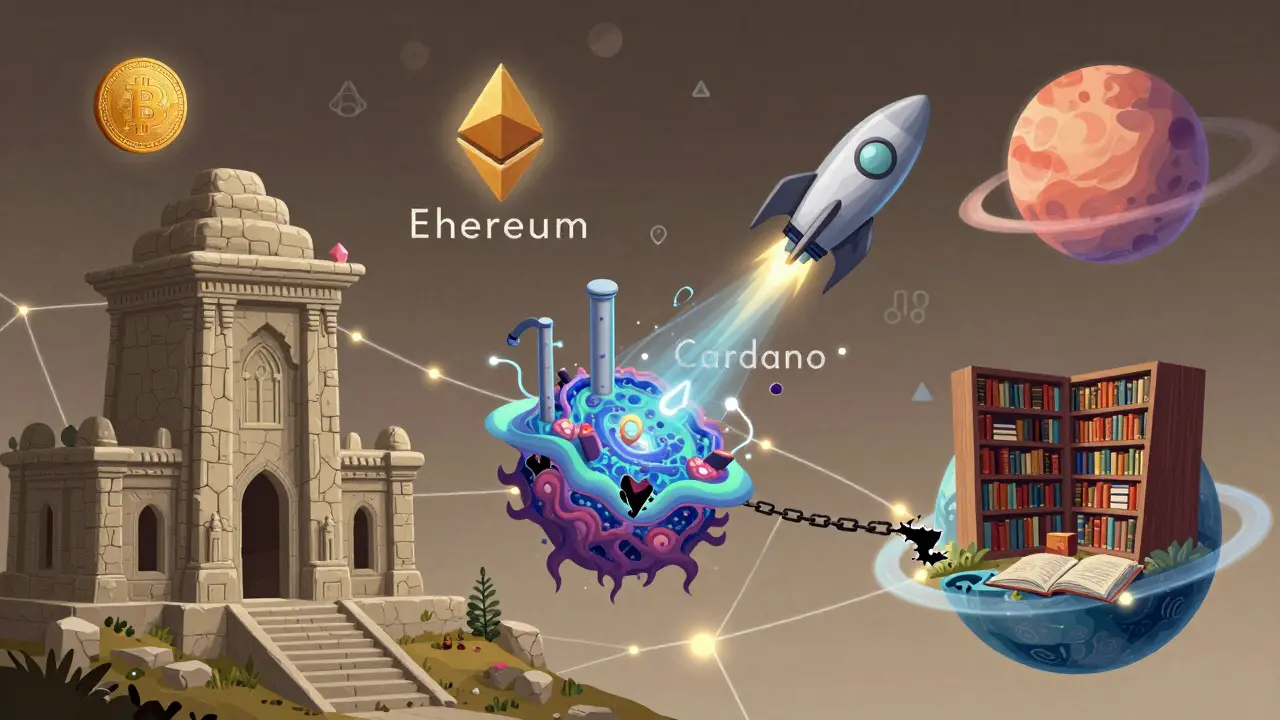
Bitcoin and Ethereum dominate the conversation, but they’re not the only players. Cardano, launched in 2017, uses a proof-of-stake protocol called Ouroboros. It’s designed with academic research in mind and runs on over 2,000 nodes. Block times are 20 seconds, and fees are low-usually under $0.20. But adoption has been slow. Its dapp ecosystem is tiny compared to Ethereum’s.
Solana, launched in 2020, is the speed demon. It claims to handle 65,000 transactions per second using a unique consensus method called Proof-of-History. That’s faster than most banks. But speed comes at a cost. Solana had six major outages in 2022. One lasted over 15 hours. Critics say its centralization risk is higher because fewer nodes run full validators. Still, developers love it for high-frequency apps like gaming and trading bots.
Then there’s Polygon, which isn’t a standalone blockchain but a Layer-2 scaling solution built on Ethereum. It’s not as decentralized as the others, but it’s cheap and fast. Over 80% of new NFT projects now launch on Polygon because of low fees and quick confirmations.
Each of these networks makes different trade-offs. Bitcoin prioritizes security and decentralization. Ethereum focuses on programmability. Solana pushes speed. Cardano leans on research. There’s no single best choice-it depends on what you need.
Who Uses These Blockchains-and Why?
Bitcoin users are mostly savers. A Glassnode report showed that 62% of Bitcoin addresses haven’t moved coins in over a year. People buy it as long-term savings. Reddit’s r/Bitcoin community is full of posts like “Just bought my first 0.01 BTC as long-term savings-am I crazy?” with thousands of upvotes. The narrative is clear: Bitcoin is money you hold, not spend.
Ethereum users are active. DappRadar found 1.8 million daily active wallets on Ethereum in Q3 2023, compared to 850,000 on Bitcoin. These are people swapping tokens, staking ETH, minting NFTs, or playing blockchain games. Reddit’s r/ethereum is full of technical questions: “Best Solidity resources for 2023?” or “How do I debug this contract?”
Institutions are mostly on Bitcoin. Fifteen U.S. public companies, including MicroStrategy and Tesla, hold over $12 billion in Bitcoin on their balance sheets. Ethereum? Almost none. Why? Because Bitcoin is seen as a digital asset. Ethereum is seen as a platform. Regulators are still deciding if Ethereum qualifies as a security. Gary Gensler of the SEC has hinted it might.
What’s Next for Public Blockchains?
Bitcoin is getting smarter without changing its core. The Taproot upgrade in 2021 improved privacy and efficiency. Now, the upcoming Taproot Assets protocol (expected Q1 2024) will let users issue tokens on Bitcoin-like NFTs or stablecoins-without adding complexity to the base layer. This could make Bitcoin a multi-asset platform without sacrificing security.
Ethereum’s next big move is Dencun, launching in early 2024. It introduces proto-danksharding, a way to reduce Layer-2 transaction costs by up to 90%. That’s huge. If it works, Ethereum could become the default platform for global apps, not just crypto ones.
But challenges remain. Bitcoin’s energy use draws criticism from regulators. Ethereum’s complexity scares off average users. Solana’s instability raises doubts. New blockchains keep popping up-some promising quantum resistance, others aiming for carbon neutrality. The future isn’t one blockchain to rule them all. It’s a web of specialized networks, each solving different problems.
Final Thoughts: Which One Should You Care About?
If you want to store value securely, Bitcoin is the safest bet. It’s battle-tested, simple, and decentralized. If you want to build or use apps-DeFi, NFTs, DAOs-Ethereum is where the action is. The rest? They’re experiments. Some will fade. Others might grow.
Public blockchains aren’t magic. They’re tools. Bitcoin is a vault. Ethereum is a factory. Cardano is a lab. Solana is a racecar. Choose based on what you need-not what’s trending.
What’s the difference between Bitcoin and Ethereum?
Bitcoin is designed as digital cash and a store of value. It’s simple, secure, and slow-processing about 7 transactions per second. Ethereum is a programmable platform that lets developers build apps using smart contracts. It’s faster (15-30 TPS) and more complex, but also more versatile. Bitcoin holds value; Ethereum runs programs.
Is Ethereum more secure than Bitcoin?
No. Bitcoin is more secure. Its network has over 200 exahashes of computing power securing it, making attacks astronomically expensive ($14.5 billion estimated). Ethereum’s security is strong too, but after switching to proof-of-stake, its attack cost is lower-around $35 billion, still extremely high. However, Ethereum’s smart contracts can have bugs, which Bitcoin’s simpler system avoids. So while the network is secure, applications built on it may not be.
Can I use Bitcoin to run apps like Ethereum?
Not directly. Bitcoin’s scripting language is intentionally limited to prevent complex programs. But with the upcoming Taproot Assets upgrade (Q1 2024), Bitcoin will support tokenization-like NFTs and stablecoins-without changing its core rules. This allows basic asset issuance, but not full smart contracts like Ethereum. If you need complex logic, Ethereum or other platforms are still the better choice.
Why do Ethereum gas fees vary so much?
Ethereum gas fees depend on network demand. When lots of people are using dapps-like during an NFT drop or DeFi surge-transactions compete for space in the next block. Users bid higher fees to get priority. This creates spikes. The Merge didn’t fix this. That’s why Layer-2 solutions like Arbitrum and Optimism exist-they handle most transactions off-chain and settle in batches, cutting fees by up to 90%.
Are public blockchains regulated?
They’re not controlled, but they’re increasingly regulated. The EU’s MiCA law (effective December 2024) treats Bitcoin as a virtual asset and Ethereum as a utility token, meaning different compliance rules apply. In the U.S., the SEC is still deciding if Ethereum is a security. Exchanges like Coinbase must follow anti-money laundering rules. So while the blockchain itself is decentralized, the services around it (wallets, exchanges, apps) are subject to laws.
Should I invest in Bitcoin or Ethereum?
It depends on your goal. If you want to preserve wealth over time, Bitcoin is the more proven choice. If you believe in decentralized apps, DeFi, or the future of digital ownership, Ethereum offers more potential. Many investors hold both. Don’t chase hype. Understand what each does-and why it matters-before putting money in.




Chidimma Catherine
January 23, 2026 AT 12:57Bitcoin as digital gold makes perfect sense to me
Its simplicity is its superpower
Ive watched it survive wars sanctions and regulatory crackdowns
While other chains chase flashiness Bitcoin stays steady
Its not about speed its about sovereignty
When your country collapses your Bitcoin doesnt
Thats why I hold it
Not for speculation but for survival
Every time I see a new blockchain launch I ask myself does this add real value or just more complexity
Bitcoin answers that question with silence
It doesnt need to explain itself
Its just there
Like a mountain
Unmoved
Unshakable
Nathan Drake
January 24, 2026 AT 18:00Its interesting how we anthropomorphize blockchains
We say Bitcoin is a vault Ethereum is a factory
But theyre just code running on machines
The meaning we give them comes from us
Bitcoin as money
Ethereum as computation
But what if the real innovation isnt the tech but the shift in collective belief
That value can exist outside institutions
That trust can be algorithmic
That no single entity needs to be the gatekeeper
Maybe thats the quiet revolution
Not in the code
But in the minds of those who choose to use it
We are redefining ownership
One transaction at a time
Jessica Boling
January 25, 2026 AT 12:01So Ethereum is basically a fancy calculator that costs $3.50 every time you press equals
Meanwhile Bitcoin just sits there looking like a brooding poet who refuses to explain itself
And people wonder why I still use paper for receipts
At least paper doesnt require a PhD in Solidity to send $5
Also who thought letting people write programs on money was a good idea
Its like giving toddlers access to a nuclear launch code
And then acting surprised when someone accidentally nukes their own wallet
Still
At least the NFTs are funny
Tammy Goodwin
January 27, 2026 AT 06:39Im glad someone mentioned Polygon
Most people act like its not even real
But its where most of the actual activity is
Not on mainnet
Not on Layer 1
But on the quiet backroads
Where creators dont have to pay $200 to mint a cat picture
Its not sexy
Its not decentralized
But its working
And thats what matters
People are building
People are transacting
People are happy
Thats the real metric
Not how many nodes are running
But how many people are using it
Polygon gets that
Andy Simms
January 28, 2026 AT 10:13For anyone new to this
Dont get lost in the noise
Bitcoin is about preserving value
Ethereum is about enabling innovation
Cardano is about academic rigor
Solana is about speed at all costs
Polygon is about practicality
Each has its place
But if you want to understand the space
Start with the why
Why does Bitcoin exist
Why does Ethereum exist
Why are people spending billions on this
Its not about the tech
Its about the philosophy
One is about freedom from control
The other is about freedom to create
Both are powerful
Both are valid
And both are changing the world
Quietly
And irreversibly
Bonnie Sands
January 29, 2026 AT 14:26Theyre all controlled by the Fed anyway
Did you know the Ethereum Foundation is secretly funded by BlackRock
And Bitcoin mining is just a front for NSA surveillance
They want you to think its decentralized
But the real power is in the private keys held by five billionaires in Switzerland
And the 2024 Taproot Assets upgrade is just a Trojan horse for CBDC integration
Theyre using crypto to normalize digital identity
Soon your wallet will be tied to your SSN
And your NFTs will be taxed as property
Theyre building the matrix
And youre all just feeding it with your gas fees
Wake up