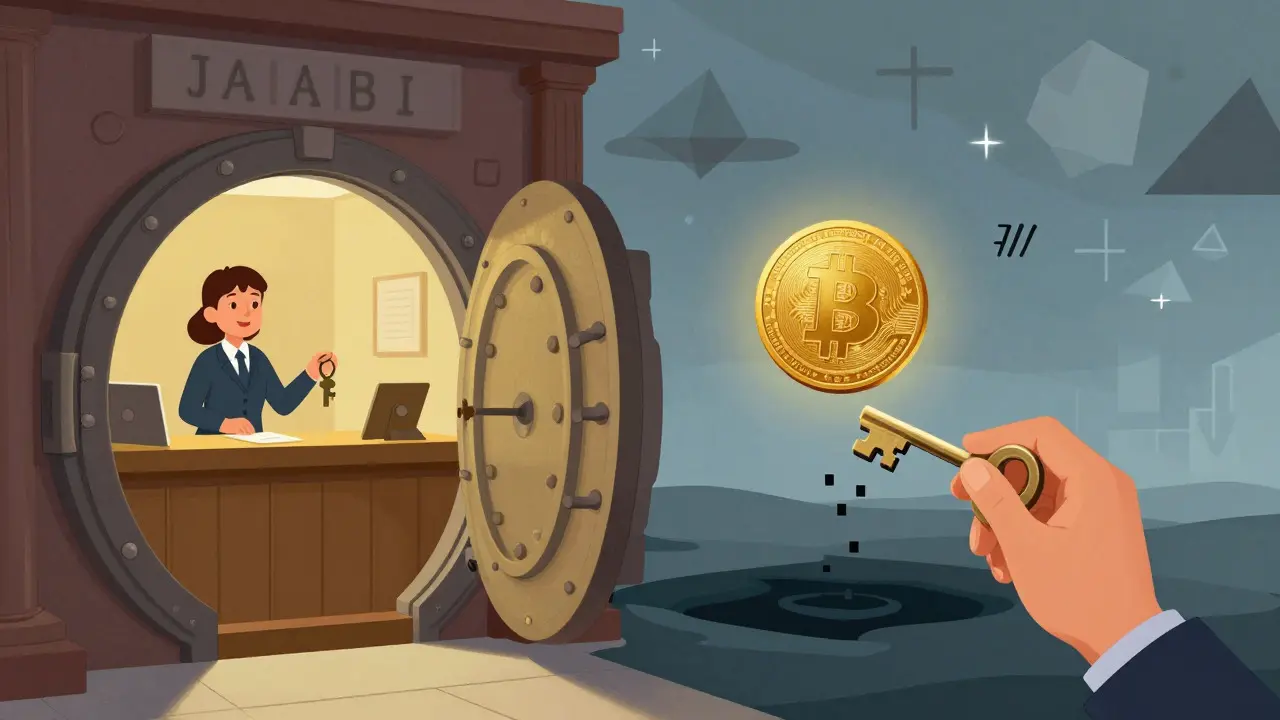
Imagine handing someone your house keys and then walking away without locking the door. In the world of traditional banking, if you lose your debit card, you call the bank, they freeze the account, and you get a new one. It’s annoying, but you’re safe. Now imagine doing that with cryptocurrency. If you lose the specific code that proves you own your Bitcoin or Ethereum, there is no customer service line. There is no reset button. Your money is gone forever.
This stark difference exists because cryptocurrency relies on a system called asymmetric cryptography, which uses a pair of mathematical codes known as public and private keys. Understanding these two components is not just for tech geeks; it is the single most important thing you need to know to keep your digital assets safe. Without this knowledge, you aren’t really owning your crypto-you’re just renting space on someone else’s server.
The Core Concept: What Are Public and Private Keys?
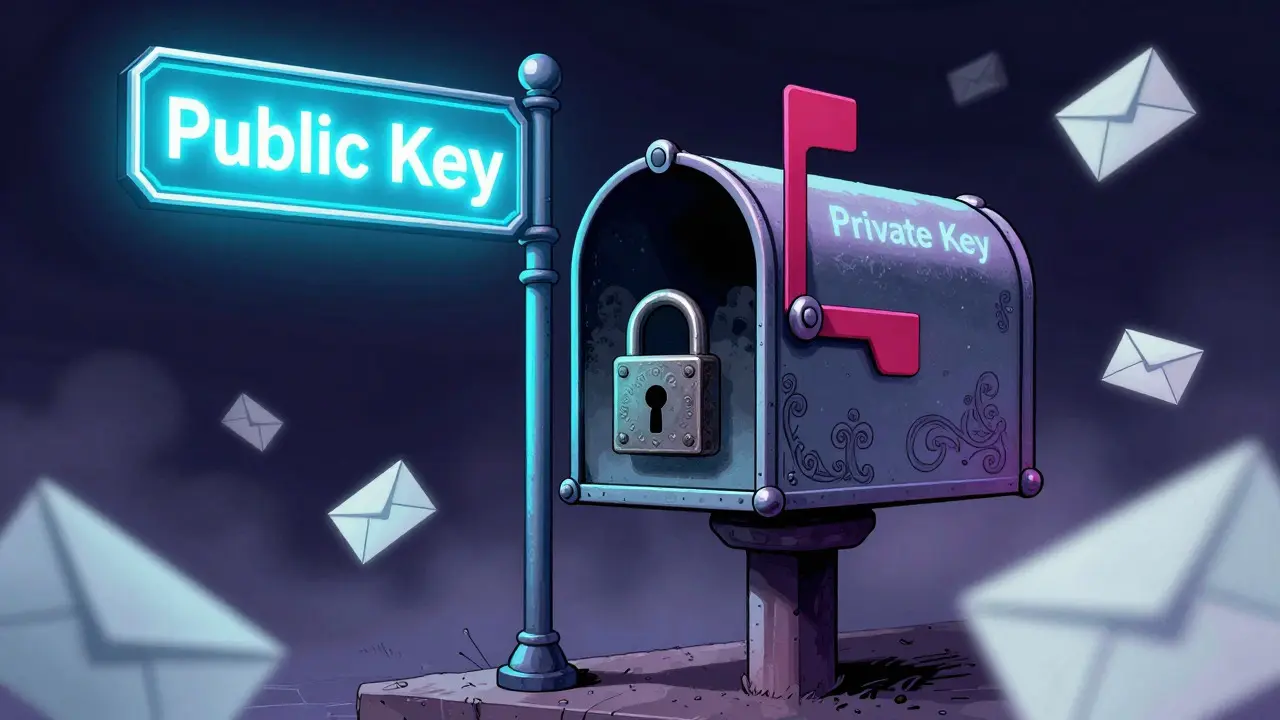
To make sense of this, let’s strip away the complex math for a moment and look at what these keys actually do. Think of them like a mailbox.
Your public key is like the street address of your mailbox. You can write it on business cards, post it on social media, or email it to anyone. Its only job is to tell people where to send things. Knowing your address doesn’t allow anyone to steal the letters inside; it just allows them to deliver mail to you.
Your private key is the physical key to that mailbox. It is the only thing that lets you open the box and take out the contents. If you lose this key, the mail stays in the box forever. If you give this key to a stranger, they can empty the box and run. The security of the entire cryptocurrency ecosystem rests on keeping this private key secret while freely sharing the public key.
In technical terms, these are long strings of random characters. A private key is typically a 64-character hexadecimal string (0-9 and A-F). The public key is derived from the private key using a one-way mathematical function. This means you can easily go from private to public, but going from public back to private is computationally impossible with current technology. This one-way street is what makes the system secure.
How Key Pairs Work Together
You might wonder why we need both. Why not just use one password? The answer lies in how blockchain transactions are verified. When you want to send Bitcoin, you don’t just say "move 1 BTC from me to Bob." You have to prove to the network that you are actually the owner of those funds.
Here is the step-by-step process:
- Initiation: You decide to send funds. Your wallet software creates a transaction draft.
- Signing: Your wallet uses your private key to create a unique digital signature for that specific transaction. This signature proves you authorized it, without revealing the private key itself.
- Broadcasting: The signed transaction is sent to the blockchain network.
- Verification: Network nodes (computers) use your public key to check if the signature matches. If the math checks out, the transaction is valid.
- Confirmation: Once verified by enough nodes, the transaction is added to a block, and the funds move.
Notice that at no point did you share your private key with the network. You only shared the proof that you had it. This is the magic of asymmetric cryptography. It allows for trustless verification-strangers can verify your ownership without ever seeing your secret.
Wallet Addresses: The User-Friendly Face of Public Keys
If you’ve ever bought crypto, you’ve probably seen a wallet address. It usually looks like a long, messy string of letters and numbers starting with a '1', '3', or 'bc1' for Bitcoin, or '0x' for Ethereum. You might think this *is* the public key, but technically, it’s not.
A wallet address is a hashed version of the public key. Hashing is another one-way mathematical process that turns data into a fixed-length string. We do this for two reasons:
- Brevity: Raw public keys are very long. Addresses are shorter and easier to copy-paste.
- Error Checking: Addresses include checksums. If you mistype one character when sending funds, the wallet will often reject the address before you lose money. Raw public keys don’t always have this safety net.
So, the hierarchy is: Private Key → Public Key → Wallet Address. You generate the private key first. From that, the public key is derived. From that, the address is created. You can generate many different addresses from a single private key (or more accurately, from a single seed phrase), which adds a layer of privacy since each transaction can use a new address.
Private Keys vs. Seed Phrases: Know the Difference
New users often confuse private keys with seed phrases. They are related, but distinct. Understanding this difference is crucial for backup strategies.
| Feature | Private Key | Seed Phrase (Recovery Phrase) |
|---|---|---|
| Format | Long string of hex characters (e.g., 5HueCGU... | 12 or 24 common English words (e.g., witch collapse practice...) |
| Scope | Controls access to a single specific address/wallet. | Masters all keys generated by the wallet. Can recover hundreds of addresses. |
| Primary Use | Signing individual transactions. | Restoring an entire wallet on a new device. |
| Risk Level | High. Loss means loss of funds in that specific wallet. | Critical. Loss means permanent loss of all funds across all derived wallets. |
Think of the seed phrase as the master blueprint. It generates the private keys, which generate the public keys, which generate the addresses. Most modern wallets (like MetaMask, Ledger, or Trezor) give you a 12-word seed phrase during setup. Write this down on paper. Store it in a fireproof safe. Never type it into a computer unless you are restoring a wallet. If you lose this phrase, you lose everything. Period.
Security Best Practices: Protecting Your Keys
Since there is no central authority to help you, your security habits define your financial safety. Here are the non-negotiable rules for managing keys in 2026.
1. Cold Storage is King
"Cold storage" refers to keeping your private keys offline. Hardware wallets (like Ledger or Trezor) are devices that store your private keys in a secure chip that never connects directly to the internet. Even if your computer has a virus, the virus can’t steal the key because the key never leaves the hardware device. For any significant amount of crypto, cold storage is essential.
2. Avoid Digital Copies
Never store your seed phrase or private key as a screenshot, in a cloud note, or in an email. Hackers target these places constantly. If a hacker gets into your Google Drive, they get your life savings. Physical paper, metal plates (which resist fire and water), or steel backups are the gold standard.
3. Beware of Phishing
The biggest threat isn’t a mathematical break in the code; it’s human error. Scammers create fake websites that look exactly like legitimate wallets or exchanges. They ask you to enter your seed phrase to "verify" or "sync" your wallet. Legitimate services will never ask for your seed phrase. If a website asks for it, close the tab immediately.
4. Use Multi-Signature Wallets for High Value
For large sums, consider multi-sig wallets. These require multiple private keys to authorize a transaction (e.g., 2 out of 3 keys). You might keep one key on a laptop, one on a phone, and one in a safe deposit box. To steal funds, a hacker would need to breach two separate locations simultaneously. This drastically reduces risk.
Common Mistakes That Cost Millions
Every year, billions of dollars in cryptocurrency are lost due to user error. Here are the most frequent pitfalls:
- Sending to the Wrong Chain: Sending Bitcoin to an Ethereum address. Since the keys and protocols are different, the funds are often unrecoverable. Always double-check the network (ERC-20, BEP-20, etc.).
- Trusting Online Generators: Using online tools to generate private keys. These sites often log the keys and sell them to hackers. Always generate keys on a trusted, offline device.
- Ignoring Updates: Outdated wallet software may have known vulnerabilities. Keep your apps updated, but be cautious of fake update prompts.
- Sharing Screenshots: Posting photos of your wallet balance or seed phrase on social media. Image recognition bots scan these posts for vulnerable accounts.
The Future: Quantum Computing and Beyond
One question often arises: Will quantum computers break cryptocurrency? Currently, the math behind public/private keys (Elliptic Curve Cryptography) is secure against classical computers. However, powerful quantum computers could theoretically reverse-engineer a private key from a public key.
Don’t panic yet. This threat is still years, possibly decades, away from being practical. Moreover, the crypto community is already developing "quantum-resistant" algorithms. Most experts believe the transition will be smooth, similar to how we moved from older encryption standards to TLS 1.3. For now, your immediate risks are far more likely to come from a phishing link than a quantum supercomputer.
Understanding public and private keys transforms you from a passive user into a true owner. It’s empowering, yes, but it demands responsibility. Treat your private key like the deed to your house. Keep it safe, keep it secret, and never, ever share it.
Can I recover my private key if I forget it?
No. Unlike a bank password, there is no "forgot password" option for a private key. If you lose the private key (or the seed phrase that generates it), the funds associated with that key are permanently inaccessible. This is why backing up your seed phrase on physical media is critical.
Is it safe to share my public key?
Yes, absolutely. Your public key (and the wallet address derived from it) is meant to be shared. It functions like an email address or bank account number. Sharing it allows others to send you cryptocurrency. It does not expose your private key or allow others to spend your funds.
What happens if someone steals my private key?
If someone obtains your private key, they have full control over the funds in that wallet. They can transfer all assets to their own address instantly. Because blockchain transactions are irreversible, you cannot cancel the transfer. This is why keeping private keys offline and avoiding phishing scams is vital.
Do I need a private key to use a centralized exchange like Coinbase?
Technically, yes, but you don't manage it. When you buy crypto on an exchange, they hold the private keys in custody for you. You interact with a username and password. While convenient, this means you don't truly own the crypto; you own a claim on the exchange. For self-custody, you must withdraw funds to a personal wallet where you hold the private key.
Can I generate a new private key if mine is compromised?
You can generate a new key pair in a new wallet, but the old funds are still at risk if the compromise was recent. You should immediately transfer any remaining funds from the compromised wallet to a new, secure wallet with a fresh private key and seed phrase. Then, treat the old wallet as dead.




Marcia Albert
July 27, 2026 AT 21:38Man, reading this felt like a cold splash of water to the face. I used to think my phone was safe enough for my little stash, but now I’m staring at that seed phrase on my fridge and feeling kinda exposed. It’s wild how we just hand over our digital lives without thinking twice. The mailbox analogy really clicked for me though. You wouldn’t leave your house key under the mat, right? Yet here we are, screenshotting our financial lifelines. I guess I need to go buy some metal plates or something before I lose my mind.
Emma Smith
July 28, 2026 AT 16:51the duality of existence is mirrored in these keys one public one private a yin yang of cryptographic identity yet we ignore the deeper truth that ownership itself is an illusion constructed by consensus algorithms and human greed why do we cling to the idea of control when the network dictates the flow of value it is a philosophical trap we walk into willingly blinded by the promise of decentralization while remaining tethered to the fragile ego of self custody
Ed Mitchell
July 29, 2026 AT 02:25Do not be fooled by this simplistic narrative designed to pacify the masses into false security. The article conveniently omits the fact that hardware wallets themselves have been compromised through supply chain attacks orchestrated by shadowy entities within the intelligence community. They want you to believe that holding your own keys is freedom, but it is merely a cage with a better view. The moment you connect that device to a computer, you are feeding data back into the grid. Trust no one, especially not the vendors selling you 'security' while they log every keystroke. The system is rigged from the silicon up.
Michael Mostyn
July 29, 2026 AT 03:14One must consider the epistemological implications of asymmetric cryptography. It is fascinating how mathematical certainty replaces social trust. In traditional banking, we rely on institutional integrity; here, we rely on the immutable laws of elliptic curves. However, this shift places a profound burden on the individual user. The concept of 'self-custody' is not merely technical but ethical. If one loses their key, is the money truly gone, or does it remain in a state of quantum superposition until observed by a valid signature? Perhaps the loss is not of the asset, but of the ability to interact with its potential energy. We are learning to become our own banks, which is both liberating and terrifyingly lonely.
Erica Johnson
July 30, 2026 AT 09:43Actually, let's get one thing straight because everyone here is missing the nuance. :P Yes, cold storage is good, but multi-sig is where the real pros play. And don't even get me started on people who write their seed phrases on paper. Paper burns. Paper rots. Paper gets eaten by dogs. Metal is the only way if you actually care about preserving wealth across generations. Also, the article says 'never type it into a computer' but what about air-gapped devices? There's a whole ecosystem of open-source verification tools you can use offline. Ignorance is bliss, I suppose, but knowledge is power. ;)
Ken G
July 30, 2026 AT 14:19you all are so focused on the tech that you forget the moral decay behind it hoarding digital tokens while the world burns is selfish yes keep your keys secret but ask yourself why you need them at all the elite know that crypto is just a distraction from the real collapse of society they want you busy checking charts while they strip mine the earth for lithium to power their servers simple truth complex problem