
Trading digital assets when your government isn't exactly a fan is a high-stakes game. You're not just fighting market volatility; you're navigating a minefield of legal risks. Many people think the only way to trade in a restricted area is to "go underground," but that's a fast track to frozen bank accounts or legal trouble. A compliance-first approach isn't about finding loopholes; it's about understanding the exact line between what is prohibited and what is permitted, then staying firmly on the right side of it.
The Spectrum of Restriction: Where Do You Stand?
Not all "bans" are created equal. To trade safely, you first need to figure out which bucket your country falls into. Some nations, like Bangladesh, maintain a total blackout. The Bangladesh Bank has explicitly banned the trade, usage, and even the possession of digital assets. In these zones, any interaction with crypto is a legal gamble that can lead to criminal proceedings under anti-money laundering laws.
Then you have the "nuanced ban," which is where China lives. While the government prohibits mining and centralized exchange trading to prevent capital flight and financial instability, they haven't explicitly banned the act of holding assets in a self-custody wallet. This creates a massive distinction: trading via an intermediary is illegal, but simply owning the asset is a grey area that many users navigate by avoiding local exchanges entirely.
Finally, there are partial restrictions. Take Indonesia. They don't let you use crypto as a payment method for your morning coffee, but they've classified digital assets as commodities. Because of this, Bappebti (the regulatory body) allows crypto to be traded as an investment. If you're in a country like this, your compliance strategy is simple: treat your crypto as a stock or gold, not as a currency.
The Banking Wall and the P2P Pivot
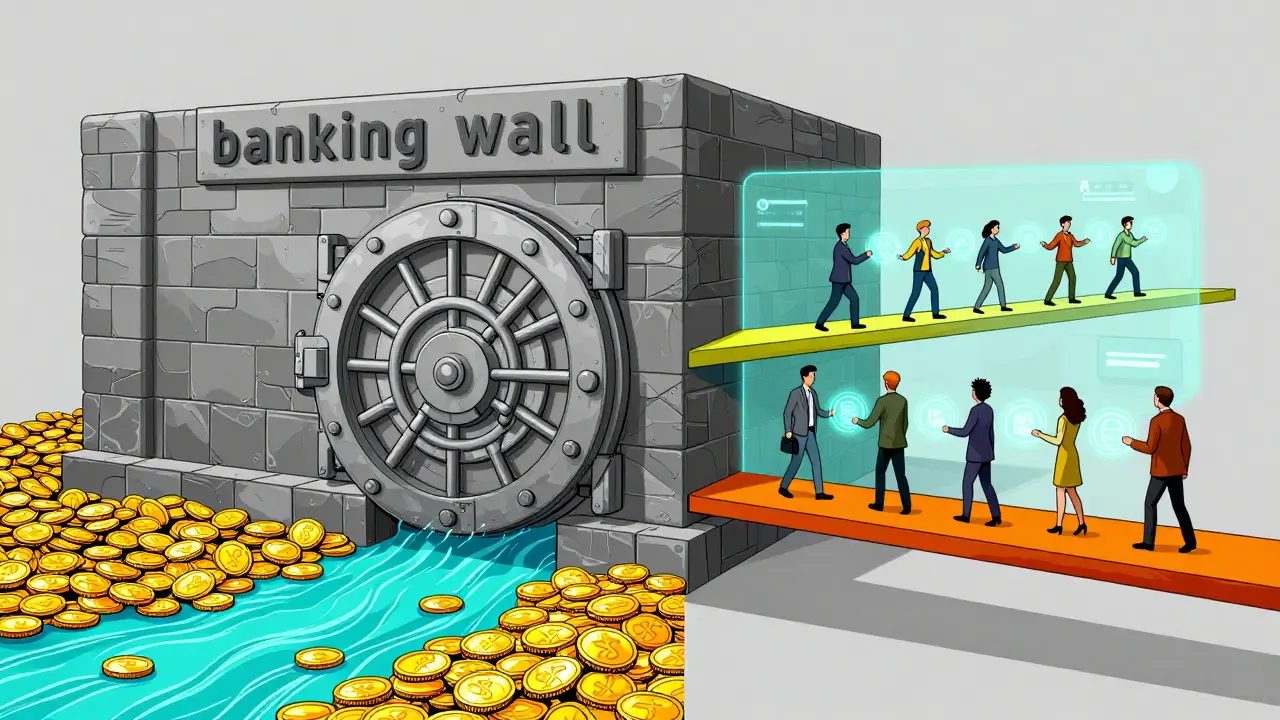
The biggest headache in restricted countries isn't usually the law itself, but the banks. When a central bank tells commercial banks to stop facilitating crypto payments, your "on-ramps" (converting cash to crypto) and "off-ramps" (converting crypto back to cash) disappear. We saw this clearly in Nigeria, where the Central Bank of Nigeria prohibited banks from dealing in virtual currencies.
When the banks shut the door, many traders pivot to Peer-to-Peer (P2P) networks. While this bypasses the bank's restriction, it introduces a different risk: fraud. Trading directly with another human without a corporate escrow means you're relying on trust. A compliance-first trader handles this by using reputable P2P platforms that offer some level of dispute resolution, rather than chatting with strangers on Telegram.
| Country | Status | Primary Restriction | Permitted Activity |
|---|---|---|---|
| Bangladesh | Strict Ban | Possession & Trade | None |
| China | Trading Ban | Exchanges & Mining | Self-Custody Holdings |
| Indonesia | Partial | Payment Usage | Commodity Investment |
| Nigeria | Banking Ban | Bank Facilitation | P2P / Private Trading |
Leveraging Decentralized Finance (DeFi) as a Tool
If centralized exchanges (CEXs) are the primary target of regulators, Decentralized Finance (or DeFi) provides a structural alternative. Because DeFi protocols operate via smart contracts on a blockchain rather than through a corporate entity, there is no "company" for a government to shut down or subpoena.
Interestingly, data from the 2025 Global Crypto Adoption Index shows that some countries, like Jordan, have a much higher value of DeFi activity than centralized service activity. This suggests that savvy traders in restrictive environments are moving away from platforms that require KYC (Know Your Customer) and toward non-custodial protocols. However, remember that while the platform is decentralized, your funding still usually touches the traditional banking system, which remains the weakest link in the compliance chain.
The Global Gold Standard: Learning from Crypto Hubs
To understand where restricted countries are heading, look at the hubs that got it right. Singapore and Hong Kong have both moved away from bans and toward strict licensing. Singapore's FIMA Act allows the Monetary Authority of Singapore to conduct on-site inspections of crypto-derivative entities, ensuring that innovation doesn't come at the cost of financial stability.
Hong Kong has taken a similar path with its Stablecoins Ordinance. By requiring issuers to maintain full asset-backed reserves and obtain licenses, they've turned a volatile asset class into a regulated financial tool. For a trader in a restricted country, these models prove that the goal isn't "zero regulation," but rather "clear regulation." It's much easier to be compliant when the rules are written in stone rather than whispered in a courtroom.

Practical Steps for a Compliant Setup
If you're determined to trade while staying legal, follow these rules of thumb:
- Audit Your Local Laws: Determine if you are in a "possession ban" or a "trading ban" zone. If possession is illegal, no amount of technical trickery makes you compliant.
- Prioritize Non-Custodial Wallets: Use wallets where you control the private keys. This removes the risk of a centralized exchange freezing your funds due to a sudden change in local laws.
- Document Everything: Keep meticulous records of your trades. If you're ever questioned by tax authorities, being able to show a clear audit trail of where your funds came from is your best defense.
- Separate Your Finances: Avoid using your primary savings account for crypto-related transfers. Use a dedicated account to isolate risk if the bank decides to flag your activity.
- Consult a Professional: Cryptocurrency laws move fast. A consultation with a local financial lawyer who specializes in digital assets is worth the cost to avoid a criminal record.
The Future of Global Compliance
The trend is moving toward frameworks, not bans. The Financial Action Task Force (FATF) reported in mid-2025 that 99 jurisdictions are currently passing or drafting crypto laws. This means the "wild west" era is ending. Even countries that were once strictly against crypto are starting to see the value of blockchain technology-like the Nigerian government's committees studying blockchain adoption despite the banking ban.
For the individual trader, this means the window for "grey area" trading is closing. The most successful long-term participants will be those who embrace AML (Anti-Money Laundering) and CTF (Counter-Terrorist Financing) standards now, rather than waiting for the government to force them into compliance through penalties.
Is it legal to hold Bitcoin in a country where trading is banned?
It depends entirely on the specific law. In China, for example, trading through exchanges is banned, but holding Bitcoin in a private wallet is generally not prohibited. However, in Bangladesh, the ban covers possession as well. You must check if your local law bans "trading" or "possession."
What is the safest way to buy crypto when banks block transactions?
Peer-to-Peer (P2P) trading is the most common alternative. Instead of sending money to an exchange, you send money directly to another individual who then releases the crypto to you via an escrow service. To stay compliant, use platforms with strong reputation systems and avoid unverified sellers.
Does using a VPN make my trading compliant?
No. A VPN hides your location, but it doesn't change the law. If you use a VPN to access a banned exchange and then use a local bank account to fund it, the bank will still see the transaction. Compliance is about following the law, not hiding from it.
What is a "commodity classification" for crypto?
This is when a government treats cryptocurrency as a tradeable good (like gold or oil) rather than as money. Indonesia uses this model, which allows people to invest in crypto for profit while still banning its use as a legal means of payment for goods and services.
How do DeFi protocols help with compliance in restricted areas?
DeFi removes the centralized intermediary. Since there is no company to block your account or report your activity to a local regulator, it allows for more permissionless interaction. However, the "on-ramp" (getting money into the system) still requires a compliant method to avoid banking triggers.






Rob Mitchell
April 10, 2026 AT 05:09The point about non-custodial wallets is crucial. Controlling your own keys is the only way to ensure your assets aren't frozen by a third party during a regulatory shift.
EDOZIEM MICHAEL
April 12, 2026 AT 00:57laws are just shadows of what we believe to be right but the flow of money is like water it always finds a way through the cracks regardless of the walls we build
Chidinma Sandra okafor
April 12, 2026 AT 23:24Oh great, another guide telling us to be "compliant" while our own banks treat us like criminals. It's just wonderful how some people think a few bullet points can fix the systemic mess in Nigeria. Truly inspiring stuff
Akshay Gorad
April 14, 2026 AT 14:21I appreciate the distinction between trading and possession. Many people confuse the two, and understanding that boundary is essential for staying safe in restrictive regions.
Alan Seiden
April 15, 2026 AT 13:57Absolute rubbish. The idea that any of these "hubs" are a gold standard is laughable. Most of these regulatory frameworks are just elaborate schemes to tax the populace while the elites move their capital through the same loopholes this article pretends to discourage. Typical neoliberal drivel that ignores the reality of state power.
Samson Selleck
April 15, 2026 AT 17:19The asymmetry of information here is glaring. While the author focuses on basic compliance, they completely omit the systemic implications of liquidity fragmentation within DeFi protocols. The delta between a non-custodial interface and the underlying solvency of the liquidity pool is where the actual risk resides, rendering a simple "audit trail" practically useless in a black-swan event. It's a pedestrian analysis of a highly complex macroeconomic phenomenon that requires a more robust understanding of algorithmic stability and the interplay between fiat on-ramps and synthetic assets. One must consider the parasitic nature of centralized intermediaries in the transition to a decentralized paradigm, yet the narrative remains tethered to an antiquated regulatory framework that fails to account for the velocity of capital in a borderless digital economy. The juxtaposition of the FIMA Act against the volatility of emerging markets is a category error in financial analysis. We are seeing a convergence of state surveillance and decentralized ledger technology that will inevitably lead to a social credit system integrated with asset ownership. The naive belief that a dedicated bank account isolates risk is quaint at best and dangerously reductive at worst. True risk mitigation requires an understanding of the cryptographic primitives and the geopolitical incentives driving the FATF's mandate. Without a deep dive into the technical architecture of these protocols, any advice on "compliance" is merely superficial window dressing for the inevitably systemic collapse of centralized trust. This discourse lacks the intellectual rigor required to navigate the current epoch of financial transformation.
jennelle williams
April 16, 2026 AT 09:00it feels scary to lose everything
just stay safe everyone
Lauren Abrams
April 18, 2026 AT 03:30The part about Indonesia treating it as a commodity is an interesting middle ground. It seems like a way to acknowledge the value without giving it the status of currency.