Cuba Remittance Cost Calculator
Send Money to Cuba
Compare the cost of sending money to Cuba through traditional services versus cryptocurrency
Results
Traditional Remittance
(e.g., Western Union, MoneyGram)
Typically takes 1-5 days
Crypto Remittance
(e.g., Bitcoin, Ethereum)
Completed in under 15 minutes
Total Savings
$0.00That's 0% saved compared to traditional services
Most countries treat cryptocurrency like a threat - ban it, restrict it, or ignore it. Cuba did something unexpected: it made crypto legal. Not just tolerated - legal. And not because it’s trendy. Because it had to be.
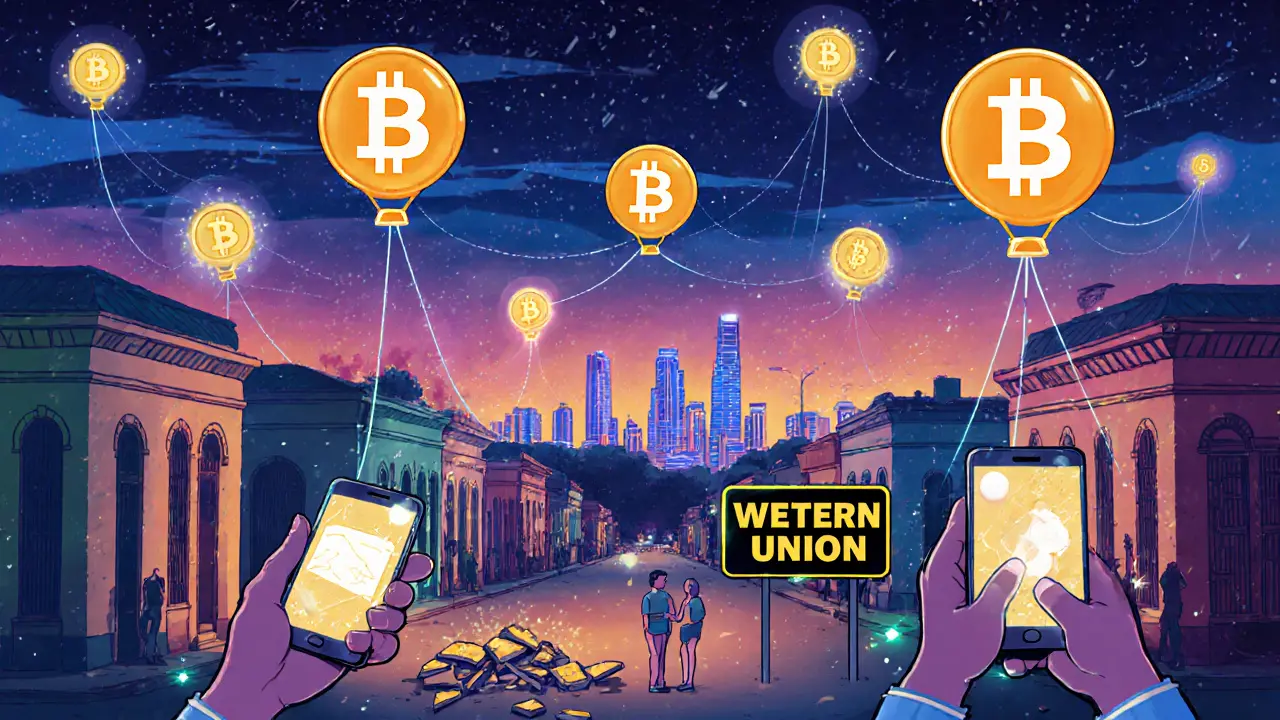
In August 2021, Cuba’s Central Bank issued Resolution 215. It didn’t crack down on Bitcoin. It licensed it. The reason? Sixty years of U.S. sanctions had cut Cubans off from the global financial system. Western Union shut down its 400+ branches in Cuba in 2020. PayPal? Blocked. Credit cards? Useless. Amazon? Out of reach. Families abroad couldn’t send money. People couldn’t buy essentials online. The economy was choking.
So Cuba turned to crypto. Not as a rebellion. Not as a gamble. As a lifeline.
How Crypto Became Cuba’s Financial Workaround
Before crypto, remittances were the backbone of Cuban households. Over 50% of families relied on money sent from relatives in the U.S., Spain, or elsewhere. But with Western Union gone, that pipeline dried up. People started using Telegram groups and WhatsApp to coordinate cash transfers through third countries - risky, slow, expensive. Then came Bitcoin.
Now, Cubans use crypto to receive money from abroad. A cousin in Miami buys $100 worth of Bitcoin on Coinbase, sends it to a wallet address in Havana, and the recipient cashes out through a local peer-to-peer trader. No bank. No middleman. No sanction-triggering transaction. The whole process takes under 15 minutes.
It’s not just remittances. Cubans use crypto to buy medicine, laptops, phone parts, and even groceries from international sellers who won’t accept Cuban bank cards. A dentist in Santiago might pay for dental equipment using Ethereum. A small business owner in Holguín uses Avalanche to buy tools from Alibaba. These aren’t fringe cases - they’re daily routines for tens of thousands.
Estimates suggest 100,000 to 200,000 Cubans - about 1% to 2% of the population - actively use crypto. That’s a huge number for a country where mobile internet only became widespread in 2019.
The Government Didn’t Block It - It Regulated It
Here’s where Cuba breaks the mold. Most authoritarian regimes fear crypto because it’s decentralized. Cuba feared the opposite: chaos. So it didn’t ban it. It built a system to control it.
In 2022, the Central Bank of Cuba (BCC) released Decree Law 215. It said: you can operate crypto services, but only if we license you. Only the BCC can approve providers. Every exchange, wallet service, or mining operation needs government permission. Applicants must prove experience, financial stability, and clean records. They must follow strict anti-money laundering rules. Suspicious activity? Report it. Or lose your license.
The government also controls which coins are allowed. Bitcoin? Yes. Ethereum? Yes. Tether? Maybe, if it meets compliance. Random meme coins? No. The BCC doesn’t just allow crypto - it curates it.
And here’s the twist: crypto mining is legal too. Not just tolerated - encouraged. The government built solar-powered mining farms in Matanzas and Pinar del Río, where renewable energy is abundant. They partnered with international tech firms to install cooling systems and secure hardware. They even launched training programs to teach locals how to maintain mining rigs.
This isn’t a loophole. It’s a policy. Cuba isn’t trying to become the next Switzerland. It’s trying to survive.

Why the U.S. Sanctions Made Crypto Necessary
The U.S. sanctions on Cuba date back to 1962. They’re not just about trade. They’re about isolation. Any foreign bank that deals with Cuba risks U.S. fines. That’s why Visa, Mastercard, and PayPal left. That’s why international wire transfers stopped. That’s why Cubans couldn’t even buy a Netflix subscription legally.
Crypto bypasses all of that. Blockchain doesn’t care about U.S. sanctions. A Bitcoin transaction is peer-to-peer. No bank. No intermediary. No paper trail that a U.S. regulator can trace back to a Cuban state-owned entity.
But here’s the catch: Cuba’s economy is state-controlled. Most businesses are owned by GAESA or Gaviota - military-run conglomerates that the U.S. Treasury’s OFAC has explicitly sanctioned. So if a Cuban uses crypto to buy something from a state-owned company, is that a violation? Maybe. But enforcement is nearly impossible. The U.S. can’t monitor every wallet address in Havana.
That’s why crypto works - not because it’s perfect, but because it’s invisible to the old system.
The Real Challenges: Internet, Access, and Trust
Legal doesn’t mean easy. Cuba still has one of the slowest internet connections in Latin America. Many people pay $2-$3 per hour for Wi-Fi access at public hotspots. Not everyone can afford to stay online long enough to complete a crypto transaction.
And while crypto is legal, international exchanges like Binance and Kraken don’t operate in Cuba. Cubans rely on peer-to-peer platforms like Paxful, LocalBitcoins, and Telegram-based traders. These are risky. Scams happen. People lose money. There’s no customer service. No chargebacks.
Still, people adapt. They use trusted contacts. They verify identities. They trade in small amounts first. Many now use “crypto wallets” on their phones - apps like Trust Wallet or Exodus - that store Bitcoin and Ethereum offline. They keep private keys on paper. They’ve learned the hard way.
What’s surprising is how fast trust built. A generation that grew up without ATMs now trusts a 12-word recovery phrase more than a bank account.

What This Means for the Rest of the World
Cuba isn’t a crypto utopia. It’s a crypto necessity. And that’s what makes it important.
Other sanctioned nations - Venezuela, Iran, North Korea - have tried crypto too. But they did it chaotically. Cuba did it with rules. With oversight. With licensing. With compliance.
It’s not about freedom. It’s about function. Cuba didn’t adopt crypto to overthrow capitalism. It adopted it to keep its people fed, connected, and alive.
Other countries watching this could learn something: you don’t have to ban crypto to control it. You can regulate it. You can tax it. You can monitor it. You can even profit from it - through licensing fees and energy sales to miners.
Cuba’s model might become the blueprint for other isolated economies. If you can’t play by the old rules, build your own.
What’s Next for Cuban Crypto?
By 2025, Cuba is expanding its crypto infrastructure. More mining farms are being built. A national digital wallet system is in testing. The government is exploring a state-backed stablecoin tied to the peso - not to replace crypto, but to bridge it with the traditional economy.
They’re also working with international blockchain firms to create secure, compliant gateways for foreign investors who want to support Cuban entrepreneurs - without violating sanctions. It’s a tightrope walk. But they’re walking it.
One thing is clear: crypto isn’t going away in Cuba. It’s becoming part of the fabric. A quiet, digital underground economy that keeps the lights on, the phones charged, and families connected.
For Cubans, crypto isn’t speculation. It’s survival.
Is cryptocurrency legal in Cuba?
Yes, cryptocurrency is legal in Cuba. The Central Bank of Cuba officially recognized Bitcoin and other digital assets as legal payment methods in August 2021 through Resolution 215. The government regulates crypto through licensing, requiring all service providers - exchanges, wallets, and miners - to obtain approval. Only the Central Bank can issue these licenses, and all operations must comply with anti-money laundering rules.
Why did Cuba legalize cryptocurrency?
Cuba legalized crypto because U.S. sanctions blocked access to traditional financial services. Western Union shut down its Cuban operations in 2020, and international banks refused to process transactions involving Cuba. Crypto became the only reliable way for Cubans to receive remittances from family abroad, buy goods online, and participate in the global economy. The government saw it not as a threat, but as a necessary economic tool.
Can Cubans mine Bitcoin legally?
Yes, cryptocurrency mining is legal in Cuba and is actively regulated. The government has established mining farms in areas with renewable energy, like solar-powered sites in Matanzas and Pinar del Río. Miners must follow energy consumption limits, cybersecurity standards, and licensing rules. The state even partners with international tech companies to provide equipment and training, turning mining into a formal sector.
How do Cubans buy and sell crypto without international exchanges?
Most Cubans use peer-to-peer platforms like Paxful, LocalBitcoins, and Telegram groups to trade crypto. They connect with trusted traders who accept cash, mobile payments, or even barter. Since international exchanges like Binance don’t operate in Cuba, P2P is the only practical option. Many users start with small amounts and build trust over time. Wallets like Trust Wallet and Exodus are commonly used to store Bitcoin and Ethereum securely.
Is Cuba’s crypto system at risk from U.S. sanctions?
Yes, but indirectly. While crypto transactions themselves aren’t blocked, U.S. sanctions make it hard for foreign companies to work with Cuban entities. Banks and payment processors avoid any contact with Cuba to prevent penalties. This limits access to tools like Coinbase or PayPal. Also, since many Cuban businesses are state-owned (and sanctioned), there’s risk of unintentional violations. But because crypto is decentralized, enforcement is nearly impossible - making it a practical workaround despite the risks.





Christina Oneviane
November 29, 2025 AT 01:03fanny adam
November 30, 2025 AT 21:33Casey Meehan
December 2, 2025 AT 04:40Tom MacDermott
December 2, 2025 AT 13:58Martin Doyle
December 4, 2025 AT 13:24Susan Dugan
December 5, 2025 AT 14:42Tina Detelj
December 6, 2025 AT 17:05Angel RYAN
December 7, 2025 AT 10:26stephen bullard
December 8, 2025 AT 20:25