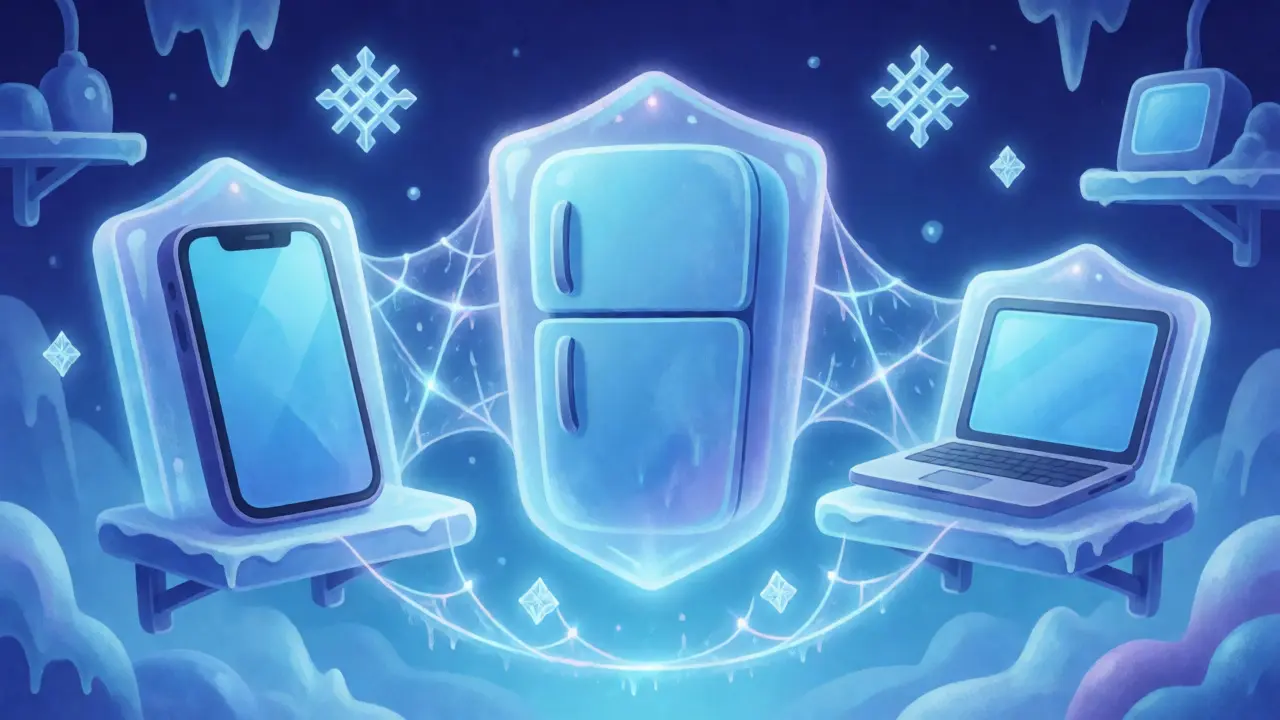
Imagine a world where every device you own-from your smartphone to your smart fridge-actively helps secure the internet. Not just by connecting, but by validating that everything around it is safe, in real-time. That’s the core promise of Naoris Protocol, a new breed of blockchain infrastructure designed to fix cybersecurity from the ground up.
If you’ve been following crypto trends, you know the usual suspects: Ethereum for apps, Solana for speed, Bitcoin for store-of-value. But what happens when the threat isn’t just slow transactions or high fees? What happens when quantum computers break current encryption standards? Enter Naoris Protocol ($NAORIS), which calls itself the first "Sub-Zero Layer" blockchain. It doesn’t compete with Ethereum; it sits underneath it, acting as a security mesh for the entire decentralized web.
The Core Problem Naoris Solves
Traditional cybersecurity is reactive and centralized. You run an audit, find bugs, patch them, and hope nothing breaks until the next audit. This model fails in a decentralized environment where millions of devices connect and disconnect constantly. Naoris flips this script. Instead of waiting for an audit, it uses Decentralized Proof-of-Security (dPoSec) to generate live trust scores. Every node validates its peers instantly. If a device behaves suspiciously, its trust score drops on-chain immediately. No waiting weeks for a report.
This approach targets both Web2 and Web3 systems. Whether you’re running a traditional enterprise server or a DeFi protocol on Cosmos, Naoris provides a layer of post-quantum cryptographic verification. It’s not just about securing wallets; it’s about ensuring the integrity of the physical and digital infrastructure powering these networks.
How the Technology Works: The Sub-Zero Layer
Most blockchains are Layer 1s (like Bitcoin) or Layer 2s (scaling solutions like Arbitrum). Naoris introduces a new category: the Sub-Zero Layer. Think of it as the foundation beneath the foundation. It operates below smart contracts and bridges, embedding trust directly into the network topology.
The magic ingredient here is Swarm AI. Naoris integrates artificial intelligence at the consensus level. These AI agents monitor network behavior, detect anomalies, and coordinate validation across thousands of nodes simultaneously. This allows for millisecond-speed attestations. When a validator checks another node, the result is anchored on-chain almost instantly. This creates a "trust mesh" where no single point of failure exists.
Crucially, Naoris uses post-quantum cryptography. As quantum computing advances, standard RSA and ECC encryption methods face obsolescence. Naoris builds resistance against these future threats into its DNA, making it relevant not just for today’s crypto markets, but for the long-term survival of digital assets.
Understanding the $NAORIS Token
The native token, $NAORIS, is more than just a speculative asset; it’s the fuel for the security economy. Here’s how it works:
- Proof of Trust: Each bonded $NAORIS token represents participation in the network. Validators stake tokens to secure their position.
- Rewards: Validators earn $NAORIS for performing integrity checks. The faster and more accurate the validation, the higher the reward.
- Deflationary Mechanics: Tokens flow back into the ecosystem through rewards and security bonds, reducing circulating supply over time.
As of mid-2026, the maximum supply is capped at 4 billion tokens. Currently, approximately 599 million tokens are in circulation, representing about 15% of the total cap. This low initial circulation means significant future dilution risk if not managed carefully, but it also leaves room for substantial growth if adoption scales.
| Feature | Naoris Protocol | Traditional L1 (e.g., Ethereum) |
|---|---|---|
| Primary Function | Cybersecurity & Trust Verification | Smart Contracts & DApps |
| Consensus Mechanism | dPoSec™ (Decentralized Proof-of-Security) | PoS / PoW |
| Validation Speed | Millisecond-level attestations | Seconds to Minutes |
| Cryptography Type | Post-Quantum Secure | Standard ECC/RSA (Vulnerable to Quantum) |
| Integration Scope | EVM, Cosmos, Move, Web2 Infrastructure | Native Ecosystem Only |

Market Performance and Trading Data
Like many emerging infrastructures, $NAORIS has seen volatility. In May 2026, prices fluctuated between $0.08 and $0.12 depending on the exchange. Kraken reported highs near $0.11, while Robinhood showed lower bids around $0.09. This spread reflects liquidity fragmentation-a common issue for newer tokens not yet fully integrated into all major trading venues.
The token reached an all-time high of $0.1860 earlier in its lifecycle. While currently down roughly 44% from that peak, it remains up significantly from its all-time low of $0.0083. Daily trading volumes hover around $12 million, indicating moderate but steady interest. Note that some platforms list the price index but restrict actual trading, so always verify tradability before buying.
Who Is This For? Enterprise and Developer Use Cases
Naoris isn’t just for retail investors chasing moonshots. Its primary target audience includes enterprises and governments struggling with legacy cybersecurity models. By shifting to a decentralized community compute model, organizations can reduce reliance on expensive, siloed security vendors.
For developers, Naoris offers dual utility. You can build directly on the Naoris sovereign chain using its smart contract capabilities. Alternatively, you can integrate Naoris as a security layer for existing projects on Ethereum, Cosmos, or Polkadot. This interoperability is key. It exports trust proofs to other ecosystems, allowing a DeFi protocol on Polygon to verify the security status of its oracle providers via Naoris.

Risks and Considerations
No technology is without challenges. First, the "Sub-Zero" concept is novel. Educating the market on why we need a separate security layer takes time. Second, competition is fierce. Projects like Chainlink provide data verification, and other L1s are integrating security features natively. Naoris must prove its dPoSec mechanism is superior and scalable enough to justify its existence.
Additionally, the heavy reliance on Swarm AI introduces complexity. How transparent is the AI decision-making process? Can it be gamed? These are questions early adopters should watch closely. Finally, regulatory scrutiny on post-quantum cryptography is minimal right now, but could increase as standards evolve.
Frequently Asked Questions
Is Naoris Protocol a competitor to Ethereum?
No, Naoris is designed to complement rather than replace major Layer 1 blockchains. It acts as a Sub-Zero Layer, providing security and trust verification services to chains like Ethereum, Cosmos, and others. Think of it as a security shield that sits underneath the main application layers.
What makes Naoris different from other cybersecurity blockchains?
Naoris distinguishes itself through its proprietary Decentralized Proof-of-Security (dPoSec) consensus and integration of Swarm AI. Unlike projects that focus solely on data availability or storage, Naoris focuses on real-time device integrity and post-quantum resilience, operating at the infrastructure level rather than just the application level.
Where can I buy NAORIS tokens?
As of 2026, NAORIS is available on several centralized exchanges including Kraken, Coinbase, and Binance. Liquidity varies by platform, with daily trading volumes typically ranging between $9 million and $12 million. Always check specific exchange listings for real-time availability and withdrawal limits.
Is Naoris resistant to quantum computing threats?
Yes, Naoris utilizes post-quantum cryptography algorithms specifically designed to withstand attacks from future quantum computers. This makes it one of the few blockchains proactively addressing the potential collapse of current encryption standards due to quantum advancements.
How do validators earn rewards on Naoris?
Validators, known as TrustNodes, earn $NAORIS rewards by performing millisecond-speed integrity attestations. They validate the behavior and security status of peer devices and nodes. Successful validations contribute to the network's overall trust score and yield token rewards based on performance and uptime.




Harish Ramaiah
September 7, 2026 AT 03:22Oh wow, another blockchain trying to solve cybersecurity?? 😩😩 I am SO tired of these buzzwords... "Sub-Zero Layer" sounds like a fancy name for nothing! 🥶🥶 The AI part is scary too, what if the swarm goes rogue?? 😱😱 And don't get me started on the tokenomics... 4 billion max supply?! That's just dilution waiting to happen!! 💸💸 I'm emotional about this, why do they always overpromise and underdeliver?? 😭😭 My heart hurts for the investors who will get burned again!! 🔥🔥
Kathy Siew
September 7, 2026 AT 14:26Look, i hate to be the one bursting your bubble harish but you're missing the point. its not just about the token price or whatever hype cycle we are in right now. its about infrastructure.
traditional security is broken. full stop. we cant keep patching leaks with duct tape while quantum computers are literally knocking on the door. naoris actually addresses the root cause by decentralizing trust itself.
yeah the marketing is cringe but the tech stack looks legit enough to warrant attention. give it a chance before you cry into your pillow about it being a scam.
Idowu Emmanuel
September 9, 2026 AT 12:16I really appreciate the perspective shared here! It’s great to see people engaging deeply with the technical aspects rather than just looking at charts.
The idea of community compute reducing reliance on siloed vendors is genuinely exciting for emerging markets like Nigeria where enterprise software costs can be prohibitive. If Naoris can deliver on that interoperability promise, it could be a game changer for local developers building on Cosmos or EVM chains without needing massive capital expenditure on security audits.
Let’s keep supporting each other as we navigate these new technologies!
Jennifer Brosnan
September 11, 2026 AT 07:29Oh please, spare me the corporate propaganda. This whole "Sub-Zero" thing is just rebranded vaporware designed to extract liquidity from retail sheep who don't understand cryptography.
You think "Swarm AI" isn't just a black box algorithm that nobody can audit? Of course you do because you haven't read the whitepaper closely. They claim post-quantum resistance but show me the peer-reviewed papers proving their specific implementation isn't vulnerable to side-channel attacks.
I bet there's a hidden clause in the validator contracts that lets insiders dump early. It's always the same story. Wake up sheeple, the emperor has no clothes and he's wearing a $NAORIS hoodie.
John Lewis
September 12, 2026 AT 08:52That's a fair critique regarding the transparency of the AI components, Jennifer. In my experience working with similar consensus mechanisms, the challenge isn't usually the cryptographic primitives themselves-those are often standardized NIST finalists-but rather the orchestration layer.
If the Swarm AI agents have permissionless access to network topology data, you are correct that gaming the validation scores becomes a non-trivial attack vector. However, the millisecond attestation speed mentioned does offer a significant advantage over traditional oracle networks which operate on block-time intervals.
It might be worth monitoring how they handle dispute resolution in the first few months of mainnet activity. If the dPoSec mechanism holds up against adversarial nodes, then the value proposition shifts from speculative to utility-based quite quickly.
lea terrade
September 12, 2026 AT 11:43i wonder though if we are creating a dependency on ai that we dont fully understand yet
if the swarm decides something is secure when its not do we even know until its too late
it feels like we are trading human oversight for machine speed and im not sure thats always the right trade off philosophically speaking
but maybe im overthinking it
Finlay Samms
September 14, 2026 AT 06:34Valid points Lea. :)
Speed vs accuracy is always the tension. But consider that current systems fail silently all the time anyway. At least with a transparent on-chain trust score you have an immutable record of when the system thought things were fine.
Its a different paradigm. Not necessarily better or worse but definitely different. :) :)
Sophie Fitzgerald
September 15, 2026 AT 19:01the liquidity spread issue is real tho. buying on robinhood vs kraken makes such a diff. hard to recommend entry points when vol is so high.
Ritchie Grogg
September 16, 2026 AT 06:23Dude, don't stress about the spreads! Just DCA in slowly and chill out. 😌
I was sweating bullets last week watching the chart dip below $0.09 but honestly? The fundamentals look solid. We've got real use cases here, not just memes.
Keep your head down and hold tight. We're gonna make it fam. Don't let the FUD get you down! 🚀❤️
Alexander James
September 18, 2026 AT 05:38It is morally imperative that we support protocols that prioritize long-term security over short-term greed.
While some critics whine about dilution, they ignore the ethical responsibility of securing our digital future against quantum threats. Naoris represents a noble pursuit of integrity.
To dismiss it as mere speculation is to misunderstand the profound duty we have to protect decentralized assets. We must stand firm in our conviction that this technology is the shield humanity needs.
Let us not be swayed by the cynicism of those who lack vision. The path forward is clear: embrace the Sub-Zero revolution.