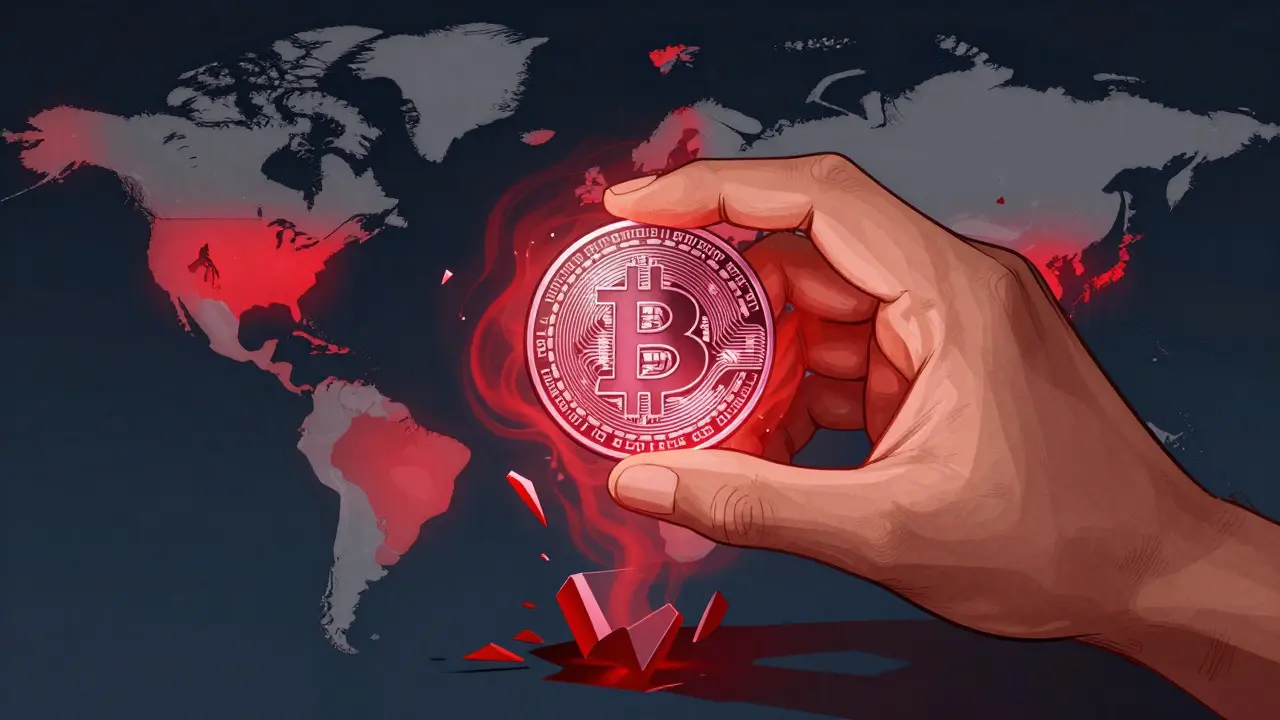
Imagine holding a wallet full of Bitcoin, only to realize that in your home country, simply possessing it could land you in prison or result in heavy fines. It sounds like a plot from a dystopian movie, but for roughly 18% of the world's population, this is their daily reality. As of mid-2026, the global map of crypto ban countries remains a complex patchwork where some nations have outlawed digital assets entirely, while others just stopped banks from touching them.
Navigating these rules isn't just about knowing which flags are red on a map; it's about understanding the specific legal traps each jurisdiction sets. Whether you're an investor looking to diversify, a traveler carrying hardware wallets, or a developer building decentralized apps, knowing where the law bites back is crucial. Here’s the breakdown of where crypto is truly illegal, what "illegal" actually means in practice, and how to protect yourself if you live in or visit these zones.
The Hard Bans: Where Possession is Risky
At the top of the restriction ladder are the ten countries that maintain total prohibitions. In these places, trading, mining, holding, and using cryptocurrencies can all be considered violations of local law. The list includes China, Egypt, Nepal, Morocco, Afghanistan, Algeria, Bangladesh, Bolivia, Tunisia, and Iraq.
However, "total ban" doesn't always mean the same thing everywhere. Take China, which has enforced one of the strictest bans globally since 2021. The government prohibited financial institutions from dealing with digital assets and banned mining operations, citing energy consumption and environmental concerns. Yet, Beijing continues to push forward with its own state-run digital currency, the e-CNY. This signals that the issue isn't technology itself, but rather who controls it. For residents, the risk is high; while casual possession might not always lead to immediate arrest, any transactional activity involving exchanges or OTC deals can trigger scrutiny under anti-money laundering laws.
Bangladesh takes a similarly punitive approach. Under its Money Laundering Prevention Act, the central bank clarified that all cryptocurrency usage, trade, and possession are banned due to instability risks. Violators face years in prison, making it one of the most dangerous jurisdictions for crypto enthusiasts. If you hold assets there, the legal gray area is thin, and enforcement agencies have shown willingness to use criminal codes rather than just civil fines.
Other nations like Egypt and Morocco often classify crypto as an unregulated foreign currency. This means using it to pay for goods or services is illegal, and converting local currency to crypto without official approval can lead to confiscation. While outright jail time for holding a small amount is rare compared to Bangladesh, the administrative penalties and banking blacklists can be just as damaging to your financial life.
Partial Restrictions: The Gray Zone
Not every country that restricts crypto has issued a total ban. Many operate in a middle ground where crypto is legal to buy but illegal to spend. This category includes major economies like India, Russia, and Indonesia, as well as Turkey, which serves as a prime example of the "banking prohibition model."
In Turkey, the central bank banned cryptocurrencies as a payment tool in April 2021. Why? Because when the Turkish lira plummeted, citizens turned to Bitcoin and Ethereum as inflation hedges, threatening monetary sovereignty. So, Ankara didn't ban holding crypto; they just made sure you couldn't use it to buy bread. You can still buy, sell, and hold, but merchants aren't allowed to accept it. This creates a strange dynamic where the asset class exists legally but lacks utility as money.
Indonesia follows a similar path. The State Bank prohibits using crypto for payments, but the Commodity Futures Trading Regulatory Authority (Bappebti) regulates it as a commodity. This means you need to trade on licensed local exchanges. If you use offshore platforms, you're technically operating outside the regulated framework, which exposes you to regulatory crackdowns. Vietnam adds another layer: the State Bank prohibits crypto as a payment method, and violators face fines ranging from 150 million VND to 200 million VND (roughly $6,500 to $8,800 USD). These fines are significant enough to deter casual experimentation but low enough that underground markets thrive.
| Country | Restriction Type | Legal Status of Holding | Legal Status of Spending | Potential Penalties |
|---|---|---|---|---|
| China | Total Ban | Gray/Risky | Illegal | Fines, Contract Voiding |
| Bangladesh | Total Ban | Illegal | Illegal | Prison (AML Laws) |
| Turkey | Payment Ban | Legal | Illegal | Administrative Fines |
| Vietnam | Payment Ban | Legal | Illegal | Fines ($6k-$8k) |
| India | Tax/Regulation | Legal | Restricted | High Tax Rates |

Why Do Governments Ban Crypto?
It’s easy to assume governments hate crypto because they dislike new tech. But the real drivers are usually economic control and stability. The primary motivations fall into three buckets: monetary sovereignty, anti-money laundering (AML), and tax compliance.
Monetary sovereignty is the big one. When a central bank loses control over the money supply, inflation can spiral out of control. In countries with volatile currencies, like Argentina or Turkey, citizens naturally flee to stable assets like Bitcoin. To stop capital flight, regulators restrict access. They don't necessarily want to destroy the technology; they want to keep the value inside the national economy.
Then there’s the AML angle. Decentralized finance (DeFi) and privacy coins make it harder for authorities to track illicit flows. Countries like Bangladesh and Nigeria (though Nigeria has liberalized recently) have historically cited this fear. If you can’t see the money moving, you can’t tax it or freeze it. This leads to blanket bans as a blunt instrument to regain visibility.
Finally, there’s the infrastructure gap. Some developing nations lack the legal frameworks to define what a digital asset even is. Instead of spending years writing new laws, it’s easier to say, "This isn't recognized, so it's illegal." This regulatory vacuum creates uncertainty that scares away institutional investors, further isolating the local market.
Living with the Ban: Practical Realities
So, what does it look like to live in a banned country? Enforcement varies wildly. In China, you won't see police knocking on doors for holding a small amount of ETH, but if you try to open a business accepting crypto, you'll likely face legal trouble. The ban targets systemic risk, not individual hoarding.
In stricter environments like Bangladesh or Egypt, the risk is higher. Local banks may flag transactions that look like crypto-related wire transfers. You might find your account frozen if you move large sums to offshore exchanges. This is why many users in these regions rely on peer-to-peer (P2P) trading via Telegram groups or local OTC desks. It’s cash-based, off-book, and invisible to the banking system. But it comes with counterparty risk-what if the other person double-spends or scams you?
Travelers should also be cautious. If you’re flying from a banned country to a friendly one, carry your hardware wallet securely. Customs officials in some jurisdictions have been known to ask questions about digital assets, though seizures are rare. Still, keeping proof of ownership and avoiding public discussions about your holdings at border crossings is smart hygiene.
The Future: Will Bans Stick?
As of 2026, the list of total bans has remained relatively stable, but the pressure is changing. Younger, tech-savvy populations in these countries are increasingly vocal about their right to financial freedom. Social media sentiment shows continued interest, with users expressing frustration at missing out on global innovation.
Furthermore, the rise of Central Bank Digital Currencies (CBDCs) suggests a shift. Countries banning private crypto are often the same ones pushing CBDCs. This implies that the objection is to decentralization, not digitization. If a government can offer a digital yuan or e-naira that is secure and efficient, the appeal of Bitcoin drops for the average citizen. However, for those seeking censorship resistance, the demand will persist, driving underground adoption regardless of official policy.
Experts predict that within the next five years, we’ll see more "regulatory clarity" replacing "outright bans." Nations will likely move toward taxing and regulating crypto rather than prohibiting it, mirroring the path taken by El Salvador, Switzerland, and the UAE. Until then, navigating the current landscape requires vigilance, local knowledge, and a healthy dose of caution.
Is it illegal to hold Bitcoin in China?
Holding Bitcoin in China exists in a legal gray area. While trading and mining are explicitly banned, simple possession hasn't been criminalized for individuals. However, contracts related to crypto are void, and any attempt to transact through unofficial channels carries significant legal and financial risk.
What happens if I use crypto to pay for something in Turkey?
Using crypto as a payment method for goods and services is illegal in Turkey. Merchants who accept it can face fines, and consumers may encounter issues with refunds or warranty claims. However, buying, selling, and holding crypto on licensed exchanges remains legal.
Which country has the strictest crypto ban?
Bangladesh is widely considered to have one of the strictest bans, as it utilizes anti-money laundering laws to impose potential prison sentences for crypto activities. China follows closely with comprehensive bans on trading and mining, backed by strong state enforcement capabilities.
Can I use a VPN to trade crypto in a banned country?
Technically, yes, but it doesn't change your legal liability. Using a VPN helps bypass IP blocks, but if you are caught transacting, the underlying act is still illegal in your jurisdiction. Additionally, KYC requirements on major exchanges may flag non-resident addresses, leading to account freezes.
Will crypto bans ever end?
Many analysts believe total bans are unsustainable long-term. As blockchain technology matures and CBDCs gain traction, governments are shifting from prohibition to regulation. We expect more countries to adopt frameworks that tax and monitor crypto rather than outlaw it completely.





Quang Thai Tran
August 23, 2026 AT 00:35One must observe with a keen eye that this so-called "ban list" is merely the first domino in a grander design orchestrated by the global financial elite. It is not about energy consumption, as the propaganda suggests; it is about the total annihilation of individual sovereignty. The e-CNY is not a currency, but a leash, and those who hold Bitcoin are merely holding the key to their own liberation from this digital prison. We see the pattern clearly now: restrict, monitor, then control. The paranoia is justified because the enemy is everywhere, watching every transaction, waiting for the moment when the last unmonitored dollar is exchanged for a tracked token. Do not be fooled by the gentle language of "regulatory clarity." Clarity is the mask they wear while tightening the noose around your financial neck. The true risk is not the fine, but the silence that follows once you are deemed non-compliant. Wake up before the door is kicked in.