Imagine owning a slice of a commercial building in New York or a share in a private equity fund, but instead of waiting weeks for paperwork and paying hefty broker fees, you trade it instantly on your phone. That’s the promise behind Realio Network (RIO). It isn’t just another meme coin chasing hype; it’s an EVM-compatible Layer-1 blockchain built specifically to handle tokenized real-world assets (RWAs). If you’ve ever wondered how blockchain technology could actually disrupt traditional finance by making illiquid assets like real estate more accessible, Realio is one of the serious contenders trying to solve that puzzle.
But here’s the catch: understanding what RIO does requires separating the utility token from the regulated investment products running on top of it. Many newcomers confuse the two, leading to confusion about risk and value. This guide breaks down exactly what Realio Network is, how its unique "multistaking" mechanism works, and why its dual-token system matters for anyone interested in the future of digital ownership.
The Core Mission: Bridging Traditional Finance and Web3
Realio Network launched publicly in April 2023, but its roots go back to 2018 when founders Derek Boirun, Aaron Gooch, Eduardo Romeiro, and Marcelo Moyano started working on the infrastructure. The goal was straightforward yet ambitious: create a permissionless, open-source settlement network where traditionally illiquid assets-think private equity funds, real estate, and venture capital stakes-could be issued, managed, and traded with the speed of cryptocurrency.
Unlike general-purpose blockchains that try to do everything, Realio is specialized. It focuses on institutional-grade workflows. This means it supports compliance-heavy processes like Know Your Customer (KYC) checks and anti-money laundering (AML) protocols directly within its asset model. For an investor, this translates to a platform where security tokens can exist legally and efficiently, rather than just existing as unregulated digital receipts.
The project operates within the Cosmos ecosystem but with a critical twist: full Ethereum Virtual Machine (EVM) compatibility. This hybrid approach allows developers to use familiar tools like MetaMask, Hardhat, and Solidity while leveraging Cosmos features such as Inter-Blockchain Communication (IBC). It’s essentially the best of both worlds-Ethereum’s developer familiarity and Cosmos’s interoperability.
Understanding the Dual-Token System: RIO vs. RST
To grasp how Realio functions, you must distinguish between its two native tokens. Confusing them is the most common mistake users make.
| Feature | RIO Token | RST Token |
|---|---|---|
| Type | Utility Token | Hybrid Digital Security Token |
| Primary Use | Gas fees, staking, governance | Staking collateral, representing security interests |
| Regulatory Status | Not classified as a security by project docs | Subject to securities regulations |
| Wallet Compatibility | EVM wallets (MetaMask) | Specific compliant wallets/platforms |
RIO is the fuel of the network. You need it to pay for transactions, deploy smart contracts, and participate in governance. It behaves like ETH on Ethereum or ATOM on Cosmos. The official documentation explicitly states that RIO is not an investment in Realio itself; it’s a utility asset. Its value is speculative and tied to network usage.
RST, on the other hand, is a security token. It represents ownership or rights in underlying assets. Because it falls under securities laws, holding or trading RST often involves accreditation requirements and jurisdiction-specific rules. While RIO powers the engine, RST represents the cargo being transported.
How Multistaking Secures the Network
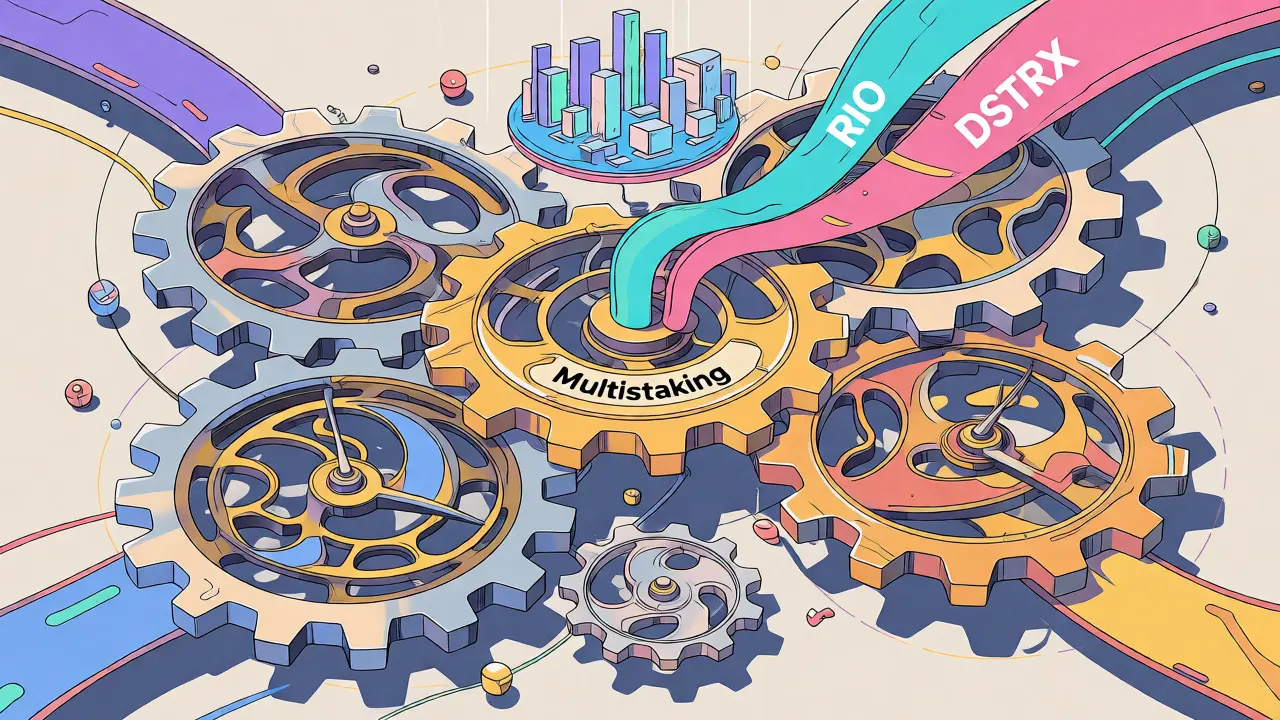
Most Proof-of-Stake (PoS) chains require validators to stake only the native coin to secure the network. Realio takes a different route called multistaking. Validators on Realio can accept delegation in three specific assets: RIO, RST, or DSTRX (an ERC-20 token).
This design choice serves a strategic purpose. By allowing security tokens (RST) to be used for staking, Realio incentivizes holders of these regulated assets to participate in network security. It creates a deeper economic link between the financial instruments issued on the chain and the health of the blockchain itself. However, it adds complexity. Validators must manage multiple types of collateral, and delegators need to understand which asset they are bonding and the associated risks.
The network aims for a validator set of 100 nodes. If a validator goes offline frequently, double-signs blocks, or fails to vote on governance proposals, they can be "jailed" or slashed. This means part of their staked funds is burned as a penalty. For regular users, this ensures the network remains robust, but it highlights that operating a validator node is technically demanding work involving server uptime, key management, and constant monitoring.
Technical Architecture: Cosmos SDK Meets EVM
Under the hood, Realio is built using the Cosmos SDK and CometBFT consensus engine. But unlike standard Cosmos chains, it embeds an EVM module. This allows developers to write smart contracts in Solidity-the dominant language for Ethereum development-and deploy them directly onto Realio without rewriting code in Go or Rust.
Precompiled contracts bridge the gap between the EVM and native Cosmos modules. For example, a Solidity contract can call native functions to handle staking or governance votes, something that usually requires separate interfaces in other hybrid chains. This reduces friction for developers migrating dApps from Ethereum or Polygon.
The network is open-source, with its GitHub repository maintained actively since late 2021. Recent updates through November 2026 show ongoing improvements to validator migration tools and documentation, indicating active maintenance despite its small market cap.
Market Reality: Risks and Volatility
If you’re looking at RIO purely as an investment vehicle, you need to look past the tech specs and examine the market data. As of mid-November 2026, RIO trades as a small-cap asset. Market aggregators report conflicting supply figures-some cite ~226 million circulating coins, others ~330 million-which suggests indexing discrepancies or recent supply changes. Always verify data from primary sources before making decisions.
With a market capitalization hovering around $7-11 million depending on the aggregator, RIO lacks the deep liquidity of major Layer-1s. This means large buy or sell orders can significantly impact the price (slippage). Furthermore, because the token has existed across multiple networks (including BNB Chain and Ethereum historically), ensuring you hold the correct version on the Realio mainnet is crucial for staking rewards.
Regulatory risk is also non-negligible. While RIO is marketed as a utility token, the broader RWA sector faces evolving scrutiny globally. Changes in securities law could affect how RST and similar assets are treated, potentially impacting demand for the network’s services.

Who Is Realio For?
Realio isn’t designed for the average meme-trader. Its ideal user base includes:
- Institutional Asset Managers: Firms wanting to tokenize private equity or real estate portfolios with built-in compliance.
- Developers: Teams building DeFi applications tailored for RWAs who want EVM ease-of-use with Cosmos interoperability.
- Accredited Investors: Individuals seeking exposure to tokenized alternative investments who understand the legal nuances of security tokens.
Recent developments, such as the launch of the Freehold RWA Tokenization Studio in May 2026, target exactly these groups. Partnerships with advisory firms like Cevidica further signal a shift toward serving professional capital markets rather than retail speculation.
Frequently Asked Questions
Is RIO a security token?
No, according to Realio's official documentation, RIO is a utility token used for gas fees, staking, and governance. It is distinct from RST, which is a hybrid digital security token subject to regulatory frameworks. However, regulatory classifications can vary by jurisdiction, so independent legal advice is recommended.
Can I stake RIO on any wallet?
You can hold RIO in EVM-compatible wallets like MetaMask. Staking typically requires interacting with the network's specific staking interface or validator dashboard, often accessed via a web portal connected to your wallet. Ensure you are on the Realio Mainnet network configuration.
What is the difference between Realio and Ethereum?
While both support EVM smart contracts, Realio is a specialized Layer-1 focused on Real World Assets (RWAs) and compliance. Ethereum is a general-purpose platform with a much larger ecosystem. Realio offers lower transaction costs and native Cosmos interoperability (IBC) but has significantly less liquidity and developer activity than Ethereum.
Why do market data sites show different supplies for RIO?
Discrepancies often arise due to differences in how aggregators track circulating vs. total supply, potential delays in updating new minting/burning events, or historical multi-chain deployments. Always check the latest on-chain data via a block explorer for the most accurate current figure.
Is Realio audited?
Yes, the protocol has undergone audits by Nethermind, a reputable blockchain security firm. However, audits cover specific versions and scopes at specific times. Users should review the latest audit reports for details on scope, findings, and remediation status, as no audit guarantees absolute security against all future vulnerabilities.
Final Thoughts on Realio’s Future
Realio Network represents a serious attempt to marry blockchain efficiency with traditional finance rigor. Its technical foundation-combining Cosmos scalability with Ethereum tooling-is solid. The focus on RWAs aligns with one of the biggest trends in crypto for 2026: bringing trillions of dollars in off-chain assets on-chain.
However, success depends on adoption. Technology alone doesn’t drive value; institutions need to issue assets on the chain, and investors need to trade them. With low current liquidity and a niche focus, RIO is a high-risk, high-potential asset suited for those who believe in the long-term digitization of private markets. Do your own research, watch the validator count, and keep an eye on institutional partnerships before diving in.