
Imagine buying a stock that drops 20% before your morning coffee is finished. For most traditional investors, this sounds like a nightmare scenario reserved for the worst days of history. But in the world of cryptocurrency, which encompasses digital assets secured by cryptography and operating on decentralized networks, this kind of wild swing is just Tuesday. If you’ve ever watched your portfolio fluctuate wildly overnight, you’re not alone. The question isn’t whether crypto will be volatile-it’s understanding exactly why it happens so often and so intensely.
We often hear experts blame "speculation" or "hype," but those are vague labels that don’t help us navigate the market. To truly grasp why prices jump from $76,000 to over $119,000 in Bitcoin within months, we need to look under the hood. It comes down to five specific mechanics: thin liquidity, fixed supply caps, emotional herd behavior, macroeconomic tides, and the heavy footprints of institutional players. Let’s break down each one so you can stop guessing and start understanding the forces moving your money.
The Liquidity Trap: Why Small Trades Cause Big Swings
The biggest reason crypto prices move so fast is simple math: there isn’t enough money sitting on the sidelines to absorb every trade without changing the price. This concept is called liquidity. In traditional markets like the New York Stock Exchange, billions of dollars change hands every second. If you want to sell 1,000 shares of Apple, there are thousands of buyers ready instantly at nearly the same price. The price barely blinks.
In crypto, especially for smaller altcoins, the pool of available cash is much shallower. Think of it like trying to fill a bathtub with a fire hose versus a garden hose. In a deep market (the fire hose), adding more water doesn’t raise the level much. In a shallow market (the garden hose), even a small amount of water causes the level to spike quickly. When liquidity dries up-which happens frequently during weekends or global economic uncertainty-buyers and sellers disappear. A single large order can then sweep through all available orders, causing the price to gap up or down dramatically in minutes.
- Deep Markets: High volume allows large trades with minimal price impact.
- Shallow Markets: Low volume means small trades cause disproportionate price changes.
- The Weekend Effect: Trading volumes drop significantly when traditional banks are closed, amplifying volatility.
This liquidity constraint is foundational. Without sufficient depth, the market cannot efficiently price assets, leading to the sudden, sharp movements that define the crypto experience.
Supply Shocks: The Impact of Fixed Caps and Halvings
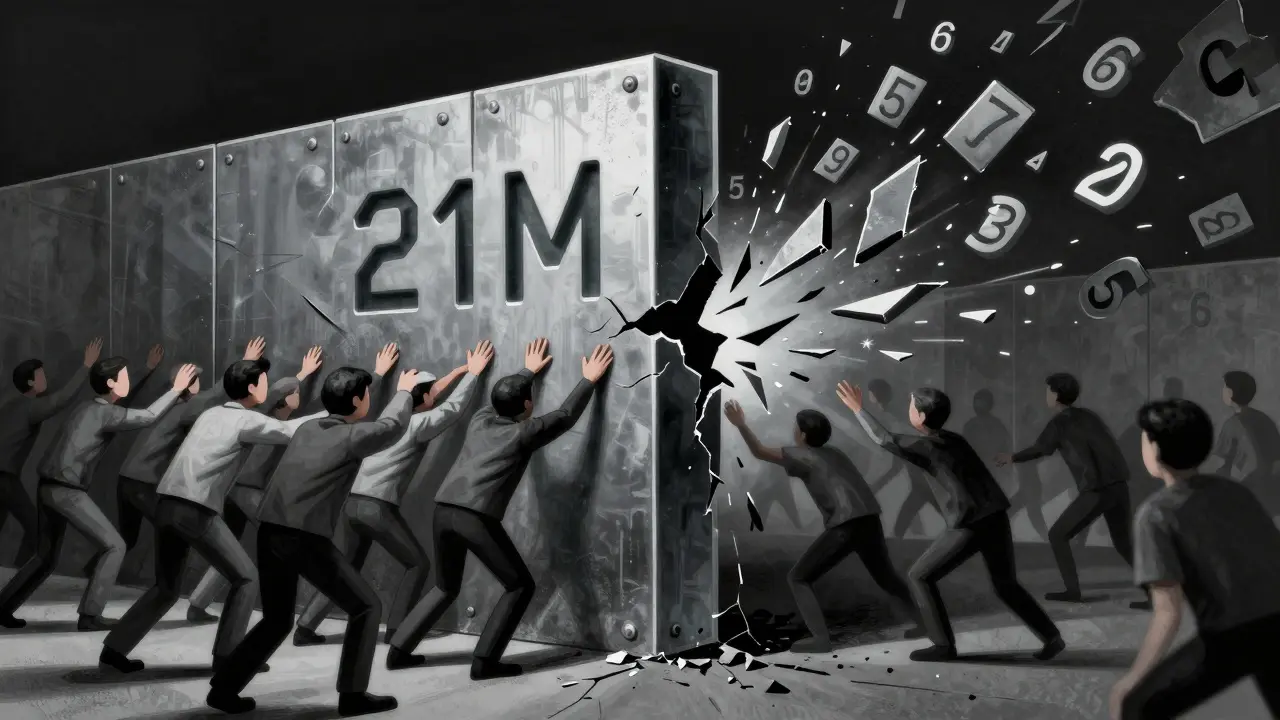
Unlike fiat currencies, which central banks can print endlessly, many cryptocurrencies have hard limits on their total supply. Bitcoin, the largest cryptocurrency by market capitalization, has a strict cap of 21 million coins. This scarcity is built into its code. When demand increases but supply remains static-or decreases due to mining rewards being cut in half every four years (known as a halving)-prices react violently.
Consider the dynamics of 2025. Bitcoin’s price swung from peaks near $104,700 in January to lows around $76,500 in April, only to surge past $119,000 by October. Part of this movement was driven by the underlying scarcity metrics. The Stock-to-Flow ratio, a model used to estimate scarcity based on existing supply versus new production, rose by 20% between late January and mid-April 2025. Normally, higher scarcity should push prices up. However, because the supply side was rigid, any negative news or external selling pressure had nowhere to go but down, crashing the price despite the improving scarcity fundamentals. This disconnect shows how fixed supply creates a brittle market structure where prices overshoot in both directions.
| Feature | Fiat Currency (e.g., USD) | Cryptocurrency (e.g., Bitcoin) |
|---|---|---|
| Supply Control | Central Banks (Flexible) | Algorithmic Code (Fixed/Rigid) |
| Elasticity | High (Can print more to stabilize) | Low (Cannot create more to meet demand) |
| Volatility Driver | Inflation/Interest Rates | Demand Shocks against Fixed Supply |
Sentiment Contagion: FOMO, Fear, and Herd Behavior
If liquidity is the engine, sentiment is the gas pedal-and sometimes the brake. Crypto markets are heavily influenced by psychology. Because the asset class is still relatively young compared to stocks or bonds, a significant portion of participants are retail investors who may lack decades of experience managing drawdowns. This makes them highly susceptible to emotional trading.
We see this clearly in the phenomenon of FOMO (Fear Of Missing Out). When prices rise, social media feeds flood with stories of quick riches. This triggers a reflexive feedback loop: people buy because prices are rising, which drives prices higher, attracting more buyers. We saw this in January 2021 when Tesla announced a purchase of Bitcoin, sparking exuberance that pushed BTC toward $69,000. Conversely, when fear sets in, the reverse happens. Panic selling accelerates as everyone tries to exit at once, creating a cascade effect.
Tools like the Crypto Fear & Greed Index track this mood. By October 2025, greed levels were rising, indicating strong optimism. But here’s the trap: extreme greed often signals that the market is overextended. When too many people are bullish, there are few buyers left to push prices higher, making a sharp correction likely. Understanding that you are part of a herd helps you resist the urge to chase green candles or panic-sell red ones.
Macroeconomic Tides: Interest Rates and Global Stability
Crypto does not exist in a vacuum. Despite claims of being "uncorrelated," digital assets are deeply tied to the broader global economy. They are often treated as "risk-on" assets, meaning they perform well when investors feel confident and poorly when uncertainty reigns.
When inflation runs high, some investors turn to Bitcoin as a hedge against currency devaluation, boosting demand. However, when central banks raise interest rates to fight inflation, traditional investments like bonds become more attractive. Capital flows away from risky assets like crypto and into safer havens. This dynamic was evident in the first quarter of 2025. Despite Bitcoin’s improving scarcity metrics, its price fell sharply from $104,700 to $76,500. Why? External macroeconomic instability and regulatory uncertainty overwhelmed the fundamental bullish case. Investors retreated to safety, demonstrating that no matter how strong the tech is, global economic winds can blow crypto prices down.

Institutional Footprints: Whales and ETF Flows
The entry of big money has changed the game. Institutional investors, such as pension funds and asset managers, now participate via products like Spot ETFs. While this brings legitimacy, it also introduces new volatility drivers. These entities trade in massive volumes. When an ETF sees a large inflow, it must buy the underlying asset, pushing prices up. When it sees an outflow, it sells, pushing prices down.
In July 2025, healthy ETF inflows contributed to a 13.3% growth in total market cap. But these flows aren't smooth. Large institutional entries can trigger algorithmic trading bots that amplify moves. Additionally, "whales"-individual holders with vast amounts of crypto-can manipulate smaller markets. If a whale decides to sell a significant portion of their holdings in a low-liquidity altcoin, the price can crash 50% in hours. This concentration of power means that individual actors can still sway the market disproportionately.
Navigating the Volatility: Practical Steps for Investors
Understanding these drivers doesn’t eliminate risk, but it allows you to manage it. Here is how to adjust your strategy based on what we’ve learned:
- Check Liquidity Before Buying: Avoid tiny altcoins with low trading volumes unless you are prepared for extreme swings. Stick to assets with deep order books.
- Ignore Short-Term Noise: Sentiment shifts daily. Focus on long-term trends rather than hourly charts.
- Monitor Macro Data: Keep an eye on interest rate decisions and inflation reports. These often dictate the direction of risk assets.
- Use Dollar-Cost Averaging (DCA): Instead of trying to time the bottom, invest fixed amounts regularly. This smooths out the impact of volatility.
- Set Stop-Losses Wisely: Protect your capital from catastrophic drops, but set them wide enough to avoid being shaken out by normal wicks.
Volatility is not a bug in crypto; it is a feature of a young, evolving market. As institutions continue to enter and liquidity deepens, swings may become less extreme, but they will never disappear completely. By recognizing the interplay of liquidity, supply, sentiment, macro factors, and institutional flow, you transform from a passive observer into an informed participant.
Is crypto volatility decreasing over time?
While some data suggests that annualized volatility has decreased slightly as market cap grows, short-term spikes remain frequent. Institutional adoption adds stability in some areas but also introduces new types of correlated risk. Expect volatility to persist, though potentially with less extreme percentage swings in major assets like Bitcoin.
What causes Bitcoin to drop suddenly?
Sudden drops are usually caused by a combination of low liquidity and negative sentiment triggers. This could be a large whale selling, a regulatory announcement, or a macroeconomic shock like a rise in interest rates. In illiquid conditions, these events cause cascading liquidations of leveraged positions, accelerating the decline.
How do ETFs affect crypto prices?
ETFs act as conduits for institutional money. When investors buy shares of a Bitcoin ETF, the fund manager must buy actual Bitcoin to back those shares. Large inflows create buying pressure, raising prices. Conversely, outflows force sales, lowering prices. This links crypto markets more closely to traditional stock market trading hours and behaviors.
Why are altcoins more volatile than Bitcoin?
Altcoins generally have lower market caps and significantly lower liquidity than Bitcoin. This means there is less money available to absorb trades. A trade that would move Bitcoin by 1% might move a small altcoin by 10% or 20%. Additionally, altcoins are often more speculative, making them more sensitive to hype and sentiment shifts.
Does the Bitcoin Halving increase volatility?
Yes, halvings reduce the rate of new supply entering the market. This structural change can lead to increased price sensitivity. If demand remains constant or increases while supply growth slows, prices tend to rise. However, the period surrounding a halving is often marked by heightened speculation and anticipation, which fuels additional short-term volatility.







Tawny Holmes
July 10, 2026 AT 13:33The liquidity argument is the only one that actually matters for short term swings. The rest is just noise.
Winston Lacewing
July 11, 2026 AT 14:02Oh my god, can we talk about how terrifying this is?! 😱 I literally checked my portfolio three times today and my heart is racing like crazy! 💔 It’s not just 'volatility' it’s pure chaos and panic and I don’t know if I can handle another red day without crying in the bathroom! 😭 Why do we even bother with this financial torture when stocks are so much safer?? 📉🤯
Kristine Lawson
July 12, 2026 AT 12:34It is quite fascinating, really; however, one must consider that the emotional response described above is entirely unnecessary, given that market fluctuations are a natural consequence of free-market dynamics, which operate independently of individual sentiment or distress, thereby rendering such outbursts both irrational and counterproductive to sound investment practices.
Jessie Smith
July 13, 2026 AT 06:09look man its all just vibes n stuff u gotta understand the deeper meaning of the blockchain its not just code its a spiritual journey into the void where money becomes meaningless lol but also i made some cash so whatever dont @ me im right about everything basically cause i read whitepapers u never have
Drew M
July 14, 2026 AT 02:02My dear friends, you are missing the grand tapestry of wealth accumulation! 🎨✨ The volatility is merely the brushstrokes of genius painting our future! I simply adore how the whales dance around us, it is truly a symphony of capital! 🐋💃 One must embrace the chaos with open arms and a smile, for that is where the true magic happens! 🪄💰
Deep Rahman
July 15, 2026 AT 00:29I think that when we look at the way people feel about money and how it moves up and down very quickly we should remember that life is like a river that flows in many different directions at once and sometimes the water goes fast and sometimes it goes slow and we cannot control the river but we can learn to swim better in it by thinking about why the water moves the way it does and understanding that fear is just a feeling that passes away eventually if we let it go and breathe deeply while watching the numbers change on our screens every single day without getting too upset about it because tomorrow will bring new changes again.